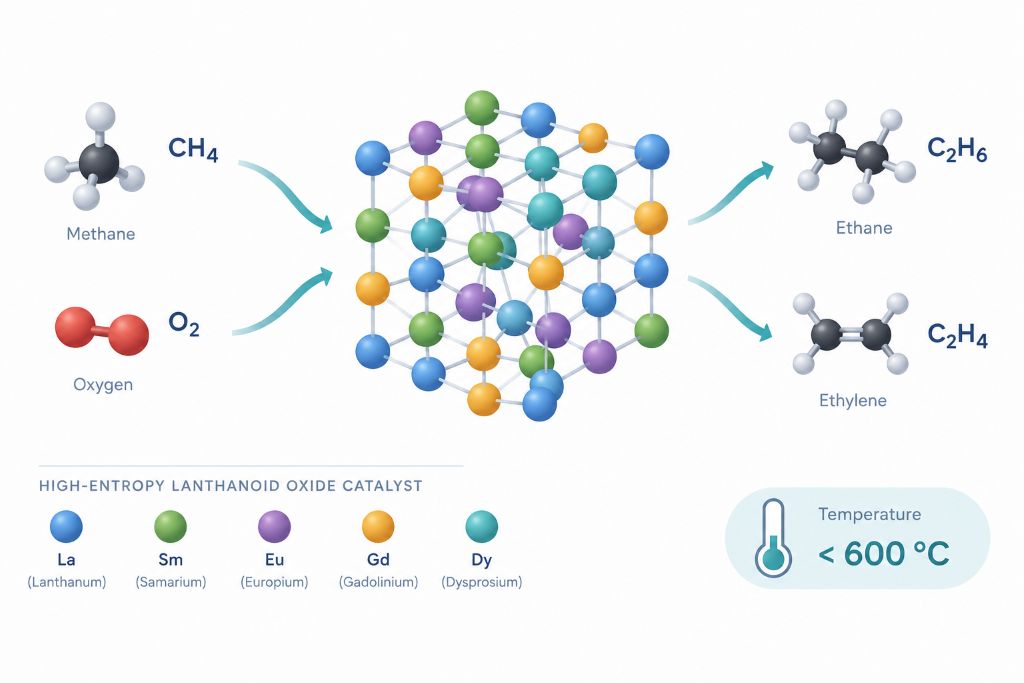
Every chemistry classroom has met methane, a simple molecule of one carbon and four hydrogens. It burns cleanly in a Bunsen flame, yet industry leaves most of it unused. The strong carbon–hydrogen bonds hold the molecule together too tightly. Turning methane into useful building blocks normally demands very high heat. A team in Japan has now found a way to lower that heat. Researchers at the Institute of Science Tokyo, led by Professor Keigo Kamata, report a new catalyst built from five lanthanoid metals. Their study appears in the Journal of the American Chemical Society (DOI 10.1021/jacs.6c15276). The catalyst, written as (LaSmEuGdDy)0.4O3, drives the oxidative coupling of methane to ethane and ethylene below 600 °C. It also holds steady for 240 hours of continuous use. This result matters because it points toward a cheaper, more durable route from natural gas to plastics and fuels.
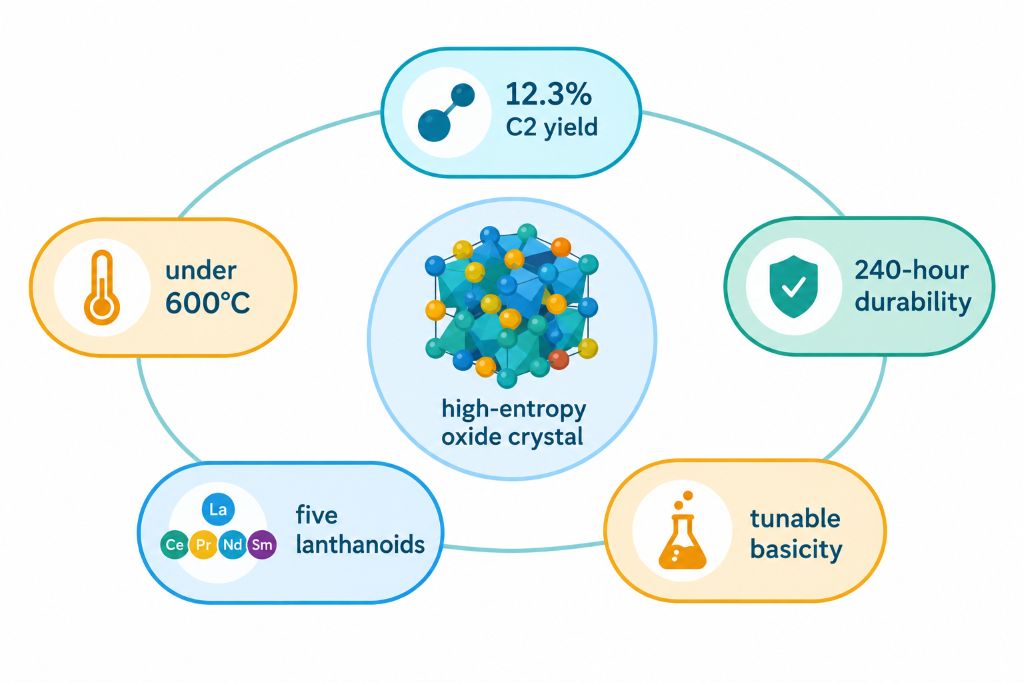
Fig. 1: Five Headline Results from the Study
What Is Oxidative Coupling of Methane?
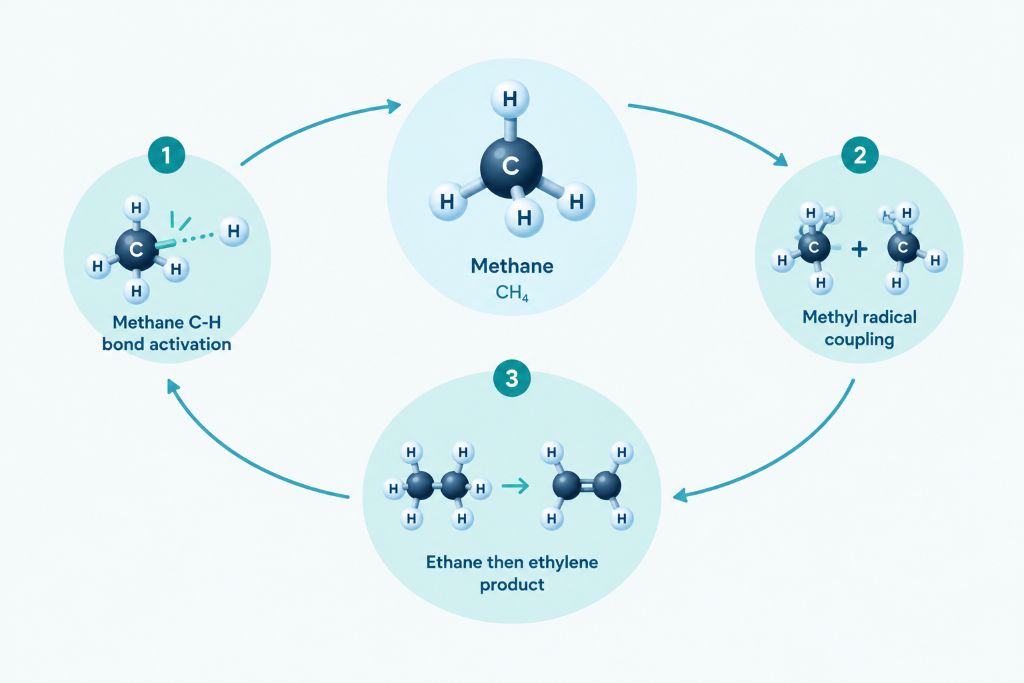
Oxidative coupling of methane, or OCM, joins two methane molecules into a single two-carbon product. The reaction uses methane and oxygen, the two main parts of natural gas. Those two-carbon products, ethane and ethylene, feed the world’s chemical industry. Ethylene alone makes up about half of the hydrocarbon feedstock used worldwide. A direct route from cheap methane to ethylene is therefore a major prize. The trouble lies in the chemistry itself. Breaking a methane carbon–hydrogen bond takes a lot of energy, roughly 438 kilojoules per mole. Meanwhile, the products ethane and ethylene react more readily than methane does. They tend to burn further into carbon dioxide and carbon monoxide. This over-oxidation steals away the very molecules the chemist wants to keep.
The Longstanding Hurdle
Conventional OCM catalysts face a harsh trade-off. They need operating temperatures near 800 to 850 °C to work at all. One leading catalyst, Mn–Na2WO4/SiO2, reaches a C2 yield of about 30 percent, but only near 850 °C. Such extreme heat costs energy and slowly damages the catalyst itself. Many materials also fade over time, a process called deactivation. Cooling the reaction usually means accepting a much lower yield. Researchers have long wanted one catalyst that runs cooler, keeps its activity, and resists over-oxidation. That triple goal has stayed out of reach until now. The new work does not break the yield record. It instead targets the cooler, steadier end of that trade-off.
Fig. 2: The Oxidative Coupling of Methane in Three Steps
High-Entropy Oxides as a Fresh Answer for OCM
High-entropy materials mix five or more metals into one shared crystal structure. The idea began with alloys around 2004 and later spread to ceramics and oxides. These oxides bring welcome flexibility in both composition and structure. In catalysis, high-entropy oxides have already helped in water splitting and alcohol oxidation. Yet most of that earlier work dealt with simple, one-product reactions. The oxidative coupling of methane is harder because it demands careful selectivity. The team set out to test whether a high-entropy oxide could meet that stricter test. Their answer was (LaSmEuGdDy)0.4O3, a C-type rare-earth oxide nicknamed HEO-2. Its five metals are lanthanum, samarium, europium, gadolinium, and dysprosium.
How the Catalyst Was Built
The researchers screened 55 compositions across five crystal structures and 24 elements. Lanthanoid-containing systems stood out for their balance of C2 yield and structural stability. Seven candidate oxides were then made as nanoparticles using a sol–gel method. This method starts from metal acetate salts and aspartic acid dissolved in water. Heating the dried precursor to 750–800 °C forms the final oxide. HEO-2 combines its five lanthanoids in near-equal amounts. X-ray diffraction confirmed that the five metals mix evenly into one phase rather than staying separate. The result is a single crystalline solid, not a blend of five powders. That uniformity matters, because it lets the whole surface act together during the reaction.
The Key Findings in Numbers
HEO-2 began forming two-carbon products at 525 °C. That onset sits well below the single oxides, some of which need more than 600 °C. At 600 °C, HEO-2 reached a 12.3 percent C2 yield. In a 240-hour run it held a steady 11.1 percent yield, nearly unchanged from the first hour. Its deactivation rate came to 1.0 mmol per gram per hour squared. That figure is more than 25 times lower than the corresponding single oxides. The catalyst also kept its structure and its active surface sites after the long run. These numbers mark real gains in durability, even if the yield stays modest. The steady low-temperature performance is the true headline here.
The Science Behind the Win: Surface Basicity
The team traced the success to a property called surface basicity. Basic sites on a catalyst help pull a hydrogen atom off methane. But too much basicity backfires. Very strong basic sites push the two-carbon products into burning and trap carbon dioxide. The sweet spot is a moderately basic surface, and HEO-2 lands there. Its carbon dioxide desorbed mainly between 300 and 400 °C, the zone tied to useful C2 formation. As a classroom teacher, I have often watched students overshoot a target by adding too much reagent. The lesson here is the same. The strongest is not always the best in catalysis, just as it is not in titration. Precision beats excess every time.
A Descriptor That Predicts Performance
Even better, the team found a simple rule. The surface basicity tracks the average ionic radius of the lanthanoid elements. Ionic radius is the size of a metal ion inside the crystal. A larger average radius gives a stronger basic site, and a smaller one gives a weaker site. HEO-2 has an average ionic radius of 0.957 angstroms, which sits in the moderate range. By choosing five metals, the chemists could tune that average with precision. This turns the average ionic radius into a genuine design handle. Engineers can now pick a target basicity before they even make the catalyst. That predictability is a real step forward for selective catalysis.
Challenges, Motivation, and Why It Matters
The motivation here is economic as well as scientific. Natural gas is abundant, and methane is its chief component. Converting it directly to ethylene would skip several costly industrial steps. Yet the reaction has defeated researchers for decades. High temperatures, fast deactivation, and runaway oxidation all stood in the way. In my own teaching, this problem shows students a key truth about science. The hardest problems are often the simplest to state and the most stubborn to solve. The team met the obstacle with entropy, mixing many metals into one structure. Entropy, it turns out, both tunes the surface and locks it in place over time. That dual role is what makes high-entropy design so promising here.
What Comes Next
The study opens several paths forward. One is to push the yield higher while keeping the low temperature. Another is to test the catalyst at a larger, industrial scale. The same design rule could also guide other selective oxidation reactions. For students, this work is a live example of materials chemistry in action. For engineers, it offers a fresh way to think about chemical engineering challenges in greener terms. Careers in catalysis, energy, and sustainable chemistry all stand to gain from it. The principle of tuning surface basicity through ionic radius may travel far beyond methane alone.
What This Means for STEM and Industry
Oxidative coupling of methane touches more than one classroom subject. It links thermodynamics, kinetics, and materials science in a single, coherent story. Teachers can use it to show how basic concepts become real technology. On the business side, a cooler and longer-lasting catalyst lowers energy bills over time. It also reduces wear on expensive reactor equipment. Cheaper ethylene could ripple through plastics, textiles, and packaging. Those are exactly the connections that make a topic worth teaching. This work, in other words, is a bridge between a laboratory result and everyday products. That bridge is where much of modern engineering lives and earns its value.
Conclusion
A five-metal high-entropy oxide has made methane coupling cooler and steadier. The catalyst HEO-2, built from lanthanum, samarium, europium, gadolinium, and dysprosium, starts OCM at 525 °C. It reaches a 12.3 percent C2 yield at 600 °C and endures for 240 hours. Its secret is a moderately basic surface, tuned through the average ionic radius. This design rule could reshape how selective catalysts are made. It will not by itself replace today’s high-yield industrial systems, not yet. What it offers is a predictable way to design cooler, longer-lived catalysts for the future. For students, educators, and engineers alike, that is a result worth watching.
References:
Takahashi, R., Wachi, K., & Kamata, K. (2026). High-entropy lanthanoid oxide catalysts for oxidative coupling of methane. Journal of the American Chemical Society. https://doi.org/10.1021/jacs.6c15276
Institute of Science Tokyo. (2026, October 8). High-entropy lanthanoid oxide catalyst enables low-temperature oxidative coupling of methane. https://www.isct.ac.jp/en/news/956ohpk65w34
The draft is faithful to the source and clearly written for a general science-literate audience. My comments are about emphasis, not accuracy.
First, the framing of the yield deserves one more candid sentence. A reader leaves the piece impressed by 12.3% at 600 °C, but the paper itself positions the result as a design principle rather than a yield record. The benchmark Mn–Na₂WO₄/SiO₂ system still reaches roughly 30% C2 yield, albeit near 850 °C. Stating that gap once, plainly, would not weaken the story. It would sharpen it, because the real novelty here is the tunable descriptor — average ionic radius controlling surface basicity — and not the absolute number. That is the claim a skeptical chemical engineer will go looking for, and it is worth making explicit rather than implied.
Second, the mechanism section is the one place where a little more rigor would pay off. The paper rules out several pathways — Mars–van Krevelen, proton-coupled electron transfer, acid–base heterolysis, and hydroxyl-radical-mediated routes — and lands on surface-activated oxygen adjacent to moderately basic sites as the operative path. The draft gestures at this but could name the eliminated mechanisms, briefly, to show that the conclusion was reached by exclusion and not by preference. For an audience of educators and curious readers, that one paragraph would convert a plausible claim into a demonstrated one.
Shreyas Kulkarni is a Chartered Electrical Engineer and renewable energy pioneer with over eight years of hands-on experience in the clean energy sector. He is the Co-Founder of UNICUS Energy, a leading provider of solar energy solutions in India, where he drives technical execution, system architecture, and clean tech deployment.
As an author for ENTECH Magazine, Shreyas focuses on making solar technology practical and understandable for students, engineers, and homeowners. His contributions include detailed guides on the inner workings of rooftop solar systems and deep dives into modern hardware advancements, such as lightweight solar panels and flexible photovoltaic materials.