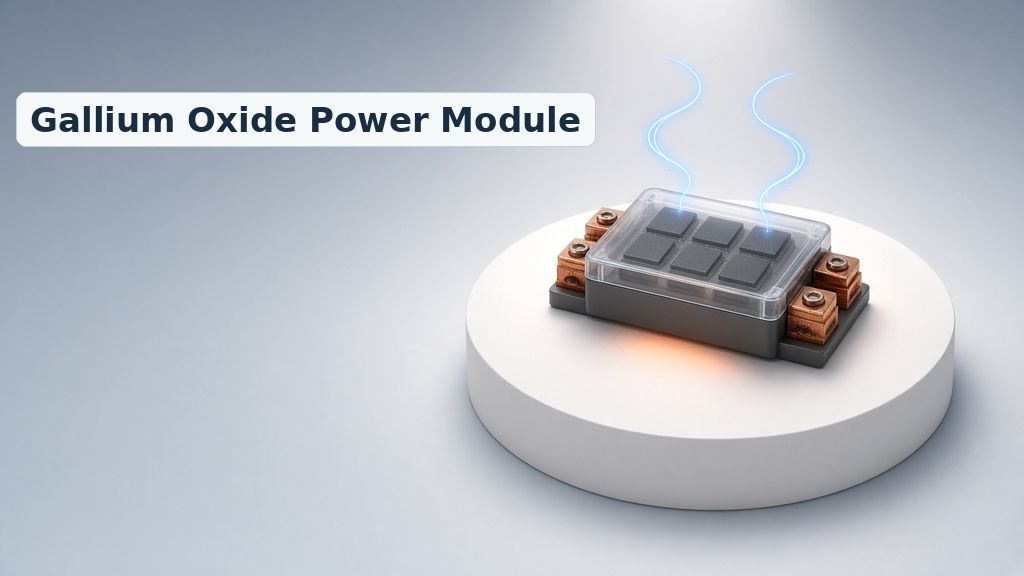
HKU engineers built a gallium oxide power module that repeatedly switches 1,000 volts and 1,000 amperes, reaching one megawatt with a clever chip-and-package design.
You charge your phone without a second thought. Yet tiny electronic switches control every bit of that power. Most of them rely on silicon, and silicon is running out of road. So here is a challenge for you. Can a different material carry far more power without melting? On November 9, 2026, HKU answered yes in an official HKU news story. Its engineers built a gallium oxide power module that switches 1,000 volts and 1,000 amperes. It repeats that switching 1,000 times every second. As a result, it reaches a peak power of one megawatt. In other words, that equals ten thousand 100-watt bulbs at once. At the same time, HKU calls it a world first for its material class. The full study appeared in Nature Communications on March 30, 2026.
Why a Gallium Oxide Power Module Was So Hard to Build
Power devices act like super-fast light switches for electricity. First, they let current flow when on. Then they block high voltage when off. In other words, they decide where electrical energy goes, and when. For decades, silicon did this job well. However, demand for power keeps climbing, and silicon is nearing its physical limits. Newer wide bandgap materials such as silicon carbide and gallium nitride have pushed further. The US Department of Energy explains how wide bandgap chips cut waste in power electronics. Gallium oxide belongs to an even newer group called ultra-wide bandgap materials. On paper, it looks amazing. Its power score beats gallium nitride and silicon carbide by 3.8 times or more. Against silicon, in contrast, the gap is about 3,000 times. So why has nobody built a big gallium oxide module before?
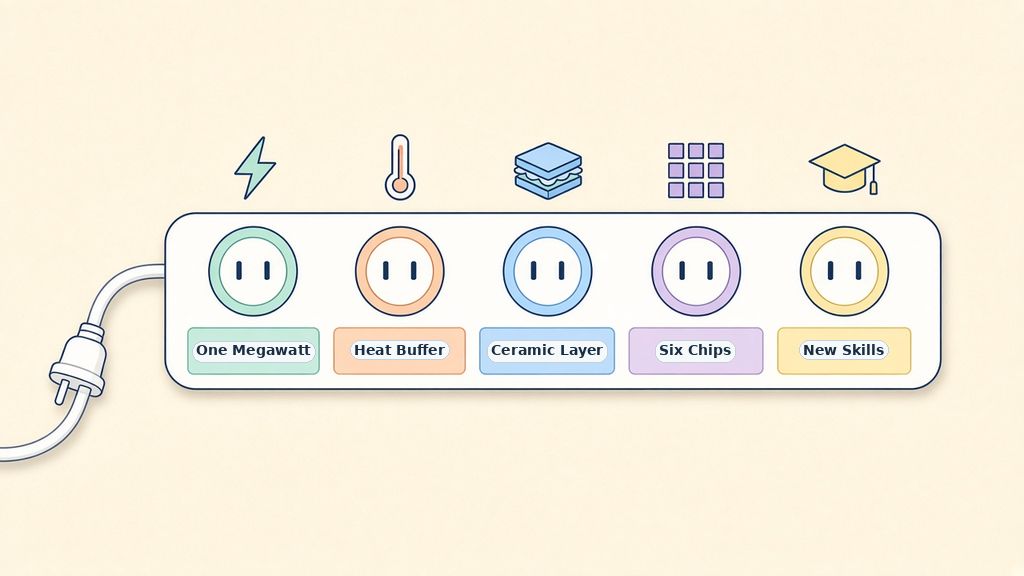
Fig. 1: Key Takeaways From the HKU Power Module
The Heat Problem Nobody Could Ignore
The answer is heat, plus a few stubborn manufacturing problems. Gallium oxide is a poor heat conductor. In contrast, silicon carbide moves heat away much more easily. So hot spots can build up quickly inside a gallium oxide chip. Engineers also cannot just make one giant chip from a whole wafer. That trick works for silicon, but newer materials have too many defects. For this reason, a bigger device often loses some of its voltage strength. The usual fix is a module, where several smaller chips share the load. Still, crowded chips at high voltage create fierce electric fields at their edges. As a result, these devices stayed stuck at kilowatt levels for nearly a decade. One earlier gallium oxide test, for example, switched 400 volts and 15 amperes. In other words, the new module had to leap a long way.
Explainer: What a Bandgap Means for Power Switches
Every semiconductor has a bandgap, an energy barrier inside the material. Electrons must jump this barrier before they can carry current freely. A small gap lets heat shake many electrons loose by accident. Those stray electrons cause leakage current, which can trigger an early breakdown. A wider gap, on the other hand, keeps electrons in place far better. As a result, the material can block stronger electric fields and survive hotter conditions. Here is a quick sum to try yourself. Power capacity is switching voltage multiplied by switching current. So 1,000 volts times 1,000 amperes gives 1,000,000 watts, or one megawatt. Earlier ultra-wide bandgap devices managed only kilowatts, which are thousands of watts. In addition, the HKU study treats the module as a pulsed switch. Put simply, it fires short, intense bursts of power rather than a steady flow.
Why Heat Capacity Matters More Than You Think
Now comes a twist that most textbooks skip. During a very short pulse, heat has no time to spread out. Instead, the temperature rise depends on how much heat the material can soak up. Scientists call this volumetric heat capacity. For example, a full bucket of water warms slowly, while a thin pan heats fast. In the same way, a material with high heat capacity buffers sudden surges. According to the paper, gallium oxide has the largest heat capacity among common power semiconductors. In fact, its value is nearly twice that of silicon carbide. Earlier studies largely overlooked this strength. At the same time, gallium oxide devices can block high voltages at high temperatures. Together, these features make the material a strong fit for pulsed power. So the weakness everyone feared becomes less important for short bursts.
Inside the HKU Design: A Megawatt Power Module Built as One System
Professor Yuhao Zhang led the work at HKU’s Department of Electrical and Computer Engineering. Dr Hehe Gong and PhD student Xin Yang joined him. Professor Guo-Quan Lu of Virginia Tech and Professor Jiandong Ye of Nanjing University also collaborated. Their big idea was to design the chip and its package together. Zhang said this device-package co-design managed electric field, heat flow and stress together. To begin with, the team flipped each chip upside down onto a copper-bonded plate. This junction-side cooling pulls heat straight from the hottest region. Without it, heat would have to crawl through the poorly conducting chip. But this layout has a known side effect. The silver paste that bonds the chip can spill toward its edges. As a result, extra electric field peaks appear, and the voltage rating drops. Usually, engineers add a metal post to keep the paste away.
A Thin Ceramic Layer That Tames the Electric Field
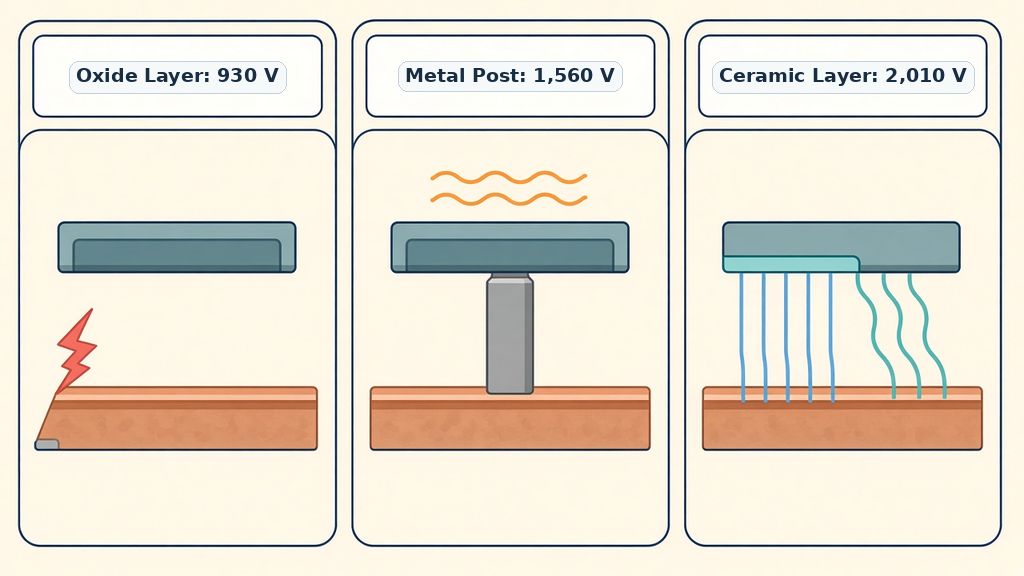
That post, however, blocks some of the heat on its way out. So the HKU team replaced the post with something far thinner. They added a 300-nanometer layer of barium titanate, a ceramic with very high permittivity. Permittivity measures how strongly a material responds to an electric field. In this case, the ceramic forms tiny electrical dipoles that flatten crowded field lines. The team then compared three versions of a single-chip sub-module. One version with ordinary silicon dioxide broke down at just 930 volts. In contrast, the version with a post reached 1,560 volts. The ceramic version, meanwhile, held off 2,010 volts. Not only that, it cut thermal resistance by more than half versus the post. In other words, the same layer helped the chip shed heat and block voltage together. That double win is the heart of the co-design approach.
Fig. 2: Three Package Designs Compared
Testing the Ga2O3 Power Module at Full Strength
Next, the team pushed a single sub-module hard. At 1,000 volts, it conducted 234 amperes in a pulse lasting 5 microseconds. A microsecond is one millionth of a second. Then the engineers arranged six sub-modules symmetrically into one full module. This full module switched 1,000 volts and 1,000 amperes at 1 kilohertz. In addition, it turned off in just 23 nanoseconds, which is very fast. Thermal images also showed the six sub-modules sharing current evenly. At steady state, the case reached 92 °C on top. For comparison, that is a little below the boiling point of water. Even so, the module kept working under continuous pulsed switching. As a result, its power capacity tops the previous best by two orders of magnitude. In other words, it is more than a hundred times higher.
How It Stacks Up Against Silicon and Silicon Carbide
So does gallium oxide really beat today’s favorites? In these tests, the answer looks promising. The ceramic sub-module blocked 2,010 volts at room temperature. Then its blocking voltage actually rose to 2,240 volts at 250 °C. A commercial silicon carbide diode, in contrast, weakened as it heated up. At 200 °C, its blocking voltage dropped to 61% of the room-temperature value. In other words, it lost almost two-fifths of its strength. The gallium oxide sub-module also survived a surge of 856 amperes in a 3.6-microsecond pulse. Its surge current beat a similar industrial silicon carbide diode, especially for short pulses. In addition, the team ran 10,000 power cycles on the ceramic sub-module. It showed only minimal changes afterward. Meanwhile, the silicon dioxide version degraded clearly after about 1,200 cycles.
What Ultra-Wide Bandgap Semiconductors Mean for Future Engineers
At the same time, where could such a module go first? HKU points to pulsed power, where huge energy must arrive within microseconds. Examples include grid protection, particle accelerators, medical systems and fusion energy facilities. The paper also mentions MRI scanners and pulsed lasers. Next-generation electric vehicle platforms, meanwhile, support charging at up to 1,000 volts and 1,000 amperes. For this reason, megawatt-class switches could matter beyond the lab. Dr Gong called the result the first megawatt-level module of its class. He also said it offers a scalable way to turn material promise into practical systems. So here is the real challenge for young engineers. Can you design packages as cleverly as you design chips? ENTECH has explored careers in the semiconductor industry before. This story shows that packaging deserves a place on that list too.
Skills This Breakthrough Asks You to Build
Several fields came together in this project. First, materials science explained why gallium oxide stores heat so well. Then electrical design tamed the electric fields around each chip. Thermal engineering moved heat away, while mechanical design handled stress from repeated heating. Electrical engineers on O*NET research, design, develop, test or supervise electrical equipment. In addition, Zhang works at HKU’s semiconductor research centre, known as CASIC. Our explainer on electronics that survive shock and vibration shows similar packaging thinking. Similarly, the story of ultraviolet modulator chips shows how new materials open new devices. So which skill will you sharpen first? Not only coding but also physics and hands-on testing will count. The best engineers here will think across every layer of a power module.
Where the Gallium Oxide Power Module Still Falls Short
Still, this is a lab prototype, not a product you can buy. The module uses diodes, which steer current but cannot switch on by command. According to the authors, gallium oxide transistors with the same design ideas are still needed. Heat limits also remain. At 300 °C, the sub-module’s blocking voltage fell to 1,330 volts. In addition, fast repeated pulses can raise the average chip temperature. For this reason, the authors call for better external cooling. They also call for larger, more uniform gallium oxide wafers with fewer defects. Even so, the result breaks a barrier that held for nearly a decade. As a result, the gallium oxide power module is a serious pulsed-power contender. So the challenge passes to the next generation of engineers. Can you carry this idea from the lab to the grid?
References
Gong, H., Yang, X., Wang, B., Zhang, Z., Yuchi, Q., Yang, Z., Porter, M., Cui, H., Qin, Y., Zhang, R., Wang, H., Dong, D., Ye, J., Lu, G.-Q., & Zhang, Y. (2026). A megawatt ultra-wide bandgap semiconductor module for pulsed power electronics. Nature Communications, 17, 4783. https://doi.org/10.1038/s41467-026-71274-6
This story turns a dense power-electronics paper into a lively challenge, with everyday comparisons that make bandgaps and heat capacity easy to grasp. The three-package comparison shows clearly why the thin ceramic layer matters. A simple sketch of a pulsed power circuit could help newer readers see where the module sits. Readers who want the full technical story can turn to the original paper in Nature Communications.
Editorial note
We chose this story because it shows that clever packaging can matter as much as a new material. The article explains why gallium oxide suits short, intense bursts of power, and it keeps the prototype’s limits in view. The paper first appeared in Nature Communications in March, and the university announced it in November. For the complete account, readers can turn to the HKU news story and the original paper.
Shreyas Kulkarni is a Chartered Electrical Engineer and renewable energy pioneer with over eight years of hands-on experience in the clean energy sector. He is the Co-Founder of UNICUS Energy, a leading provider of solar energy solutions in India, where he drives technical execution, system architecture, and clean tech deployment.
As an author for ENTECH Magazine, Shreyas focuses on making solar technology practical and understandable for students, engineers, and homeowners. His contributions include detailed guides on the inner workings of rooftop solar systems and deep dives into modern hardware advancements, such as lightweight solar panels and flexible photovoltaic materials.