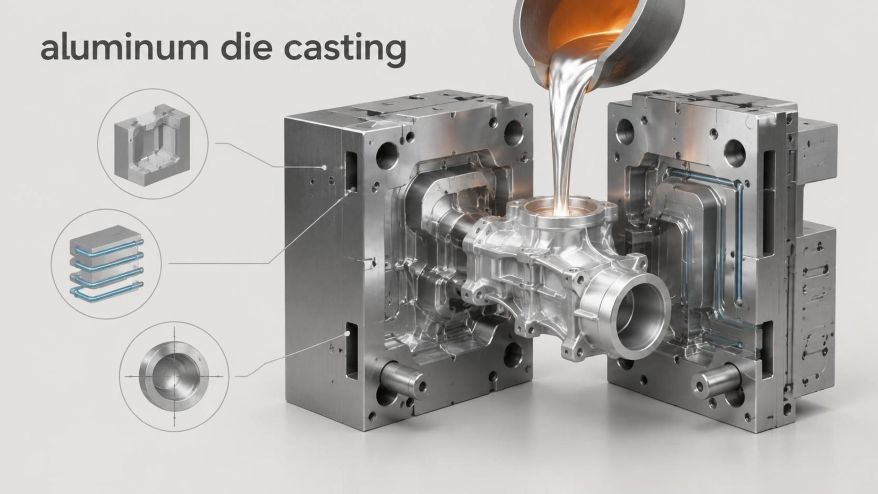
Learn what OEM engineers should include in an aluminum die casting tooling RFQ, from CAD drawings and alloy specifications to production requirements, quality checks, and tooling acceptance criteria.
A tooling request for quotation is more than a 3D model and an annual volume. It is the agreed technical basis on which a die maker evaluates feasibility, selects a tooling concept, estimates engineering effort, and defines what will be delivered. When those assumptions remain unstated, two quotations can appear to cover the same part while allowing for different dies, validation work, or production conditions. For an aluminum die casting project, a useful RFQ package combines controlled product data with the expected operating environment and a measurable acceptance plan. Consequently, clearly specifying the design requirements for an aluminum die casting tool helps OEM engineers and buyers obtain proposals they can genuinely compare.
1. Submit a Controlled 3D Model and a Dimensioned Drawing
Provide the current 3D CAD model, preferably in a widely exchangeable format such as STEP, alongside a revision-controlled 2D engineering drawing. The model communicates the intended geometry; the drawing communicates which characteristics actually govern acceptance. One should not silently replace the other.
The drawing should identify units, material specification, datum references, applicable geometric tolerances, surface requirements, threads, and any features that must remain as-cast or receive machining. Highlight critical-to-function dimensions rather than applying unnecessarily tight tolerances to every surface.
State the current design status. Is the CAD model released, preliminary, or expected to change after design-for-manufacturability (DFM) review? Mark any permitted geometry adjustments and the approval route for proposed changes. A review of draft, wall transitions, deep pockets, local undercuts, and machining stock can reveal problems before die steel is cut. A practical example of the issues considered during aluminum die casting mold DFM analysis shows why this stage belongs in the RFQ discussion rather than after purchase-order release.
If multiple versions have circulated, provide a single approved file package and a revision log. Otherwise, a supplier may quote the wrong geometry while the buyer assumes everyone is working to the latest design.
2. Define the Alloy and the Intended Use of the Part
Specify the required aluminum alloy or an approved material range, using the designation and standard relevant to the project. A statement such as “aluminum casting” leaves a meaningful engineering variable unresolved. If a substitute alloy is acceptable, identify who may approve it and what performance evidence would be required.
Describe the part’s duty in a few direct sentences. For example, a gearbox cover may require dimensional alignment and a machined gasket face; a fluid housing may have pressure-tightness criteria; a bracket may contain strength-critical mounting points. These functions influence cavity design decisions and the subsequent inspection plan.
Provide any relevant operating temperature, load cases, corrosion exposure, leak limits, coating requirements, or regulatory specifications. Do not ask for a generic “porosity-free” casting without defining the functional requirement and method of verification. If internal soundness matters, identify the critical regions and the proposed inspection or testing criteria.
3. State Demand, Production Horizon, and Equipment Constraints
A tooling proposal should distinguish annual demand, expected peak-month demand, batch size, and lifetime volume. These are not interchangeable. A small initial release followed by sustained high-volume production may justify a different cavity configuration than a short replacement-parts program with the same first-year quantity.
Include the expected ramp-up, available production hours, and required delivery schedule. The supplier can then examine trade-offs among cavity count, tooling investment, machine utilization, and the output of acceptable parts. More cavities increase parts per shot, but they do not guarantee proportional gains after cycle time and yield are considered.
Clarify the production location and whether the finished tool will run in the buyer’s facility or at the casting supplier. For buyer-owned equipment, supply the relevant die casting machine details: nominal clamping capacity, platen and tie-bar envelope, shot system limits, utility connections, and any existing cooling, vacuum, or automation interfaces. If the machine has not been selected, say so and request the supplier’s equipment assumptions explicitly.
For cold-chamber aluminum HPDC, the machine review must consider total projected area and shot mass, including runner and overflow metal – not merely the net casting weight.
4. Identify Machining, Datums, and Critical Quality Characteristics
A casting RFQ often becomes difficult to price because the buyer shows the final machined part but does not distinguish features produced in the die from features created later. Supply as-cast and finished-part models where available, or clearly mark machining stock and the intended sequence of operations.
Identify machining datums, locating pads, bore relationships, thread requirements, sealing faces, and surfaces that will be hidden or exposed in the final assembly. Consider whether the casting can be fixtured repeatably and whether the cutter can reach the required feature without excessive material removal.
Turn broad quality language into measurable acceptance criteria. Instead of “high dimensional accuracy,” name the relevant tolerances. Instead of “good sealing,” state the leak-test method, test medium, pressure, allowable leakage, and whether testing applies to raw or machined parts. Where X-ray, CT, sectioning, or destructive tests are needed, define the regions, acceptance criteria, and sampling responsibilities.
The North American Die Casting Association (NADCA) provides product-specification standards and purchasing checklists that distinguish drawings, dimensional requirements, casting specifications, and finishing expectations. Those distinctions are worth carrying into an OEM RFQ so a quote does not conceal differences in inspection scope.
5. Separate Tooling Supply from Casting and Finishing Scope
Before asking for a price, define what is being purchased. A tooling-only order can include die engineering, manufacturing, assembly, sampling, and delivery of the completed mold. A production-casting order can additionally require casting, trimming, CNC machining, finishing, inspection, packaging, and ongoing supply. The two scopes should not be compared as though they were equivalent.
Ask each respondent to identify what is included in the mold price: DFM review, die-layout approval, mold-flow analysis if specified, tool steel and key inserts, spare wear parts, trials, modifications after trials, and documentation. For a project involving custom high-pressure aluminum die casting molds, the RFQ should also address compatibility with the production machine and the format of the eventual tooling handover.
Record ownership and use rights for the completed tooling, CAD data, NC programs where relevant, replaceable inserts, and trial records. Clarify where the mold will be stored, who funds routine maintenance and major repairs, and how a transfer to a different casting facility would be handled. These terms should be settled commercially rather than assumed by either party.
If proprietary design data is involved, agree on confidentiality arrangements and access to files before sharing sensitive details.
6. Specify Trial Deliverables and Acceptance Gates
A quoted tool is not necessarily a production-ready tool on the date machining ends. Define the expected sequence of design approval, tool manufacture, initial trial, review of findings, corrections, and final release. Distinguish an initial trial casting from evidence that the process meets the intended acceptance requirements.
A useful RFQ asks for specific outputs: DFM observations, approved die drawings, an agreed trial plan, raw cast samples, dimensional reports for critical features, relevant casting-quality results, an open-issue list, and a final handover package. Require each supplier to state the number of trial rounds or modification allowance included in its quotation, rather than assuming unlimited revisions.
When relevant, define the customer’s approval process, such as first-article inspection or an agreed production-part approval submission. Do not use “PPAP required” as a stand-in for specifying the submission level, records, or responsible party. Set a realistic technical decision point for each stage and identify who signs off on geometry changes.
7. Use a Quote-Comparison Checklist Before Release
A complete RFQ should make omissions visible. The following concise checklist can be used in an internal engineering review or attached to the external quotation package.
RFQ Item
Information to Provide or Confirm
Controlled product files
3D CAD, 2D print, units, revision, GD&T, critical features
Alloy and function
Specified alloy, service conditions, essential quality requirements
Planned production site, HPDC machine envelope and interfaces
Machining scope
Raw versus machined condition, datums, stock, surface finishing
Inspection and validation
Critical dimensions, test methods, sample size, acceptance gates
Tooling commercial scope
Ownership, included trials, spare components, revisions, handover
Schedule and approvals
Design release, trial dates, milestone owners and sign-off rules
Before evaluating total price, request that suppliers list exclusions and assumptions in the same order. A lower quoted tooling price may reflect fewer included trials, no inspection reporting, different machine assumptions, or a narrower delivery package. Consistent inputs make engineering comparisons more meaningful and expose commercial differences before production begins.
Final Takeaway: Aluminum Die Casting
The strongest aluminum die casting tooling RFQs connect geometry, material, functional quality, production demand, machine conditions, and acceptance responsibilities. They leave room for engineering recommendations without leaving essential purchasing requirements undefined. A controlled data package and a transparent scope of supply do not eliminate every tooling risk. However, they make alternatives easier to evaluate. More importantly, they prevent surprise differences between proposals from appearing after the tool is already built.
FAQs: Aluminum Die Casting
1. What is an aluminum die casting tooling RFQ?
An aluminum die casting tooling RFQ is a request for quotation that outlines the technical, production, quality, and commercial requirements for manufacturing a casting die.
2. What information should an aluminum die casting tooling RFQ include?
It should include 3D CAD models, dimensioned drawings, alloy specifications, production volumes, machine requirements, quality criteria, and tooling scope.
3. Why are 3D models and engineering drawings important in a die casting RFQ?
They help suppliers understand the part geometry, dimensions, tolerances, critical features, and machining requirements before preparing a quotation.
4. What quality requirements should OEMs specify in a die casting tooling RFQ?
OEMs should define critical dimensions, porosity requirements, leak-test methods, inspection procedures, sampling responsibilities, and acceptance criteria.
5. How can OEMs compare aluminum die casting tooling quotations?
OEMs should compare tooling costs, included trials, materials, inspection scope, delivery schedules, tooling ownership, and supplier assumptions to identify differences between proposals.
References:
Andrejiova, M., Pinosova, M., Šolc, M., & Markulik, Š. (2026). Effect of return material utilization in High-Pressure die casting on the quality of automotive castings. Applied Sciences, 16(12), 5761. https://doi.org/10.3390/app16125761
Mizgan, H., & Ganea, M. (2022). Optimization of aluminium die-casting process through predictive maintenance and parameter traceability systems. IOP Conference Series Materials Science and Engineering, 1256(1), 012028. https://doi.org/10.1088/1757-899x/1256/1/012028
Baser, T. A., Umay, E., & Akıncı, V. (2022). New trends in aluminum die casting alloys for automotive applications. The Eurasia Proceedings of Science Technology Engineering and Mathematics, 21, 79–87. https://doi.org/10.55549/epstem.1227541
Dinesh Joshi is a leading consultant in the field of product design and development, production engineering, industrial engineering, and program management. He has worked with esteemed domestic as well as European and US organizations.
Mr. Dinesh G. Joshi has completed Graduation in Mechanical Engineering from Pune University and thereafter pursued Post Graduation in Production Engineering from Walchand College of Engineering Sangli (Shivaji University). He is member of Project Management Institute (PMI), Pennsylvania, USA as well as Indian Institute of Welding (IIW) Kolkata. He has good blend of diversified experience of about 22 years in Product Design and Development, Production Engineering, Industrial Engineering and Program Management by virtue of working in the esteemed domestic as well as European and US organizations in addition to 5 years of academic experience.