A metal spoon left overnight in a winter car does not crack in your hand. The same spoon, chilled to the boiling point of liquid nitrogen, can shatter like glass under a light tap. That dramatic change is the famous ductile-to-brittle transition (DBTT). Most steels and many other metals turn brittle as temperatures fall, because their atoms stop gliding past one another. Yet a team of materials scientists recently described alloys that refuse to follow this rule. In a 2026 study published in Nature, the researchers cooled two body-centered cubic (bcc) refractory alloys to just 20 kelvin, close to absolute zero. They still bent, stretched, and absorbed energy instead of snapping. This discovery reshapes how we understand low temperature toughness and points toward stronger parts for space, cryogenics, and clean energy.
What the Researchers Found About Cryogenic Toughness
The team, led by David H. Cook, Xiaoyu Chen, and Robert O. Ritchie, tested two electron-matched bcc alloys at 20 K. The first was a medium-entropy alloy, Nb45Ta25Ti15Hf15. The second was a simple binary, Nb70Ti30. Both belong to the group IV–V family of refractory metals. The researchers found that yield strength stayed nearly flat as temperature dropped. For the medium-entropy alloy, yield strength measured about 939 MPa at 20 K, almost identical to 937 MPa at 77 K. The binary showed the same pattern, so the results were not a fluke of one composition. You can read the full open-access study on the Nature article page.
Four takeaways, summarizing cryogenic toughness findings at 20 K.
Fracture toughness behaved the same way. The crack-initiation toughness of the medium-entropy alloy reached about 96 MPa·√m, while its crack-growth toughness hit roughly 118 MPa·√m at 20 K. The binary alloy did even better, with an initiation toughness near 170 MPa·√m. These numbers stayed high across the whole temperature range tested. In short, these materials held onto their low temperature toughness where ordinary metals would have gone brittle.
Key findings on toughness at extreme cold.
Cracking Open the Deformation Mechanisms
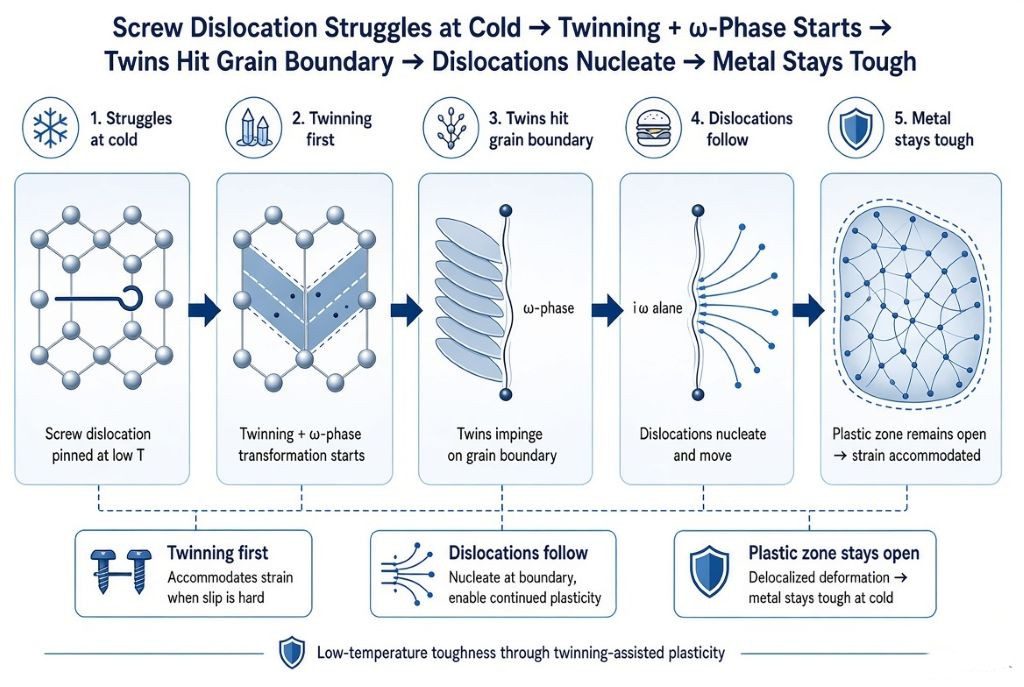
Why did these alloys stay tough? The answer lies in how they deform. In most bcc metals, screw dislocations carry the load, and their motion slows sharply in the cold. That slowdown constricts the plastic zone at a crack tip, which is what causes brittleness. These alloys behaved differently. Ahead of a crack, twinning and an ω-phase transformation switched on globally. These two mechanisms then nucleated fresh dislocations at twin boundaries and ω boundaries. Because dislocation birth at interfaces does not depend much on temperature, yielding could begin even at 20 K. This inverted sequence let the material keep deforming instead of cracking.
Sequence that keeps alloys tough at 20 K.
Picture it as a chain reaction that starts by itself. A weak spot forms, a twin grows, and that twin spawns new dislocations on demand. You can think of the process as the material supplying its own mobile defects. This is the crux of the study and a genuinely new way to explain sub-zero toughness.
Why This Research Matters — Motivation and Difficulties
Engineers have long known that refrigeration machinery, rocket fuel tanks, and fusion magnets demand metals that do not fail in the cold. Yet the classic picture said bcc metals should always turn brittle somewhere on the way down. The researchers saw an opening. Earlier work on Nb45Ta25Ti15Hf15 had already shown impressive strength and toughness at 77 K, with fracture toughness up to 90 MPa·√m. The open question was whether that toughness would survive going much colder. Answering it required pushing experiments to about 20 K, where a slip-to-twinning transition tests the old theory.
Obstacles the Team Had to Overcome
Working at 20 K is far from simple. The team had to run uniaxial tensile tests and J-based fracture toughness tests at cryogenic temperatures with clip-on extensometers rated for use near 1 K. Measuring a real crack-tip response also posed a challenge. The triaxial stress state near a crack produces principal stresses three to five times higher than simple tension, which changes how fracture begins. On top of that, the two alloys had to be made just right. Each was arc-melted, forged, and cross-rolled to a 33 percent thickness reduction, then heat-treated at about 56 percent of its solidus temperature to form clean, equiaxed grains. The medium-entropy alloy ended up with grains near 259 micrometers, while the binary showed a bimodal mix from about 51 to 412 micrometers.
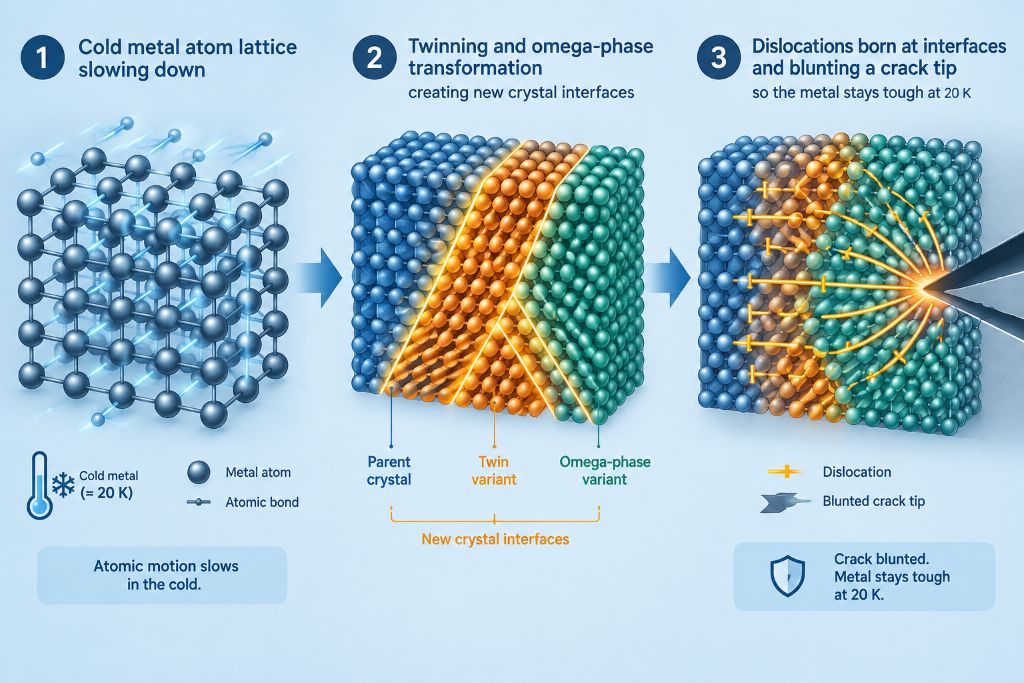
How twins and omega phase stop cracks.
Characterizing the deformation was its own hurdle. The researchers combined post-fracture electron backscatter diffraction, fractography, and transmission electron microscopy to watch twinning and the ω-phase transformation evolve. Catching both mechanisms in action, near a crack and in tension, took careful imaging at the smallest scales. In my own materials lab classes, I watch students struggle to even keep a specimen frost-free at room temperature. Doing all of this at 20 K, and doing it twice across two compositions, demands a patience that textbooks rarely show.
What Is Low Temperature Toughness, Anyway?
Toughness is simply how much energy a material can absorb before it breaks. A rubber band is tough; a dry cracker is not. Low temperature toughness describes whether a material keeps that energy-absorbing ability when it gets very cold. Strength is different. A material can be very strong yet brittle, like a ceramic tile that snaps with almost no bending. The ideal engineering metal is both strong and tough, and it should stay that way even at 20 K.
Why Cold Usually Makes Metals Snap
Metal deforms because dislocations, which are line defects in the crystal lattice, glide through it. In many metals, especially bcc ones, this gliding needs thermal energy to happen easily. As temperature falls, the atoms vibrate less, and the dislocations can no longer move as freely. The result is a steep rise in strength with cooling, and a shrinking plastic zone at any crack tip. When that zone gets too small, the material can no longer blunt a crack, and it fails suddenly. That sudden failure, over a narrow temperature window, is the ductile-to-brittle transition. It is why a frozen spoon shatters.
How These Alloys Escape the Transition
The new alloys dodge this trap by activating a different starting mechanism. Twinning and an ω-phase transformation begin first, and both create interfaces where dislocations can be born without needing much heat. The twin itself is a crystalline region that mirrors its parent, like a kink that copies itself. The ω phase is a coordinated shuffle of atoms into a new crystal structure. Both happen readily at low temperature. Together they keep supplying dislocations, so the crack tip keeps blunting and the metal keeps absorbing energy. This is the “competing mechanisms” idea in the title. One pathway shuts down in the cold, but another carries the load.
What the Results Mean for Engineering
These findings point toward tougher parts for extreme cold. Liquid-hydrogen storage, superconducting magnets, and deep-space structures all sit near 20 K or lower. A metal that keeps its toughness without a ductile-to-brittle transition could make those systems safer and lighter. Refractory alloys already resist heat and wear, which adds to their appeal. The study gives engineers a design rule too: alloying that promotes twinning and interface nucleation may be a reliable route to cryogenic toughness. That insight could guide the next generation of structural alloys.
Still, hurdles remain before these materials reach production. Niobium, tantalum, and hafnium are costly and dense. Processing them into large, defect-free parts is hard, and the study itself notes that slight processing defects can shift toughness values. The two alloys also showed some intergranular fracture signs near cracks, even though they stayed tough overall. These are the honest trade-offs a researcher must weigh against the promise.
Conclusion
The bottom line is striking. Two bcc refractory alloys held onto strength and toughness all the way down to 20 K, with no ductile-to-brittle transition. They did it through an inverted sequence, where twinning and an ω-phase transformation arrive first and pump out dislocations at interfaces. That temperature-insensitive start keeps the crack tip from shutting down in the cold. The result challenges a long-standing rule in metallurgy. It also gives engineers a fresh target: design metals that switch on twinning early, and cryogenic brittleness might simply disappear. For students, this is a reminder that the oldest rules in a subject can still bend. The challenge now is turning a clever lab result into affordable, large-scale materials. If that happens, colder could finally stop meaning more brittle.
Reference
Cook, D. H., Chen, X., O’Leary, M., Rao, S., Wang, W., Belcher, C. H., Payne, M., Borges, P., Asta, M., Lavernia, E. J., Apelian, D., Minor, A. M., Lee, T. L., Devaraj, A., Liu, D., Kumar, P., & Ritchie, R. O. (2026). Competing mechanisms toughen bcc binary and medium-entropy alloys at 20 K. Nature, 658, 924–930. https://doi.org/10.1038/s41586-026-11065-7
Charudatta Pathak was a student at St. Aloysius High School in Bhusawal, established in 1874, making it one of India's oldest convent institutions. He earned his bachelor's degree in mechanical engineering from SSVPS College of Engineering, Dhule in 1995, demonstrating exceptional academic achievement. Thereafter, he launched his career as a CNC programmer in a toolroom. He has utilized FANUC, Deckel, Maho, and Mikron controllers to operate 2-axis and 3-axis machines for the fabrication of jigs, fixtures, dies, and molds. He commenced his career as an academic in 1996, when he assumed the role of lecturer at SSVPS College of Engineering, Dhule. Additionally, he earned his post-graduate degree in CAD/CAM from L. D. College of Engineering, Ahmedabad, in 2000, and then acquired a Ph.D. from COEP in 2011 while concurrently engaged in teaching. Until 2023, he occupied many academic roles, including lecturer, assistant professor, professor, dean, principal, director, and vice chancellor at both public and private universities throughout India. From 2008 to 2010, he served as the project lead in the CAE department of a European multinational firm. During his 28-year professional tenure, he identified a need for dependable books targeted at students in grades 8 to 12, particularly for nascent career planning. He founded ENTECH Digital Magazine, a free monthly publication available on entechonline.com and magzter.com. Teens with a strong interest in Science, Technology, Engineering, and Mathematics (STEM) who aspire to pursue careers in these fields may find ENTECH Digital Magazine beneficial.