Embodied AI pairs light, yielding arms with remote demonstrations and on-robot learning, while broader autonomy and safety claims await fuller evidence.
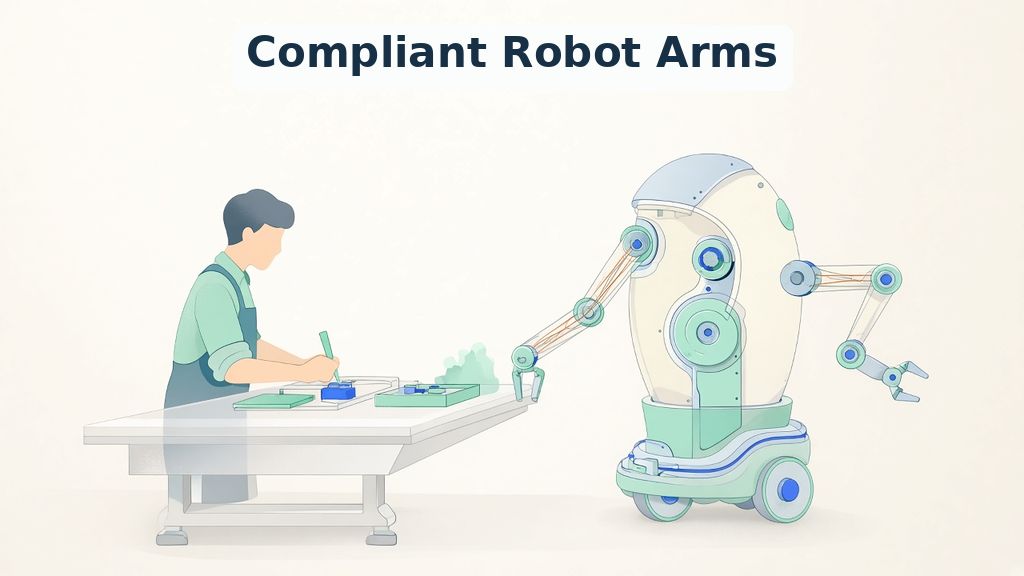
Passing a fragile model across a school workbench takes care and gentle movements. A factory robot faces a similar challenge when people share its workspace. However, stronger motors alone cannot solve every handling problem around nearby workers. Embodied AI has announced AIR, pairing compliant robot arms with learning from examples. Meanwhile, the Lausanne company grew from EPFL, the Swiss technical university. According to its official launch release, AIR has wheels and a pair of arms. Instead of loading the arms with heavy parts, the design keeps weight near its center. As a result of this, the arms stay light and yield during contact. A remote operator first controls tasks while the system gathers working examples. At the same time, those examples support the intended move toward greater autonomy. The release dates to November 6, 2026; it is not a journal paper.
Factories handle work that can change between products, batches, and individual items. The developer aims its robots at varied tasks that people still do by hand. However, teaching those tasks requires more than repeating a polished example. Therefore, a person must guide movements around the real objects and nearby tools. In practical terms, learning starts where people already make or handle real goods. The company’s technical overview describes human supervision alongside teleoperation and imitation learning. Teleoperation means that a person controls a robot from another location. Meanwhile, imitation learning uses examples of actions to shape later robot behavior. At the same time, the release leaves key rollout details open. It names customer sectors, but does not name the firms involved. For this reason, its account supports a plan, not proof of readiness everywhere.
The Factory Problem Starts With Variation
A task can look simple while demanding careful changes in each movement. The website lists picking, placing, plugging, and tool integration among planned uses. For example, plugging connects the broader automation problem with controlled physical contact. These examples explain why the work matters, not the results in every task. In other words, an application list describes goals rather than a test plan. The company proposes learning under working conditions rather than simulation alone. However, the source does not describe how many examples each task requires. It also gives few details about training time or how tasks fail. At the same time, human involvement shows actions that the robot can copy. Thus, the design challenge joins physical handling with the quality of examples. Consequently, useful evaluation would track both successful actions and moments needing intervention.
Explainer: How Compliant Robot Arms Give Way
Mechanical compliance means that a structure can yield when something pushes against it. A familiar comparison is a flexible ruler rather than a rigid metal bar. However, a yielding arm remains a powered machine, not a harmless toy. The hardware design description places AIR’s heavy parts inside its torso. As a result of this, its moving arms carry less weight themselves. Specifically, the release says those light arms can give way during contact. Meanwhile, the website also describes a soft exterior and compliant joints. In practical terms, lighter moving parts resist changes in motion less strongly. That classroom idea describes inertia, the tendency to keep moving or remain still. Consequently, the design tackles a mechanical concern before software chooses an action. At the same time, these principles do not establish safe contact in all conditions.
Tendon-Driven Arms Move Mass Inward
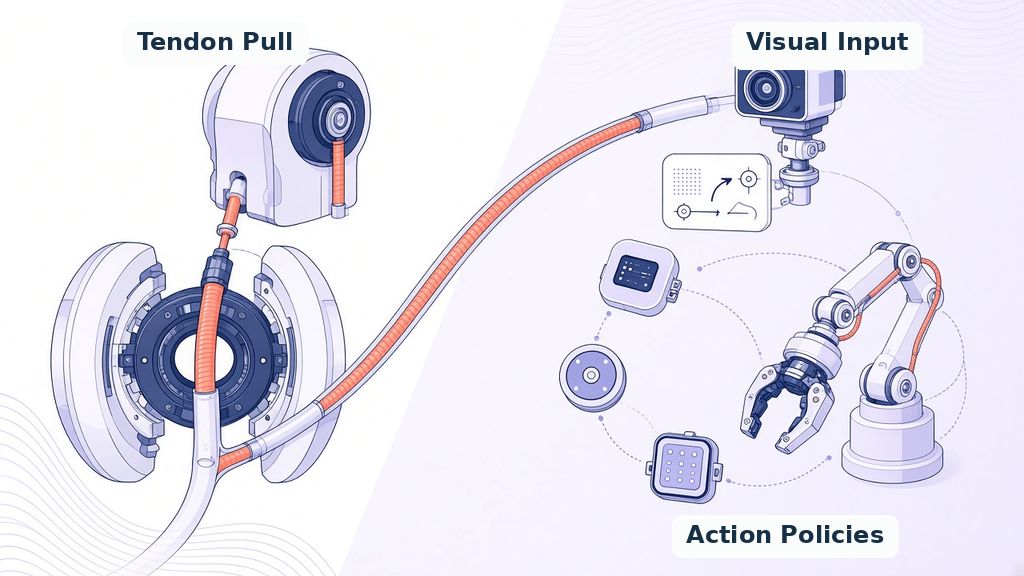
The website lists lightweight tendon-driven manipulators, meaning robot arms, among the developer’s hardware. A tendon here means a cable-like part that transmits a pulling force. For example, a cord can transfer a pull between moving parts set apart. That comparison explains the principle without revealing the company’s detailed inner workings. In other words, the term describes transfer of force, not a full design drawing. Also, the release separately explains that AIR keeps heavy parts in its torso. Together, these descriptions help readers understand the interest in light robot arms. However, the website does not document every tendon route within the unveiled machine. The sources also omit a full list of each arm’s moving parts. For this reason, illustrations here show concepts rather than the actual hardware layout. At the same time, where weight sits differs from how force reaches the joints.
Contact Requires More Than Soft Joints
Compliance addresses contact, while the whole working system still needs safety checks. The release describes uncaged work as a design aim for nearby people. However, it supplies no outside safety report covering work across a range of factories. The company plans CE marking for 2027, rather than reporting completed marking. For this reason, readers should not confuse a planned milestone with present completion. Additionally, the website also mentions sensing, but gives little detail about test conditions. Meanwhile, a light arm and a moving wheeled base pose different safety questions. Those questions concern the whole machine, its task, and the shared workspace. In practical terms, useful future reporting would describe contact tests and limits on use. The release does not establish that every proposed application can remove barriers. Consequently, the design promise deserves attention without a blanket statement of safety.
From Remote Demonstrations To Learned Actions
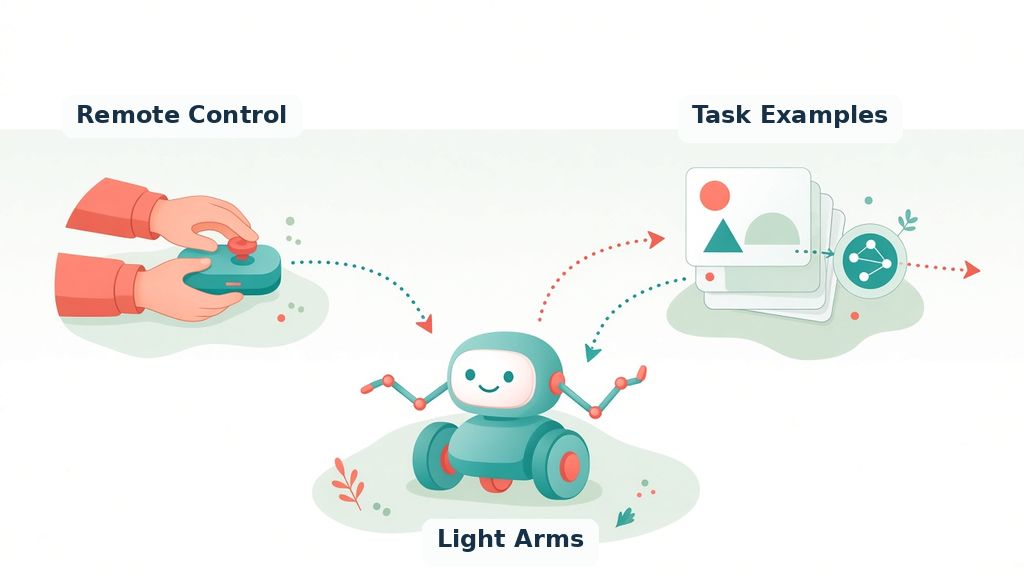
The learning process starts with a person performing the actual task remotely. Embodied AI describes this work as useful production alongside the collection of examples. First, human guidance supplies the actions that the learning system can study. In other words, direct human control and later autonomy describe different operating stages. The control system overview also keeps people available to supervise and intervene. Meanwhile, ENTECH’s remote handling feedback explainer examines another important part of human control. That related story provides context, not evidence about AIR’s specific controls. For this reason, readers should not assume AIR includes those specific feedback features. Therefore, the official materials do not document its human controls in comparable detail. However, they clearly connect human examples with the planned path toward more self-control. At the same time, a useful example does not itself prove reliable independence.
Fig. 1: Human Examples Support Robot Learning
Compliant Robot Arms Learn From Operators
Imitation learning draws from examples of actions rather than a full list of motions. The website connects this method with tasks performed at the workplace itself. For example, a person can supply examples under the conditions the robot encounters. These examples set the plan apart from learning in simulated settings alone. In practical terms, the person contributes both useful labor and a source of examples. The release claims that a robot can take over within a month. However, it does not provide a task-by-task test plan supporting that schedule. At the same time, supervision remains part of the system the website describes. The key question is which actions need human help after training. Consequently, stronger reporting would separate autonomous completions from assisted ones for each task. For this reason, flexible factory arms need evaluation alongside examples, not just more examples.
Vision And Language Coordinate Smaller Controllers
The website describes compact multimodal policies coordinated through a vision-language model. A policy means a learned rule for choosing actions from the data it has. Meanwhile, multimodal means that a system handles different kinds of data together. A vision-language model connects what the robot sees with language rather than handling pictures alone. In other words, the design links a task planner with smaller systems that choose actions. The company says these systems run on the robot itself while it works. However, it does not publish detailed model sizes or an independent comparison. Readers therefore cannot infer computing demands or results from the architecture’s description alone. At the same time, this arrangement explains a distinct design choice about coordination. Consequently, students can separate understanding an instruction from making a movement. For this reason, on-robot computation deserves explanation without implying a machine that understands everything.
Fig. 2: Tendons And Models Guide Movement
Evidence, Limits, And The Next Engineering Steps
The production pilot account contains a key distinction about paid factory work. It says the same AI stack already works within a separate robot cell. However, that cell is not the newly unveiled wheeled AIR platform. The release describes a two-arm cell working on a customer’s production line. For this reason, paid-line experience supports the stack, not AIR deployment at scale. The company also reports an average success rate of 95% across paid pilots. In everyday terms, that resembles about nineteen successful attempts out of twenty. However, the source gives no detailed breakdown linking that average to individual tasks. It neither names pilot customers nor provides an outside evaluation of AIR. At the same time, a broad average cannot explain every failure‘s practical importance. Consequently, readers should treat this reported rate as a claim from the company.
What Production-Line Results Actually Support
Shared software does not make distinct machines work the same way in factories. The website distinguishes its two-arm cells from the humanoid-style wheeled machine. However, both appear within the developer’s account of its broader physical AI stack. That link makes the factory work relevant without erasing the difference between machines. In other words, shared software gives context without proving the same results for both. The official materials also describe site assessment, a focused pilot, and later rollout. Meanwhile, these stages suggest a practical order for investigating a potential deployment. A pilot should show how the complete system handles the selected workplace task. For this reason, future reports would benefit from clearly separating each platform’s results. They should also describe human help and the conditions around reported successes. At the same time, transparent testing would help show where the approach genuinely fits.
Conclusion: Skills For Human-Guided Automation
The central idea pairs yielding hardware with examples gathered during actual work. However, the strongest design story concerns that combination, not a race between brands. Students can trace the links between moving mass, taught actions, and robot control. In practical terms, robotics links physics with circuits, code, and careful study of tasks. The project also highlights why people remain important while automation develops. Meanwhile, teleoperation and supervision connect human judgment with the robot’s physical actions. These functions suggest areas to explore, not a measured forecast of job growth. For this reason, readers can investigate controls, safety checks, and the design of task examples. The next useful evidence would show task-specific reliability and clear safety limits. Consequently, compliant robot arms offer a clear topic for learning across STEM fields. At the same time, progress means showing what machines can do and where people help.
Keep the distinction between guided work and independent operation visible throughout the story. A future update could explain task-specific failures and how operators regain control. Consult Embodied AI’s original official announcement for the developer’s own account.
Editorial note
Robotics offers a lively meeting point for physics, coding, and human judgment. ENTECH is running this story to help teens connect those subjects with possible STEM study paths, not to endorse a product or forecast job losses. The central lesson concerns the link between yielding hardware and learning from human examples. Paid production-line evidence concerns a related robot cell, not proof that the newly unveiled wheeled AIR works autonomously at scale. The success rate and proposed learning timeline come from the company, while CE marking remains planned. Readers can find the developer’s full framing in the original official release and website.
Charudatta Pathak was a student at St. Aloysius High School in Bhusawal, established in 1874, making it one of India's oldest convent institutions. He earned his bachelor's degree in mechanical engineering from SSVPS College of Engineering, Dhule in 1995, demonstrating exceptional academic achievement. Thereafter, he launched his career as a CNC programmer in a toolroom. He has utilized FANUC, Deckel, Maho, and Mikron controllers to operate 2-axis and 3-axis machines for the fabrication of jigs, fixtures, dies, and molds. He commenced his career as an academic in 1996, when he assumed the role of lecturer at SSVPS College of Engineering, Dhule. Additionally, he earned his post-graduate degree in CAD/CAM from L. D. College of Engineering, Ahmedabad, in 2000, and then acquired a Ph.D. from COEP in 2011 while concurrently engaged in teaching. Until 2023, he occupied many academic roles, including lecturer, assistant professor, professor, dean, principal, director, and vice chancellor at both public and private universities throughout India. From 2008 to 2010, he served as the project lead in the CAE department of a European multinational firm. During his 28-year professional tenure, he identified a need for dependable books targeted at students in grades 8 to 12, particularly for nascent career planning. He founded ENTECH Digital Magazine, a free monthly publication available on entechonline.com and magzter.com. Teens with a strong interest in Science, Technology, Engineering, and Mathematics (STEM) who aspire to pursue careers in these fields may find ENTECH Digital Magazine beneficial.