KAIST-led researchers built heat-read labels from gallium and alloy droplets that reveal a valid key for only about 15 seconds and bury it among decoys.
Fake goods cost companies billions of dollars each year. On top of that, counterfeit medicines and electronics can put people at risk. Now a Korean-led team reports liquid metal security labels that resist copying in two ways. Jae-Woong Jeong and Young Min Song of KAIST are the corresponding authors. Simok Lee and Min Seok Kim share first authorship. In addition, Kongju National University, GIST, MIT, and NC State joined the work. The paper appeared in Nature Communications on October 30, 2026. It is an Article in Press, so final editing may still change small details. In short, the labels hold tiny droplets of two metals that look the same. A thermal camera reads them only while they heat up. As a result, a valid key appears for just a short time. Its DOI, for reference, is 10.1038/s41467-026-78973-0.
Security tags like these are called physical unclonable functions. Each one carries a random pattern that acts like a fingerprint, for example. Older tags, however, share a weak spot. In other words, their responses stay readable all the time. Attackers can therefore collect many responses and train software to copy them. According to the paper, one earlier attack modeled such tags with over 97% accuracy. That attack, moreover, needed only about 33 minutes of training. The new labels fight back with time limits and fake patterns. With decoys, copying accuracy fell from 69.9% to 38.7%. Adding the time limit then made such attacks effectively infeasible, the authors say. Even so, all tests took place in the lab, not in shops or warehouses. Below, we explain how the labels work and what limits remain.
Counterfeits hurt many industries, from luxury goods to medicines. Brands often use holograms, special inks, or printed codes, such as barcodes. Skilled forgers, however, can copy many of these features. Ideally, a good tag should be impossible to rebuild, even by its maker. Random physical patterns help achieve that goal. In particular, no two tags form in exactly the same way. The real challenge lies in digital cloning. Here, attackers skip the physical tag and copy its behavior with software. They feed many challenges to a tag and record each response. Machine learning then predicts new responses from the old ones. Our story on hybrid quantum authentication covers another approach to proving that something is genuine. For this reason, the KAIST team aimed to block both kinds of copying.
Two Metals That Look the Same
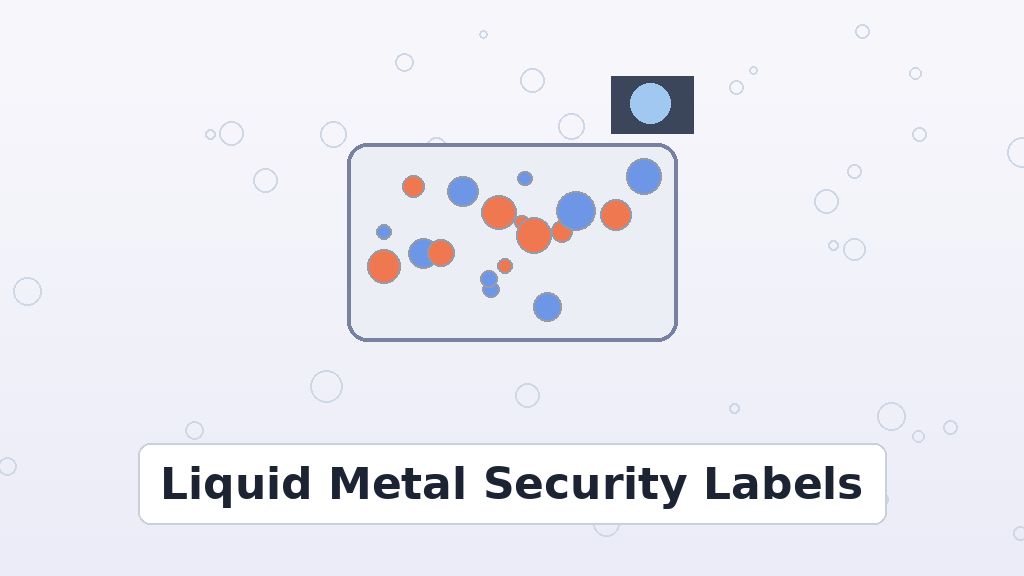
The labels mix droplets of two different liquid metals. One is gallium, which melts near room temperature. The other is Field’s metal, an alloy of bismuth, indium, and tin. Both look silvery and, in fact, nearly identical to the eye. Gallium, however, stores about 1.8 times more heat per gram. That difference is the key to the whole design. When the label warms, each droplet heats at its own rate. In other words, a thermal camera sees a unique pattern of warm and cool spots. The droplets range from 200 to 1200 micrometers across. After that, they sit inside soft silicone rubber called PDMS. On top, a thin resin layer about 50 micrometers thick seals everything. That layer also withstood pressing forces up to 181 newtons without failing.
How the Liquid-Metal PUF Reads Its Key
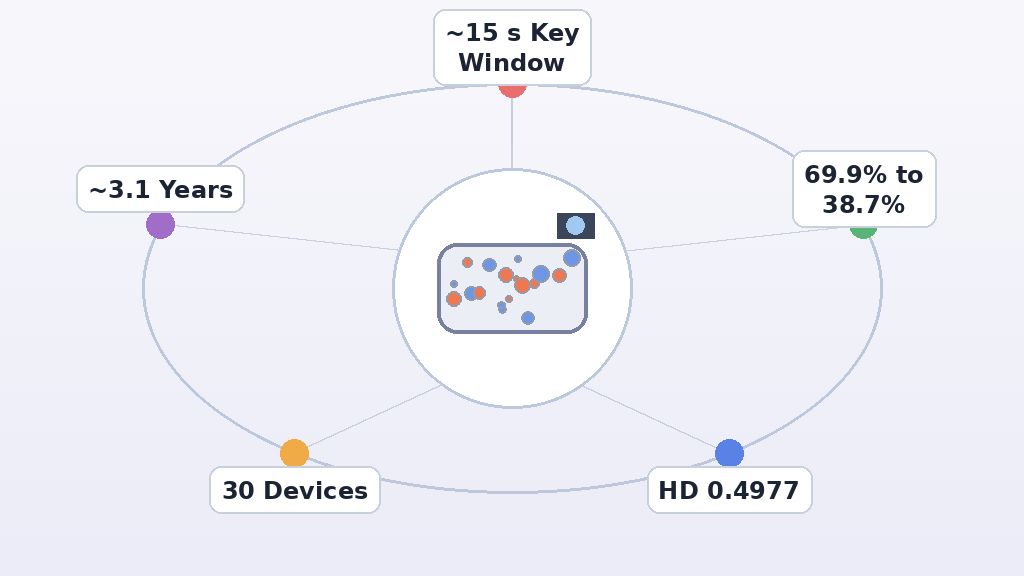
Reading a label starts on a small heating stage. A Peltier stage warms the label, and a FLIR infrared camera records it. At steady temperature, the label reveals no useful key at all. The paper calls this state cryptographically silent. During heating, by contrast, thermal patterns change over time. Software turns each pattern into a string of digital bits. A key stays readable only within a transition window of about 15 seconds. After about 16 seconds, the pattern drifts enough to form a different key. As a result, an attacker gets very little time to record useful data. In total, the team built and tested 30 separate devices for the study. Full methods appear in the Nature Communications paper. Together, these steps turn heat into a fleeting password.
Decoys Inside Each Liquid-Metal PUF
The second defense uses a quirk of gallium. In particular, gallium melts at about 13 °C. Sometimes, though, it stays liquid below that point for a while. Scientists call this effect supercooling. If heating starts above 13 °C, all droplets stay liquid. In that case, the label gives the same real key each time. On the other hand, colder starts leave some droplets frozen and others liquid. That random mix, as a result, produces misleading patterns, or decoys. Copying software then struggles to tell real keys from fake ones. Models trained only on real keys reached 69.9% accuracy on unseen challenges. With decoys added, however, accuracy fell to 38.7%. That figure, in turn, marks a drop of 31.2 percentage points. Combining decoys with the time limit, the authors report, made attacks infeasible.
Fig. 1: Key Results of the Liquid-Metal PUF Study
Testing Liquid Metal Security Labels
Good security tags must be both unique and repeatable. The team measured both using a score called Hamming distance. Repeat readings from the same label differed by only about 8.29% of bits. Readings from different labels, in contrast, differed by about 49.77%. A perfect random tag, by contrast, would sit at 50%. In addition, the estimated clone probability was 4.62 times 10 to the minus 38th. The keys also passed seven randomness tests from a United States standards body. Those tests checked 92,160 bits in total. After that, durability tests came next. Labels survived ultraviolet light and 60 cycles between minus 10 and 100 °C. They also survived 10,000 rounds of mechanical stress. Finally, an aging test suggested about 3.1 years of stable indoor use.
Explainer: Why Time Limits Beat Copying Software
Most digital attacks need lots of data. Software studies many challenge and response pairs to find hidden rules. With more data, as a rule, its predictions get better. Static tags, therefore, give attackers all the time they want. These labels, however, release a key only while they heat. Each key also lasts only about 16 seconds before changing. In this way, the label limits how much data anyone can gather. Decoys add a second layer of confusion. An attacker cannot easily tell which recorded patterns are real. Put simply, it acts like a password that changes and hides among fakes. Our guide to quantum computing and data security explains why stronger hardware security matters. Overall, the defense comes from the material’s physics, not from extra code.
From Banknote Patterns to Phone Cameras
The team also showed that the labels can take many shapes. They used stencil printing to form detailed currency patterns. Next, they built working QR codes from the same liquid-metal and rubber mix. A FLIR ONE Gen 3 camera attached to a smartphone read those codes. Such a reader is far cheaper than a lab camera, at least today. For example, a pharmacist or shop worker might one day check a package this way. The paper, however, does not report any field trials. Phone-based readers would make checks much more practical. Even so, the team tested only lab conditions here. At the same time, the authors suggest uses in secure supply chains. Banknotes, ID cards, and medicines could all benefit, though none were tested in real use.
Fig. 2: How Heat Reveals a Hidden Key
Challenges for Liquid Metal Security Labels
Several hurdles remain before shoppers see these labels. First, reading needs a controlled heating stage and an infrared camera. Most stores do not own such tools today. Our report on perovskite thermal imaging describes one route to cheaper heat cameras. Second, the decoy trick depends on heating that starts below about 13 °C. Warm climates or careless handling could, in turn, change which patterns appear. Third, the aging estimate of 3.1 years comes from a lab model. The team assumed indoor conditions of 25 °C and 40% humidity. Real shipping, by contrast, can expose labels to heat, moisture, and rough handling. In addition, the paper reports no production cost per label. It also does not report trials with real products or real counterfeiters. The study does show that the gallium oxide skin grew only 0.34 nanometers during aging. That thin skin, according to the authors, protects the droplets.
What Comes Next for Hardware Tags
To begin with, this paper is an Article in Press, so details may still change. Also, the team tested 30 devices, a modest number for security work. In the long run, larger batches would help confirm the uniqueness scores. Future work could also test smaller, cheaper readers for everyday use. In fact, the smartphone camera demo hints at that path. The authors frame the labels as tamper-resistant tags for supply chains. Funding came from the National Research Foundation of Korea and the InnoCORE program. Industry partners, meanwhile, would need to test printing at large scale. At the same time, standards groups would need to judge the security claims. For now, the work stays an early but clever proof of concept. Still, it shows how simple metal droplets can guard valuable goods. Even small labs can, after all, build on this idea.
Conclusion: Heat, Time, and Trust
This study shows a smart new design for liquid metal security labels. Two look-alike metals heat at different rates and form unique thermal patterns. A key appears only during a short heating window. Decoys from supercooled gallium, moreover, hide the real key from copying software. Tests on 30 devices, in turn, showed strong uniqueness and stable readings. The keys also passed seven NIST randomness tests on 92,160 bits. At the same time, the labels need special readers and further real-world testing. Shipping conditions, costs, and large-scale printing remain open questions. Such work blends materials science, thermal imaging, and cybersecurity. Next, researchers must show the idea works outside the lab. If it does, fakes could become much harder to pass off. Until then, the labels remain an encouraging step for product security.
References
Lee, S., Kim, M. S., Kim, W. J., Heo, S.-Y., Ahn, Y., Lee, J., Kwon, D. A., Oh, S., Yoon, S.-E., Dickey, M. D., Song, Y. M., & Jeong, J.-W. (2026). Liquid-metal physical unclonable functions resistant to both physical and digital cloning. Nature Communications. Advance online publication (Article in Press). https://doi.org/10.1038/s41467-026-78973-0
The liquid-metal security label draft keeps anti-counterfeit ideas engaging. I would still tighten how key-hiding is explained so newcomers see the method before the drama. A constructive note on durability and readout limits would deepen the challenges section. Readers may wish to look up the original study that this piece is based on for the complete record.
Editorial note
ENTECH is covering liquid-metal anti-counterfeit tags because materials security and electronics careers meet. The tone stays curious without treating the labels as a finished seal of approval. We encourage readers to turn to the original source paper from which this story is sourced.
Aditya Joshi is an SDE Intern at Coneixement India, the company behind ENTECH STEM Magazine and STEMQuiz. He is a Computer Engineering graduate from Savitribai Phule Pune University (SPPU), with honours in Machine Learning and Data Science. His academic background and hands-on project experience have developed his interest in artificial intelligence, emerging technologies, software development, and the practical applications of computing.
His areas of technical interest include Artificial Intelligence (AI), Generative AI, Machine Learning, Data Science, Large Language Models (LLMs), Natural Language Processing (NLP), Retrieval-Augmented Generation (RAG), GraphRAG, and knowledge graphs. Through projects involving locally hosted language models, Neo4j knowledge graphs, multilingual chatbots, and AI-powered analytics, he has explored how emerging technologies can be used to solve practical problems.
Aditya's professional experience includes work in frontend development, AI/ML application development, and full-stack software projects. During his internships at Maharashtra Knowledge Corporation Limited (MKCL) and Hilwitz Solutions, he worked on applications involving web technologies, Python, Flask, and AI-driven functionality. He has also developed projects such as SalesCope, an AI-assisted sales analytics platform, and a multilingual chatbot designed to help users explore Indian government schemes.
At ENTECH STEM Magazine and STEMQuiz, Aditya brings a technology-focused perspective shaped by his engineering education and practical experience with AI and software systems. He is interested in making complex science and technology concepts easier to understand through clear explanations, relatable everyday examples, and an emphasis on how emerging innovations work and affect real-world applications.
His broader goal is to help bridge the gap between technical concepts and public understanding, encouraging curiosity about artificial intelligence, computing, and the technologies shaping the future.