Quantum computers using Shor's algorithm can break RSA and ECC encryption, threatening most current digital security.
The Impact of Quantum Computing on Data Security in 2026
Estimated reading time: 8 minutes
Quantum computers are no longer a futuristic idea. It is an object that has real-world consequences. Most importantly, the implications of quantum computing for data security require urgent attention. Our data was encrypted before this decade. Today, safety is at risk.
To explain the problem, think of a lock. Conventional computers have a problem with complex locks. Like a master locksmith, quantum computers break these puzzles open in quick order. So, any digital system is vulnerable. In fact, the current encryption standards are based on mathematical problems. Because quantum algorithms such as Shor’s algorithm can solve these problems, change is urgent.
Plus, the time line is shorter than anticipated. Now, experts say a “Q-day” is coming in 5-10 years. This is the day an RSA-2048 is broken by a quantum computer. Many thought this was decades away at first. However, the race for quantum hardware has sped up. In essence, we need to get ready now.
In this case. The answer is post quantum cryptography. Researchers develop new algorithms for the purpose of protecting data. Finally these algorithms are resistant against quantum attacks. Consider the example of lattice-based cryptography. It is essentially different from RSA. To stay secure, organizations have to move.
All in all quantum computing data security is a juggling act. Quantum has benefits on the one hand. It imperils existing systems, in contrast. Briefly, the first step is to understand this impact.
Also Read: Data Privacy Careers in STEM
Key Takeaways: Quantum Computing Data Security
- Quantum computers will break today’s encryption schemes such as RSA.
- Post-quantum cryptography provides us with new mathematical protections.
- The NIST standardization process will be nearly finished in 2026.
- Hybrid systems mix classical and quantum-safe algorithms.
- Finance, healthcare and government are the most vulnerable.
- Begin planning migration now to prevent exposure of data.
- Quantum key distribution provides security at the physical layer.
Why Quantum Will Break Current Encryption: Understanding the Threat

At this point, you must grasp the technical threat. Practically modern encryption depends on two fundamental problems. First: the factoring problem. Second, the discrete logarithm problem. Large prime values are employed in RSA encryption. Similar to mixing colors, factoring reverses the mix. This is hard on traditional computers. Quantum computers are awesome!
To enumerate Shor’s algorithm factors large numbers in polynomial time. This factoring used to take exponential time. Moreover this difference is huge. Usually quantum computers can crack RSA-2048 in hours. But symmetric encryptions such as AES are still more secure. AES-256 still safe since Grover’s algorithm halves key strength.
Unlike public-key systems, symmetric ciphers have options. If you double the key size, you are safe. But the real threat is harvest now, decrypt later attacks. In the meantime attackers steal encrypted data today. Then they wait for quantum computers to break it. That is to say data that has long term value is in immediate danger.
This threat is being met with a response from the industry. Finally, the National Institute of Standards and Technology (NIST) leads the way. To date four post-quantum algorithms have been selected by them. In conclusion, the threat is real but manageable.
How Shor’s Algorithm Works in Simple Terms
Simply put, Shor’s algorithm is looking for patterns. Like the way you can hear a repeating rhythm in music, it perceives cycles. In the beginning The algorithm employs quantum superposition as its basis. Then, it does quantum Fourier transforms. The punchline is that it factors exponentially faster .
For example , suppose a lock with 1000 keys . Classical search examines every key. Shor’s algorithm, in contrast, tries all of them at once. In the same way it finds the right key immediately. In terms of cryptography this breaks everything.
Post-Quantum Cryptography: The New Normal
Post-quantum encryption is the answer, as I said. These algorithms use different math . Detailed One example is lattice-based cryptography, which is based on high-dimensional structures. Like searching for a needle in a growing haystack, lattices resist quantum attacks. What’s more NIST picked CRYSTALS-Kyber as the key exchange algorithm. Along with CRYSTALS-Dilithium for signatures, these are the new standard.
Migration usually involves updating software. Currently Large companies like Google and Cloudflare are testing these algorithms. So far the performance overhead is light. Most importantly start planning your migration now.
How Post-Quantum Cryptography Protects Data – Step by Step
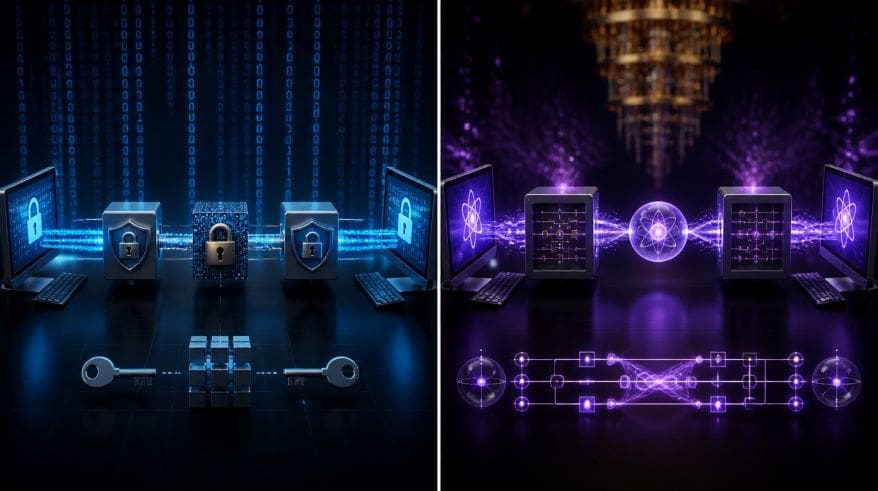
Learned the threat, now let’s talk about protection. First, post-quantum cryptography does not require quantum computers. Actually it runs on classical hardware. To show this, it employs mathematical problems that quantum computers cannot solve. Like changing the lock before the burglar comes, it is proactive.
The process is essentially three steps. First, choose a NIST-approved algorithm. Two: Incorporate it into your systems. **Third, Compatibility check. At last, this calls for careful planning.
To list the algorithms selected by NIST:
- CRYSTALS-Kyber: Key encapsulation.
- CRYSTALS-Dilithium: electronic signatures.
- Falcon: Smaller signature option.
- SPHINCS+: Hash-based signatures, stateless.
Simultaneously, hybrid approaches are available. For slow migration apply classical and quantum-safe algorithms. Similarly, you maintain backward compatibility. Hybrid systems are recommends to ensure security.
Take the example of a banking app. It uses RSA-2048 before migration. After that it adds Kyber beside RSA. The outcome: data is secured by Kyber if RSA is broken. Most of all this two-layer strategy buys time.
Practical Applications in Different Industries
Today, quantum computing data security impacts every industry. As an example, consider these industries:
- Healthcare: Patient records encrypted with RSA are compromised. Medical data continues to be relevant for decades, and therefore harvesting attacks are dangerous. If this is the case hospitals must switch to post-quantum cryptography immediately.
- Finance: RSA signatures are uses in bank transactions. Furthermore, stock market data requires long-term integrity. Like a counterfeit check, quantum tampering could undermine markets.
- Government : Top Secret documents are encrypted . In any case, the biggest threat is to intelligence agencies. Migration is key, as long as data is kept for years.
- Technology. Cloud providers like AWS deal with huge volumes of data. Likewise , they need to upgrade encryption protocols . All in all, the industry is moving quickly.
- Education. Universities are working on quantum algorithms. They also protect student records eventually. For example a database is hacked, revealing personal details.
All in all, no sector is safe. Summary: Migration needs to be pre-emptive.
Advantages of Post-Quantum Cryptography
First and foremost: quantum resistance means future security. The advantages include:
- Long-term data security: Your encrypted data will be safe for decades.
- Compatibility: Runs on current hardware, no quantum computers needed.
- Standardization: NIST algorithms are well tested.
- Scalability: Global availability in software upgrades.
- Security: Rebuilds confidence in digital infrastructure.
Finally, the benefits of migration make it worthwhile. Plus, the cost of not acting is higher.
Challenges and Constraints
It may be true but there are obstacles. First, there is a performance penalty. Post-quantum algorithms need larger keys, essentially. They use more bandwidth and memory, like carrying a bigger backpack. Either way this can be done.
Second, the complexity of integration is high. If your systems are legacy, migration is a tough proposition. That is, each application needs to be upgraded. Third, standardization is still in flux. NIST has made progress, but some algorithms may change.
Ignoring these challenges increases risk. Similarly, early adopters have an advantage. Migration is essential at the end of the day.
Upcoming Trends & Future Scope
Today, the data security of quantum computing is changing fast. Spot the latest trends:
- Quantum key distribution (QKD): Utilising quantum physics to exchange keys securely. Like a tamper-proof envelope, QKD detects eavesdropping.
- Entanglement-based networks: The quantum internet of the future will distribute keys globally. China and Europe deep pioneer satellite QKD.
- AI in cryptography: It is used to optimize parameters of algorithms. Plus AI finds vulnerabilities quicker.
- Hardware security modules (HSM): Dedicated chips that accelerate post-quantum operations. They also guard keys physically.
These trends build a layered defense foremost of all. By all means, the future is quantum-safe.
Conclusion
To wrap up, quantum computers are having a revolutionary impact on data security. Overall, post-quantum cryptography represents an obvious path forward. Now that you are aware of the threat, the solutions, take action. Most important, begin to evaluate your systems today.
At this moment the clock is ticking. Now is the time to protect your data. The good news? The tools are there. Start your migration to quantum safe standards.
Frequently Asked Questions
Q: When will quantum computers break today’s encryption? A
Experts say Q-day is coming in 5-10 years. At present, there is no quantum computer that can crack RSA-2048. But things are moving quickly. Above all, begin the migration now.
Q: Can I use post-quantum cryptography now?
Yes. The NIST-selected algorithms are ready to be tested. In fact, they are already being used by Google and Cloudflare. You can merge them eventually today.
Q. Will I need to replace all my current hardware?
No. Post-quantum cryptography can run on existing hardware. Mostly software upgrades. Compared with replacing servers, it is economical.
Q: What is the difference between QKD and post-quantum cryptography?
QKD is physics-based; PQC is math-based. Just like a lock versus guard, they are on different layers. ** All in all ** Both are useful .
Q: What is post-quantum cryptography and how does it differ from current methods?
Post-quantum cryptography uses mathematical problems remaining difficult for quantum computers, such as lattice-based or code-based approaches. Unlike RSA depending on integer factorization, these methods resist quantum attacks, providing quantum computing data security against future threats.
References
- Chen, L., Jordan, S., Liu, Y. K., Moody, D., Peralta, R., Perlner, R., & Smith-Tone, D. (2016). National Institute of Standards and Technology (NIST) Internal Report, 8105. https://doi.org/10.6028/NIST.IR.8105
- Khan, A.A., Laghari, A.A., Almansour, H. et al. Cloud Comp 14, 43 (2025). https://doi.org/10.1186/s13677-025-00771-8
- Author
- Latest Posts

Deven Nandapurkar is a Software Engineer, Project Lead; working at the strategic intersection of software engineering, productivity science, and emerging technologies. Driven by a core philosophy of “building things worth building,” he leads cross-functional teams and drives end-to-end technical strategy—from early-stage conceptualization through production-grade deployment.
A Computer Engineering graduate from Pune University, Deven brings a sharp systems-thinking approach to technical leadership, honed by years of managing high-stakes engineering projects and leading teams to top placements in national and international hackathons, including the NASA Space Apps Challenge and the Peerlist GenAI Hackathon.
Deven explores how human cognition and emerging technology converge. He regularly writes about cognitive performance optimization, attention management, AI integration, and the evolving dynamics of the modern workforce – offering actionable frameworks for professionals seeking to maximize their productivity and thrive alongside intelligent systems.