Discover how circuit board testing works, including test fixtures, in-circuit testing, functional testing, and automated methods used to detect defects before shipment.
The game controller in your hands, the phone in your pocket, the smartwatch on your wrist: each one carries a circuit board with hundreds of tiny solder joints. Any single joint can fail. A bit too little solder, a part placed a fraction of a millimeter off, and the whole device might act strangely or die within a week. So factories don’t just hope for the best. Before a board gets packed into a box, it undergoes rigorous circuit board testing that you never see. Most of those checks depend on one unglamorous piece of hardware that rarely gets any credit. Understanding it tells you a lot about how real engineers think about quality.
What a Test Fixture Actually Does to a Circuit Board?
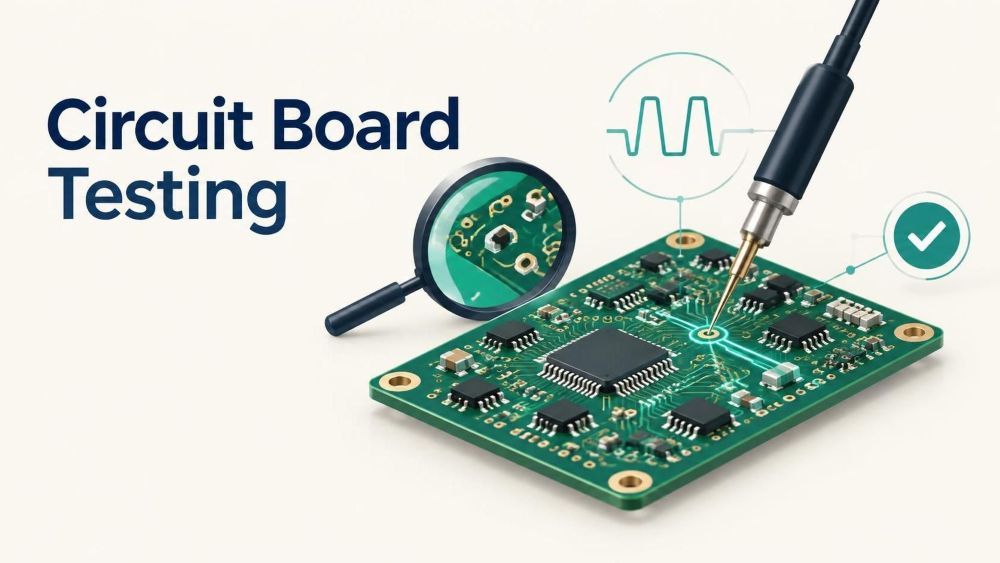
Fig. 1: Bed-of-nails Test (illustration – AI Generated)
Think of a test fixture as a custom docking station for a circuit board. The board drops in, the fixture holds it in exactly the same position every time, and a set of contacts touches the right spots on the board so a tester can measure what’s going on electrically.
A person poking at a board with a handheld probe will miss spots, slip, or press too hard. A fixture touches every required point at once, with the same pressure, thousands of times in a row. Because every board layout is different, engineers build custom test fixtures around the specific placement of pads, connectors, and components on each design.
The most familiar version is the bed-of-nails fixture, a staple of automated circuit board testing. It’s a plate studded with spring-loaded pins, and each pin lines up with a test point on the board. Lower the board onto the pins, apply a little pressure, and the tester gets a connection to the entire circuit in about a second.
Two Questions Every Test Asks
Almost every electronics test boils down to one of two questions. The first is “Was this board built correctly?” That’s what in-circuit testing (ICT) checks. It looks at the structure of the board: are the right parts installed, are they the right values, and are the connections solid? A good ICT result doesn’t just say “fail.” It points to the exact faulty joint, which saves a technician from hunting across the board.
The second question is “Does this board do its job?” That’s functional testing. The fixture powers the board up and makes it behave the way it would inside the finished product. If it’s a motor controller, the test asks whether the motor spins. If it’s a sensor board, the test feeds it a known input and checks the output.
Some chips make the first question harder. Modern processors often hide their connections under the package, where no probe can reach. Engineers handle that with boundary scan, a method standardized as IEEE Std 1149.1 (often called JTAG), which lets the chip’s own pins report whether they’re connected properly.
Why go to this trouble? A large-fleet study posted to arXiv in 2025 found about 5,000 defective parts per million among chips that had passed testing, far above the 100 to 500 per million the industry expects. You can read the details in the arXiv paper on test escapes.
Why Every Board Gets Its Own Fixture
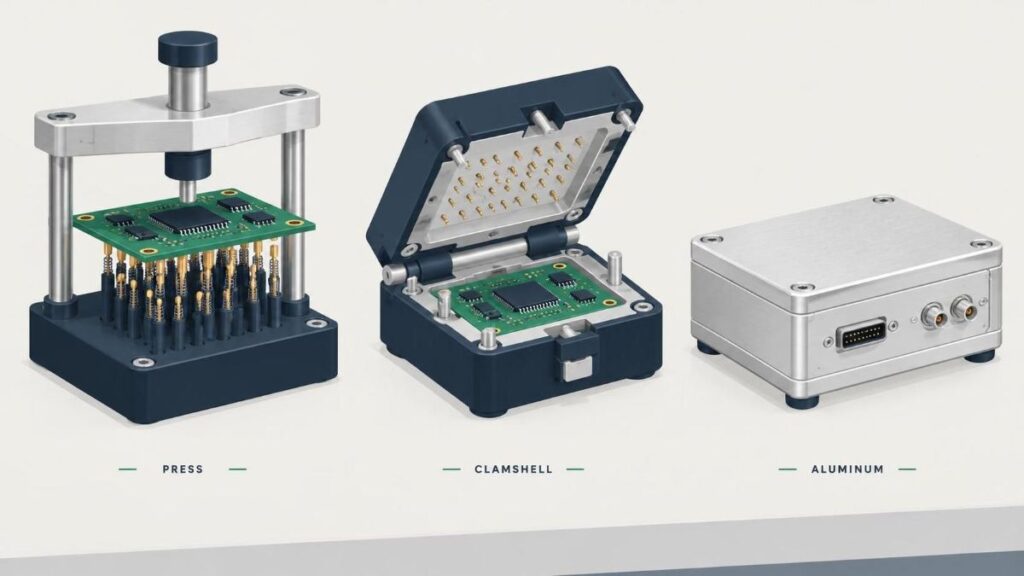
Fig. 2: Different fixture styles side by side on a test lab bench: a bed-of-nails press, an open clamshell, and an aluminum fixture housing (illustration – AI Generated)
If one board needs a fixture shaped to its layout, does a new product mean building a new fixture? Usually, yes. Pin positions have to match test points to within a small fraction of a millimeter, so a fixture built for one design rarely fits another. Building one typically takes a few weeks.
There are several common designs. Bed-of-nails fixtures press pins up into the board from below. Clamshell fixtures close like a waffle iron and contact both sides of the board at once. Modular fixtures swap out just the part that’s board-specific, so the rest can be reused. Vacuum or pneumatic versions pull the board down onto the pins with suction rather than a mechanical press.
The tradeoff is cost versus speed. A fixture takes time and money to build, but once it exists, it tests a board in seconds. The alternative, a flying probe tester, moves tiny probes around the board one point at a time. It needs no custom fixture, so it’s ideal for prototypes and small runs, but each board takes minutes instead of seconds. For a product built in the thousands, the fixture wins easily. That kind of decision, balancing setup effort against throughput, is the daily work of production engineers, and our introduction to how production engineering works walks through the same logic for entire factories.
The Money Math of Catching Mistakes Early
Engineers often use a rough rule of thumb called the “rule of ten”: a defect costs about ten times more to fix at each later stage, from solder paste inspection, to the oven where parts are attached, to functional test, and finally to a customer’s hands. NXP’s engineering blog describes this idea and argues that investing in test is frequently the rational economic choice. It’s a heuristic, not a law of physics, but the direction is hard to argue with. Replacing a $0.02 resistor on the line is cheap. Recalling ten thousand finished devices is not.
You can see the stakes in how much the world spends on checking things. The Test and Measurement Equipment Market Report 2026 from Research and Markets puts the global market at roughly $34.81 billion in 2025 and projects it to reach $45.19 billion by 2030. That money flows toward testing because catching a flaw early is far cheaper than explaining it to angry customers later.
Circuit Board: Where Testing Is Heading
Fixtures are getting smarter. Newer test stations sit directly on the production line, so boards move through them automatically without a person loading each one. Software now logs every measurement, which lets engineers spot a drifting process before it produces bad boards. Fortune Business Insights estimated the automated test equipment market at $5.41 billion in 2025 and expects it to reach $9.72 billion by 2034, growing about 7.10% a year, as outlined in its automated test equipment market analysis.
Artificial intelligence is joining in, too. Pattern-spotting software can flag a slow change in readings long before a test actually fails. By analyzing results across thousands of boards, these systems can help engineers identify recurring problems, spot unusual patterns, and adjust production processes before small defects turn into larger failures.
Careers Behind the Fixture
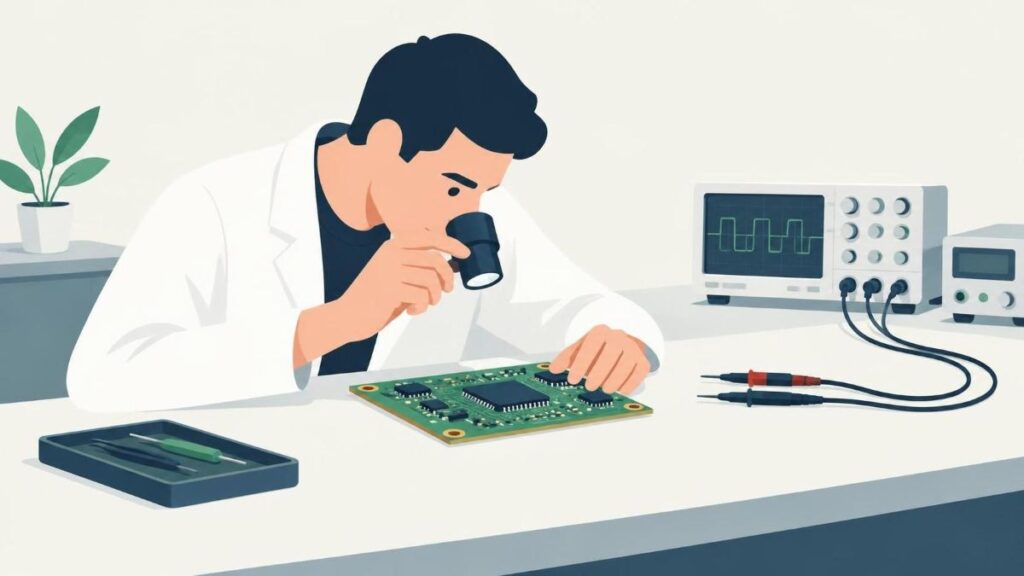
Fig. 3: A test engineer checking a circuit board on a lab bench (illustration: AI Generated)
Behind every custom test fixture is a team that rarely appears in product launch videos. Test engineers decide what a circuit board needs to prove during testing. Mechanical engineers design the plates, pins, and clamps. Firmware engineers write the code that runs the board through its paces. Data analysts dig through the results to find patterns.
If this sounds appealing, the usual paths start with electrical engineering, mechatronics, or production engineering. Build a simple circuit on a breadboard, break it on purpose, and work out how you’d prove it’s fixed. That’s the same mindset, just at a smaller scale.
Built to Be Reliable
Reliable electronics aren’t an accident. Somebody decided what to check, built a tool to check it the same way every time, and measured whether it worked through reliable circuit board testing. The next time a device simply works the moment you switch it on, remember the quiet hardware that made sure of it before the box ever closed.
FAQs: Circuit Board Testing
What is circuit board testing?
Circuit board testing is the process of checking a printed circuit board (PCB) to ensure its components, solder joints, electrical connections, and functions work as expected. Manufacturers use different testing methods to identify defects before the board is installed in a finished product.
What are the main types of circuit board testing?
The main types include in-circuit testing (ICT), functional testing, flying probe testing, and boundary scan testing. Each method checks different aspects of a circuit board, from component placement and electrical connections to overall functionality.
What is a test fixture in circuit board testing?
A test fixture is a custom-built tool that holds a circuit board in a fixed position and connects it to testing equipment through contact pins. It helps engineers perform repeatable electrical checks quickly and accurately. A bed-of-nails fixture is one common example.
What is the difference between in-circuit testing and functional testing?
In-circuit testing checks individual components, their values, and electrical connections to identify manufacturing defects. Functional testing checks whether the assembled circuit board performs its intended job under specified conditions. Manufacturers often use both methods to assess board quality.
Why is circuit board testing important in electronics manufacturing?
Circuit board testing helps manufacturers detect defects before products reach customers. Identifying problems early can reduce repair costs, production delays, product failures, and warranty claims. It also improves product reliability and helps maintain consistent manufacturing quality.
Deven Nandapurkar is a Software Engineer, Project Lead; working at the strategic intersection of software engineering, productivity science, and emerging technologies. Driven by a core philosophy of "building things worth building," he leads cross-functional teams and drives end-to-end technical strategy—from early-stage conceptualization through production-grade deployment.
A Computer Engineering graduate from Pune University, Deven brings a sharp systems-thinking approach to technical leadership, honed by years of managing high-stakes engineering projects and leading teams to top placements in national and international hackathons, including the NASA Space Apps Challenge and the Peerlist GenAI Hackathon.
Deven explores how human cognition and emerging technology converge. He regularly writes about cognitive performance optimization, attention management, AI integration, and the evolving dynamics of the modern workforce - offering actionable frameworks for professionals seeking to maximize their productivity and thrive alongside intelligent systems.
Divyesh R. Sawant is an Electronics and Telecommunication Engineer, tech communicator, and creative media strategist. His technical focus spans the intersection of hardware-software integration, modern telecommunication systems, embedded programming, and consumer technology trends.
Demonstrating a strong dual capability in engineering and technical media, Divyesh serves as the Editor-in-Chief at Tech Talk 360, where he leads content strategy covering emerging technology and digital innovation. Additionally, he manages visual media and digital storytelling as a Video Editor for TEDxMMCOE, translating complex ideas into engaging visual narratives for broader audiences.
As a contributor to ENTECH Magazine, Divyesh writes on consumer technology evolution, telecommunication systems, signal processing applications, and the real-world impact of next-generation hardware.