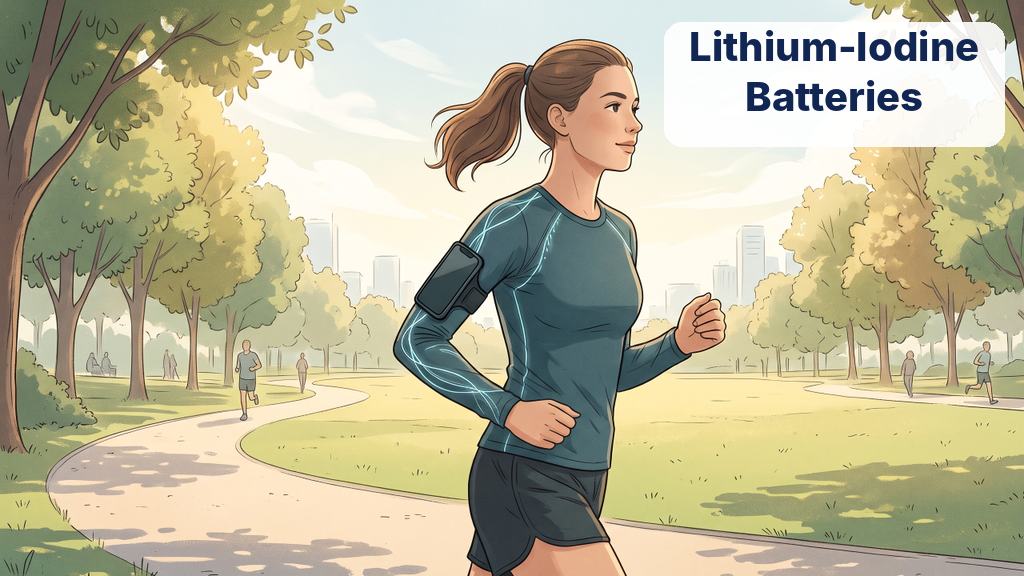
Smartwatches, fitness bands and smart clothing all need batteries that can bend. In particular, iodine is a cheap, plentiful element suited to flexible power sources. However, today’s lithium-iodine batteries use only half of what iodine could store. Now a Nanyang Technological University team in Singapore reports a simple fix. They added one small organic molecule, called phthalimide, to the battery liquid. As a result, each iodine atom can trade four electrons instead of two. The work appeared on November 11, 2026, in the open-access journal Nature Communications. Afterwards, its bendable cells powered an armband phone charger and sensor-filled sportswear. So how does one molecule free up the extra electrons?
Most phones and cars run on lithium-ion batteries with layered metal-oxide cathodes. According to the authors, these cells near a ceiling of 300 watt-hours per kilogram. For that reason, chemists are exploring cathodes that store charge through chemical conversion instead. Lithium-iodine batteries are one such option, already used in medical implants and sensors. In a standard cell, iodine swaps between iodide and iodine, moving two electrons. As a result, that reaction gives about 211 milliampere-hours per gram of iodine. In theory, a further step to positively charged iodine could double this capacity. Even so, that extra step has proved very hard to control in practice.
Explainer: Four-Electron Iodine Chemistry
A battery stores energy by moving electrons between two electrodes during each cycle. The more electrons each atom can move, the more charge a gram can hold. Normally, iodine shifts from minus one to zero, giving two electrons. In four-electron iodine chemistry, iodine continues from zero to a positive ion. On paper, this therefore raises capacity to 422 milliampere-hours per gram of iodine. Energy per kilogram of iodine then climbs to about 1,324 watt-hours. However, the positive iodine ion is extremely reactive and falls apart easily. Meanwhile, dissolved iodine drifts to the lithium side, a problem called shuttling.
One Molecule That Switches Sides
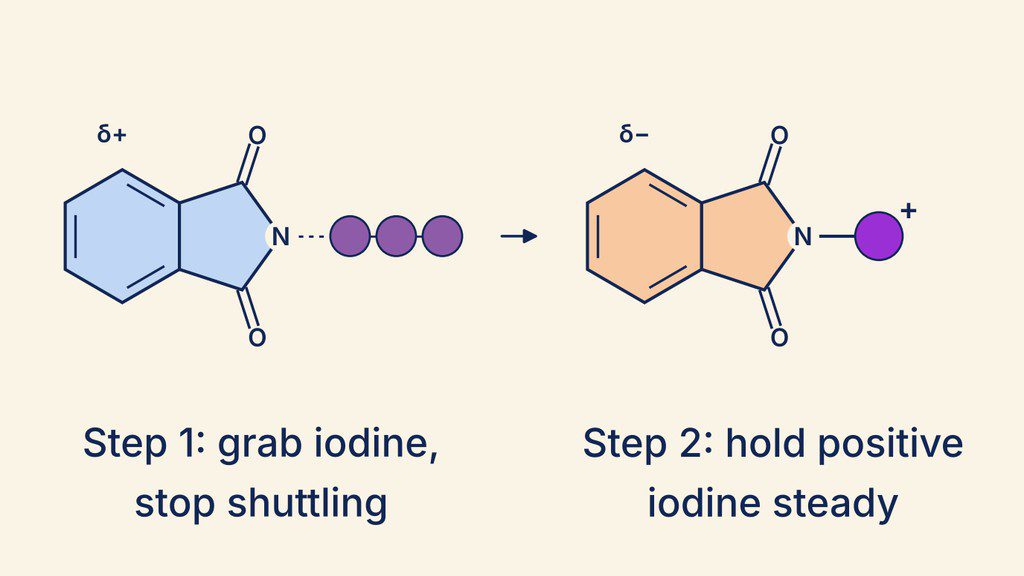
To tackle all three problems, the team chose phthalimide, a white powder. In essence, its molecule joins a benzene ring to a ring with two carbon-oxygen groups. Notably, electrons can spread easily across this backbone, so it tolerates gaining or losing charge. During charging, phthalimide first becomes electron-poor and grabs iodine and polyiodide species. This grip slows shuttling and also pushes iodine towards its positive form. Then the same molecule becomes electron-rich and holds on to the fragile positive iodine. In other words, one additive switches its polarity to suit each reaction stage. Spectroscopy and computer calculations supported this view, though the authors call it their interpretation.
Fig. 1: One Molecule Switches Its Charge to Guide Each Reaction Step
Two Jobs, One Additive
Without the additive, voltage scans showed only one clear reaction, the usual two-electron step. With phthalimide, by contrast, two distinct pairs of peaks appeared during charging and discharging. In effect, that second pair is the signature of the extra iodine reaction. The team also compared phthalimide with chloride, an additive already known to help. In this case, phthalimide let lithium ions move faster through the iodine reactions. Similarly, it cut the energy barrier for charge transfer to 5.50 kilojoules per mole. With chloride instead, that barrier stood at 11.96 kilojoules per mole. Taken together, these tests suggest phthalimide speeds the slow extra step more effectively.
Testing a Flexible Iodine Battery
Next, the researchers built thin, flexible pouch cells for real-world testing. The cathode was carbon nanotube cloth holding up to about 64% iodine by weight. Its anode was a thin strip of lithium metal on copper foil. To begin with, each cell delivered 398.1 milliampere-hours per gram of iodine. That equals about 1,200 watt-hours per kilogram of iodine. After 1,000 cycles, the cell still kept 92.5% of its capacity. By comparison, cells without the additive kept only 55.2% after 800 cycles. At faster charging rates, capacity faded by just 0.007% per cycle over 5,000 cycles. A larger high-loading cell reached 113 milliampere-hours and kept 97.8% after 500 cycles. This makes it a promising flexible iodine battery for clothing.
Fig. 2: Bendable Cells Charged a Phone and Ran Motion Sensors
Cold, Heat and Bending
Wearable power must survive bending, winter walks and hot pockets. For instance, a 3-by-15-centimetre pouch cell was bent up to 360 degrees. At the same time, its capacity stayed stable at every angle, flat to rolled. Even after 1,000 bending cycles, it retained about 97.6% of its capacity. At 0 °C, the cells still delivered 83.9% of their room-temperature capacity. Even at −20 °C, they managed 75.4%, although the extra iodine step slowed down. On the other hand, warmth helped, giving slightly more capacity at 40 and 60 °C. Moreover, the cells ran for more than 100 cycles at 60 °C without obvious fading.
Fiber Batteries in Workout Clothing
The team also wound iodine-loaded nanotube fibers around thin aluminium wire. These fiber batteries kept 88.1% of their capacity after 1,000 cycles. Even after 10,000 bends, they still retained about 95% of their capacity. In addition, a half-metre fiber battery powered a fiber light even when twisted. For the first demo, three pouch cells were joined in a sports armband. Together, they wirelessly charged a smartphone in a 30-minute test. After that, fiber batteries and motion sensors were sewn into workout clothing. The system tracked elbow bending and walking, running steadily for 800 seconds. Our story on stretchy strain sensors for clothing shows a related idea.
Reading the Big Numbers Carefully
Note that the headline numbers are measured per kilogram of iodine alone. In other words, they leave out the lithium, electrolyte and packaging a cell needs. At the cathode level, the high-loading cell reached 883.4 watt-hours per kilogram. Across the whole cell, however, the figure fell to about 91.5 watt-hours per kilogram. That is less than a third of today’s best lithium-ion cells. For this reason, these lithium-iodine batteries will not replace phone or car batteries soon. Instead, their strengths are flexibility, long cycle life and cheap iodine. Those strengths suit small wearables, where bending matters more than maximum energy.
Business Opportunities in Wearable Batteries
In the near term, researchers can test switching additives in other halogen cells. The authors suggest the idea may become a general strategy for multi-electron halogen chemistry. Within five years, bendable lithium-iodine batteries could be piloted in smart textiles and armbands. Medical wearables that need long cycle life could also benefit. At the same time, makers of carbon nanotube cloth and fibers may find new customers. In the long run, cheap iodine cathodes could support a new class of wearable batteries. Consequently, that would create jobs in flexible-cell design, textile integration and testing. Of course, cell-level energy and lithium metal safety must improve first.
Careers and What to Study
Lithium-iodine batteries need chemists, engineers and designers working together. For example, battery chemists design additives such as phthalimide and test how they behave. Electrochemical engineers, in turn, build pouch and fiber cells and measure their lifetimes. Meanwhile, wearable-electronics engineers fit batteries, sensors and wireless chargers into clothing. Textile engineers, likewise, learn to weave power and sensors into everyday fabrics. According to the US Bureau of Labor Statistics, chemists earned a median $91,240. That was in May 2025, when electrical and electronics engineers earned a median $125,040. Of course, these are US figures, and pay differs between countries. For study, consider chemistry, materials science, electrical engineering or textile engineering.
Limits Worth Keeping in Mind
Note that these are laboratory cells, not commercial products. In addition, the cells use lithium metal anodes, which bring safety challenges. Our article on a separator that helps lithium metal cells charge faster explains why. Moreover, the fiber cells reached only about 92% charge efficiency, so some shuttling remains. The authors say longer studies are needed on the additive’s stability over time. They also want tests with heavier iodine loading and over 10,000 bends. Even so, one switching molecule tackling three problems is a clever chemistry idea. In the long run, lithium-iodine batteries could quietly power the clothes we wear.
The article explains four-electron iodine chemistry, shuttling and the polarity-switching additive in clear, student-friendly terms. Its figures match the paper, including 398.1 mAh per gram of iodine, 92.5% retention after 1,000 cycles and 75.4% capacity at -20 °C. It clearly separates per-iodine energy from the 91.5 Wh/kg full-cell figure and notes the lithium metal anode. Readers who want the full experiments should check the original research paper this story draws on.
Editorial note
ENTECH is running this Discovery because wearables and smart clothing need batteries that bend, last many cycles and use affordable materials. This paper shows how one switching molecule makes iodine store twice as much charge. It connects chemistry and materials science with consumer electronics and textile design. The per-iodine numbers are impressive, but the whole cell reaches only about 91.5 Wh/kg, uses a lithium metal anode and is lab-scale. For the full methods and data, we suggest readers turn to the original open-access paper.
Ojas Joshi is an industrial project manager, young entrepreneur, and manufacturing process specialist. He holds a B.Tech in Production Engineering from Vishwakarma Institute of Technology (VIT Pune) and an M.Tech in Project Management from COEP Technological University, secured after achieving an All India Rank of 409 in the GATE examination.
Ojas brings diverse hands-on experience across heavy machinery and medical device manufacturing. He previously served as Process Quality Lead for the excavator production line at JCB India Ltd and completed a specialized project management residency in the MedTech division at Philips Healthcare India. His expertise spans Product Lifecycle Management (PLM), process integration, supply chain optimization, Enterprise Resource Planning (ERP) systems, and operations research.
As an author for ENTECH Magazine, Ojas shares insightful, practical analyses on modern industrial engineering, medical device manufacturing, supply chain dynamics, and data-driven project management strategies.