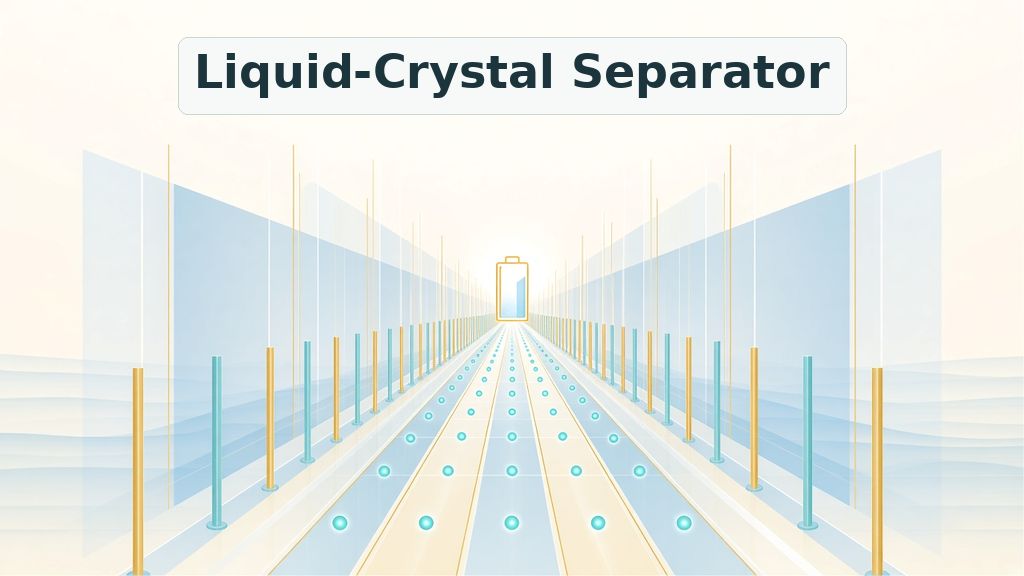
Most people blame slow charging on the charger or the battery chemistry. That view is incomplete. Inside every lithium battery sits a thin film that rarely gets credit. This film, the separator, keeps the two electrodes apart while ions pass through it. Now KAIST chemists argue that the film’s inner layout also deserves attention. Professors Dong Ki Yoon and Hye Ryung Byon led the joint team in Daejeon. Together they built a liquid-crystal separator whose molecules stand up in neat rows. As a result, lithium ions travel through straight channels instead of twisting tunnels. In a lithium metal test cell, the design kept 94 percent of its capacity. That result held after 100 cycles at a demanding fast-charge rate. KAIST announced the work on November 9, 2026, in its official newsroom. The paper itself appeared in the journal ACS Nano in September 2026.
Why A Liquid-Crystal Separator Matters For Fast Charging
Fast charging is the promise every electric car buyer hears, yet physics pushes back. Today, charging times range from under 20 minutes to 20 hours or more. The Alternative Fuels Data Center shows that spread in its EV charging guide. In addition, the Department of Energy (DOE) wants charge times of 15 minutes or less. Its vehicle battery research goals pair that target with longer range and lower cost. Lithium metal batteries could help because they store more energy than standard lithium-ion cells. In other words, the same weight could carry a car farther. Their negative electrode is a sheet of lithium metal rather than graphite. On the other hand, that metal behaves badly when charging speeds up. Our guide to how factories build lithium-ion batteries shows where each layer sits.
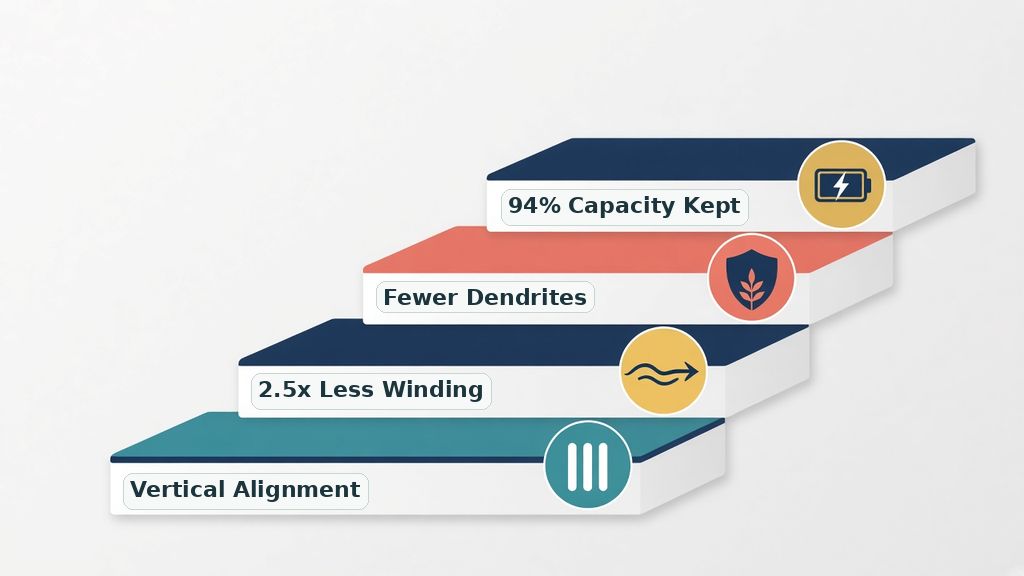
Fig. 1: Key Takeaways From The Aligned Separator Test
Challenges A Fast-Charging Battery Separator Must Solve
During charging, lithium ions leave the positive side and settle onto the lithium metal. Ideally, they would then spread out in an even, smooth coat. However, lithium often piles up in a few spots instead. Those spots grow sharp, branch-like spikes called dendrites. Dendrites shorten battery life, and they can also damage the separator itself. As a result of this, the electrodes can touch and cause an internal short circuit. KAIST warns that such damage can even lead to fires. Moreover, KAIST says fast charging makes this uneven buildup a bigger threat. The route through the separator plays a key role here. If the path twists and turns, ions must detour and can bunch up in places. For this reason, the KAIST team asked a sharper question. Could a straighter route deliver ions evenly, even during rushed charging? Our article on electric vehicle battery safety explains why shorts matter.
How An Aligned Battery Separator Guides Lithium Ions
Think of the separator as a crowded city between two train stations. Ions must cross it so they can carry charge between the electrodes. Typical films connect their pores like winding back alleys. In contrast, a well-designed film would act like a straight expressway. Scientists describe this winding with a number called tortuosity. In other words, it compares the real path length with the film’s straight thickness. A perfectly straight channel has the lowest possible tortuosity. Higher values mean longer, twistier trips and more chances for ions to pile up. The KAIST team tackled this by controlling how molecules line up inside the film. To begin with, they needed a material whose molecules follow orders. That material is a liquid crystal, a substance family also used in display screens.
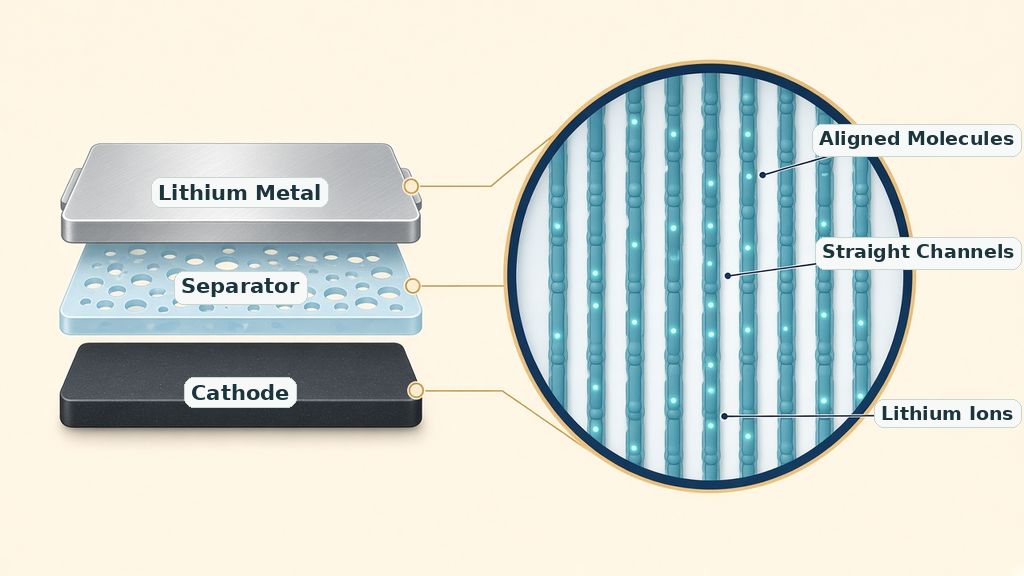
Fig. 2: How Upright Molecules Open Straight Ion Channels
Liquid Crystals Put Molecules In Order
Liquid crystals sit between two familiar states of matter. Their molecules, on the one hand, line up in regular patterns like a solid. On the other hand, they can still flow like a liquid. Surface treatment and similar methods can also change their alignment. For this reason, the KAIST chemists could set the direction of their molecules. First, they made a liquid-crystalline polymer film riddled with pores only nanometers wide. A nanometer is a billionth of a meter, so each pore is extremely tiny. Next, they attached chains of polyethylene glycol, or PEG, to the molecules. According to KAIST, these chains help lithium ions move through the film. Finally, the team made the molecules either stand vertically or lie horizontally. In other words, they built two films that differ mainly in molecular direction.
Vertical Versus Horizontal Channels
The side-by-side comparison delivered a clear and striking verdict. In the vertical film, the molecules then formed channels pointing straight at the electrode. KAIST compares this change to turning tangled back alleys into an orderly road. As a result, the ion path’s tortuosity dropped about 2.5 times versus the horizontal film. Lithium ions therefore moved faster and spread more evenly across the metal. At the same time, the film effectively suppressed dendrite formation and improved stability. The team also compared ionic conductivity, porosity and activation energy across both layouts. However, KAIST’s public release does not list those detailed figures. For this reason, this story reports only the numbers in that release. Even so, the core lesson is plain. The direction molecules face matters, not just the molecules themselves.
Testing The Liquid-Crystal Separator Under 4C Charging
A clever film means little until it survives a real battery test. So the researchers placed the vertical liquid-crystal separator inside a real lithium metal battery. Then they charged and discharged it at a rate called 4C. Specifically, the C-rate describes how fast a battery fills compared with its rated capacity. At 1C, a full charge takes about one hour in theory. In the same way, 2C means about 30 minutes, and 4C means about 15 minutes. At the same time, that 15-minute figure matches the DOE charging goal. However, KAIST adds an honest warning about that number. Real charging time depends on battery properties and the charging method. In other words, 4C describes a test condition, not a promise for your phone. Our story on plain-foil LMFP cells also shows another route to shorter stops.
What 94 Percent After 100 Cycles Means
After 100 cycles at 4C, the battery kept 94 percent of its starting capacity. Picture a water bottle that still holds 94 percent after 100 rushed refills. That retention matters because fast charging usually drives the buildup that degrades batteries. Not only did the film survive the test, but it also limited that damage. KAIST says the result shows molecular alignment can reduce fast-charge performance loss. Still, 100 cycles is an early checkpoint, not a full battery lifetime. Yet a phone charged daily can pass hundreds of cycles in a single year. In addition, the release does not report tests in large commercial cells. For this reason, readers should treat the 94 percent figure as proof of concept. Even so, a clear result at such a demanding rate earns serious attention.
What Comes Next For Fast-Charging Lithium Metal Batteries
KAIST sees a bigger idea behind this single film. According to the release, designers should care about molecular direction, not just materials. Professor Dong Ki Yoon said the method can “efficiently design lithium-ion transport pathways” inside batteries. In addition, he said it can help “improve battery performance and stability” too. Next, he said he expects it to support “high-energy-density next-generation battery technologies”. For such batteries, he noted, “long driving ranges and rapid charging” are essential. These quotes are KAIST’s own translation, from its official English release. So if engineers can make such films at scale, the payoff could reach everyday life. For example, KAIST points to longer-lasting electronics and electric vehicles that drive farther. Doctoral student Geunjung Lee and Rak Hyeon Choi, who holds a doctorate, were co-first authors. Byon and Yoon, meanwhile, acted as co-corresponding authors. The official KAIST news release lists the full team and funding.
Limits The Release Leaves Open
A skeptical reader should ask what the release does not show. First, it reports 100 cycles, while commercial batteries must last far longer. Second, it also gives no results for large cells, battery packs or real cars. Third, it does not report cost, manufacturing speed or film strength. Those factors decide whether a liquid-crystal separator ever leaves the lab. In addition, the public release leaves out the full data. As a result, most students cannot check every number for themselves. Larger cells and longer tests would settle many of these questions. Meanwhile, other teams attack dendrites from different angles. For example, safer solid-state battery research swaps flammable liquid electrolytes for solid materials. In contrast, KAIST keeps a porous film and simply rearranges its interior. Overall, both approaches deserve data-driven scrutiny as they mature.
Careers In Battery Materials
This research shows how many skills a single battery layer demands. To begin with, battery materials scientists design new molecules and test how ions move. Polymer chemists build chains such as PEG and attach them to larger structures. In the same way, liquid-crystal researchers learn to steer molecular alignment with surface treatments. Film process engineers then face the hardest question of all. Can a precise lab film become kilometers of uniform roll? Next, battery test engineers run cells through many charge cycles and spot early failures. Safety engineers, meanwhile, study shorts and fires and design ways to prevent them. As a result, students who enjoy chemistry, physics and math have many paths. A degree in chemistry, materials science or chemical engineering opens the door. In addition, electrochemistry courses add the battery knowledge each role needs.
Conclusion: Why A Lithium Metal Battery Separator Deserves Attention
Fast charging will not improve through bigger chargers alone. Instead, this study shows the humble separator deserves a seat at the design table. By standing liquid-crystal molecules upright, KAIST turned twisting pores into straight channels. As a result, the ion path’s tortuosity fell about 2.5 times. The film also suppressed dendrites, and a cell kept 94 percent after 100 cycles. Not only does this liquid-crystal separator challenge old habits, but it also raises questions. Can the film survive thousands of cycles? Will factories make it cheaply and uniformly? Until those answers arrive, treat the result as a strong first step. Even so, the message for future engineers is clear. Inside a battery, the direction of every molecule may shape how fast a car charges.
Lee, G., Choi, R. H., Park, G., Kim, J., Kim, Y., Byon, H. R., & Yoon, D. K. (2026). Directional Li+ flux control via liquid-crystalline polymer separators for fast-charging lithium metal batteries. ACS Nano.
This article gives students a sharp, skeptical look at a battery part most readers never think about. A brief sketch of where the separator sits between the electrodes, early in the piece, would help first-time readers. Future coverage could follow whether aligned films hold up in larger cells and much longer charging tests. Readers who want more detail can start with the official KAIST release, which names the underlying ACS Nano paper.
Editorial note
Faster charging usually gets credited to chargers and electrodes, so a story about the thin film between them stood out. ENTECH picked it because KAIST explains, in plain terms, how lining up molecules straightens the road for lithium ions. The result comes from a test cell over a limited number of cycles, and the release leaves cost and large-scale production open. The full study appears in ACS Nano, and KAIST’s official English and Korean releases offer a clear summary for readers who want the original account.
Shreyas Kulkarni is a Chartered Electrical Engineer and renewable energy pioneer with over eight years of hands-on experience in the clean energy sector. He is the Co-Founder of UNICUS Energy, a leading provider of solar energy solutions in India, where he drives technical execution, system architecture, and clean tech deployment.
As an author for ENTECH Magazine, Shreyas focuses on making solar technology practical and understandable for students, engineers, and homeowners. His contributions include detailed guides on the inner workings of rooftop solar systems and deep dives into modern hardware advancements, such as lightweight solar panels and flexible photovoltaic materials.