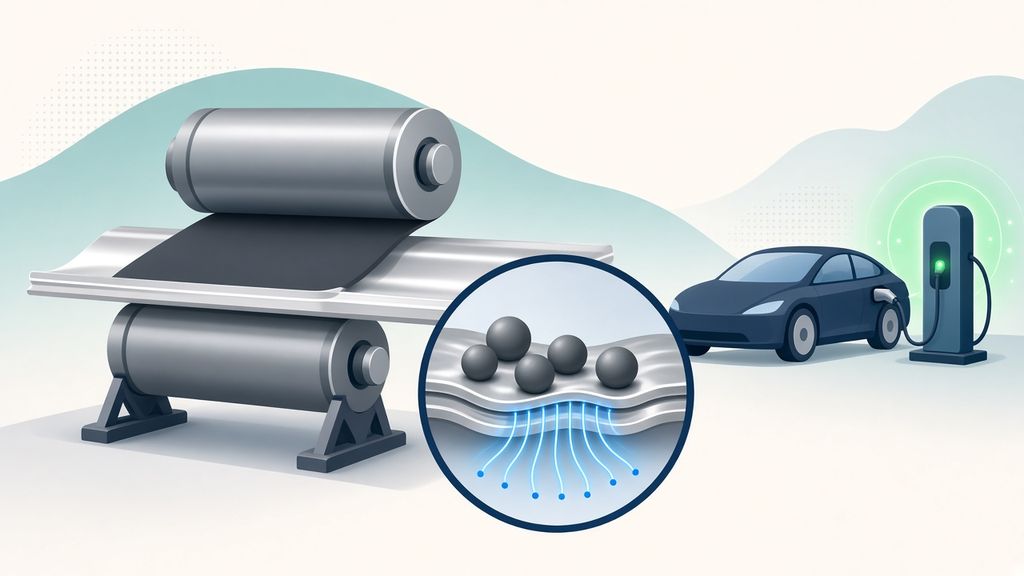
A phone can refill during a short coffee break. Electric cars, however, still need longer stops at public chargers. Now, a UK team shows that fast-charging LMFP batteries need one less costly part. LMFP stands for lithium manganese iron phosphate, a low-cost cathode material. Usually, makers coat the cathode’s aluminum foil with carbon to help electrons flow. In this study, however, pressing the electrode harder made that coating unnecessary. As a result, plain-foil test cells charged from 10% to 80% in about 16 minutes. Rebecca Sellers, Louis Piper and Gerard Bree led the work at WMG, University of Warwick. Partners included the Faraday Institution, the Imperial spin-out Polaron and Imperial College London. The journal Advanced Science published the study (DOI: 10.1002/advs.78510).
In a lithium-ion cell, the cathode largely sets both cost and energy. LMFP adds manganese to lithium iron phosphate, the chemistry engineers call LFP. As a result, the cell gains an extra voltage step near 4.1 volts. That step stores more energy than plain LFP while keeping its stability. LMFP also avoids nickel and cobalt, two costly and scarce metals. According to the Warwick study, this mix balances cost, lifetime and sustainability. On the other hand, LMFP carries a stubborn weakness. Both electrons and lithium ions move through it slowly. For this reason, suppliers grind LMFP into tiny particles and wrap each one in carbon. In particular, the team tested LiMn0.6Fe0.4PO4, where manganese fills 60% of the metal sites. Phosphate cathodes also offer thermal stability, as our battery safety in electric vehicles guide explains. So, LMFP looks ideal for affordable cars, if it can charge quickly.
The Knowledge Gap in Electrode Design
First, factories spread a cathode paste onto thin aluminum foil and dry it. Next, heated steel rollers squeeze the coating flat in a step named calendering. This squeeze sets the electrode density, measured in grams per cubic centimeter. In other words, higher density packs more energy into the same space. Yet LMFP studies usually stop between 1.8 and 2.2 g/cm³. In contrast, industrial LFP electrodes reach up to 2.7 g/cm³. Tiny carbon-coated LMFP particles resist packing, so researchers rarely push them harder. At the same time, few studies had tracked how pressing changes the foil contact. According to the authors, this link between densification and interface resistance remained poorly understood. Reports comparing LMFP on plain and carbon-coated foil were also rare. Because of this gap, makers kept paying for coatings that might not help. For that reason, the Warwick paper set out to test that habit directly.
Challenges and Motivation Behind the Research
Carbon-coated foil carries a primer layer about one micrometer thick. In this study, for example, the carbon black layer reached about 1.4 micrometers. That primer lowers the electrical resistance where cathode paste meets metal. However, it adds dead mass and volume that store no energy. In addition, it adds an extra coating step to the supply chain. The authors list coated foils at roughly six times the price of plain foil. Those figures come from small lab orders, so factory prices may differ. Meanwhile, the industry keeps thinning its foils to save weight. Aluminum foil thickness fell by 44% between 1999 and 2021. As a result, a thick primer works against that trend. Likewise, the U.S. Department of Energy targets lower battery cost, volume and weight. Given these points, the team asked a simple question. Could harder pressing alone match the benefit of the carbon coating?
Key Findings on Fast-Charging LMFP Cells
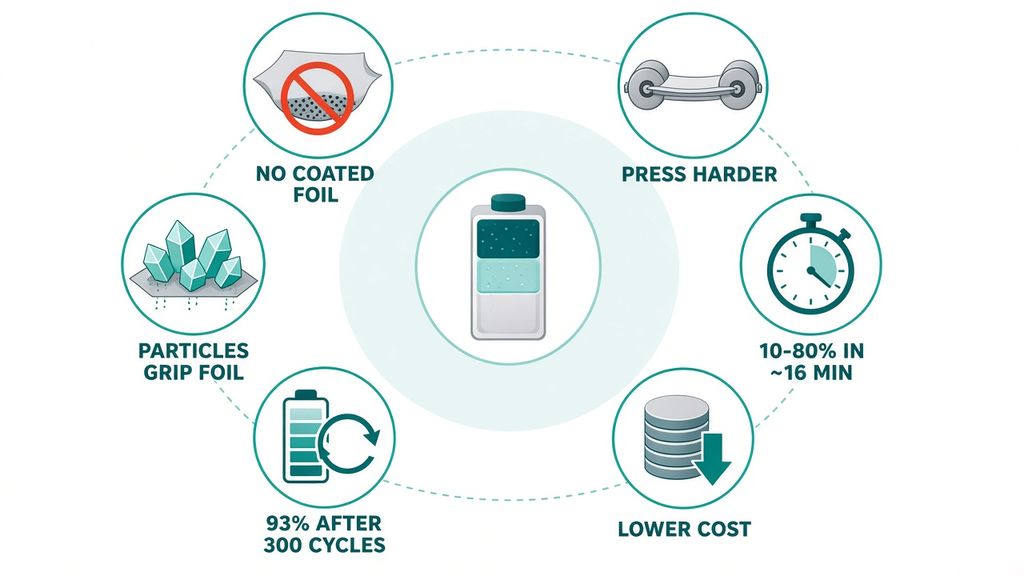
To begin with, the researchers built thick electrodes with 93% active material. Each layer, in fact, weighed 13.5 milligrams per square centimeter. Then they pressed electrodes to densities from 1.95 to 2.75 g/cm³. Over that range, empty pore space dropped from 42% to 18%. Graphite anodes completed coin-sized full cells, with three cells for each condition. At a gentle C/3 rate, every cell delivered about 140 mAh/g. Differences appeared as soon as cycling sped up. At 1.95 g/cm³, plain-foil cells gave almost no capacity at a 2C rate. In contrast, coated-foil cells at that density still delivered 85 mAh/g at 5C. By 2.50 g/cm³, however, the gap had vanished. Plain foil gave 66 mAh/g at 5C, while coated foil gave 64 mAh/g. According to the study, that small difference was not statistically significant. In short, dense electrodes no longer needed the primer.
Fig. 1: Key Takeaways from the Warwick LMFP Study
Particles That Grip Plain Aluminum
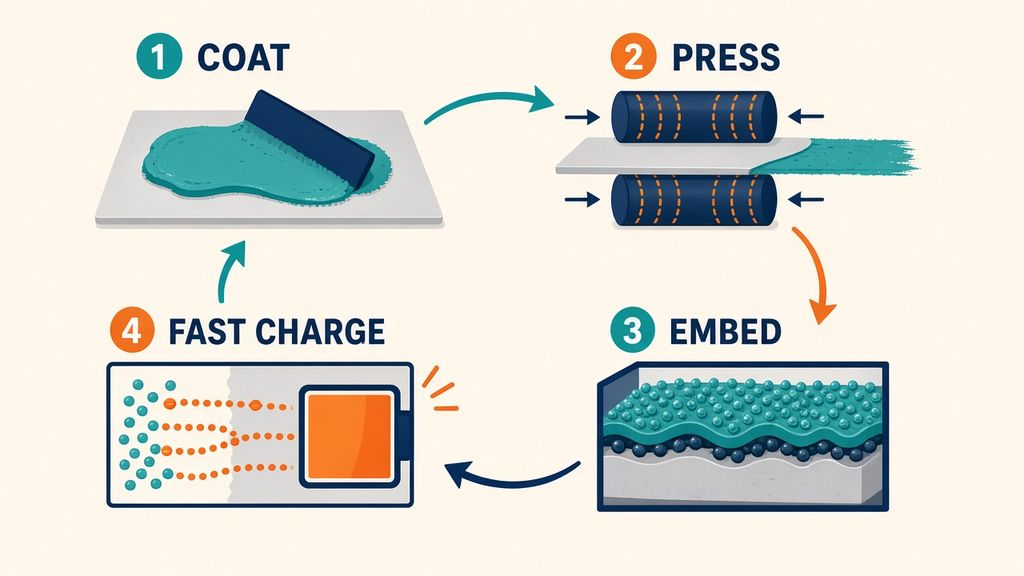
Why did pressure help so much? Electrical tests on the electrodes held part of the answer. On plain foil, interface resistance fell from 10.4 to 0.21 ohm square centimeters. That drop occurred as density rose from 2.15 to 2.7 g/cm³. By comparison, coated foil stayed below 0.2 ohm square centimeters at every density. Next, the team cut cross-sections and studied them with electron microscopes. Image analysis, in turn, revealed LMFP particles pressed into the soft aluminum surface.
The share of foil contact holding embedded particles climbed from 28% to 83%. Those dents stayed shallow, under 100 nanometers deep in 15-micrometer foil. In other words, such tiny pits pose no threat to the foil. Small single crystals made this possible, unlike porous clusters that crush inward. Each embedded particle acts like a nail, creating a direct electrical bridge. As a result, density did the primer’s job in fast-charging LMFP batteries. Full details appear in the open-access paper.
LMFP Fast Charging in About 16 Minutes
Real drivers care about charge time, not test labels. So, the team used a fast-charge, slow-discharge test aligned with ISO 12906. Cells charged at C/3 up to 10C, then discharged gently at C/3. In practice, this mirrors an EV that charges fast and then drives steadily. The best plain-foil cell used 2.70 g/cm³ electrodes. Even after a 10C charge, it delivered 100 mAh/g. At 5C, the same cell moved from 10% to 80% charge in about 16 minutes. By comparison, the industry goal sits below 15 minutes. For comparison, the authors cite a Tesla Model 3 LFP pack at 24 minutes. An Audi e-tron GT, in turn, needs about 16 minutes on public data. Still, very fast charging carried risks for these cells. At 10C, metallic lithium coated the graphite anode, a problem called plating. The paper treats plating as a key limit for LMFP fast charging.
Denser Electrodes Lasted Longer
Long life matters as much as speed. First, the team cycled plain-foil cells 300 times at C/3. Over that test, the 1.95 g/cm³ cell lost 61% of its capacity. In contrast, the 2.75 g/cm³ cell lost only 7%, starting from 138 mAh/g. Afterward, a slow C/20 test restored the weak cell to 135 mAh/g. That recovery shows the lithium had not disappeared. Instead, poor contact had slowed charge transfer at the foil. Impedance tests confirmed this picture, since interface resistance grew most in loose electrodes. On the other hand, coated-foil cells behaved differently. Their lifetimes barely changed with density, even without any calendering. Taken together, these results point to contact resistance, not chemistry, as the main threat. For battery makers, the lesson is clear. In these tests, dense LMFP on plain foil lasted as long as coated designs. The full cycling data sit in the published article.
Explainer: The Science of LMFP Fast Charging
Fig. 2: How Dense LMFP Electrodes Grip Plain Foil
Foil, Density and C-Rates in Plain Words
For example, think of a cathode as a sponge glued onto a metal sheet. The sponge holds lithium, while the sheet, or current collector, carries electrons. A plastic glue called PVDF holds the sponge together, as our binders explainer describes. Calendering then squeezes the sponge thinner, much like rolling dough. In this study, electrodes shrank from about 75 to 50 micrometers thick. A denser sponge stores more energy per liter, yet it leaves fewer pores. Ions travel through those pores, so too much squeezing slows them. The team found that balance near 2.50 g/cm³ at the fastest discharge rate. C-rates, in contrast, describe charging speed. A 1C rate fills a battery in one hour, while 5C takes 12 minutes. Our guide on how factories build lithium-ion batteries shows where calendering fits in production. The study adds one rule: press LMFP harder, and plain foil works.
Conclusion: Business, Careers and Next Steps
For business, dropping coated foil removes one material and one processing step. Higher density also lifts energy per liter, which matters for compact electric car packs. Therefore, firms that build high-pressure calenders for wide rolls may see new demand. At the same time, powder makers could offer dense single crystals and mixed sizes. Image-analysis companies, such as partner company Polaron, also gain a role in tuning electrodes. As a result, these openings create jobs for battery process engineers, electrochemists and materials scientists.
Data scientists who read microscope images will find work too. Students who enjoy chemistry and physics should consider materials science or chemical engineering. Coding skills add value, because modern labs pair experiments with image analysis. The U.S. Bureau of Labor Statistics profiles materials engineers, a common path into this field. In addition, internships at battery pilot lines offer hands-on experience with calendering and testing. Look for degree modules on electrochemistry and energy storage as well.
Limits and the Road Ahead
This work comes from coin cells, not full car batteries. Lithium plating at 10C still limits charging speed. Very dense electrodes can also turn brittle. In that case, they may crack when wound into cylindrical cells. Notably, the team reached top densities only on strips under 2 centimeters wide. Factory rollers would therefore need far higher pressure across wide sheets. The study also left pack-level heat and charger limits for future work. Next, the authors suggest testing LMFP with more manganese and bimodal particle sizes. Other cathodes, such as NMC, may respond differently because their particles differ in hardness. Even so, the core message holds. Smart electrode design can replace a costly coated foil in fast-charging LMFP batteries. Readers can find the full results in Advanced Science. With cheaper cells and quicker stops, affordable electric cars move a step closer for everyone.
References
Sellers, R., Proprentner, D., Dahari, A., Kench, S., Paez-Fajardo, G., Piper, L., & Bree, G. (2026). Battery electrode engineering enables fast charging LMFP cells without carbon-coated foil. Advanced Science. Advance online publication. https://doi.org/10.1002/advs.78510
The study is careful about evidence: it pairs resistance tests with X-ray imaging and modeling, uses three coin cells per condition, and says when a difference is not statistically significant. The article reports the paper's numbers accurately. Readers should know that the 16-minute charge comes from small LMFP-graphite coin cells, and the densest electrodes could only be pressed as strips under 2 cm wide, which leaves brittleness and winding questions for factory rolls. At 10C, lithium plating appeared and the 2.70 g/cm³ cell did not fully recover. The cost advantage rests on lab-scale online prices, and no pack-level heat or charger study was done. Fixes: drop "Imperial spin-out" for Polaron, which the paper lists only as a London company, and soften "Costly" in the headline.
Shreyas Kulkarni is a Chartered Electrical Engineer and renewable energy pioneer with over eight years of hands-on experience in the clean energy sector. He is the Co-Founder of UNICUS Energy, a leading provider of solar energy solutions in India, where he drives technical execution, system architecture, and clean tech deployment.
As an author for ENTECH Magazine, Shreyas focuses on making solar technology practical and understandable for students, engineers, and homeowners. His contributions include detailed guides on the inner workings of rooftop solar systems and deep dives into modern hardware advancements, such as lightweight solar panels and flexible photovoltaic materials.
I am an inspirational writer and emerging science blogger with a deep-rooted passion for understanding and sharing the wonders of the world around us. My journey began with a Bachelor of Science in Chemistry from AKI’s Poona College of Arts, Commerce and Science, where I developed not only a strong foundation in scientific principles but also a mindset that values curiosity, observation, and critical thinking. Studying chemistry has taught me to approach problems with logic, to look beyond the obvious, and to see patterns where others might only see complexity. These experiences have shaped the way I perceive life and influence the way I express my thoughts, both scientifically and creatively.
I have always believed that knowledge is only as powerful as the way it is shared. This belief has guided me to create content that bridges the gap between science and everyday life. I aim to simplify complex scientific ideas so they become approachable, relatable, and engaging for everyone—whether someone has a formal background in science or is simply curious about the world. Science, in my view, is not confined to textbooks and laboratories; it is a way of thinking, understanding, and connecting with the world around us. By making science accessible, I hope to inspire curiosity, ignite learning, and encourage people to see the beauty and relevance of scientific discovery in their daily lives.
Alongside my love for science, I am deeply passionate about motivational writing. I believe words carry the power to transform perspectives, encourage self-reflection, and inspire action. By combining analytical thinking with creativity, I create content that is intellectually stimulating yet emotionally resonant. Whether I am breaking down a chemical concept, exploring a scientific phenomenon, or crafting motivational narratives, my goal is to communicate ideas in a way that is clear, meaningful, and impactful.
Through my work, I strive to empower my readers - not just by helping them understand the science around them, but by inspiring them to grow, learn, and realize their full potential. Every article, post, or story I write reflects my commitment to turning knowledge into inspiration. I want to spark curiosity, encourage self-improvement, and show that learning and personal growth are deeply connected. For me, writing is not just a craft; it is a way to touch minds, connect hearts, and make ideas come alive in a way that truly resonates.