Explore the fascinating process of how lithium-ion batteries are made and the advances in battery technology in recent years.
How Lithium-Ion Batteries Are Made from Raw Materials to Final Product

Estimated reading time: 15 minutes
People often wonder how lithium-ion batteries are made. The lithium-ion battery manufacturing process overview begins with sourcing raw materials and ends with producing a high-performance battery. In 2023, factories produced 2.5 TWh of batteries, which is 780 GWh more than in 2022—a 25% increase. Eventually, by 2025, factories may manufacture over 2,500 GWh, reflecting the rapid growth and recent advances in lithium-ion battery technology.
The lithium-ion battery manufacturing processes can be divided into three main stages. Firstly, electrode processing in lithium-ion battery production. In fact, it is the most time-consuming, accounting for about 40% of the total production time. Secondly, cell assembly. Finally, cell finishing, which includes cell testing and packing, each take up 30%. Specifically, this lithium-ion battery manufacturing process overview highlights the importance of each step. Electrode processing in lithium-ion battery manufacturing is especially critical, as it directly impacts battery performance and safety.

Quality control in lithium-ion battery cell production is essential to ensure that every battery meets strict safety and performance standards. With the help of new technologies and improved quality control in lithium-ion battery cell manufacturing, today’s batteries are safer and more reliable than ever before.
- Factories produced 2.5 TWh of batteries in 2023, an increase of 780 GWh from 2022.
- By 2025, production may exceed 2,500 GWh.
| Stage | Percentage of Total Production Time |
| Electrode fabrication | 40% |
| Cell assembly | 30% |
| Cell testing & packing | 30% |
Key Takeaways
- Lithium-ion battery production went up by 25% in 2023. It reached 2.5 TWh last year. Thus, this shows more people want batteries now.
- Making batteries has three main steps. These are electrode processing, cell assembly, and cell finishing. Certainly, each step is important for how well batteries work.
- Quality control is very important when making batteries. Also, it helps keep batteries safe and reliable. This makes batteries last longer and work better.
- Separators in batteries stop short circuits from happening. They let ions move but keep electrodes apart. Undoubtedly, this is very important for safety.
- Batteries are packed and labeled carefully before shipping. This helps them arrive safely and be ready to use.
Raw Material Preparation
Extraction of Lithium and Other Materials
At first, lithium-ion battery making begins by collecting raw materials. And, these are lithium, cobalt, nickel, manganese, and graphite. Each material comes from a different country. For example, lithium is found in Australia, Chile, and Argentina. Cobalt comes from the Democratic Republic of Congo. Nickel is needed more and comes from many places. Manganese is mostly used for steel. China makes most of the world’s graphite.
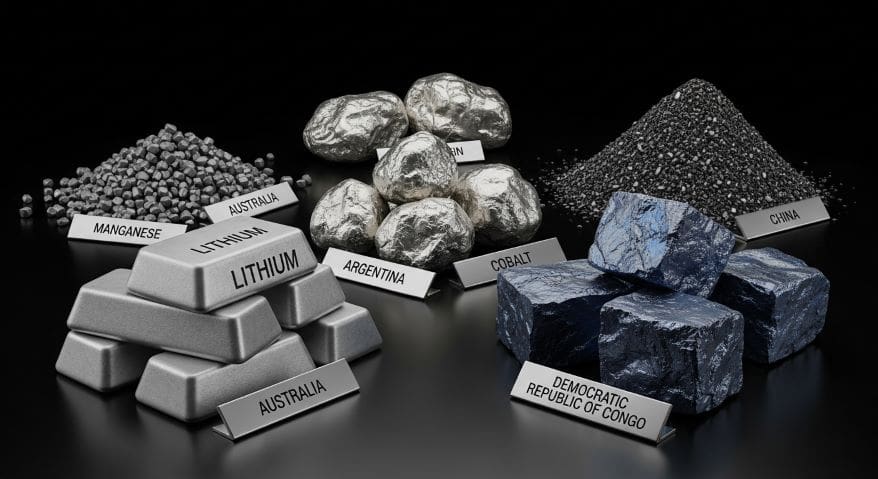
Most lithium is taken out in two ways. Firstly, brine extraction, which gets lithium from salty water under the ground. This happens a lot in South America. Secondly, hard rock mining, which digs lithium out of rocks. Particularly, Australia is the top country for this method.
| Raw Material | Source Countries |
| Lithium | Australia, Chile, Argentina |
| Cobalt | Democratic Republic of Congo |
| Nickel | Various, with significant demand growth |
| Manganese | Primarily used in steel industry |
| Graphite | China (dominant producer) |
Note: Mining can hurt nature. It can destroy animal homes and pollute water. Some places, like Salar de Uyuni, may lose clean water.

| Method | Description | Global Production Share |
| Brine Extraction | Gets lithium-rich water from underground salt flats. | ~60% |
| Hard Rock Mining | Mines lithium from rocks, mostly spodumene ore. | ~47% |
Active Material Synthesis
After getting the materials, factories change them into active materials. Also, they make special mixes for the cathode and anode. Thereafter, workers grind these mixes into tiny powders. Then, they add binders and solvents to make a thick liquid called slurry. Thereafter, this slurry is spread onto metal foils. Aluminum is used for the cathode foil. Copper is used for the anode foil. Finally, the foils are dried to get rid of the solvents. After drying, the foils are pressed flat and smooth.
In general, factories check quality at this step. Especially, they use tools like ion chromatography and ICP-OES. To be sure, these tools look for purity and tiny bits of other stuff. Pure materials help batteries work well and last longer.
Preparation of Battery Components
Making lithium-ion batteries needs other parts too. Specifically, these are separators, electrolytes, and current collectors. Workers cut separators to the right size and dry them. Additionally, they mix chemicals to make electrolytes with the right balance. All parts are checked carefully before use. This careful work helps every battery stay safe and work well.
- Main steps in component preparation:
- Get and check raw materials.
- Mix and spread active materials on foils.
- Cut and dry separators.
- Mix and test electrolytes.
These steps get everything ready for the next part of making lithium-ion batteries.
Lithium-Ion Battery Electrode Manufacturing
Mixing Active Materials
The first thing workers do is mix the active materials. They make slurries for both the positive and negative electrodes. Workers pick the right amount of solids and liquids. Also, this choice changes how thick the slurry is. Most factories use either half solids and half liquids or a little more solids. The team picks mixers based on how thick the slurry should be. They run small tests to find the best way to mix.
Workers add things in a certain order. First, they put in the solvent and binder. Next, they add conductive additives. Last, they add the active material. This order keeps the active particles safe. Quality control is very important here. Machines check the temperature and pressure to keep the mix correct.
The binder is important in lithium-ion battery production. It helps the active material stick to the metal foil. When the binder mixes with the active material, it forms a strong film. This film covers both the positive and negative electrodes. Actually, a good binder mix makes the electrode strong and bendy. The slurry must flow well when coating but stop flowing after. Such as, this makes a smooth and even layer.
Coating on Metal Foils
After mixing, workers put the slurry on metal foils. As has been noted, they use aluminum foil for the positive electrode and copper foil for the negative electrode. Additionally, special machines help with this step. The machines unwind the foil and feed it into the coater. The start and end of the foil connect to make a long belt.
The machine keeps the foil flat and in the right place. Workers clean the foil and coater with alcohol before they start. The slurry is put on the foil in sections. For double-sided coating, the machine works on both sides at once. The wet electrode goes into a drying channel right after coating.
How thick the coated layer is matters a lot. Most electrodes are 50 to 100 micrometers thick. Some wet coatings can be 100 to 300 micrometers. The foil is very thin, only 10 to 20 micrometers. The coating must be smooth and even. Certainly, this helps both electrodes work well in the battery.
Tip: Keeping the foil flat and clean stops folds and mistakes.
Drying and Calendering
After coating, the electrodes go through drying. The drying channel takes out the solvents from the slurry. The temperature depends on how fast the line moves and how thick the coating is. Drying must be even to stop cracks or bubbles.
Next, the electrodes go to calendering. Calendering means pressing the electrode between rollers. This step is important in lithium-ion battery manufacturing. The rollers press the electrode to make it denser. More pressure packs the particles closer together. This raises the compaction density. A denser electrode has lower electrical resistance. It also stays strong after many uses.
| Evidence Type | Description |
| Powder Compaction Mechanisms | More pressure packs particles tightly, making the electrode denser. |
| Electrical Resistivity | Denser electrodes carry electricity better. |
| Mechanical Properties | Dense electrodes stay strong during battery use. |
Calendering helps both electrodes work better. It also makes the electrode thickness more even.
Slitting Electrodes
The last step here is slitting. Workers cut the long rolls of electrode into strips. Each strip must be the right width and have smooth edges. Special slitting machines make clean cuts. This saves expensive copper and aluminum foils.
Even strips help both electrodes line up inside the battery. Good alignment means the battery works better and lasts longer. Slitting also lowers resistance and helps energy move better.
| Specification | Value (µm) |
| Lower Spec Limit (LSL) | 300 |
| Design Target | 550 |
| Upper Spec Limit (USL) | 1000 |
The negative electrode is often a little bigger than the positive one. This helps stop problems like lithium plating. Workers check the strips for width and edge quality before the next step.
Note: Careful slitting and lining up of the strips are important for safe and long-lasting lithium-ion batteries.
Battery Cell Assembly Process
Stacking or Winding Electrodes
Workers begin by putting together the main battery parts. There are two ways to do this. Some factories use stacking. They cut electrode sheets and stack them in layers. Each layer has a separator between the electrodes. This is called Z-stacking. Other factories use winding. They roll up the electrode sheets with separators. This makes a jelly roll shape. Winding helps make batteries with regular shapes. Both ways keep the electrodes and separators in order. This step is important for making lithium-ion batteries.
- Stacking: Workers cut sheets and stack them with separators.
- Winding: Workers roll up electrodes and separators for a jelly roll.
These methods help stop short circuits and keep batteries safe.
Adding Separators
Separators are very important in lithium-ion batteries. They keep the electrodes from touching each other. Workers use thin films made from polypropylene (PP) and polyethylene (PE). PP films are strong and can handle heat. PE films have tiny holes and soak up the electrolyte well. Some separators have ceramic coatings to handle heat better. During assembly, workers put separators between each electrode layer. They use stacking or winding. Sometimes, they add the separator right away to save time and money. This also helps make batteries safer and work better.
- Separator materials include:
- Polypropylene (PP) films
- Polyethylene (PE) films
- Ceramic-coated films
Workers check that separators are the right thickness and have enough tiny holes. These things help ions move and keep batteries safe.
Electrolyte Filling
Next, workers fill the battery with electrolyte. Electrolytes help lithium ions move between electrodes. Common electrolytes are lithium hexafluorophosphate (LiPF6), lithium tetrafluoroborate (LiBF4), and lithium perchlorate (LiClO4). Workers pour liquid electrolyte into the cell. They keep the temperature between 20°C and 30°C. This helps the liquid spread evenly. Humidity stays between 30% and 60% to keep out water. Electrolytes can catch fire and are poisonous. Workers store them in special places. They watch the barrels for pressure to stop accidents.
Tip: Keeping the right temperature and humidity stops heat and water problems.
Cell Sealing
After filling, workers seal the battery to stop leaks. There are different ways to seal lithium-ion batteries. Welding uses lasers or electricity to seal metal parts. Adhesive bonding uses glue, but it is not used much. Gasket sealing uses silicone or EPDM to make a tight seal. Crimping presses the case and lid together. Sometimes, workers use crimping with glue. Hermetic sealing uses glass-to-metal or metal-to-metal welding for airtight seals.
| Sealing Technique | Description |
| Welding | Lasers and electricity make strong seals for metal parts. |
| Adhesive Bonding | Special glue sticks the lid and case but is not used much. |
| Gasket Sealing | Gaskets squeeze together using silicone or EPDM. |
| Crimping | The case and lid are pressed together, sometimes with glue. |
| Hermetic Sealing | Glass-to-metal or metal-to-metal welding makes airtight seals for important uses. |
Workers check the seal with X-rays. They look for problems and make sure the layers are tight. Formation testing checks how much energy the cell can hold and how well it works. Impedance analysis measures how well the cell works. These steps help make sure batteries are made well.
Note: Careful sealing and testing help keep lithium-ion batteries safe and working well.
Cell Finishing and Testing
Formation (Initial Charging)
After building the battery, workers start formation. They charge and discharge each battery for the first time. Given that, this helps the battery’s chemistry become stable. Now that, a solid electrolyte interphase (SEI) layer forms on the negative electrode. The SEI layer keeps the battery safe and helps it last longer. Workers use a set program for charging and discharging. Lithium ions move from the positive to the negative electrode. Finally, the SEI film forms and helps the battery work well.
- Formation makes a strong SEI layer.
- Workers use careful charging and discharging.
- Lithium ions and electrolyte make the SEI film.
Aging Process
After formation, workers begin aging. They store batteries for a certain time. This step acts like long-term use. Aging shows how batteries change as they get older. Manufacturers use these tests to make battery chemistry better. They also improve how batteries are made. Results from aging help pick better materials. This makes batteries safer and more reliable.
- Aging tests show how batteries change over time.
- Makers improve chemistry and production with test results.
- Aging helps batteries become safer and last longer.
Performance Testing
Workers test every battery before it is approved. They check how the battery works in different situations. Tests include high-altitude, hot and cold cycles, shaking, and strong impacts. Workers also test for crushing, hitting, and short circuits. They watch voltage and mass loss after tough tests. These steps make sure the battery is safe and works well.
| Test Type | Description |
| High-altitude simulation | Checks battery at low air pressure. |
| Thermal cycling | Tests battery in hot and cold. |
| Vibration testing | Shakes battery for nine hours. |
| Mechanical shock | Hits battery with strong force. |
| Crush/impact testing | Squeezes the battery to see how strong it is. |
| Short-circuit test | Checks safety circuits after stress. |
| Voltage and mass loss | Looks for problems inside after testing. |
Quality Control
Quality control is very important when making batteries. Workers pick the best materials for lithium-ion batteries. They check sizes and electrode coating. Good assembly stops problems. Workers use many tests and checks. New ways to study materials help find tiny issues. Different methods look at how materials act and if they are clean. Careful control and testing make batteries work better and last longer. This helps more people use lithium-ion batteries.
| Quality Control Measure | Description |
| Material Selection | Workers choose the best materials for making batteries. |
| Dimensional Accuracy | Workers keep sizes exact for good battery performance. |
| Electrode Coating | Workers make coatings better for strong and long-lasting batteries. |
| Cell Assembly | Workers put parts together carefully to stop mistakes. |
| Testing and Inspection Procedures | Workers test and check batteries to meet safety and performance rules. |
Note: Careful finishing and testing help lithium-ion batteries stay safe and last a long time.
Final Packing and Distribution
Module Assembly
After testing, workers build battery modules. In short, they follow steps to make sure each battery works well in a group. To sum up, here are the main steps:
- Firstly, workers use spot welding to attach nickel strips.
- Then, they put in the BMS module and connect balance wires.
- Thereafter, they solder wires and add insulation to keep connections safe.
- To be sure, they test the pack for voltage and check the BMS.
- Then, they put the battery pack in a case and add labels.
- Finally, they wrap the pack with shrink wrap and seal it with heat.
- Sometimes, they use a hard or soft case for extra safety.
Each step helps the battery module stay safe and last longer. Good assembly makes batteries strong.
Safety Labeling
Safety labels tell people what is inside each package. Workers must follow rules before shipping any lithium-ion battery. They use special labels to show the battery type and how to handle it.
| Label Type | Description |
| UN3481 | For lithium-ion batteries in equipment. |
| UN3480 | For lithium-ion batteries shipped alone. Not allowed on passenger planes. |
| UN3091 | For lithium metal batteries in equipment. |
| UN3090 | For lithium metal batteries shipped alone. Not allowed on passenger planes. |
Workers add the UN number, hazard class, and shipping name on each label. They fill out a Dangerous Goods Declaration with important details. These steps help keep people and nature safe during production and transport.
Preparing for Shipment
Before shipping, workers check each package again. They make sure every battery meets safety rules. For this purpose, they sort batteries by type and watt-hour rating. After that, they add the right markings and hazard labels. Some shipments need extra labels for air, sea, or road.
Workers pack batteries in strong boxes. They use padding to stop movement. They seal each box and add warning signs. This careful work helps stop accidents during shipping. Good packing and clear labels help batteries arrive safe and ready to use.
Tip: Careful packing and labeling help batteries get to you safely and ready to use.
Making batteries starts with raw materials and has many steps. Workers take out, mix, and form each part carefully. Each step helps the battery be safe and strong. People can notice the skill and care in every battery. Learning about this process helps us appreciate battery technology in our lives.
FAQ
What is the main material in lithium-ion batteries?
Lithium is the most important material. Workers also use cobalt, nickel, manganese, and graphite. Additionally, these materials help the battery hold and give out energy.
How do workers keep batteries safe during manufacturing?
Workers test each battery. Also, they look for leaks and short circuits. They make sure the seals are strong. Careful tests help batteries stay safe and last longer.
Why do batteries need separators?
Separators keep the two electrodes apart. Also, they stop short circuits from happening. Thin films let ions move but block the electrodes from touching.
Can batteries be recycled?
Yes, many companies recycle batteries. They collect old batteries and take out useful materials. These materials are used again. Recycling helps protect the environment.
What happens if a battery fails a test?
Workers take out batteries that fail tests. These batteries are not shipped. Only batteries that pass all tests go to customers.
References
- Liu Y, Zhang R, Wang J, Wang Y. Current and future lithium-ion battery manufacturing. iScience. 2021 Mar 19;24(4):102332. https://doi.org/10.1016/j.isci.2021.102332. PMID: 33889825; PMCID: PMC8050716.
- Fatoki, O., Mohammed, H., Parupelli, S. K., Mathew, A., Kaur, M., Rehmat, A., Muhammed, S., Bastakoti, B. P., & Desai, S. (2025). Review of Recent Advances in Lithium-Ion Batteries: Sources, Extraction Methods, and Industrial Uses. Batteries, 11(12), 433. https://doi.org/10.3390/batteries11120433
- Örüm Aydin, A., Zajonz, F., Günther, T., Dermenci, K. B., Berecibar, M., & Urrutia, L. (2023). Lithium-Ion Battery Manufacturing: Industrial View on Processing Challenges, Possible Solutions and Recent Advances. Batteries, 9(11), 555. https://doi.org/10.3390/batteries9110555
- Tao, R., Gu, Y., Du, Z. et al. Advanced electrode processing for lithium-ion battery manufacturing. Nat. Rev. Clean Technol. 1, 116–131 (2025). https://doi.org/10.1038/s44359-024-00018-w
- Dai, F., Cai, M. Best practices in lithium battery cell preparation and evaluation. Commun Mater 3, 64 (2022). https://doi.org/10.1038/s43246-022-00286-8
Disclaimer: This article/blog post is not intended to provide professional or technical or medical advice. Images (including AI-generated images) are used only for illustration and decoration. Their accuracy, quality, and appropriateness can differ. Users should avoid making decisions or assumptions based only on the text and images.
- Author
- Latest Posts

Charudatta Pathak was a student at St. Aloysius High School in Bhusawal, established in 1874, making it one of India’s oldest convent institutions. He earned his bachelor’s degree in mechanical engineering from SSVPS College of Engineering, Dhule in 1995, demonstrating exceptional academic achievement. Thereafter, he launched his career as a CNC programmer in a toolroom. He has utilized FANUC, Deckel, Maho, and Mikron controllers to operate 2-axis and 3-axis machines for the fabrication of jigs, fixtures, dies, and molds. He commenced his career as an academic in 1996, when he assumed the role of lecturer at SSVPS College of Engineering, Dhule. Additionally, he earned his post-graduate degree in CAD/CAM from L. D. College of Engineering, Ahmedabad, in 2000, and then acquired a Ph.D. from COEP in 2011 while concurrently engaged in teaching. Until 2023, he occupied many academic roles, including lecturer, assistant professor, professor, dean, principal, director, and vice chancellor at both public and private universities throughout India. From 2008 to 2010, he served as the project lead in the CAE department of a European multinational firm. During his 28-year professional tenure, he identified a need for dependable books targeted at students in grades 8 to 12, particularly for nascent career planning. He founded ENTECH Digital Magazine, a free monthly publication available on entechonline.com and magzter.com. Teens with a strong interest in Science, Technology, Engineering, and Mathematics (STEM) who aspire to pursue careers in these fields may find ENTECH Digital Magazine beneficial.