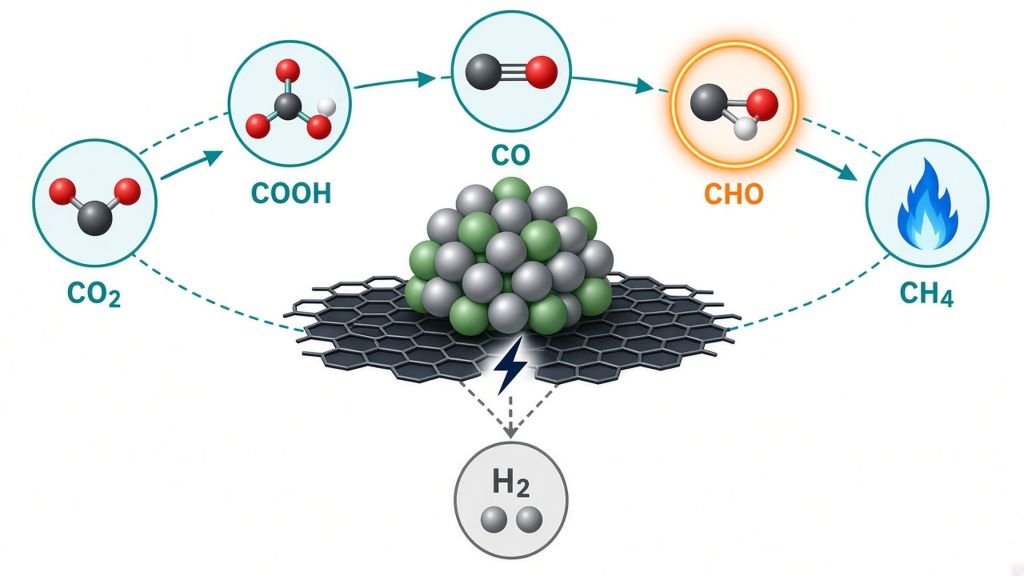
On a cold morning, you can watch gray exhaust curl from a bus tailpipe. Factory chimneys release the same gas, carbon dioxide, in far larger amounts. Chemists in China and Canada now report a way of turning CO2 into fuel gas. Their tin-nickel catalyst uses electricity to convert dilute flue-gas CO2 into a methane-containing syngas. As a result, the outlet gas holds almost no hard-to-separate multi-carbon by-products. Bohua Ren of Central South University led the study with Guobin Wen of Hunan University. Xiaoman Duan of the University of Saskatchewan and Canadian Light Source added key X-ray studies. Shuxuan Liu and Ningce Zhang of Hunan University also took part in the work. The team reported its results in Nature Communications as an Accelerated Article Preview (DOI: 10.1038/s41467-026-79041-3).
Burning coal, gas, and oil releases carbon dioxide, as the U.S. Environmental Protection Agency explains. Cement making also adds more through its own chemical reactions. For this reason, scientists want to catch this gas and turn it into fuel. One route uses electricity to change CO2 at a metal surface. Chemists call this electrochemical CO2 reduction, and it can run near room temperature. Methane makes a good target because it stores 55.5 megajoules per kilogram. According to the paper, no other one-carbon product packs more energy per kilogram. In addition, pipes and burners for natural gas already exist. However, real chimney gas is far from pure CO2. Flue gas holds only about 15% CO2, with about 80% nitrogen and 4% oxygen. It also carries dust and traces of sulfur and nitrogen oxides. In other words, any useful process must cope with a weak and dirty feed.
The Tin Catalyst Knowledge Gap
Most catalysts that turn CO2 into methane use copper, the authors note. Copper, though, also makes larger molecules such as ethylene. As a result, those by-products need a separate clean-up stage, which adds cost. Tin offers a cheap, non-toxic option that also holds back unwanted hydrogen gas. Still, few groups had used tin to make methane. Instead, tin usually yields carbon monoxide or formate, a salt of formic acid. Pure tin in particular favors formate. This matters because methane formation hinges on one slow step. In that step, bound carbon monoxide gains hydrogen and becomes a CHO fragment. Chemists therefore call it the rate-limiting step for methane. So the open question was clear. Could a tin catalyst block formate, keep carbon monoxide, and speed up CHO formation? ENTECH’s story on copper nanoclusters for clean methane shows how cluster size can steer results.
Challenges and Motivation Behind the Research
The team faced two linked problems, one at each end of the process. At the inlet, low CO2 pressure slows how fast the gas reaches the catalyst. This creates diffusion-limited kinetics, so methane output drops. At the outlet, on the other hand, copper catalysts leave a costly mix. Splitting methane from ethylene, for example, adds an expensive extra stage. The published study therefore sets a simple goal: flue gas in, fuel gas out. To fix the inlet problem, the group reused its own earlier flow cell design. This cell takes in a potassium bicarbonate solution rather than CO2 gas.
First of all, potassium carbonate soaks up CO2 in a mild, mature step. Nitrogen and oxygen barely dissolve in that liquid, so most impurities stay behind. As a result, the cell receives clean, rich carbon from a weak source. Methane, however, faces a third hurdle inside fast flow cells. Rapid CO2 use there raises the local pH and starves the surface of protons. Because methane needs eight electron and proton transfers, it suffers most.
Key Findings: Fuel Gas From Flue Gas CO2
Fig. 1: Converting Dilute CO2 into Fuel Gas.
Computer Screening Points to Tin-Nickel Clusters
According to the Nature Communications paper, the team began with computer screening. They used density functional theory, which predicts how atoms bond. In total, they tested 33 surface models. Tin’s partners were nickel, zinc, indium, silver, copper and gallium. Tin-nickel scored best at making carbon monoxide rather than formate. After that, the team compared three tin-nickel designs for the slow CHO step. Tiny clusters on a nickel-nitrogen-carbon base needed only 0.57 electronvolts. By comparison, a surface alloy needed 0.65 eV and a bulk alloy 0.77 eV. Pure tin, by contrast, needed 2.44 eV, which fits its poor methane output. Guided by these numbers, they grew sub-nanometer clusters using timed doses of current. After 60 seconds, clusters measured about 7 to 8 ångströms across. Longer growth, such as 300 seconds, gave larger particles instead. Synchrotron X-ray studies then confirmed the cluster size and layout.
High Methane Current With Pure CO2
Lab tests first used a simple two-chamber H-cell with pure CO2. There, the cluster catalyst sent 81.4% of its electric charge into methane. Chemists call this share the Faradaic efficiency. In contrast, the tin-nickel surface alloy reached only 28.6%. Similarly, the bulk alloy lagged behind, at 15.7%. Meanwhile, the nickel base alone made no methane. Next, the team moved to a 1 cm² flow cell, still fed pure CO2. Methane’s partial current density approached 1,024 milliamperes per square centimeter (mA/cm²). At that point, total current topped 2 A/cm². Methane’s share, however, fell to 50% there. The best share in this cell, 75%, came at a gentler voltage. In addition, the catalyst proved durable. With pure CO2, it ran for over 600 hours, or more than 25 days. During that run, it held 680 mA/cm² with methane shares of 72% to 75%.
From Simulated Flue Gas to 1,500 Liters of Fuel Gas
The real test used simulated flue gas of 15% CO2, 81% nitrogen and 4% oxygen. In a 100 cm² cell, current reached 92 amperes with this mix. By contrast, pure CO2 gave 119 amperes at the same 3.8-volt setting. The team then ran the full capture and conversion system for over five days. At about 60 amperes, it collected roughly 1,500 liters of this fuel gas, or syngas. That gas held methane, carbon monoxide and hydrogen in a 0.3 : 0.4 : 0.3 ratio. In other words, carbon monoxide, not methane, formed the largest share. Finally, a 240 square centimeter cell added custom electrolyte distributors. The authors also describe this larger size as industrial-scale. With flue gas, its partial current density for syngas held at 997 mA/cm². Methane still kept over 60% of the charge. Its peak output reached about 66 liters of syngas per hour at 254 amperes.
Implications and Next Steps for CO2-to-Fuel-Gas Technology
The authors say their route makes CH4-rich syngas without an extra clean-up step. According to them, the gas may suit direct reduction of iron and industrial burning. The paper’s process diagram also names coal-fired power plants and cement plants as CO2 sources. For STEM research, the study offers a full workflow from computer screening to large cells. In education, it links chemistry, physics and engineering in one clear story. Businesses running furnaces or ironworks may also watch closely. Durability helps here, since tin and nickel atoms stayed evenly spread after long runs. Careers could grow for electrochemical engineers, catalyst chemists and carbon-capture designers, for example. As for next steps, the authors suggest testing new flow-field designs. They also name parallel, serpentine and vortex flow paths. Such designs could improve reactant spread, bubble removal and mass transfer. In contrast, the paper reports no tests with real flue gas.
Explainer: The Science Behind CO2-to-Fuel-Gas Conversion
Fig. 2: Tin-Nickel Cluster
How Electrolysis Turns CO2 Into Fuel Gas
Electrolysis uses electricity to drive a reaction that would not happen alone. An electrolyzer holds two electrodes, split by a thin membrane. At the cathode, CO2 gains electrons and protons and becomes new molecules. Meanwhile, the anode gives off oxygen gas. ENTECH’s guide to electrochemical cells explains these parts further. A catalyst coats the cathode and lowers the energy each step needs. Each methane molecule needs eight electron and proton transfers. Every transfer passes through brief fragments stuck to the catalyst. To begin with, a COOH fragment forms and turns into carbon monoxide. That CO then picks up hydrogen to form CHO, the key bottleneck. If a catalyst handles CHO well, the path to methane speeds up. Hydrogen gas, on the other hand, forms when protons meet electrons without carbon. For this reason, good catalysts for CO2-to-fuel-gas conversion favor carbon steps.
Why Orbital Overlap Steers the Reaction
In general, atoms bond by sharing electrons in regions called orbitals. Nickel uses its outer 3d orbitals, while carbon in CHO uses 2p orbitals. When these orbitals overlap well, chemists call it d-p hybridization. Think of two hands gripping each other, since a firm grip holds a fragment steady. The team’s math showed the most nickel-carbon overlap on the tiny clusters. As a result, CHO stuck more firmly there than on either alloy. Its binding energy was −2.99 eV, compared to −2.82 and −2.68 eV for the alloys. Yet stronger is not always better, the authors caution. Very small clusters gripped CHO too tightly, at −3.10 eV. Big clusters, in contrast, held it a little too loosely, at −2.86 eV. In short, the medium cluster gave a just-right grip that favors methane. That balance explains why cluster size mattered so much in the lab.
Conclusion: From Chimney to Fuel
A carefully sized catalyst, this study shows, can make factory CO2 useful. Tin-nickel clusters just 7 to 8 ångströms wide steered the chemistry toward fuel gas. At the same time, they kept multi-carbon by-products near zero, so no costly sorting followed. In addition, scaled cells made about 1,500 liters of syngas from simulated flue gas. The top methane current, however, came with pure CO2 rather than flue gas. Gaps remain, such as cost data and real flue gas tests. The paper, in fact, includes no cost analysis and names no industry partner. Its computer models also give guidance, not a full picture. Because the article is an early preview, final figures may still change. For now, turning CO2 into fuel gas this way looks promising but unproven on cost. Our story on carbon capture and electrochemical conversion covers related work.
References
Ren, B., Duan, X., Liu, S., Zhang, N., & Wen, G. (2026). Engineered d-p orbital hybridization unlocks dilute CO2 electrolysis to byproduct-free CH4-rich syngas [Accelerated Article Preview]. Nature Communications. https://doi.org/10.1038/s41467-026-79041-3
The study's strength is its full workflow: screening of 33 surface models, detailed X-ray characterization, and cells from 1 cm² to 240 cm². The article reports the paper's numbers accurately and notes key limits. Readers should know that the 1,024 mA/cm² methane current came with pure CO2 at 50% methane selectivity, and the 600-hour durability run also used pure CO2; the flue-gas system ran for about five days. The simulated flue gas contained no dust, sulfur oxides, or nitrogen oxides, and the paper gives no cost or full-system energy analysis. Clarity fix: explain that the 0.3 : 0.4 : 0.3 ratio is by volume, while "over 60%" is a share of charge, and methane needs eight electrons.
I am an inspirational writer and emerging science blogger with a deep-rooted passion for understanding and sharing the wonders of the world around us. My journey began with a Bachelor of Science in Chemistry from AKI’s Poona College of Arts, Commerce and Science, where I developed not only a strong foundation in scientific principles but also a mindset that values curiosity, observation, and critical thinking. Studying chemistry has taught me to approach problems with logic, to look beyond the obvious, and to see patterns where others might only see complexity. These experiences have shaped the way I perceive life and influence the way I express my thoughts, both scientifically and creatively.
I have always believed that knowledge is only as powerful as the way it is shared. This belief has guided me to create content that bridges the gap between science and everyday life. I aim to simplify complex scientific ideas so they become approachable, relatable, and engaging for everyone—whether someone has a formal background in science or is simply curious about the world. Science, in my view, is not confined to textbooks and laboratories; it is a way of thinking, understanding, and connecting with the world around us. By making science accessible, I hope to inspire curiosity, ignite learning, and encourage people to see the beauty and relevance of scientific discovery in their daily lives.
Alongside my love for science, I am deeply passionate about motivational writing. I believe words carry the power to transform perspectives, encourage self-reflection, and inspire action. By combining analytical thinking with creativity, I create content that is intellectually stimulating yet emotionally resonant. Whether I am breaking down a chemical concept, exploring a scientific phenomenon, or crafting motivational narratives, my goal is to communicate ideas in a way that is clear, meaningful, and impactful.
Through my work, I strive to empower my readers - not just by helping them understand the science around them, but by inspiring them to grow, learn, and realize their full potential. Every article, post, or story I write reflects my commitment to turning knowledge into inspiration. I want to spark curiosity, encourage self-improvement, and show that learning and personal growth are deeply connected. For me, writing is not just a craft; it is a way to touch minds, connect hearts, and make ideas come alive in a way that truly resonates.