Press the shutter on a compact camera, and the flash fires in a blink. A small capacitor stores the charge for that burst. Now, Chinese researchers report lead-free multilayer ceramic capacitors that pack high energy into tiny chips. Ying Jiang, Kezhen Hui and nine colleagues carried out the study. Most of the team works at Tsinghua University’s State Key Laboratory of New Ceramic Materials. Partners came from Shaanxi Normal University and Beijing University of Posts and Telecommunications. The devices stored 19.8 joules per cubic centimeter at 89.3% efficiency. That result beats most recently reported lead-free devices of this type. At the same time, they stayed steady up to 150 °C at a moderate field. The study appears in Nature Communications as an Accelerated Article Preview (DOI: 10.1038/s41467-026-79047-x).
A capacitor stores electric charge and releases it extremely quickly. Modern electronic devices depend on one type, the multilayer ceramic capacitor, or MLCC. Picture a stack of thin ceramic sheets separated by metal electrode films. Each ceramic sheet acts as an insulator, so electric charge accumulates on the metal films. As soon as a circuit needs power, the stack delivers that charge in microseconds. Batteries typically hold more energy, but they release it far more slowly. For that reason, engineers choose capacitors for sudden, powerful energy bursts.
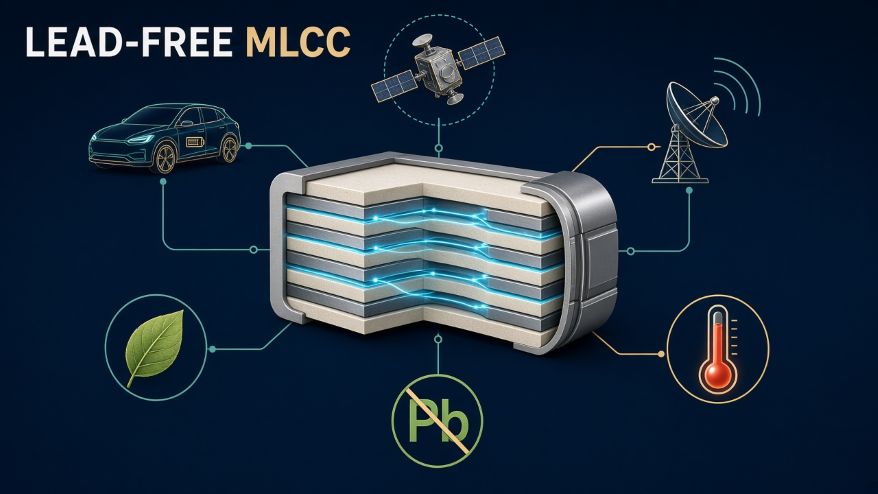
The new study calls MLCCs the most widely used part in pulsed-power devices. Examples include hybrid electric vehicles, spacecraft and high-power microwave devices. Our guide to electrostatic energy explains how charge stores energy in an electric field. In short, a better ceramic layer means a smaller, stronger capacitor. Device manufacturers also keep packing more components into less space. As a result, they need ceramic chips that hold more energy per cubic centimetre.
The Knowledge Gap in Lead-Free MLCC Research
Many high-performance capacitors have relied on lead-based ceramics. Lead, however, is a toxic metal with well-documented health risks. The National Institute of Environmental Health Sciences explains those risks for the public. For this reason, researchers now favor lead-free recipes such as barium titanate. A 2021 review of lead-free energy-storage MLCCs mapped the hurdles these materials face. One particular hurdle stands out above all. Lead-free parts must store abundant energy and waste very little of it. In addition, they must do this under strong electric fields and high heat. Earlier barium titanate MLCCs reached 20.8 J/cm³ at approximately 97.5% efficiency. Yet their best performance remained limited to 100 °C. Other textured MLCCs reached approximately 21.5 J/cm³, but at roughly 80% efficiency. In other words, no lead-free MLCC clearly met all three goals at once. That missing combination is the gap this study specifically targets.
Challenges and Motivation Behind the Research
Heat and Strong Fields Push Capacitors Toward Failure
According to the paper, pulsed-power MLCCs must survive fields of at least 500 kV/cm. They must also work reliably at 150 °C or more for extended periods. Under strong fields and heat, three problems grow worse at the same time. To begin with, the breakdown strength drops, so the ceramic fails at a lower voltage. Leakage current also rises, so electric charge leaks through the insulator. Dielectric loss climbs as well, which turns more energy into waste heat. Because of these effects, both stored energy and efficiency decline sharply. On the one hand, a ceramic needs strong polarization to store energy. Strong polarization, on the other hand, often brings large energy losses. Balancing these opposite demands is the core engineering challenge. The authors argue that chemistry and structure must change together to meet it. In fact, they treat composition and structure as two dials on one machine.
Why the Team Chose a Multiscale Strategy
The motivation was entirely practical. Device integration keeps increasing, so engineers want smaller capacitors with higher energy density. To that end, the team set out to improve weak points at every size scale. Rather than tweaking one feature, they planned four connected changes. These changes stretch from individual atoms up to the finished device. Corresponding author Xiaohui Wang’s faculty page lists multilayer chip capacitors as a core research field. Peiyao Zhao and Limin Guo also served as corresponding authors. Funding came from the National Natural Science Foundation of China and a Tsinghua laboratory project. The team also had a reason to favor relaxor ferroelectrics over other options.
Quasi-linear dielectrics have reached 43 J/cm³, but only at 2800 kV/cm. In contrast, relaxor ferroelectrics store high energy under more moderate fields. They also pair high permittivity, a measure of charge storage, with low energy loss. For this reason, the authors see relaxor-based MLCCs as a practical route to real devices.
Explainer: How Lead-Free Ceramic Capacitors Store Energy
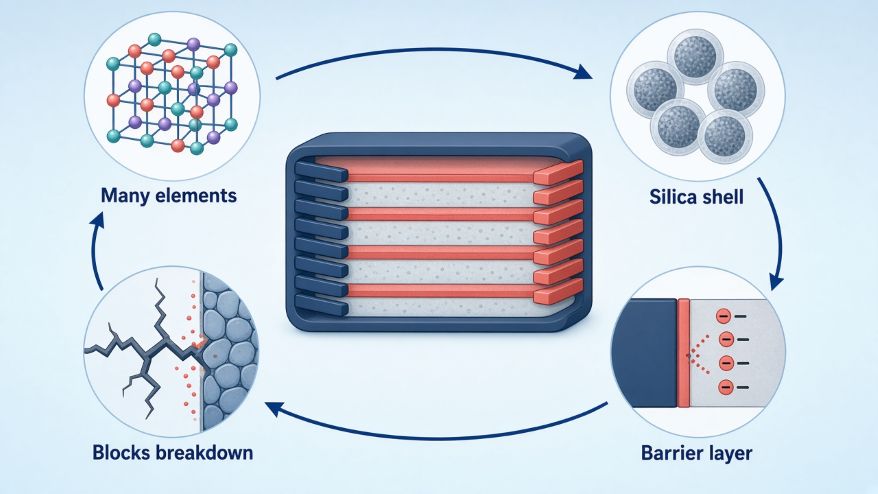
Fig. 1: Four design fixes, from many-element crystals to silica barriers, help lead-free ceramic capacitors resist breakdown.
Charge, Polarization and Breakdown in Plain Words
Picture each ceramic layer in a lead-free capacitor as a crowd of charge pairs. When you apply a voltage, these pairs tilt and align with the electric field. Scientists call this lining-up polarization. The more the material polarizes, the more energy it can store. As soon as the voltage drops, the pairs relax and release the stored energy. However, some materials do not relax fully. They keep leftover polarization, and that wastes energy as heat. Efficiency compares the energy recovered with the energy supplied. For instance, a slim loop on a polarization graph signals high efficiency.
Electrical breakdown sets the other limit. Push the voltage too high, and branching channels called electrical trees grow through the ceramic. Eventually, the layer fails completely, like a burst dam. For this reason, stored energy depends on both polarization and the highest safe field. Good capacitor design must therefore raise both at the same time.
High Entropy, Core–Shell Grains and Barrier Layers
The Nature Communications paper describes four fixes, one for each size scale. At the atomic scale, the team mixed seven metal elements into one crystal. Barium, bismuth, sodium, titanium, niobium, zinc and tantalum all share the lattice. Scientists call such a mix high-entropy because the atoms sit in a highly disordered way. As a result, long-range order breaks up and polarization becomes easier to switch. Tiny regions of three crystal phases also sit side by side at the phase scale. At the grain scale, a silica shell approximately 5 nm thick coats each ceramic grain.
Think of it as a thin glassy coating surrounding every grain. In addition, the coat keeps grains small and makes electrical trees take longer paths. Finally, at the device scale, a thin silica barrier sits between electrodes and ceramic. It raises an energy hurdle, called a Schottky barrier, that blocks injected charge. Less charge penetrates, so leakage remains low even at high temperature.
Key Findings From the New Lead-Free MLCCs
Fig. 2: Six headline results from the lead-free MLCC study; the 150 °C stability was measured at 500 kV/cm.
How the Team Built and Tested the Devices
The researchers first compared four ceramic compositions, from HERF-A to HERF-D. HERF-D showed the slimmest loop and the highest efficiency, so the team selected it. As a thin bulk ceramic, it stored 12.4 J/cm³ at 91.9% efficiency. After that, the team coated the powder with 0.5% silica by weight. As a result, the breakdown field rose by 26%, from 334 to 420 kV/cm. The coating also shrank the average grain size from 0.64 to 0.48 µm. Then came the actual multilayer devices. For this step, the team used tape-casting, the sheet-making method industry uses for MLCCs.
They stacked ceramic tapes approximately 12 µm thick with silver-palladium inner electrodes. A two-step sintering process followed. In the finished chips, each ceramic layer measured approximately 7 µm. Computer simulations in the study supported the laboratory tests. With the coating in place, breakdown paths crossed more grain boundaries and spread more gradually. In fact, the simulated breakdown field rose by 55% with the coating.
The Numbers Behind the Lead-Free Capacitor Result
At room temperature, the finished capacitors survived a field of 1421 kV/cm. Under that field, they stored 19.8 J/cm³ at 89.3% efficiency. The authors say this beats most recently reported lead-free MLCCs. It is not an all-time record, though. Their own introduction cites earlier devices near 20.8 and 21.5 J/cm³. What stands out is the combination of high energy, high breakdown field and heat tolerance. For example, at a gentler 500 kV/cm, energy fell only 3.9% up to 150 °C. Numerically, it slipped from 6.37 to 6.12 J/cm³, with efficiency above 90%. After one million charge cycles, stored energy changed by under 3%. The capacitors also discharged in approximately 1.19 microseconds. Discharge energy dropped less than 6% between room temperature and 200 °C. In addition, peak power density reached 122 MW/cm³ at 700 kV/cm. All in all, the capacitors perform well across temperature, time and speed.
What Lead-Free MLCCs Could Mean for Industry and Careers
The paper names hybrid electric vehicles, spacecraft and high-power microwave devices as target uses. In each case, capacitors must deliver sharp pulses while running hot for extended periods. Because the team used tape-casting, these are real device prototypes, not just lab pellets. Still, the study reports no cost data, patents or industrial partners. For students, the work links chemistry, physics and electrical engineering in one tiny component. Careers here include electronic ceramics engineer, power-electronics engineer and component process engineer. ENTECH has also covered AI-guided polymer research aimed at better capacitor insulation. Our new graphene technology report, on the other hand, covers supercapacitors, a different family. Looking ahead, the authors present their strategy as a general method for future lead-free MLCCs. They do not, however, describe specific follow-up studies. Even so, the method gives other laboratories a clear template to test.
Conclusion: A Balanced Step for Greener Capacitors
This study does not establish a new energy record. Instead, it shows that lead-free multilayer ceramic capacitors can balance several demands at once. The capacitors combine 19.8 J/cm³, 89.3% efficiency and a breakdown field of 1421 kV/cm. At a moderate field, they also hold steady up to 150 °C. They survive a million charge cycles with little change, too. That balance matters more than any single number for real pulsed-power systems. In short, the central idea is simple enough for a classroom. Improve weak points at the atom, phase, grain and device scales together. Each improvement supports the others, so the entire chip performs better.
For teachers, the work offers a fresh, practical example of materials design in action. Students, in turn, can recognize how chemistry decisions shape electronic devices. Above all, it points to greener capacitors made without toxic lead. Even so, the final typeset paper may still adjust some details.
The work is well designed: it tunes the ceramic at four scales, from atoms to the electrode interface, and tests finished multilayer devices rather than only pellets. The article reports the main results accurately and correctly calls them near-record, since earlier lead-free devices reached about 20.8 and 21.5 J/cm³. The 150 °C and million-cycle results were measured at 500 kV/cm, where stored energy is about 6.4 J/cm³, not 19.8 J/cm³, and cycling was done at room temperature. The paper itself gives both "less than 3%" and 3.9% for the change at 150 °C; the article correctly uses 3.9%. No cost or yield data appear. Fix: state the test field for the cycling and 200 °C results.
Shreyas Kulkarni is a Chartered Electrical Engineer and renewable energy pioneer with over eight years of hands-on experience in the clean energy sector. He is the Co-Founder of UNICUS Energy, a leading provider of solar energy solutions in India, where he drives technical execution, system architecture, and clean tech deployment.
As an author for ENTECH Magazine, Shreyas focuses on making solar technology practical and understandable for students, engineers, and homeowners. His contributions include detailed guides on the inner workings of rooftop solar systems and deep dives into modern hardware advancements, such as lightweight solar panels and flexible photovoltaic materials.