A single gold-coated optical fiber carries light and works as an electrode, so it can track battery chemistry even inside a sealed sodium-ion cell.
A Gold-Coated Fiber Lets Scientists Watch Battery Chemistry in Real Time
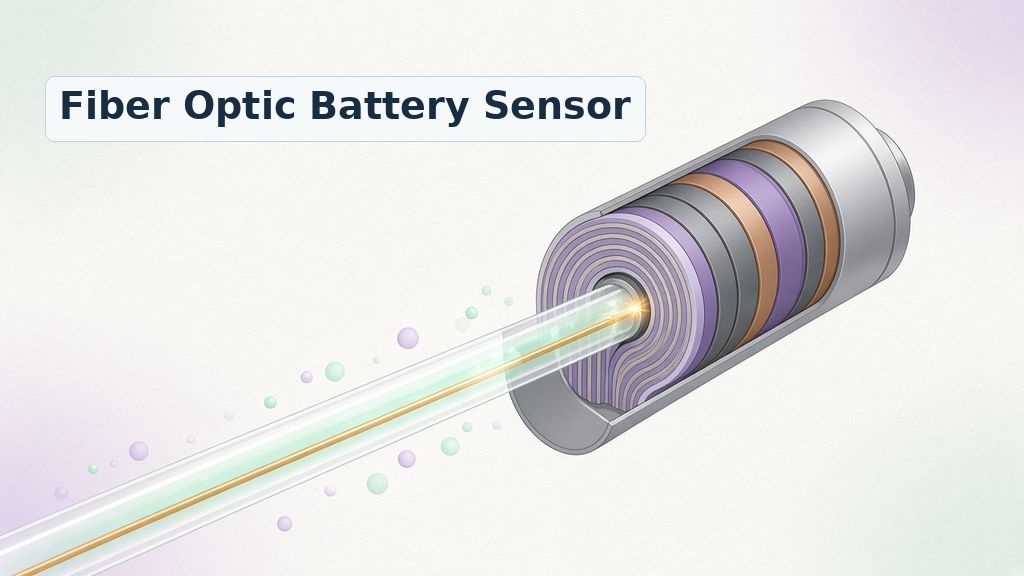
Your phone shows a neat battery percentage, yet that number is only an estimate. Nobody can peek inside the sealed can. Now a European team has built a fiber optic battery sensor that does just that. The device is a gold-coated glass fiber thinner than a pencil lead. It carries light and also works as a tiny electrode. As a result, it reads chemistry and electric charge at the same spot. Tatjana Šafarik and Jean-Marie Tarascon at the Collège de France led the work. Partners joined from Université Paris Cité, ENS-PSL and the University of Mons. In addition, TotalEnergies OneTech and NTNU in Norway took part. The results look bright. On the one hand, the fiber spotted changes about one atom layer thick. Better yet, it also worked inside a sealed sodium-ion cell. The team reported the results on November 9, 2026, in Light: Science & Applications.
Why Engineers Want a Fiber Optic Battery Sensor
Rechargeable batteries power phones, cars and solar storage. The US Department of Energy battery program lists durability among its goals. Still, battery life depends on reactions at hidden surfaces. Ions move, thin layers grow and side reactions quietly sap battery performance. Tools such as NMR and infrared spectroscopy can study these events. However, they need bulky instruments and careful sample preparation. As a result of this, they rarely watch a working cell in real time. Optical fibers offer a lighter path, because each strand is thinner than 0.2 millimeters. In fact, the Paris lab already sent infrared light through commercial batteries in 2022. Standard fiber sensors track heat, pressure and strain well. Even so, an ordinary fiber-optic sensor misses the chemistry of moving ions. In other words, engineers could feel the battery, not read it.

Challenges of Seeing Inside a Sealed Cell
Why is the inside of a battery so hard to study? The cell is dark, cramped and full of corrosive liquid. Worse, the key action happens in layers only nanometers thick. One such layer is the solid electrolyte interphase, often shortened to SEI. It forms on the negative electrode during the first charges. A Collège de France fiber explainer notes that a stable layer protects the battery. In contrast to that, an unstable layer can cause rapid decline. Earlier gold-coated fibers helped, but researchers usually placed them near an electrode. For this reason, nobody controlled exactly which surface the light sampled. That gap motivated the new design. At the same time, the team wanted one probe at the reaction site itself. In other words, the sensor would become the surface under study. That goal demanded optics, chemistry and modeling together.
How a Gold-Coated Fiber Reads Battery Chemistry
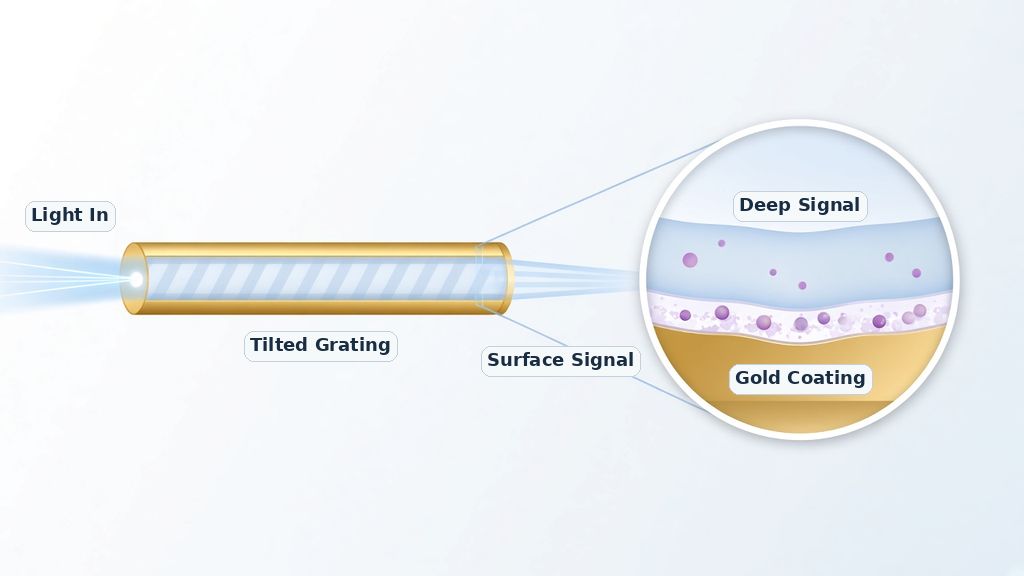
Start with an ordinary optical fiber. Light travels down its glass core and stays trapped inside. Next, engineers write tiny stripes into the core, called a fiber Bragg grating. In this design, the stripes sit at a tilt, so some light escapes outward. That leaked light forms a faint field just outside the fiber surface. Physicists call it an evanescent field, and it touches the nearby liquid. When the liquid changes, the colors of the passing light shift slightly. Then a spectrum analyzer at the far end reads those shifts every few seconds. Think of it as a ruler made of light. As a result, a tiny wavelength change reveals a change near the surface. Not only is the fiber small, but it also leaves the electrolyte nearly undisturbed. In the same way, it slips into tight spaces. Neat, right?
Surface Plasmons Make the Fiber Optic Battery Sensor Sharper
Bare tilted gratings feel a thick zone of liquid. Therefore, they struggle to separate surface events from deeper changes. The fix is a gold coating less than 50 nanometers thick. Gold lets light excite surface plasmons, which are ripples of electrons along the metal. These ripples carve a sharp dip into the transmitted light. According to the paper, the gold boosts sensitivity about ten times. Even more useful, the plasmon signal mostly feels the first few nanometers. At the same time, a second signal, the cut-off mode, reaches about a micrometer deep. A third signal, the Bragg mode, reacts only to temperature and strain. As a result, this plasmonic fiber sensor gives three readings from one strand. In other words, surface, bulk liquid and background each show up separately. That built-in comparison makes every reading easier to trust.
One Thin Strand Doing Two Jobs
Here comes the clever twist. The gold conducts electricity, so the fiber also acts as a working electrode. In a standard three-electrode setup, platinum and silver chloride electrodes complete the circuit. The fiber then drives a reaction and watches it at once. Scientists call this approach optical voltammetry. Put simply, they compare the light shift with the electric charge that flowed. During simple charging of the gold surface, both moved in lockstep. As a result of this, the rate of light shift matched the electric current. Better still, the fiber measures only 125 micrometers, about one eighth of a millimeter. Because of this, it fits where bulky probes cannot go. The design borrows from flat lab sensors that use the same plasmon effect. In contrast, a flexible fiber suits buried and remote spots.
What the Optical Fiber Sensor Revealed in Lab Tests
To begin with, the team tested the sensor in a potassium sulfate solution. Each charge builds a double layer of ions about two nanometers thick. Sure enough, the plasmon signal shifted with every charge and discharge. At the same time, the deeper cut-off signal barely moved. That contrast showed the plasmon signal really reads the surface. The light also caught slow sulfate ions that stuck to and left the gold. Then computer models reproduced those overall trends well. So the method passed its first test. Overall, the plasmon signal reached picometer-level wavelength resolution. A picometer is a trillionth of a meter, far smaller than an atom. In other words, this optical fiber sensor registers changes one atom layer thick. How many tools can say that about a working electrode? Very few.
Then the team moved to reactions that look more like real batteries. They added ferrocenemethanol, a test molecule that easily gains and loses electrons. Both optical signals shifted as the molecule reacted at the gold surface. However, the plasmon shift was about 60 times larger than the cut-off shift. For this reason, the team concluded that surface events dominated the signal. In addition, the light shifts lined up with the reaction current. Next, they watched gold oxide form in sulfuric acid. Each signal, therefore, answered a different question about the same moment. That split view helps chemists sort surface events from bulk ones. As a result, a color change becomes a measurable quantity. The lesson is clear. A good sensor does not just react. Even so, it must react in ways scientists can check.
Watching a Protective Battery Layer Form
Next came organic electrolytes, the kind used in lithium batteries. The team added a salt called LiBOB, which breaks down and builds an SEI. They also used a smaller grating tilt to suit the new liquid. During the first scan, the light revealed three stages of layer growth. Each stage gave a stronger optical response per unit of charge. Compared with the first stage, the second gave about 3.5 times more signal. The third stage, in turn, gave about five times more. In other words, the fiber could tell an organic-rich layer from denser inorganic deposits. After the first cycle, the current showed no more SEI peaks. Even so, the light still kept about 15 percent of the first shift. As a result, the team concluded the layer kept growing quietly. Only by the third cycle did the optical shift finally stop.
A Fiber Optic Battery Sensor Inside an 18650 Cell
Prussian blue offered another test, since batteries use it to store sodium and potassium ions. The team grew a thin Prussian blue film directly on the fiber. As the film thickened, the signal shifted steadily by up to 10.7 nanometers. In the same way, film thickness and light shift rose almost one to one. Then came the big step: a sealed, commercial-format 18650 sodium-ion cell. The team placed the fiber in the middle of the rolled electrodes. Later, they charged the cell to 5 volts, beyond its normal range, on purpose. Above 4.5 volts, the plasmon dip faded, which signaled a changing environment. At the same time, scans on the fiber found new oxidation features. According to the authors, these came from electrolyte breakdown at the cell electrodes. After discharge, the fiber’s scans largely returned to normal. On the other hand, a small shift remained.
Where Battery Fiber Sensors Could Go Next
What could this mean for factories? Every new cell goes through formation, the first careful charges that build its SEI. Our guide to the lead-acid formation process shows why that step matters. A battery fiber sensor inside the cell could flag harmful side reactions early. The authors see the platform first as a development tool. Later, it could serve as a quality check at scale. In addition, they plan to use machine learning to spot early aging signatures. They also hope to extend it to lithium-ion, solid-state and flow batteries. Sodium cells matter here, because salt-based sodium batteries rely on common materials. As a result, careers could grow too. Battery diagnostics engineers and photonic sensor engineers both fit this work. For students who love light and chemistry, that mix is exciting.
Limits the Team Still Has to Solve
Of course, the study is an early step. The 18650 test was a feasibility demonstration, not a finished product. In addition, a full study of cell integration is still planned. Even gold coverage on a round fiber also remains tricky. Small differences in gold thickness change the signal. For this reason, the team repeated every result at least twice. They suggest atomic layer deposition or electroplating as future fixes. Deep lithium reactions also cracked the gold coating in one test. As a result, the simple dip reading broke down there. Instead, the team tracked a wider area of the spectrum. On top of that, the hardware needs friendlier setups for wider use. Still, these limits look like engineering puzzles rather than dead ends. Oxford’s work on the hidden role of battery binders shows how much remains unseen.
Conclusion: A Clearer View Inside Every Battery
Batteries keep their most important chemistry behind steel walls. This fiber optic battery sensor offers a hopeful way to look inside. A single gold-coated strand carries light, drives reactions and measures charge. Not only did it separate surface events, but it also tracked a growing SEI. In addition, it followed a Prussian blue film almost nanometer by nanometer. Most impressive, it worked inside a sealed 18650 sodium-ion cell. There, it spotted signs of electrolyte breakdown at high voltage. Plenty of work remains, from even gold coatings to easier hardware. On the other hand, the core idea already works in water-based and organic liquids. For future engineers, this is great news. Better sensors can lead to safer, longer-lasting batteries. After all, every improvement starts with understanding. Light makes a gentle detective.
References
Collège de France. (2022, November 7). Une technologie pour « voir » dans les batteries commerciales [A technology to “see” inside commercial batteries]. https://www.college-de-france.fr/fr/actualites/une-technologie-pour-voir-dans-les-batteries-commerciales
Collège de France. (2025, January 7). La fibre optique au service des batteries électriques [Optical fiber in the service of electric batteries]. https://www.college-de-france.fr/fr/actualites/la-fibre-optique-au-service-des-batteries-electriques
Šafarik, T., Kanoufi, F., Loyez, M., Fasseaux, H., Aymé-Perrot, D., Keppetipola, N. M., N K, M., Boles, S. T., Caucheteur, C., & Tarascon, J.-M. (2026). Electroactive fiber optics for real-time, multiscale probing of ion transport and interfacial chemistry. Light: Science & Applications, 15, Article 399. https://doi.org/10.1038/s41377-026-02521-0
U.S. Department of Energy. (n.d.). Batteries. Office of Critical Minerals and Energy Innovation. https://www.energy.gov/cmei/vehicles/batteries