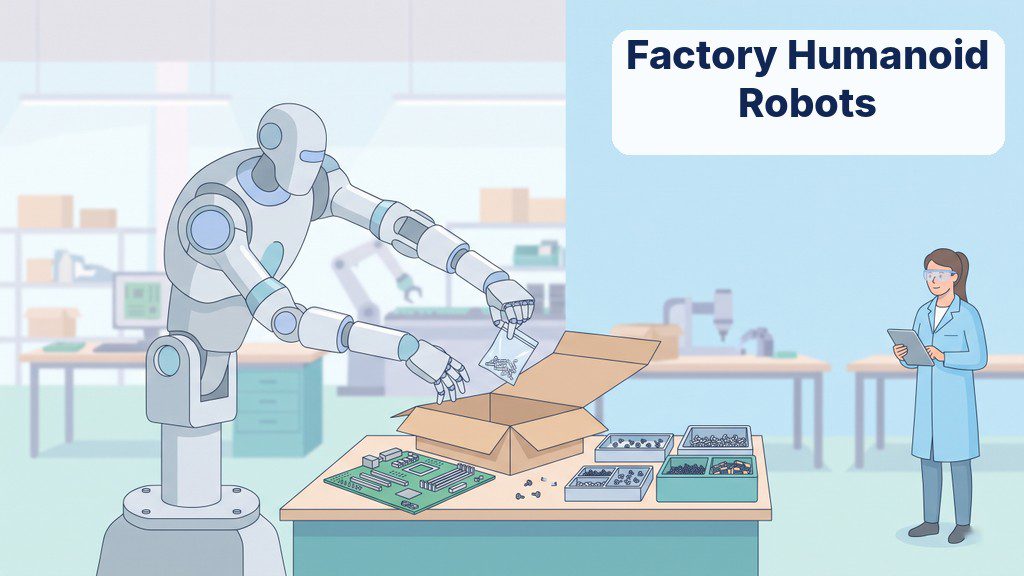
Humanoid robots now appear in countless online videos, dancing, sorting blocks and folding laundry. A factory manager, however, asks a much harder question about them. Can such a robot handle one real station for a full shift? In a November 13, 2026 post, ASUS describes its own answer, a humanoid called Gallop. Indeed, the Taiwanese computer maker is training Gallop at a real factory workstation. Gallop learns mostly by watching skilled workers, then practising on the same parts. As a result, the project tests whether factory humanoid robots can do everyday work. So far, ASUS has shared targets and designs, but no measured results. For students, in particular, the project shows how AI, mechanics and manufacturing meet.
Most factories are built around people, with stations and trays sized for human hands. Of course, traditional automation works very well for fixed, high-volume tasks. However, it struggles when the work changes from one production run to the next. A robot with two arms and dexterous hands could use the same stations. In that case, a factory would not need rebuilding around the machine. That is the main promise of factory humanoid robots. Still, ASUS admits that not every task needs a humanoid robot. Instead, the company says it picks only the tasks where the shape makes sense. It also owns electronics plants where it can test on real parts. By comparison, most robotics companies must rent such factory space, ASUS says.
Explainer: When AI Gets a Body
Until recently, most AI lived on screens, answering questions or writing text. Physical AI is different, because it lets software see, decide and move a machine. For example, a robot camera spots a part, and the AI plans a grasp. Motors then carry out the plan, while sensors check what actually happened. Industrial robots are already common, yet most repeat one fixed motion all day. According to the International Federation of Robotics, over 600,000 were installed in 2025. Overall, a record five million industrial robots now work in factories worldwide. In other words, factory humanoid robots would join an already busy workplace.
Gallop’s First Station: Small Parts, Clear Bags
Gallop’s first job is at an ASUS group electronics manufacturing plant. There, it is learning to pack the accessories that ship with motherboards. The station holds 15 small parts, and many sit in thin, clear bags. A skilled person takes about 20 seconds to pack each board. ASUS chose this station precisely because it is hard for machines. After all, small, thin and soft parts defeat a simple gripper. Moreover, the company judges itself by one simple rule for any robot. It must take on most of a job without a person standing beside it. That rule sets a high bar for factory humanoid robots.
A Target Set by Human Workers
ASUS has set a target of 99.5% success within 20 seconds. That is the same quality standard the company applies to a human worker. To put it differently, one failure in every 200 boards would be the limit. Meanwhile, the company says the full teaching loop now works on the line. First, a person shows the task, and then the robot learns it. After that, engineers test the result at the real station. Still, ASUS has not yet published a measured success rate or speed. For now, 99.5% in 20 seconds remains a goal rather than a result. Readers should therefore treat the target as a promise to check later.
How Robot Learning From Demonstration Works
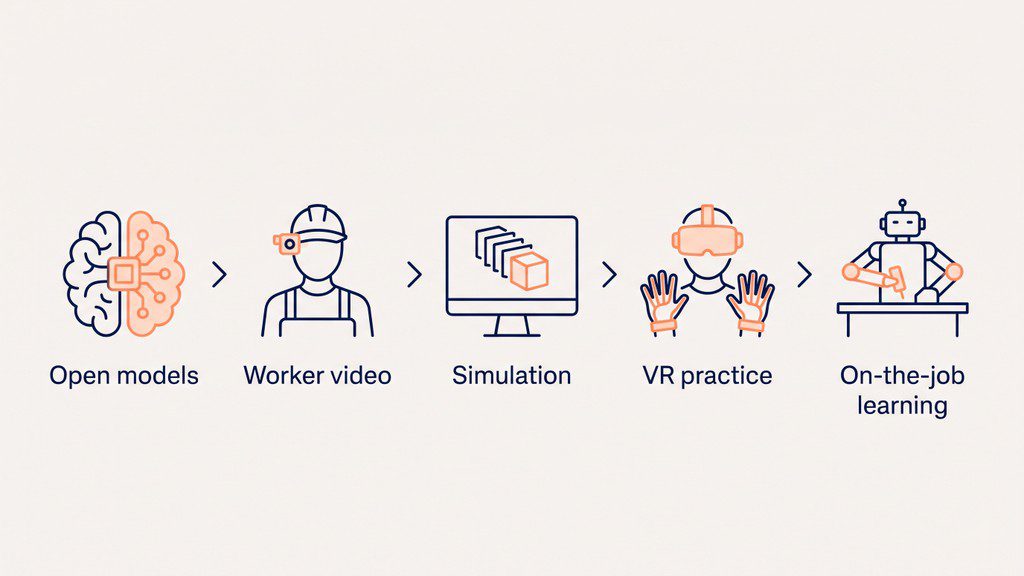
ASUS compares teaching Gallop to training a new colleague in five steps. To begin with, it starts from leading open AI models rather than building its own. These models already understand how hands and objects behave. Next, experienced workers wear small head cameras, with their consent, during real work. This robot learning from demonstration shows the robot how the job is truly done. In addition, ASUS believes its advantage is the right data, not simply more data. That means a real station, real parts and real quality rules. In particular, the company calls its workers the teachers behind Gallop’s skills.
Fig. 1: Gallop Learns in Five Steps, From Worker Videos to the Production Line
Practice in Simulation and Virtual Reality
Then, the third step uses simulation to create variations of each recorded example. As a result, small changes on the real line should not surprise the robot. For instance, a bag might sit at a new angle or spot. In the fourth step, an operator wears a VR headset and gloves. The operator then guides the robot through the task by remote control. Equally important, this practice uses the same parts and cameras as the real station. Finally, once Gallop is deployed, its own recordings feed back into training. Together, these steps aim to turn a few demonstrations into reliable skills. Our story on robots that rehearse delicate assembly in simulation explains a related idea.
Four Layers Inside the Robot
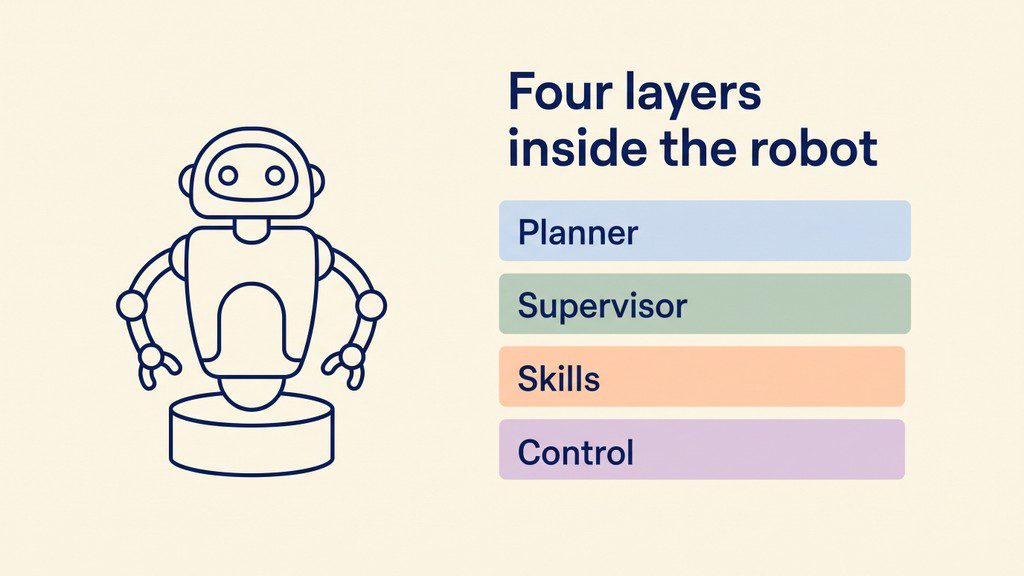
Inside, Gallop’s software works in four layers, each with its own job. At the top, a planner looks at the scene and breaks the job into steps. Below it, a supervisor, which is a second AI, checks every single step. If something goes wrong, the supervisor then makes a new plan. Then a skills layer handles reaching, grasping and placing the small parts. Finally, at the bottom, a control layer moves the arms and hands precisely. It also stops the robot instantly if anything looks wrong. What is more, the layers talk through fixed interfaces, like agreed plug sockets. For this reason, ASUS can swap in a newer AI model without rebuilding the robot.
Fig. 2: A Planner, a Supervisor, Skills and Control Work as Four Layers
A Dexterous Robot Hand With a Sense of Touch
All of Gallop’s software runs on one computer inside the robot. That computer is an NVIDIA Jetson AGX Thor, a module built for robots. According to NVIDIA, the module delivers up to 2,070 teraflops of AI computing. Moreover, ASUS designs the robot body and the hand itself. In fact, the company calls the hand the hardest part of any humanoid. Such hands are still scarce worldwide, so ASUS builds a dexterous robot hand in-house. The new hand will also have a sense of touch. Meanwhile, motors and other standard parts come from established partners. Today, Gallop works from a fixed base, and a wheeled version comes next.
Business Opportunities for Factory Humanoid Robots
Right now, electronics makers can watch how Gallop handles soft parts at existing stations. ASUS plans customer pilots in 2027, after showing Gallop at Computex 2027. After that, it is targeting market availability in the second half of 2028. If pilots meet the 99.5% target, factory humanoid robots could take over packing stations. That shift could create jobs in robot training, remote operation and maintenance. At the same time, some manual packing jobs could shrink. On the positive side, ASUS says teaching workers move into setup and supervision roles. However, that is the company’s stated plan, not an independent finding. Later, ASUS hopes similar pick-and-place skills will reach hospitals and service sites.
Careers and What to Study
Building factory humanoid robots needs people with many different skills. For example, robotics engineers design the arms, hands and sensors. AI engineers, in turn, train the models that plan and check each step. Manufacturing engineers decide which stations suit a robot and which do not. Robot operators and teleoperation trainers also guide robots through new tasks. According to the US Bureau of Labor Statistics, mechanical engineers earned a median $104,110. That figure is from May 2025, with 11% growth projected through 2035. These are US figures, and pay differs between countries. For study, consider robotics, mechanical, electrical or computer engineering, or computer science. Industrial and manufacturing engineering is another strong route into this field.
Limits Worth Keeping in Mind
Note that this story comes from a company blog, not a peer-reviewed study. ASUS has published no success rate, speed or number of working robots yet. Likewise, the in-house hand and the wheeled version are still plans. Besides, customer pilots are only due in 2027, and products in late 2028. Moreover, one packing station is a narrow test of a general-purpose robot. Even so, the post explains its engineering choices unusually clearly. In the long run, factory humanoid robots will be judged on daily results. As ASUS itself says, a demo shows a robot can do something once. A factory, by contrast, needs a robot that does the job every day.
The article explains physical AI, learning from demonstration and Gallop's four software layers in clear, student-friendly terms. Its figures match the ASUS post, including 15 small parts, about 20 seconds per board and the 99.5% target. It presents the target as a goal, not a result, and treats the worker-transition claim as ASUS's stated plan. Readers who want the company's own account should check the original ASUS post this story draws on.
Editorial note
ENTECH is running this Innovation because factory humanoid robots are moving from demo videos to real workstations. ASUS explains its engineering plainly: learning from worker videos, simulation and VR guidance, plus a layered control system with a supervisor AI. Students can see how AI, mechanics and manufacturing meet in one machine. The post is a company blog with targets, not measured results, and customer pilots start only in 2027. For the full details, we suggest readers turn to the original ASUS announcement.
Dinesh Joshi is a leading consultant in the field of product design and development, production engineering, industrial engineering, and program management. He has worked with esteemed domestic as well as European and US organizations.
Mr. Dinesh G. Joshi has completed Graduation in Mechanical Engineering from Pune University and thereafter pursued Post Graduation in Production Engineering from Walchand College of Engineering Sangli (Shivaji University). He is member of Project Management Institute (PMI), Pennsylvania, USA as well as Indian Institute of Welding (IIW) Kolkata. He has good blend of diversified experience of about 22 years in Product Design and Development, Production Engineering, Industrial Engineering and Program Management by virtue of working in the esteemed domestic as well as European and US organizations in addition to 5 years of academic experience.