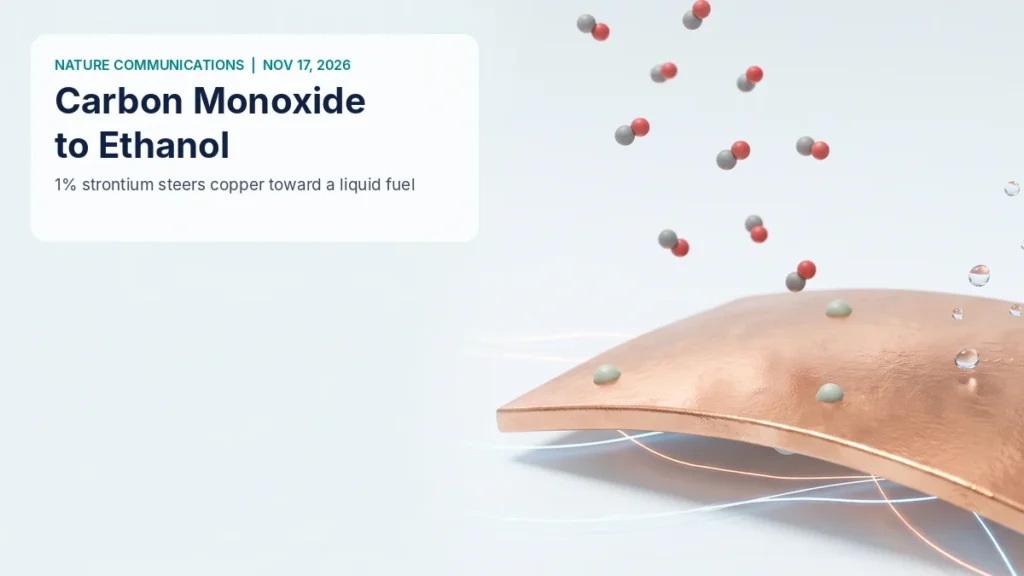
Squeeze a drop of hand sanitizer, and you’re holding plenty of ethanol. The same alcohol sits in the E10 fuel at many petrol pumps. Most of it starts life as corn or sugarcane in giant fermentation tanks. Now, what if a factory could brew it from waste gas and electricity instead? That idea has teased chemists for years. Turning carbon monoxide to ethanol with electricity sounds tidy on paper, at least. In practice, copper catalysts keep making a gas called ethylene instead. A team led by Zhejiang University in China says it found a fix. The trick is a pinch of strontium, a soft metal used in red fireworks. Their study appeared in Nature Communications on November 17, 2026. So how does one percent of a firework metal change a factory reaction?
Why Copper Struggles With Carbon Monoxide to Ethanol
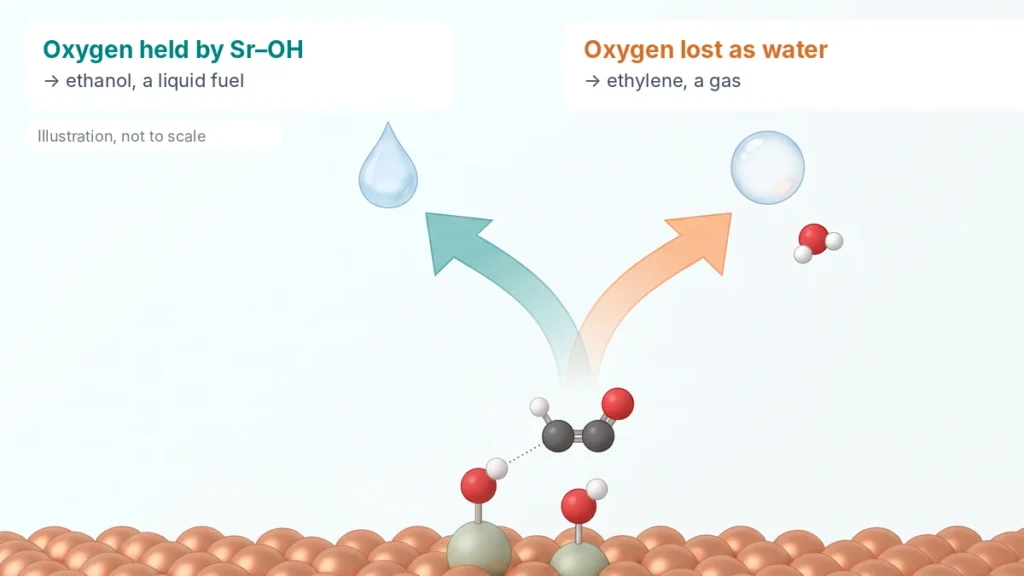
Copper is the only common metal that links carbon atoms well during electrolysis. That matters, because ethanol needs two carbons joined together. Carbon monoxide molecules land on copper, pair up and pick up hydrogen step by step. Somewhere along that route, the growing molecule reaches a fork. Keep its oxygen, and it becomes ethanol. Lose the oxygen, and it drifts toward ethylene, the gas behind most plastics. The authors write that this oxygen loss gets worse at high reaction rates. And high rates are exactly what a real plant needs to pay its bills. On plain copper, the team measured ethanol topping out near 40%. Ethylene took more than 20% of the electrons at the same time. Push the current higher, and ethylene and hydrogen kept climbing while ethanol fell.
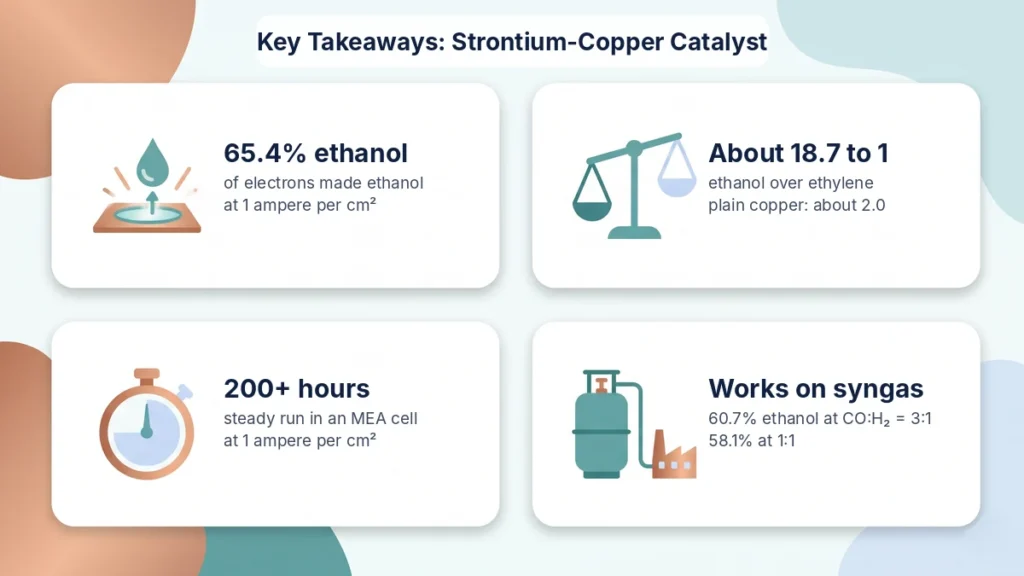
Fig. 1: Key Takeaways From the Strontium-Copper Study
The Fork in the Road Inside Each Molecule
Let’s follow one molecule for a moment. Two carbon monoxide pieces join into a small unit stuck to copper. Hydrogen atoms then arrive one at a time, and each one picks a spot. If hydrogen grabs the oxygen end, the carbon-oxygen bond gets longer and weaker. The team’s computer models showed one such bond stretching from 1.178 to 1.372 ångströms. A weak bond like that snaps easily, and the oxygen leaves as water. That snap sends the molecule down the ethylene road. If hydrogen lands on the carbon end instead, the bond barely changes. The oxygen stays, and ethanol remains on the menu. So the real job was to steer hydrogen away from that oxygen end. Simple to say, of course, but hard to build into a working surface.
Explainer: How Chemists Score a Catalyst
Two numbers decide whether a catalyst can leave the lab. The first is Faradaic efficiency, or FE for short. Think of electrons as delivery drivers, each carrying a parcel of energy. FE tells you what share of those drivers delivered to the product you wanted. An ethanol FE of 65% means about two thirds of electrons built ethanol. The rest went into ethylene, hydrogen or other side products. Our second number is current density, measured in amperes per square centimeter. It shows how fast the reaction runs on each patch of electrode. Many lab catalysts look brilliant at tiny currents and then fall apart. Industry, by contrast, usually wants currents of hundreds of milliamperes or more. One ampere per square centimeter is a common benchmark for serious electrolyzers.
What a Membrane Electrode Assembly Adds to the Test
Early tests often run in a flow cell, where liquid electrolyte washes past the electrode. That setup is handy for screening, but it isn’t what factories install. Commercial electrolyzers usually press the electrodes and a thin membrane into one sandwich. Engineers call this a membrane electrode assembly, or MEA. Gas flows in on one side, and products come out the other. The design is compact and easier to stack into large units. Passing an MEA test shows a catalyst can cope with real hardware. Durability counts too, measured in hours of steady running. Plenty of catalysts look great for ten minutes and then slowly degrade. So a long MEA run at high current is a strong early signal. It’s still far from a factory, but it’s a meaningful step.
Inside the Zhejiang Team’s Strontium Design
The team, led by Yang Hou of Zhejiang University, began with a simple idea. Hydroxyl groups, or OH, crowd onto copper during fast electrolysis. Usually they’re a nuisance, because they take spots that carbon monoxide needs. Hou’s group asked whether those OH groups could be parked somewhere useful. They chose strontium, a metal that grabs oxygen and OH strongly. First author Yaqi Chen and colleagues made copper catalysts with 0.5% to 2% strontium. Partners at Dalian University of Technology and The Chinese University of Hong Kong joined the work. X-ray tests at the Shanghai Synchrotron Radiation Facility tracked the strontium during the reaction. It changed from a carbonate form into an OH-rich form. In other words, each strontium site became a small OH parking spot beside the copper.
Fig. 2: How Sr–OH Sites Tip the Fork Toward Ethanol
How the Hydroxyl Anchor Holds On to Oxygen
Here’s the clever part of the design. The parked OH sits right next to copper, where molecules are growing. Its hydrogen leans toward the oxygen end of a nearby molecule. The two don’t form a true chemical bond, though. Instead, they share a weak, hydrogen-bond-like grip, a bit like a light magnet. Computer models put that contact at 1.942 to 2.180 ångströms. That gap is far longer than a real oxygen-hydrogen bond of about 0.98. Even so, the gentle grip protects the oxygen end from incoming hydrogen. New hydrogen then lands on the carbon end, and the carbon-oxygen bond survives. Meanwhile, nearby copper sites stay free to hold carbon monoxide and join carbons. Raman and infrared scans backed this up, showing different surface species with strontium present.
Carbon Monoxide to Ethanol Results That Hold Up Under Pressure
The best mix carried 1% strontium, written as Sr(1.0%)-Cu. At one ampere per square centimeter, its ethanol FE reached 65.4% in a flow cell. That works out to 0.64 amperes per square centimeter going into ethanol alone. Plain copper managed about 40.1% under the same conditions. Ethylene, meanwhile, dropped from 23.6% to just 3.5% with strontium added. So the ethanol-to-ethylene ratio climbed to roughly 18.7. Plain copper never beat about 2.0 across all the tested currents. Even at two amperes per square centimeter, ethanol FE stayed above 50%. More strontium didn’t help, by the way. Above 1%, strontium carbonate clumps formed and hydrogen production crept up. The authors suggest the sweet spot balances OH parking spots with free copper sites nearby. For carbon monoxide to ethanol, that balance seems to decide everything.
Controls That Rule Out a Lucky Fluke
Good science tries hard to prove itself wrong. The team mixed strontium carbonate powder with copper powder as a simple blend. That blend showed no ethanol boost at all and made more ethylene and hydrogen. Closeness at the atomic scale turned out to matter, not just the ingredients. Next, they added a chemical called N-methylimidazole, which strips OH from the surface. As its amount rose, the gap between treated and plain copper shrank. That fits the idea that parked OH drives the effect. They also swapped strontium for related alkaline-earth metals and saw similar gains. Finally, they ran tests in a water-free methanol electrolyte. Strontium still helped there, so a full network of water molecules isn’t required. Together, these checks make the hydroxyl-anchor story much harder to dismiss.
What Ethanol From Carbon Monoxide Could Mean for Industry
Next came the hardware test that engineers care about most. In a one-square-centimeter MEA, ethanol FE stayed above 50% from 0.2 to 2.0 amperes. At one ampere, it hit 64.6%, close to the flow-cell result. The cell then ran for more than 200 hours at that current. Researchers also fed it syngas, a carbon monoxide and hydrogen mix from industry. With a 3:1 mix, ethanol FE held at 60.7%, and 58.1% at 1:1. Syngas comes from gasifiers, and carbon monoxide also turns up in some steel-mill off-gases. Another route makes carbon monoxide from captured carbon dioxide, as an earlier tin-nickel catalyst story showed. Linking those steps could turn exhaust into liquid fuel using renewable power. It’s a long chain, though, and each link has to work reliably.
Who Could Use Ethanol From Carbon Monoxide First
Today’s ethanol mostly comes from fermenting crops or from chemically adding water to ethylene. An electric route could challenge both, at least for low-carbon markets. Aviation is one big draw, because ethanol can be upgraded into jet fuel. The US government’s Sustainable Aviation Fuel Grand Challenge targets 3 billion gallons a year by 2030. By 2050, it aims for 35 billion gallons, enough for all domestic demand. Electrolyzer makers, e-fuel startups and steel plants are the likely early testers. Chemical firms that buy ethanol as a solvent may follow later. A realistic horizon is three to ten years, if durability and cost keep improving. Before then, carbon monoxide to ethanol units must prove themselves at pilot scale. Earlier ENTECH coverage of a nitrate-to-ammonia catalyst at factory currents shows the same push toward industrial speeds.
Skills for Future Chemical Engineers
Work like this sits where chemistry, materials and engineering meet. Electrochemical engineers design cells and stacks that run for thousands of hours. Catalysis scientists build and test new surfaces atom by atom. Process engineers fit electrolyzers into plants with gas cleanup and product separation. Chemical technicians run the daily tests and keep instruments calibrated. Data scientists increasingly join these teams to spot patterns across thousands of runs. The O*NET profile for chemical engineers lists the core tasks and tools. Figures from the US Bureau of Labor Statistics show 21,900 chemical engineering jobs in 2025. It projects 5% growth from 2025 to 2035, faster than average. Median pay was $125,040 a year in 2025. Those numbers cover all chemical engineers, not only fuel-focused roles. Still, new routes like carbon monoxide to ethanol will need people who can scale them.
How Students Can Get Started Now
Start with solid chemistry, especially redox reactions and chemical bonding. Then add physics of electricity, so volts and amperes feel familiar. Calculus and basic statistics help when you read experimental plots. Next, try a simple school project that splits water with a battery. You’ll see bubbles form and can measure how fast they appear. Coding helps too, because Python handles data and simple simulations well. College students can take electrochemistry, reaction engineering and materials courses. Some labs also teach density functional theory, the computer method used in this study. Spectroscopy skills, like Raman and infrared, open doors in catalyst research. For a wider map of options, read our guide on stacking skills for energy-transition careers. Small steps now can lead to big projects later. Who knows, your first lab report could be about catalysts too.
Limits of This Carbon Monoxide to Ethanol Route
This result is promising, but it’s still early lab work. The MEA had an active area of just one square centimeter. Industrial stacks use cells hundreds of times larger, often joined in long rows. Full-cell energy efficiency was about 26.8% at one ampere per square centimeter. That means much of the electricity still ends up as heat and losses. Two hundred hours is solid, yet plants hope for many thousands of hours. The tests used a strong alkaline electrolyte at room temperature. Production costs and a full economic analysis are missing too. Its computer models describe trends for selected structures, not exact reaction speeds. Even so, the design idea feels fresh: treat OH as a helper, not a pest. If others repeat it at scale, ethanol from electricity could look far more practical.
References
Chen, Y., Wang, X., Wang, D., Liu, N., Chu, S., Wu, W., Yang, B., Li, Z., Zhang, Q., Lei, L., Wang, Y., & Hou, Y. (2026). Hydroxyl-mediated oxygen anchoring steers CO electroreduction toward ethanol. Nature Communications. https://doi.org/10.1038/s41467-026-79510-9
The idea of placing hydroxyl groups on purpose, rather than fighting them, is a fresh design principle, and the control experiments make the proposed mechanism more convincing. The write-up should present the computer modeling as describing trends rather than exact reaction speeds. It should also make clear that the electrolyzer tests used a small cell under laboratory conditions and that no cost analysis was reported. Readers who want the complete set of experiments should check the original research paper this story draws on.
Editorial note
ENTECH is running this story because turning waste gases and clean electricity into a liquid fuel could change how fuels and chemicals are made. The study gives students a clear look at how a tiny change at a catalyst surface can redirect a whole reaction. It also links chemistry, materials science and chemical engineering to growing careers in electrochemical manufacturing. The work is still at laboratory scale, so cost, energy use and long-term durability need much more testing. For the full methods and data, we suggest readers turn to the original research paper behind this story.
I am an inspirational writer and emerging science blogger with a deep-rooted passion for understanding and sharing the wonders of the world around us. My journey began with a Bachelor of Science in Chemistry from AKI’s Poona College of Arts, Commerce and Science, where I developed not only a strong foundation in scientific principles but also a mindset that values curiosity, observation, and critical thinking. Studying chemistry has taught me to approach problems with logic, to look beyond the obvious, and to see patterns where others might only see complexity. These experiences have shaped the way I perceive life and influence the way I express my thoughts, both scientifically and creatively.
I have always believed that knowledge is only as powerful as the way it is shared. This belief has guided me to create content that bridges the gap between science and everyday life. I aim to simplify complex scientific ideas so they become approachable, relatable, and engaging for everyone—whether someone has a formal background in science or is simply curious about the world. Science, in my view, is not confined to textbooks and laboratories; it is a way of thinking, understanding, and connecting with the world around us. By making science accessible, I hope to inspire curiosity, ignite learning, and encourage people to see the beauty and relevance of scientific discovery in their daily lives.
Alongside my love for science, I am deeply passionate about motivational writing. I believe words carry the power to transform perspectives, encourage self-reflection, and inspire action. By combining analytical thinking with creativity, I create content that is intellectually stimulating yet emotionally resonant. Whether I am breaking down a chemical concept, exploring a scientific phenomenon, or crafting motivational narratives, my goal is to communicate ideas in a way that is clear, meaningful, and impactful.
Through my work, I strive to empower my readers - not just by helping them understand the science around them, but by inspiring them to grow, learn, and realize their full potential. Every article, post, or story I write reflects my commitment to turning knowledge into inspiration. I want to spark curiosity, encourage self-improvement, and show that learning and personal growth are deeply connected. For me, writing is not just a craft; it is a way to touch minds, connect hearts, and make ideas come alive in a way that truly resonates.
I am an inspirational writer and emerging science blogger with a deep-rooted passion for understanding and sharing the wonders of the world around us. My journey began with a Bachelor of Science in Chemistry from AKI’s Poona College of Arts, Commerce and Science, where I developed not only a strong foundation in scientific principles but also a mindset that values curiosity, observation, and critical thinking. Studying chemistry has taught me to approach problems with logic, to look beyond the obvious, and to see patterns where others might only see complexity. These experiences have shaped the way I perceive life and influence the way I express my thoughts, both scientifically and creatively.
I have always believed that knowledge is only as powerful as the way it is shared. This belief has guided me to create content that bridges the gap between science and everyday life. I aim to simplify complex scientific ideas so they become approachable, relatable, and engaging for everyone—whether someone has a formal background in science or is simply curious about the world. Science, in my view, is not confined to textbooks and laboratories; it is a way of thinking, understanding, and connecting with the world around us. By making science accessible, I hope to inspire curiosity, ignite learning, and encourage people to see the beauty and relevance of scientific discovery in their daily lives.
Alongside my love for science, I am deeply passionate about motivational writing. I believe words carry the power to transform perspectives, encourage self-reflection, and inspire action. By combining analytical thinking with creativity, I create content that is intellectually stimulating yet emotionally resonant. Whether I am breaking down a chemical concept, exploring a scientific phenomenon, or crafting motivational narratives, my goal is to communicate ideas in a way that is clear, meaningful, and impactful.
Through my work, I strive to empower my readers – not just by helping them understand the science around them, but by inspiring them to grow, learn, and realize their full potential. Every article, post, or story I write reflects my commitment to turning knowledge into inspiration. I want to spark curiosity, encourage self-improvement, and show that learning and personal growth are deeply connected. For me, writing is not just a craft; it is a way to touch minds, connect hearts, and make ideas come alive in a way that truly resonates.