Chinese engineers built a sunlight-powered membrane that keeps drying very salty water without crusting over, and the water it collects is remarkably clean.
Leave a glass of salt water on a sunny windowsill for a week. Slowly, the water disappears, but a crusty white ring stays behind. That simple kitchen test shows a real engineering headache. Desalination plants, mines and factories make huge amounts of very salty leftover water. Engineers would love to dry it with free sunlight instead of costly fuel. However, salt crystals keep piling up on the drying surface. They act just like that ring in your glass. As a result, the part that catches sunlight soon clogs and slows down. Now a team in China has tackled this problem with smart chemistry. Their salt-resistant solar evaporator keeps working on brine four to six times saltier than seawater. On top of that, the water it collects is remarkably clean. So how does a thin sheet of fibers beat the salt?
The answer comes from the Institute of Process Engineering, Chinese Academy of Sciences. Partners at Delft University of Technology and Zhengzhou University also joined in. Together, they reported the work in the journal Communications Engineering on November 16, 2026. In short, the team built a fiber mat with tiny channels and fixed electric charges. The channels change how water sits inside the material. Meanwhile, the charges push salt away from the hot surface. Because of this teamwork, the device dried brine steadily through nine long test runs. At the same time, its main surface stayed free of salt crust. This study ties water, energy and chemistry into one neat package. For students, it also points to growing careers in clean water technology. Let’s see how it works.
Fresh water is getting scarce in many places. So more cities now turn to seawater desalination. Yet every desalination plant creates a second problem. In fact, large plants usually send 40 to 50 percent of their water back out. Engineers call that leftover stream concentrated brine. Put simply, almost half of what they pump in returns as salty waste. Dumping it creates real risks for nearby sea life. Many coastal towns already face shrinking coastal groundwater supplies. Wasting water there hurts twice. Meanwhile, squeezing the last water out of brine usually burns lots of energy. Solar-driven evaporation offers a cheaper route. It heats only the top skin of the water, not the whole tank. Even so, very salty brine creates a nasty salt problem for these devices.
Where All That Hypersaline Brine Comes From
Scientists call water with extreme salt levels hypersaline brine. Besides desalination plants, mines and salt lakes produce it too. For example, the team tested brines with 15 to 20 percent salt by weight. That range matches many natural salt-lake brines. Normal seawater, by comparison, holds only about 3.5 percent salt. So why not just let the sun dry these brines in open ponds? Sadly, ponds are slow. They also lose the water that escapes as vapor. Floating solar evaporators can catch that vapor and turn it back into usable water. Earlier designs, however, handled two key issues separately. Some changed how water behaves inside the material. Others used charged surfaces to steer salt. According to the authors, few had fully studied how both effects work together.
How the Salt-Resistant Solar Evaporator Works
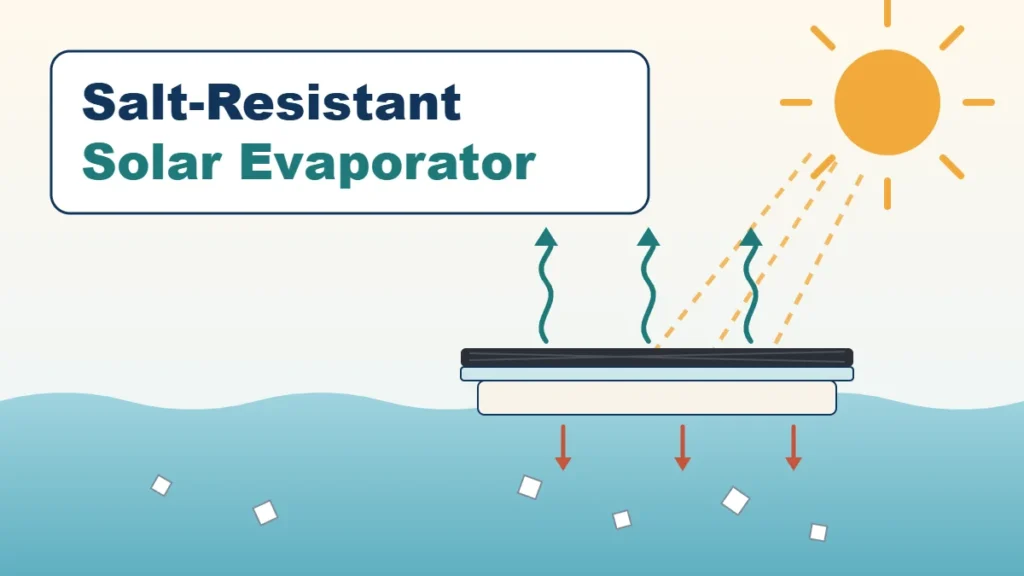
At first glance, the device looks like a dark, fuzzy sheet on foam. Each layer, though, has a clear job. First of all, the top layer is a mat of plastic fibers made by electrospinning. That process uses an electric field to pull liquid plastic into very thin threads. Next, the team mixed in MXene, a dark nanomaterial that soaks up sunlight. They also added a building block that carries sulfonate groups. These groups hold negative charges. Below the top layer, a second fiber mat wicks water upward like a candle wick. Finally, a foam base keeps the stack afloat and stops heat from leaking away. As a result, sunlight warms only the thin wet surface where vapor forms. The top layer soaked up nearly 88 percent of incoming light. That heat focus is the first trick behind its speed.
Fig. 1: Three Layers Inside the Solar Evaporator
Building Tiny Channels Inside a Solar Evaporator
The second trick happens at a scale far smaller than a hair. To begin with, the team soaked the fiber mat in a chemical bath. Then they heated it for three hours. During each soak-and-heat round, a new porous polymer grew on the fibers. After four rounds, the fibers carried pores only about 2.3 nanometers wide. For a sense of scale, a human hair is tens of thousands of times wider. Still, the bigger gaps between fibers stayed open for water flow. A fifth round, by contrast, overgrew the polymer and clogged those gaps. Its drying speed then dropped by about a fifth. Thus, four rounds became the sweet spot. How fast was that best version? In pure water under one sun, it dried 1.61 kilograms per square meter hourly.
Lab Results From the Solar Brine Evaporator
Of course, the real test was brine, not pure water. In 15 to 20 percent salt water, the rate dipped only a little. It stayed at about 1.3 kilograms per square meter each hour. Better yet, it held that pace across nine back-to-back 12-hour runs. Afterward, its main surface showed no visible crust. Only small salt deposits formed near the edge. What about the water it produced? The collected water lost more than 99 percent of its sodium. Similarly, the main dissolved metals dropped a thousand to ten thousand times. The authors say this matches the WHO drinking-water guidelines for those metals. It also worked in very acidic and very basic brine. With a vacuum pump added, the rate climbed to 2.04 kilograms. That is over 50 percent faster.
The Science of Loosely Held Water and Fixed Charges, Explained
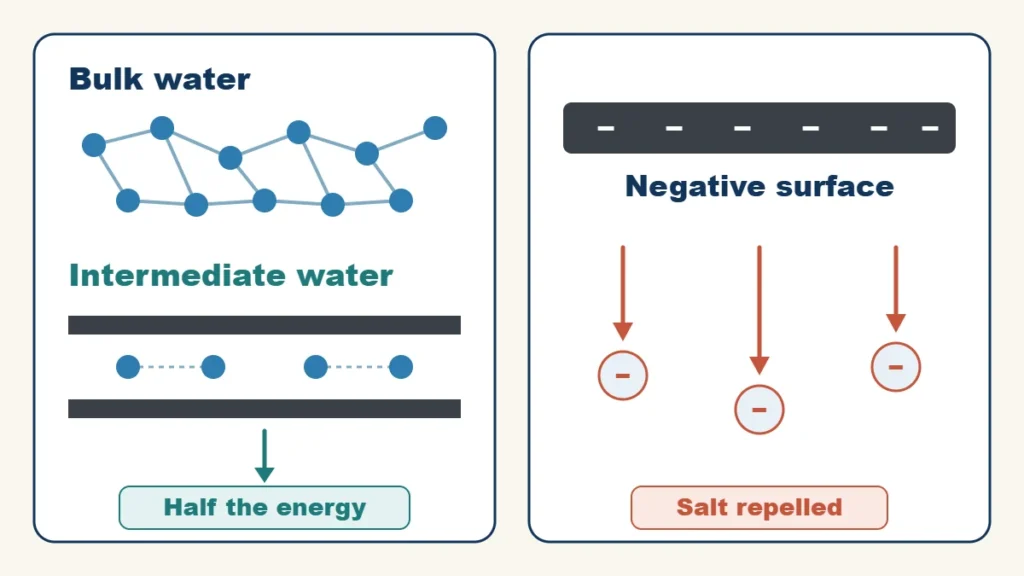
Let’s slow down and unpack the two key ideas. To start, think about how a normal kettle works. It heats every drop of water, even the drops at the bottom. By contrast, an interfacial evaporator heats only a paper-thin layer on top. Less energy goes to waste, so more of it turns water into vapor. Many towns rely on conventional wastewater treatment steps instead. Those plants use pumps, tanks and power-hungry machines. Solar evaporators, on the other hand, need no fuel at all. Yet saving heat is only half the story. The other half depends on how water molecules hold hands inside the material. That is where two ideas come in. Scientists call the first one intermediate water. The other is the Donnan effect, which handles the salt. Both work together in this design.
Fig. 2: Intermediate Water and the Donnan Effect
Why Intermediate Water Escapes More Easily
Water molecules grab each other through weak links called hydrogen bonds. In a glass of water, each molecule clings to several neighbors. Breaking all those links costs energy. That is why boiling takes so long. Inside very tiny channels, however, molecules cannot form their usual full network. Scientists call this looser state intermediate water. It is not stuck to the walls, yet it is not fully free either. Here, the nanochannels raised the share of intermediate water from about 1 to 90 percent. As a result, the energy to evaporate each kilogram fell sharply. It dropped from about 2,266 to 1,142 kilojoules. In other words, the device needed roughly half the energy that ordinary water needs. Isn’t that a neat payoff from simply making holes smaller? Small changes in shape can matter a lot.
How Negative Charges Keep Salt Away From a Solar Evaporator
Now for the salt-fighting trick, called the Donnan effect. Salt in water splits into positive sodium ions and negative chloride ions. The sulfonate groups give the fiber surface a strong, fixed negative charge. Because like charges repel, those fixed charges push chloride ions away. At the same time, charges must stay balanced near the surface. So fewer chloride ions means fewer sodium ions can gather there too. That uneven sharing of ions near a charged surface is the Donnan effect. In practice, it slows salt buildup right where water evaporates. Crystals then have a much harder time forming on the hot top layer. Here is the clever part. On their own, the charged groups made the water too free and mobile. The nanochannels balanced that out. They restored the helpful intermediate water.
Challenges and Motivation Behind This Salt-Resistant Solar Evaporator
Why did the team chase such a tricky balance? Above all, they wanted a solar device that handles real brine for a long time. Desalination keeps growing worldwide, and so does its brine waste. Even so, getting both goals at once proved hard. Adding sulfonic acid boosted the negative charge, which helped fight salt. However, it also pushed nearly all the water into a fast, free state. Ironically, that state needs more energy to evaporate. The nanochannels solved this conflict, but only within a narrow window. One extra soak-and-heat round already clogged the pores. The amount of MXene mattered too. Too much of it clumped and blocked the fibers. You can read every tuning step in the team’s full paper. Such trial and error is everyday life in materials engineering.
What Still Needs Proof Before Real Use
For now, most results come from a lab lamp that copies sunlight. The team did run one short outdoor test in Beijing on a cold December day. Even in weak winter sun, it dried over 0.4 kilograms per square meter hourly. In fact, the authors call it only a preliminary demonstration. Real brines also contain more than table salt. For instance, magnesium slowed the rate slightly. Sulfate cut it nearly in half. On top of that, the team wants longer tests in real, dirty brines. In addition, they still must make large sheets with even nanochannels everywhere. Finally, the faster vacuum mode needs extra equipment, which adds cost. In short, this salt-resistant solar evaporator looks promising. It is not ready for factories today, though. More testing will decide its future.
What Sunlight-Powered Brine Treatment Means for STEM Careers
So what does this mean for you? First, water treatment is quietly becoming a high-tech field. Designers now mix nanotechnology, chemistry and solar energy to fix old problems. For example, ENTECH recently covered a sun-powered nitrate removal reactor for well water. Clearly, cleaning water with sunlight is a growing trend. Suppose projects like this scale up one day. Desalination plants could then recycle more brine and recover more salt. That shift would need membrane scientists and desalination engineers. Environmental process engineers and solar thermal engineers would join them. To get there, focus on chemistry, chemical engineering, environmental engineering or materials science. Meanwhile, try drying a cup of salty water in the sun at home. It makes a fun start. After all, every big water solution begins with a curious mind.
The article does a good job of turning two abstract ideas, loosely held water in tiny channels and charge-driven salt repulsion, into everyday language. It could go further by comparing this approach with conventional evaporation ponds and thermal crystallizers so readers can judge its practical value. A short line on why mixed salts such as sulfate slow the device would also help. Readers who want the complete experimental details should turn to the original source paper this story is based on.
Editorial note
We are featuring this study because clean water and smart materials meet here in a way any student can start exploring with a glass of salty water on a windowsill. It shows how chemistry at the scale of a few nanometers can ease a large environmental problem: the salty waste that desalination leaves behind. It also points toward careers in water treatment, membrane science and solar engineering. Most results still come from the lab, so practical use will depend on larger and longer trials. For the full methods and data, we invite readers to consult the original research paper behind this story.
I am an inspirational writer and emerging science blogger with a deep-rooted passion for understanding and sharing the wonders of the world around us. My journey began with a Bachelor of Science in Chemistry from AKI’s Poona College of Arts, Commerce and Science, where I developed not only a strong foundation in scientific principles but also a mindset that values curiosity, observation, and critical thinking. Studying chemistry has taught me to approach problems with logic, to look beyond the obvious, and to see patterns where others might only see complexity. These experiences have shaped the way I perceive life and influence the way I express my thoughts, both scientifically and creatively.
I have always believed that knowledge is only as powerful as the way it is shared. This belief has guided me to create content that bridges the gap between science and everyday life. I aim to simplify complex scientific ideas so they become approachable, relatable, and engaging for everyone—whether someone has a formal background in science or is simply curious about the world. Science, in my view, is not confined to textbooks and laboratories; it is a way of thinking, understanding, and connecting with the world around us. By making science accessible, I hope to inspire curiosity, ignite learning, and encourage people to see the beauty and relevance of scientific discovery in their daily lives.
Alongside my love for science, I am deeply passionate about motivational writing. I believe words carry the power to transform perspectives, encourage self-reflection, and inspire action. By combining analytical thinking with creativity, I create content that is intellectually stimulating yet emotionally resonant. Whether I am breaking down a chemical concept, exploring a scientific phenomenon, or crafting motivational narratives, my goal is to communicate ideas in a way that is clear, meaningful, and impactful.
Through my work, I strive to empower my readers - not just by helping them understand the science around them, but by inspiring them to grow, learn, and realize their full potential. Every article, post, or story I write reflects my commitment to turning knowledge into inspiration. I want to spark curiosity, encourage self-improvement, and show that learning and personal growth are deeply connected. For me, writing is not just a craft; it is a way to touch minds, connect hearts, and make ideas come alive in a way that truly resonates.
Sailee Pakhare holds a Master's degree in Biotechnology, with a research background spanning microbiology, molecular biology, and disease biology. Her postgraduate dissertation examined the antimicrobial potential of bioactive peptides from lactic acid bacteria, and her research experience includes molecular identification of bacterial isolates (with sequencing data submitted to NCBI) and work as a Research Assistant at SafeWright Laboratory. She also completed a summer internship at IIT Hyderabad studying circadian rhythms and disease biology using Drosophila melanogaster as a model organism.
Her work has been recognized with the Best Poster award at the 3rd International Conference on Innovations in Biotechnology Research for Sustainable Bioresources and Bioeconomy (2025), and she has contributed to a book chapter on the role of AI and machine learning in climate change.
Sailee is also a co-founder of LifeXtension, a community focused on longevity, ageing, and health science awareness in India. An interdisciplinary thinker, she explores questions ranging from disease biology to space and the origins of life, approaching science as a way of asking questions rather than a fixed body of facts. As a science communicator and researcher, she is committed to translating complex research into writing that is clear, accurate, and engaging.