Zhejiang University researchers loosened polyester structure so a mild catalyst could pull polymer-grade PET building blocks from blended clothing waste.
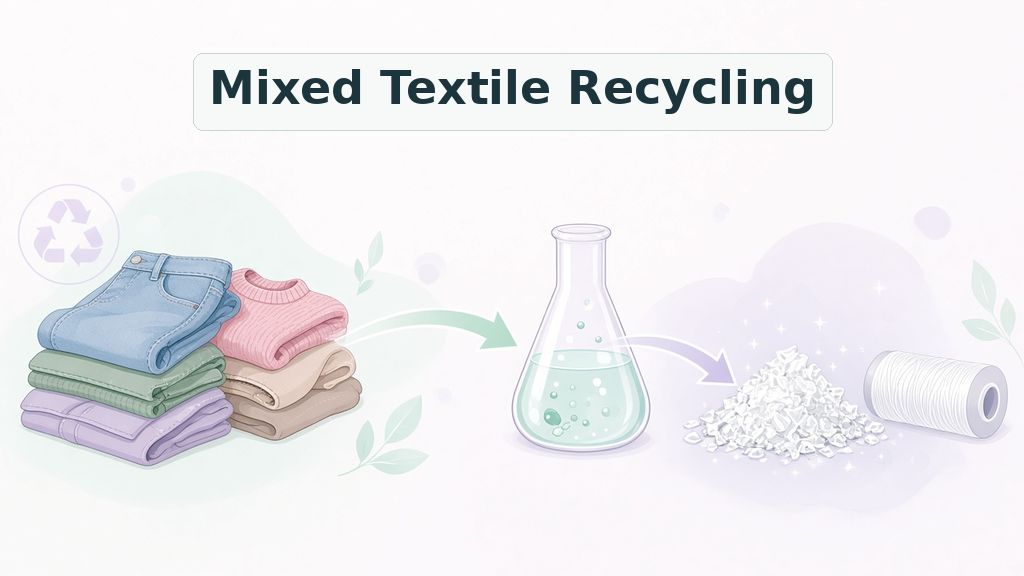
A favorite hoodie often carries a tag listing polyester, cotton, and a little spandex. However, that comfy blend becomes a puzzle once the hoodie wears out. Now researchers at Zhejiang University and Qingdao University report a cleaner path forward. First author Cheng Liu worked with senior researchers Ning Zheng and Tao Xie. Their mixed textile recycling method pulls pure polyester building blocks from blended fabric waste. To begin with, the team melts shredded fabric and cools it quickly in water. Next, hot methanol and a mild catalyst break only the polyester apart. As a result of this, cotton, nylon, and spandex mostly stay solid and filter away. The recovered building block is pure enough for making new polyester. Their open-access Nature Communications study gives full details. At the same time, a cost model suggests the route could compete with oil-based supply.
Polyester is the everyday name for a plastic called PET, or polyethylene terephthalate. The paper notes that the world uses over seventy million tons of it yearly. About two-thirds of that PET goes into textiles, while packaging takes the rest. In contrast, bottles already have a working recycling route. Recyclers melt clean flakes and reshape them, often into fiber for clothing. However, repeated melting shortens the polymer chains and weakens the plastic. In other words, each loop tends to produce a lower-grade product. Discarded textiles form an even bigger pile, about ninety-two million tons each year. Yet recyclers reclaim under one percent of that waste, according to cited sources. EPA textile waste data show US landfills took about two-thirds of 2018 textile waste. For this reason, clothing waste has become a serious environmental target.
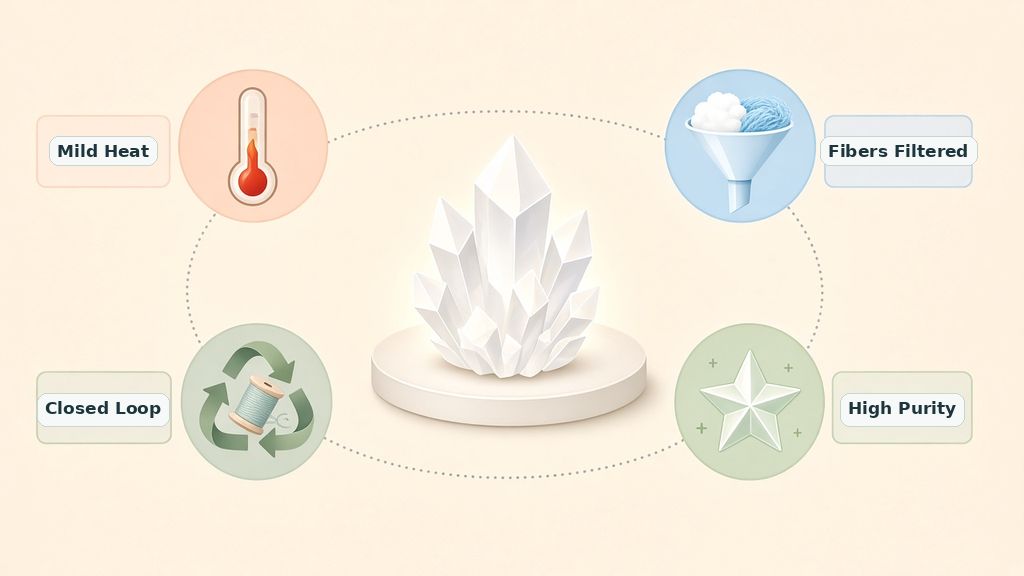
Fig. 1: Key Takeaways From Selective PET Recycling
Blended Fabrics Need A More Selective Chemistry
A single shirt can mix PET with cotton, nylon, polyurethane spandex, and dyes. Melting such a blend cannot give clean plastic, because each part behaves differently. Chemical recycling breaks PET back into its small starting molecules, called monomers. Then factories can rebuild those monomers into fresh polyester. This sounds perfect for closed-loop PET recycling, on the one hand. On the other hand, harsh chemistry also attacks cotton, nylon, and dyes. As a result, a messy, costly soup forms. Monomers must reach at least 99.9 percent purity for new polymer production. In other words, that leaves less than one impurity part in every thousand. The authors explain that each extra nine after the decimal point raises cost. Earlier textile routes reported purities between about 98 and 99.7 percent. Coverage of the fashion industry’s textile waste challenge shows why a more selective tool matters.
The Simple Science Of Breaking Polyester Apart
Think of PET as a very long necklace made from repeating beads. Chemical links called ester bonds hold each bead to the next. Methanol, a simple alcohol, can swap into those links and cut them. In other words, chemists call this methanolysis, or splitting with methanol. Each cut releases a small molecule called dimethyl terephthalate, or DMT. In addition, the reaction frees ethylene glycol, the second PET building block. DMT matters because chemists can purify it by distillation and crystallization. At the same time, a catalyst speeds the cutting without getting used up. Here the team chose tetramethylguanidine, or TMG, an inexpensive organic base. However, earlier studies often treated its low activity as a drawback. ENTECH has also covered a zinc catalyst approach that pursued strong catalytic action. Instead of seeking a stronger catalyst, this team changed the plastic itself.
Fast Cooling Keeps Polyester Chains Loose
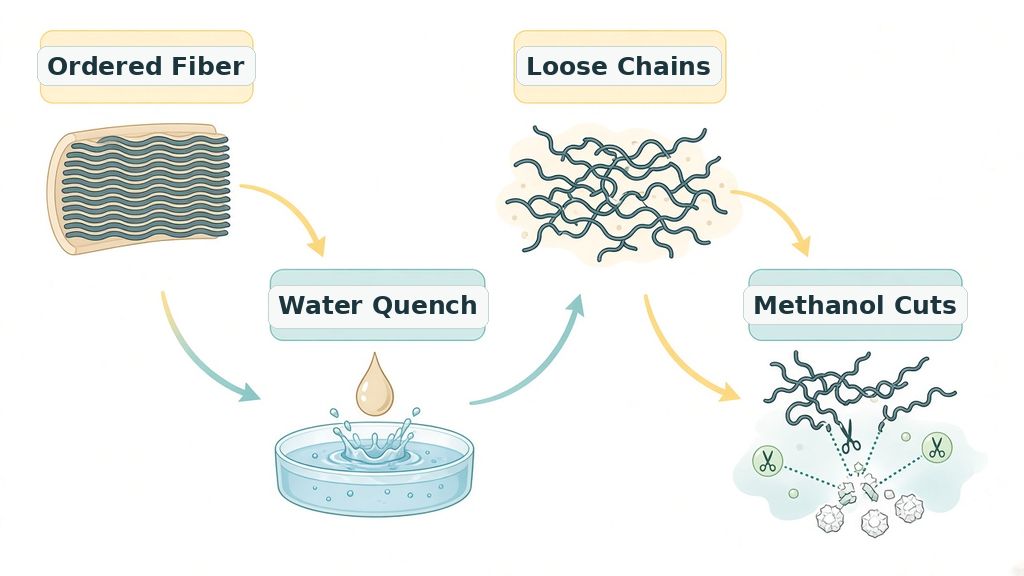
Fiber spinning stretches polyester and lines up its chains into tidy, packed zones. These ordered zones, called crystalline regions, block methanol from reaching the bonds. Untreated polyester fibers lost only about seven percent of their mass in the standard test. Next, the team melted fibers, cooled them in air, and ground them into powder. That powder lost about thirty-one percent, a clear but modest gain. Then they tried cooling the melt in room-temperature water instead. Fast cooling froze the chains before they could line up again. Crystallinity dropped from about 37 percent to about 12 percent, roughly one-third. In contrast to that, the chain length and chemical structure stayed the same. As a result of this, the water-cooled powder dissolved completely within one hour. After crystallization, DMT came out at 94 percent yield and 99.98 percent purity.
Fig. 2: Water Quenching Opens PET To Methanol
Methanol Beats Glycol At Cutting PET Chains
Many recyclers prefer ethylene glycol over methanol for breaking down PET. Glycol boils at a higher temperature, so reactions can run hotter and faster. Methanol boils easily, so fast methanol routes have often needed extreme pressure. However, a direct comparison gave the team a surprise. Under identical mild conditions, methanol broke down about 99.9 percent of quenched PET. In contrast, glycol managed only about 17.8 percent, roughly one-sixth as much. The authors link this gap to glycol’s two reactive ends. When glycol cuts a chain, the new chain ends can grab neighboring bonds. In other words, some cuts simply reconnect pieces instead of freeing building blocks. Methanol has only one reactive end, so each cut counts. The standard reaction ran near 100 °C, close to boiling water, for one hour. In addition, a sealed vial held about three and a half times normal air pressure.
What The Mixed Textile Recycling Tests Revealed
The team first built a test blend that copies typical clothing waste. It held about half PET, a quarter cotton, and some nylon and polyurethane. In Process I, a solvent removed polyurethane and most dyes before the main reaction. Next, a second solvent mix dissolved the cotton, recovered as pulp at 96 percent. The remaining solids then went through melting, water cooling, grinding, and methanol treatment. As a result, DMT came out at 91 percent yield and 99.97 percent purity. The catalyst returned at 95 percent, and distillation could recover the solvents for reuse. Not only did this route recover DMT, but it also returned usable cotton. However, heating solvents for recovery used much of the energy budget. For this reason, the team designed a leaner second route for polyester textile recycling.
A Gentle Catalyst Leaves Cotton And Nylon Untouched
Process II skips the solvent cleanup steps entirely. That shortcut works only if the reaction attacks PET and ignores everything else. For this reason, the team treated eight fiber types separately under identical conditions. PET lost about 99.4 percent of its mass, so nearly all of it broke down. In contrast, cotton, nylon, wool, linen, silk, acrylic, and polyurethane stayed mostly intact. Polyurethane lost about 5.7 percent, close to the 5.3 percent lost in plain methanol. In other words, the catalyst barely touched it. Infrared scans also showed no detectable change in these leftover fibers. Because the leftovers stay solid, simple filtration removes them. At the same time, distillation pulls most dye molecules away from crude DMT. This selectivity turns a messy separation problem into a simple sieving step.
PET Textile Recycling Clears The Purity Bar
The strongest test used a blind sample of industrially collected, post-consumer textile waste. A blind sample means the team did not know its exact makeup beforehand. First, the team shredded, melted, water-quenched, and milled the fabric into powder. That powder went straight into the methanol reaction without any pre-separation. Then filtering, washing, distillation, and crystallization produced clean white DMT. Chromatography measured its purity at 99.92 percent. In other words, that figure clears the bar for making new PET. The paper’s abstract pairs that purity with a 91 percent DMT yield. As a result of this, roughly nine of every ten possible DMT molecules returned. On the other hand, the work remains at laboratory scale for now. Still, the open-access research article offers an exciting glimpse of fiber-to-fiber PET textile recycling.
Challenges And Motivation Behind Closed-Loop PET Recycling
The team’s motivation came from a clear economic gap. Recycled PET usually sells at a premium over fresh oil-based PET. Mixed textiles were even harder, because blended fibers and dyes made cleanup costly. Therefore, the researchers set two goals: gentle, selective breakdown and low-cost purity. As a result, reaching both goals meant going against a common trend in the field. Most studies chase ever more active catalysts for faster PET breakdown. However, the authors argue that highly active catalysts also attack other fibers. For this reason, they paired a weak catalyst with low-crystallinity plastic. Even so, several challenges remain open. Above about 100 °C, gains slowed, possibly because PET began to recrystallize. The team says that behavior still needs study under reaction conditions. Finer powder broke down faster, but finer grinding costs more energy and time.
A techno-economic analysis estimates whether a process could make money at plant scale. To begin with, the team modeled a plant producing 150,000 tons of DMT yearly. Next, Process II assumed waste fabric costing $70 to $139 per ton. With Chinese power near six cents per kilowatt-hour, DMT cost $653 to $816 per ton. In contrast, US rates near eight cents raised costs to $854 to $1,017 per ton. The paper drew that US rate from the US Energy Information Administration. Both ranges sit well below the market price of $1,530 to $1,878 per ton. In other words, recycled DMT could cost roughly half the market price. However, electricity price changes the result, so cheap clean power matters for mixed textile recycling. Meanwhile, the model burns leftover cotton, nylon, and dyes for energy recovery. That choice offsets disposal costs but does not recycle those fibers.
New Careers Could Grow Around Recycling Plants
The authors suggest recycling plants could one day partly replace oil refineries. As a result, that vision would need people skilled in chemistry and large-scale engineering. Future sites would therefore rely on process engineers, polymer chemists, and distillation operators. Textile sorting specialists could also prepare consistent waste feedstock for these reactors. Students drawn to this path can build skills in organic chemistry, thermodynamics, and process design. In addition, life-cycle assessment helps engineers compare environmental costs across whole systems. Similarly, greener denim dyeing methods show that cleaner textiles can start at the factory. Not only does recycling need better chemistry, but it also needs smarter product design. The authors stress designing plastics that recyclers can process cheaply from the start. For this reason, tomorrow’s materials scientists may shape clothing long before it reaches a store.
Conclusion: Old Clothes With A Bright Future
This study shows that gentle chemistry can sometimes beat brute force. By loosening polyester structure first, the team let a mild catalyst work selectively. As a result of this, mixed textile recycling may not need costly sorting first. The process recovered DMT pure enough for new PET from real clothing waste. At the same time, important steps remain before any factory adopts it. Larger trials would likely need varied waste, long run times, and full solvent recovery. Cheaper renewable electricity would also strengthen the cost case. Even so, the work points toward a hopeful future for old wardrobes. Tomorrow’s jackets could carry polyester that once lived in yesterday’s T-shirts. For students, this story links chemistry, engineering, and sustainability in one exciting challenge. Readers who want every detail can find full data in the open-access paper.
References
Liu, C., Wang, J., Wan, H., Gao, L., Zhang, H., Li, B., Zheng, N., & Xie, T. (2026). Selective depolymerization of poly(ethylene terephthalate) for economical closed-loop recycling of mixed textiles. Nature Communications. Advance online publication. https://doi.org/10.1038/s41467-026-78713-4
This piece explains the crystallinity idea clearly and keeps the chemistry approachable for younger readers. A short note on how methanol and solvent handling would be managed at larger scale would strengthen the practical picture. Future coverage could also follow whether pilot trials confirm the cost model on varied clothing waste. Readers are encouraged to consult the original research paper on which this story is based.
Editorial note
Old clothes rarely make headlines in a chemistry story, yet this study turns a wardrobe problem into an engaging lesson on polymer structure. ENTECH chose it because it ties chemistry, engineering, and sustainability careers together for students. The cost estimates come from a process model rather than a running plant, and the leftover cotton and nylon are burned for energy rather than recycled in this route. For the full methods and data, we invite readers to turn to the original Nature Communications paper.
Dr. Sandeep Mukund Shiyekar is a distinguished civil engineer, academic leader, and continuum mechanics researcher with over 20 years of expertise in structural engineering, advanced materials, and computational mechanics. He holds a Ph.D. from IIT Bombay and completed prestigious post-doctoral research at Virginia Tech’s Aerospace Engineering Department under a NASA federal grant, where he worked on structural damage tolerance and progressive failure analysis for NASA and Airbus projects.
Throughout his career, Dr. Shiyekar has served as Professor, Head of Department, and College Principal, mentoring four Ph.D. scholars and over twenty postgraduate students. He is an expert in Finite Element Analysis (FEA), using advanced computational tools like ABAQUS, MSC.Marc, and STAAD.Pro to evaluate functionally graded materials, composite laminates, and structural dynamics. He has led over 200 structural design projects, secured major competitive research grants—including ₹12.85 Lakhs from ISRO—and published a NASA Technical Report alongside numerous peer-reviewed papers and book chapters.
As a Chartered Engineer and an active member of international engineering bodies, Dr. Shiyekar brings world-class research experience to ENTECH Magazine, sharing authoritative insights on computational mechanics, aerospace-grade structures, and smart materials innovation.