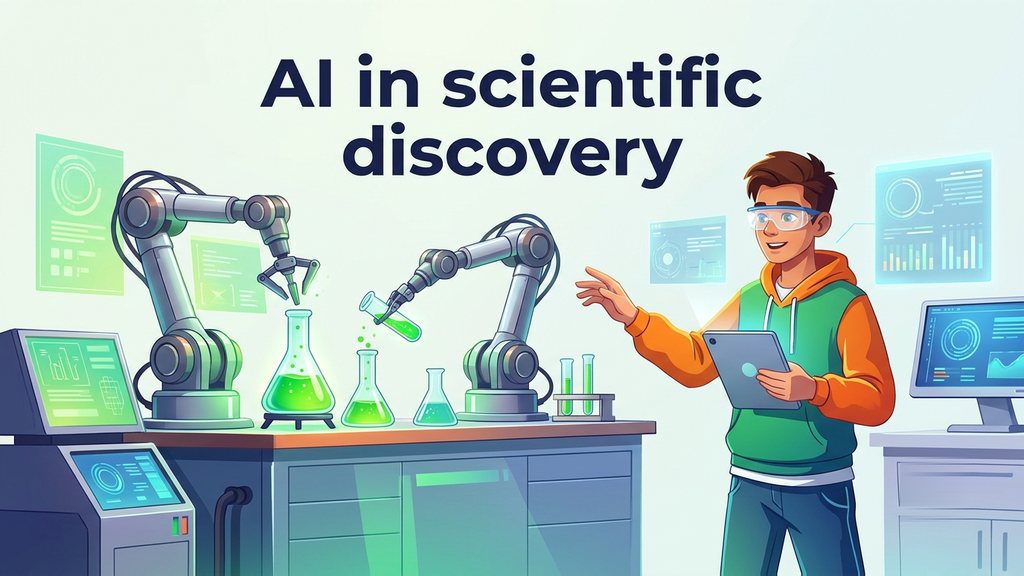
Science has always paid for its answers with time. For example, a new medicine or alloy can take years to confirm. Each step, meanwhile, waits on experiments, instruments and patient human hands. Today, though, that slow rhythm is under real pressure. AI in scientific discovery promises to shrink some research timelines dramatically. Stanford’s AI100 study panel says years can become months or even weeks. Speed, however, creates a second and much harder problem. When machines produce findings quickly, someone must still prove them true. This explainer therefore follows the problem, the tools and the trade-offs. It also asks what the shift means for business, classrooms and careers.
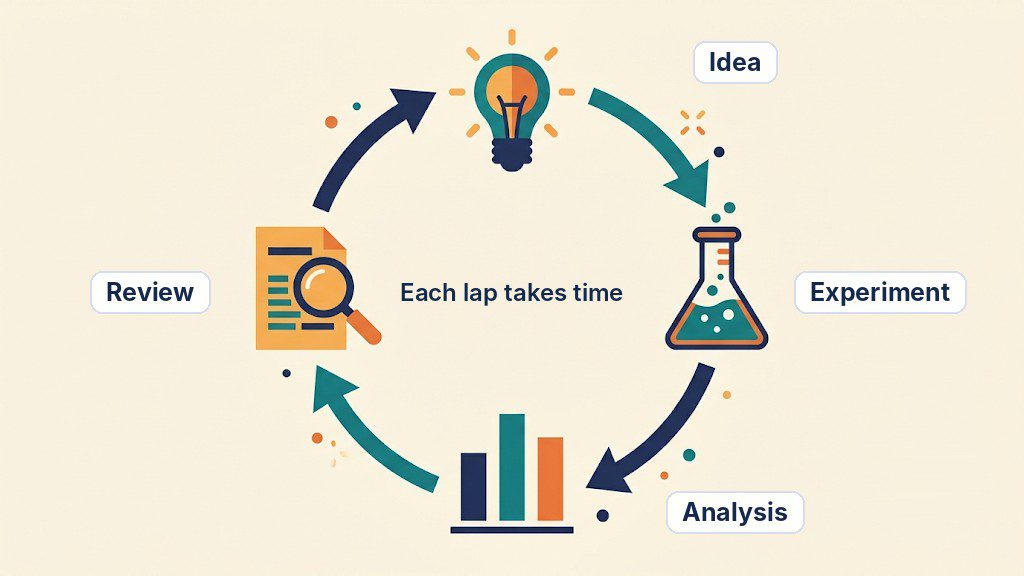
Discovery rarely arrives as a single flash of genius. Instead, it crawls through a loop of guessing, testing and checking. A researcher first forms a hypothesis, which is simply a testable guess. Then an experiment must be designed, funded, run and repeated. After that, the data needs cleaning, careful analysis and honest doubt. Finally, other experts review the claim before anyone fully trusts it. Because every stage depends on people, each stage adds delay. As a result, whole careers have been spent on one stubborn question. For students, the loop also explains why textbooks change so slowly. To see why AI in scientific discovery matters, start with that delay.
Fig. 1: The Classic Research Loop
The Long Road From Idea to Evidence
Consider the three-dimensional shape of a single protein molecule. Proteins, in short, are the working molecules inside every living cell. In fact, their folded shape decides what they can do in the body. For decades, finding one structure meant months of painstaking laboratory work. First, teams grew crystals, and then they fired X-rays at them. Meanwhile, millions of other proteins simply waited in the queue. Materials science, similarly, faced a wall of its own. A chemist could mix and test only so many compounds each year. As a result, promising ideas often died before anyone tried them. Consequently, nobody could say how many good answers were lost.
Time is not the only price of slow science. Money, equipment and trained people are also strictly limited. Therefore, laboratories must choose which questions deserve a chance. Many reasonable hypotheses, as a result, are simply never tested. That hidden loss is the real problem behind the headlines. Patients, for instance, wait longer for treatments, and engineers wait for better materials. Climate and energy research, in particular, cannot afford endless delay. So the search began for tools that could widen the funnel. Eventually, software that learns from data became one strong answer. Its arrival changed what a single laboratory could attempt in a year.
Where AI in Scientific Discovery Changes the Pace
AI in scientific discovery attacks the slowest part of the loop first. It learns patterns from past results and then predicts new ones. Because predictions are cheap, a model can screen huge numbers of options. Researchers then send only the best candidates to the laboratory bench. According to the AI100 panel, the gains follow a clear pattern. Specifically, AI helps most where data is plentiful and hypotheses are many. It also needs a relatively easy way to verify each guess. Without that check, fast prediction is nothing more than fast guessing. This condition explains why some fields moved long before others. Biology and weather had the data, so they felt the change first.
The underlying idea, admittedly, is not entirely new. After all, scientists have used statistics and simulation for many decades. What changed, above all, is the scale of the models and data. In 2024, the shift earned recognition at the very highest level. That year, Nobel Prizes in both physics and chemistry honored AI-related work. For instance, John Hopfield and Geoffrey Hinton shared physics for neural network research. Three researchers, meanwhile, shared the chemistry prize for protein design and prediction. For many observers, therefore, the awards marked AI’s arrival in core science. Since then, the pace of change has only quickened. Hardly a month now passes without another claim of a machine-made breakthrough.
How AI in Scientific Discovery Turns Years Into Weeks
The boldest claim of all concerns the research calendar itself. Specifically, work once measured in years may take months or weeks. That is a striking promise, so it deserves a careful look. In practice, the speed comes from prediction replacing trial and error. A model proposes likely answers before any glassware is touched. Laboratory time is then spent confirming those answers, not searching blindly. However, the confirming step has not vanished from the process. Three fields show both the leap and its present limits. Biology, materials science and weather forecasting each tell a different story. In particular, they reveal where the weeks are won and lost.
Fig. 2: Prediction Shortens the Search
Proteins and Genomes: Prediction in Minutes
Protein structure prediction remains the most famous example so far. AlphaFold, built by Google DeepMind, predicts a protein’s shape from its sequence. Structures that once took months of effort can now appear in minutes. Its public database, moreover, holds over 214 million predicted structures. In fact, that figure covers nearly every protein known to science. Related tools have since followed the same path into genetics. For example, one newer model interprets changes in human DNA. Another family of models generates candidate proteins that never existed before. Biologists, as a result, begin many projects with a map already in hand. Earlier generations would have spent whole doctoral projects drawing that map.
Yet a predicted map is not the same thing as proof. Knowing a shape does not reveal everything a protein actually does. Drug discovery also needs functional validation and evidence about disease causes. Chemists must still learn how a candidate drug binds to its target. Those tasks, for the most part, remain in human hands. Generated proteins likewise need wet-lab tests before anyone can trust them. The panel’s verdict is blunt: the tool shifts the biologist’s work elsewhere. In other words, speed moved the bottleneck instead of removing it. Indeed, that same lesson now repeats across almost every research field. It is the central tension inside AI in scientific discovery today.
Materials and Weather: Millions of Candidates
Materials science, meanwhile, offers an even larger headline number. A DeepMind system called GNoME predicted stability for over 2.2 million compounds. Such inorganic crystals matter, for instance, in batteries and electronics. In addition, generative models now propose materials with properties chosen in advance. Even so, a prediction on a screen is not a physical sample. Making and testing a new material remains slow and human-intensive. In the end, only verified, synthesized materials can reach a factory floor. Therefore, the real race is between prediction and confirmation. So far, prediction is winning that race by a wide margin. Closing the distance will take chemists, furnaces and a great deal of patience.
Weather forecasting shows a smoother kind of progress. For instance, agencies in the US and Europe use AI to speed forecasts. In addition, a foundation model named Aurora handles several Earth-system tasks. Specifically, it forecasts air quality, ocean waves, tropical cyclones and everyday weather. Because forecasts are checked against reality every day, errors surface quickly. Consequently, that constant feedback makes the field unusually friendly to AI. Physics, by contrast, sets much harder tests for these models. There, models must respect strict laws and report their own uncertainty. Results must also be reproducible, which keeps the standard high. Fields with slow or costly checks will therefore feel the change later.
Fig. 3: From Slow Calendars to Fast Ones
Inside AI-Powered Labs and Agent Research Teams
For AI in scientific discovery, prediction tools were only the opening act. Instead, the newer ambition is an AI that behaves like a colleague. Such systems are called agents, because they plan and act in steps. For example, they read papers, write code and suggest new experiments. Some developers go further and describe complete, end-to-end AI scientists. The AI100 panel expects AI-powered labs to become normal within a decade. Still, the same panel insists that human oversight will remain necessary. Both statements matter, and the tension between them defines this era. Understanding that tension requires a look inside these digital teams. What they can do is impressive, and what they cannot do is instructive.
Fig. 4: Agents Propose, People Decide
AI Co-Scientists That Debate Hypotheses
One well-known system is Google DeepMind’s AI Co-Scientist. In short, it uses several cooperating agents built on the Gemini model. Together, they generate, debate, rank and refine research hypotheses. Other agents, meanwhile, handle literature review and data analysis. Human researchers set the question and then guide each round. As a result, the work resembles a fast-moving seminar that never tires. In addition, the system even attempts to verify its own results. However, self-checking is not the same as independent proof. On this point, the AI100 authors leave no room for doubt. “Ultimately, humans must be responsible for verifying the validity of AI-produced research outputs,” they write.
A second project, the Virtual Lab, pushes the idea further. First, it casts one language model as the principal investigator. Additional models then play scientists from several different disciplines. A human researcher, meanwhile, provides feedback from outside the group. This unusual arrangement designed 92 new nanobodies for further study. Nanobodies are small antibody fragments that can target viruses. Crucially, those designs remain candidates, not cures, until experiments confirm them. Only laboratory testing, therefore, decides which of them deserve attention. Even the boldest agent team, in short, ends at a human checkpoint. So far, no serious project has tried to remove that checkpoint.
Why Fully Automated AI-Powered Labs Still Need People
A fully automated laboratory sounds like the finish line. Robots would run the experiments while software plans the next move. Several prototype platforms for end-to-end AI science have indeed been demonstrated. Interest is also rising among scientists, governments and large AI companies. Yet today’s systems work best inside known boundaries. They excel, for instance, at variations on well-studied protein families. Reframing a problem entirely, however, is a very different skill. So is linking two distant fields that nobody had connected before. Whether agents can make such conceptual leaps remains an open challenge. Great discoveries, after all, have often come from that kind of leap.
There are also reasons that go beyond raw capability. First, someone must decide which questions are worth asking at all. Second, safety rules, ethics reviews and regulations need accountable humans. Students, moreover, must still learn how real science feels. If machines do all the heavy lifting, that apprenticeship could weaken. The panel raises this worry directly in its list of grand challenges. Better tools, in its view, should design smarter experiments. Ideally, they would choose the tests that teach researchers the most. Until then, automation speeds the labor but not the judgment. Judgment, unlike labor, cannot simply be scaled up with more computers.
The Verification Gap in AI for Science
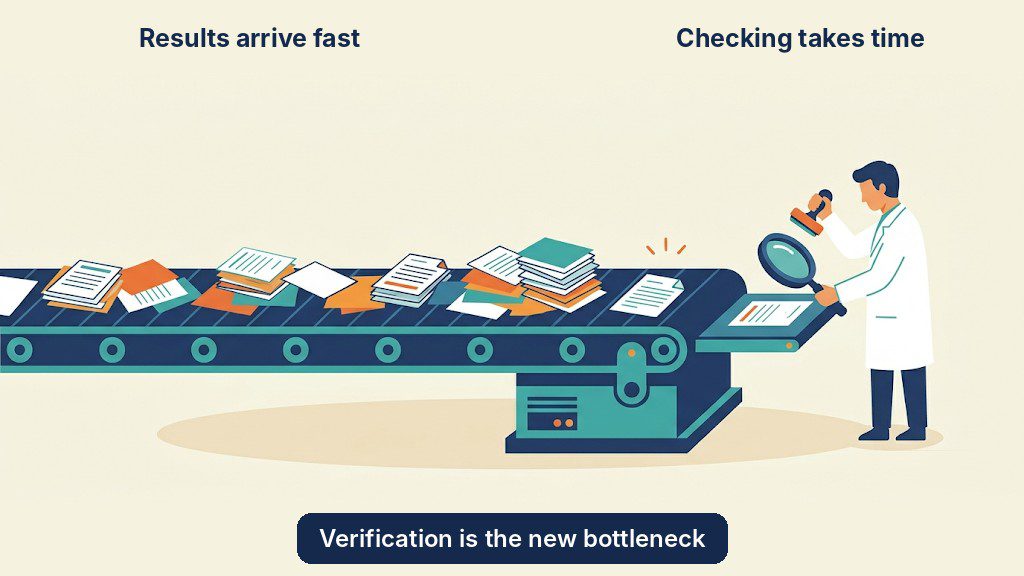
Every acceleration story eventually meets the same wall. In other words, a result nobody has checked is only a claim. Science earns trust through replication, peer review and transparent methods. Those habits, however, were built for a world of scarce results. Now candidate findings can arrive faster than reviewers can read them. Consequently, careful checking becomes the scarce and valuable resource. The panel lists validation among the grand challenges of AI in scientific discovery. Stanford’s own summary adds that rigorous new methods will be required. No complete answer exists yet, and that gap deserves attention. Until it closes, every fast result carries a silent question mark.
Fig. 5: Checking Becomes the Bottleneck
Jagged Intelligence and Confident Errors
Modern language models have an oddly uneven profile. Researchers call this quality jaggedness, and the label fits well. For instance, a model may produce expert-level analysis in one moment. Moments later, it can stumble on a simple counting task. Worse, its mistakes arrive in fluent, confident prose. As a result, the errors are unusually hard to spot. One benchmark cited by the panel measured invented details in document summaries. In early 2026, leading models produced them between 1.8% and 5.4% of the time. For casual use, such rates may be only a nuisance. Inside a research pipeline, however, they can quietly poison the evidence.
In research, a small error can spread surprisingly widely. Other teams, for example, may build on a false result for years. Courts, in fact, have already seen the danger in another profession. One US judge fined two lawyers $110,000 over invented case citations. Science has stricter traditions, but it faces the same temptation. After all, deadlines are tight, and machine output always looks finished. Therefore, verification cannot be an optional final step. It has to be designed into the workflow from the very start. Mathematics offers a preview of how heated this debate can become. There, the argument is no longer about speed but about meaning.
Predictions Without Explanations
During 2026, AI systems resolved several long-standing mathematical problems. Some solutions, however, were long and needed human help to present. Others were hard for people to understand at all. Many mathematicians, as a result, felt uneasy about an AI-led discipline. A group of them signed the Leiden Declaration on AI and Mathematics. That document, in particular, proposes ground rules for using these tools. Their underlying concern reaches well beyond pure mathematics. In fact, an answer without understanding sits awkwardly in any science. After all, explanation is supposed to be the whole point. A proof that nobody can follow teaches very little to the next generation.
The panel frames this as a deep philosophical question. If a model predicts accurately without a theory, should we trust it? Medicine, interestingly, already lives with a version of that puzzle. US regulators can approve a drug that is proven safe and effective. Approval is possible even when the mechanism is unknown. AI may therefore multiply the number of such unexplained successes. For that reason, researchers want tools that reveal causes, not just patterns. Models that simulate the physical world are one proposed route. Until they mature, human reasoning remains the bridge between prediction and knowledge. Crossing that bridge is slow work, and no shortcut has yet appeared.
How Faster Discovery Could Reshape Global Business
Science drives much of the technology that modern economies depend on. So when research speeds up, companies quickly feel the tremor. In particular, industries built on long development cycles are the most exposed. Pharmaceuticals, chemicals, energy and advanced materials all fit that description. The commercial opportunity is obvious: more candidates, sooner, at lower search cost. Its accompanying risk, however, is far less visible to outsiders. A flood of unverified leads can waste money as easily as save it. Winners will likely be firms that test as well as they predict. Indeed, that balance shapes strategy far beyond the laboratory door. For managers, AI in scientific discovery is therefore a question of evidence.
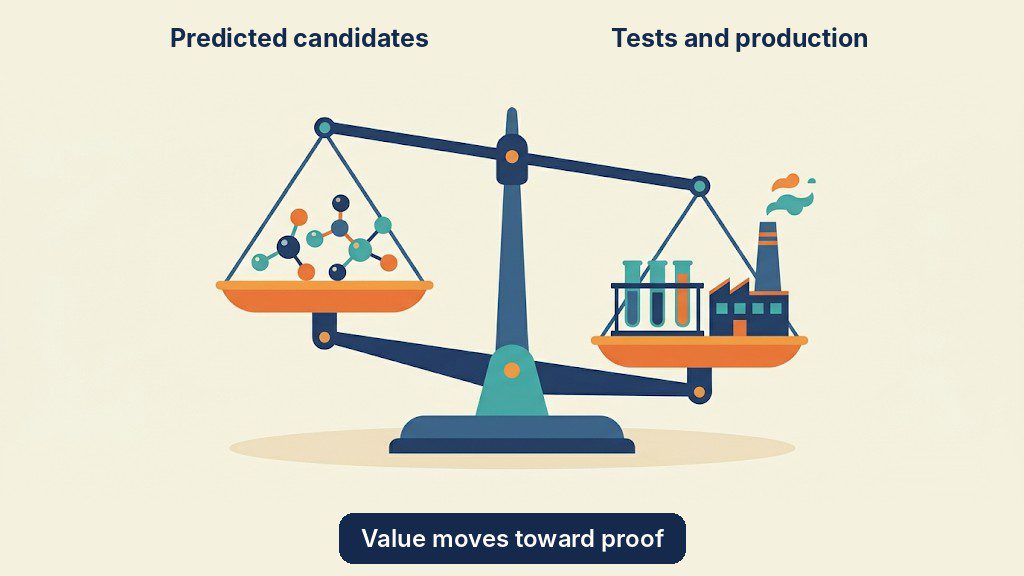
Fig. 6: Value Shifts Toward Testing
Shorter Pipelines for Drugs and Materials
Drug development shows how AI in scientific discovery might shift the economics. Previously, predicting a protein structure was a costly early hurdle. Today, predicted structures for most known proteins sit in a public database. Consequently, value moves toward the stages that software cannot finish. Those include wet-lab experiments, safety studies and clinical evidence. Companies with strong testing capacity may therefore gain an edge. The same logic also applies to battery, chip and catalyst makers. Millions of predicted compounds mean little until one is actually manufactured. Hence the word to watch in any announcement is verified, not discovered. A careful reader should ask who tested the claim, and how.
Investors should also keep the wider numbers in view. Spending on AI infrastructure has certainly reached an extraordinary scale. Nevertheless, the panel finds little sign of payoff in broad economic data. Company returns on that investment are not yet evident either. By its assessment, the technology has not yet covered its costs. Scientific tools may prove an exception, but proof takes time. Moreover, a discovery earns revenue only after trials, approvals and production. For that reason, patient capital still matters in science-based industries. Speed in the laboratory does not guarantee speed in the market. Plenty of brilliant molecules have failed at exactly that final stage.
Who Controls the Tools of AI for Science
Access to the tools is the other major business question. Frontier models come mainly from a few US and Chinese organizations. US firms lead on the most capable proprietary systems. Chinese developers, meanwhile, lead with smaller open-weight models. In other words, an open-weight model can be downloaded and adapted. Other countries, therefore, face a difficult and lasting strategic choice. They can rent foreign systems, build on open ones or develop their own. Each path affects who can run AI-powered labs at scale. Research capacity, as a result, becomes a matter of national policy. Smaller nations may need to pool resources to stay in the game.
Universities, for their part, sit in an awkward position here. Economists expect them to remain a main source of breakthrough ideas. However, the largest computing resources usually belong to corporations. Partnerships between the two are thus likely to deepen. Startups, in turn, may find room in the verification layer. Testing services, quality benchmarks and audit tools are plausible niches. Entrepreneurs, moreover, do not need a giant model to build them. What they need instead is domain knowledge and credible methods. In a crowded field, trust could become the scarcest product of all. Whoever can certify a result may matter as much as whoever generates it.
What AI in Scientific Discovery Means for STEM Careers
Students often hear that AI will take all the interesting jobs. The evidence so far tells a more careful story. Entry-level hiring has indeed fallen in some AI-exposed industries. Even so, panel chair Michael Wooldridge rejects the most dramatic forecasts. In particular, he does not expect all white-collar work to vanish within years. On research itself, his tone is openly hopeful. In his words, “we now have extraordinary new tools for science.” Tools, however, need skilled users, and that is the opening. The real question is which skills will matter most. Fortunately, the answer is already visible in how laboratories now work.
Fig. 7: Four Skills That Stay Human
Skills That Machines Cannot Sign Off
Start with the tasks that stay human by design. Somebody must frame the question and judge whether an answer matters. A named person must also take responsibility when results are wrong. Those duties therefore point toward experimental design and statistics. They also reward a habit of disciplined, evidence-first thinking. Indeed, knowing how a model fails matters as much as how it works. Similarly, clear writing helps other people check and repeat a study. Ethics, once a side topic, now sits near the center. None of these skills is new, but their value is rising. Each one becomes scarcer as routine analysis gets cheaper.
Education is already adjusting to this reality, sometimes painfully. For example, essays and take-home exams no longer prove what students know. Language models, after all, can answer many of them in seconds. Universities are therefore shifting toward in-person oral assessment. Assignments are also becoming broader and more creative. For learners at every level, the message is refreshingly direct. Use AI to go faster, but be ready to explain every line. Understanding, not output, is what examiners and employers will test. Above all, fundamental knowledge remains the base that good judgment grows from. Skipping that base may feel efficient now, yet it costs dearly later.
New Roles for Students and Founders
Job titles around AI in scientific discovery are still forming. Nobody can promise which ones will last or pay best. The direction of demand, though, is reasonably clear. First, laboratories will need people who validate machine-generated results. Second, companies will need specialists who audit models before decisions rest on them. Regulators, likewise, will need staff who understand both science and software. Research software engineering is another natural meeting point. Each of these paths combines a core discipline with data skills. A biologist who codes, for example, becomes very hard to replace. So does a statistician who understands how experiments are really run.
Fig. 8: From Raw Data to Checked Result
Would-be founders can read the very same signals. For instance, verification tools, laboratory automation and specialist datasets all need builders. Standing Committee chair Sheila McIlraith described the report’s purpose in a launch statement. It examines, she said, “what led to the extraordinary capabilities of today’s AI systems.” Understanding those origins helps newcomers judge where real gaps remain. Meanwhile, the panel admits that its own snapshot will age quickly. Specific tools named today may soon be replaced by better ones. The underlying problem, however, should outlast any single product. Fast answers, after all, will always need someone qualified to check them. Building a career around that need is a reasonable long-term bet.
The Lasting Lesson: Speed Needs Proof
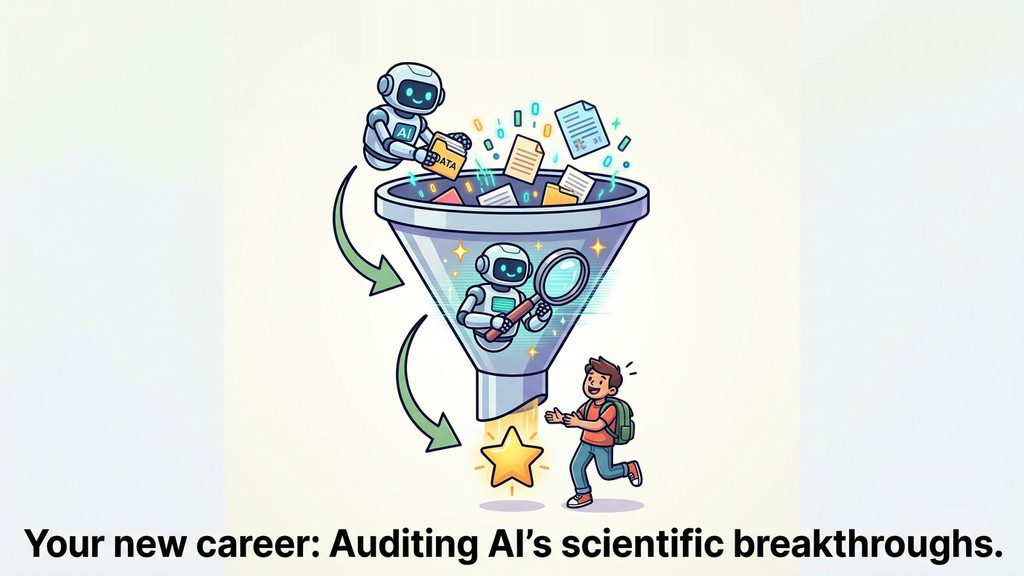
AI in scientific discovery is best understood as a trade. On the one hand, researchers gain speed, breadth and a tireless assistant. In exchange, though, they inherit a heavier duty to verify. That trade can be excellent for patients, industry and the planet. It can also mislead badly when speed outruns proof. History suggests, however, that science adapts to powerful new instruments. Telescopes and microscopes, for example, both demanded new habits of checking. Accordingly, the next generation of scientists has a clear assignment. Learn the tools deeply, question them constantly and keep the evidence honest. Whoever does that will shape what the faster laboratory actually delivers.
References
Wooldridge, M., Asaro, P., Flek, L., Gurevych, I., Hooker, S., Neff, G., Norvig, P., Perrault, R., Rahwan, I., Shorey, S., Walsh, T., & Zettlemoyer, L. (2026). AI goes mainstream: The scaling era and the rise of generative AI. The One Hundred Year Study on Artificial Intelligence (AI100) 2026 study panel report. Stanford University. https://ai100.stanford.edu/reports/2026-report
University of Oxford, Department of Computer Science. (2026, November 10). Professor Michael Wooldridge leads major international report examining advances in AI. https://www.cs.ox.ac.uk/news/2561-full.html
Jumper, J., Evans, R., Pritzel, A., et al. (2021). Highly accurate protein structure prediction with AlphaFold. Nature, 596, 583–589. https://doi.org/10.1038/s41586-021-03819-2
Merchant, A., Batzner, S., Schoenholz, S. S., et al. (2023). Scaling deep learning for materials discovery. Nature, 624, 80–85. https://doi.org/10.1038/s41586-023-06735-9
Gottweis, J., Weng, W. H., Daryin, A., et al. (2026). Accelerating scientific discovery with Co-Scientist. Nature, 655, 487–496. https://doi.org/10.1038/s41586-026-10644-y
Swanson, K., Wu, W., Bulaong, N. L., Pak, J. E., & Zou, J. (2025). The Virtual Lab of AI agents designs new SARS-CoV-2 nanobodies. Nature, 646, 716–723. https://doi.org/10.1038/s41586-025-09442-9
This explainer treats faster research as a trade and not as a simple triumph. It shows how prediction tools shorten the search for protein structures, new materials and weather forecasts, and why laboratory confirmation and human judgment still set the pace. The sections on business and careers are reasoned outlooks based on the source report, not forecasts. For full detail and context, readers should refer to the AI100 study panel report and the primary papers listed in the references.
Editorial note
This article is an ENTECH explainer based on the 2026 study panel report of Stanford University's One Hundred Year Study on Artificial Intelligence (AI100), titled AI Goes Mainstream: The Scaling Era and the Rise of Generative AI, and on public statements issued by the University of Oxford and the AI100 Standing Committee when the report was released. Short quotations are taken from those sources. The report is licensed under Attribution-NoDerivatives 4.0 International; this article summarizes its findings in our own words and does not reproduce or adapt its text. The illustrations are AI-generated and simplified. Readers should consult the original report for the complete findings.
Aditya Joshi is an SDE Intern at Coneixement India, the company behind ENTECH STEM Magazine and STEMQuiz. He is a Computer Engineering graduate from Savitribai Phule Pune University (SPPU), with honours in Machine Learning and Data Science. His academic background and hands-on project experience have developed his interest in artificial intelligence, emerging technologies, software development, and the practical applications of computing.
His areas of technical interest include Artificial Intelligence (AI), Generative AI, Machine Learning, Data Science, Large Language Models (LLMs), Natural Language Processing (NLP), Retrieval-Augmented Generation (RAG), GraphRAG, and knowledge graphs. Through projects involving locally hosted language models, Neo4j knowledge graphs, multilingual chatbots, and AI-powered analytics, he has explored how emerging technologies can be used to solve practical problems.
Aditya's professional experience includes work in frontend development, AI/ML application development, and full-stack software projects. During his internships at Maharashtra Knowledge Corporation Limited (MKCL) and Hilwitz Solutions, he worked on applications involving web technologies, Python, Flask, and AI-driven functionality. He has also developed projects such as SalesCope, an AI-assisted sales analytics platform, and a multilingual chatbot designed to help users explore Indian government schemes.
At ENTECH STEM Magazine and STEMQuiz, Aditya brings a technology-focused perspective shaped by his engineering education and practical experience with AI and software systems. He is interested in making complex science and technology concepts easier to understand through clear explanations, relatable everyday examples, and an emphasis on how emerging innovations work and affect real-world applications.
His broader goal is to help bridge the gap between technical concepts and public understanding, encouraging curiosity about artificial intelligence, computing, and the technologies shaping the future.