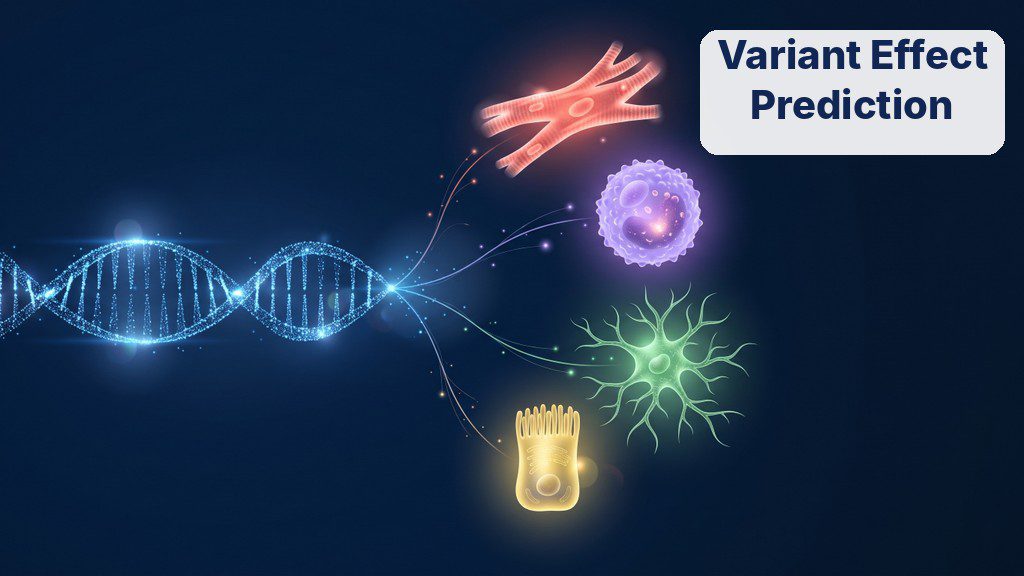
Every cell in your body carries the same DNA. Even so, a heart cell and an immune cell use very different genes. Most DNA variants linked to disease sit in switches that control those genes. However, their effects often show up only in particular cell types. Now Google DeepMind has released AlphaGenome 2 to tackle this puzzle. The model pushes variant effect prediction down to single cell types and states. According to the company, it finds nearly twice as many causal variants as earlier tools. DeepMind announced the model on November 11, 2026, in a Google DeepMind blog post. So how does it work, and what can it not yet do?
People differ from each other at millions of places in their DNA. Most of these differences, called variants, sit outside the genes themselves. Instead, they lie in non-coding regulatory DNA that acts like a set of switches. These switches decide how strongly each gene is used. In addition, the same switch may matter in one cell type but not another. Large projects such as the Human Cell Atlas now map gene activity cell by cell. Still, these atlases rarely include enough people to link variants to effects directly. For that reason, scientists want models that predict variant effects straight from sequence. That is the gap AlphaGenome 2 aims to fill.
Explainer: Genes, Switches and Cell Types
A gene is a stretch of DNA that holds instructions for a molecule. First, the cell copies a gene into RNA, which may then build a protein. However, cells do not use all their genes all the time. Regulatory regions called enhancers can boost a gene from far away along the DNA. Meanwhile, proteins and chemical tags on DNA open or close these regions. Methyl groups on DNA, for instance, often help keep genes switched off. As a result, each cell type ends up with its own pattern of active genes. In other words, the same DNA is read differently in different cells.
How the DNA Sequence Model Reads Each Cell Type
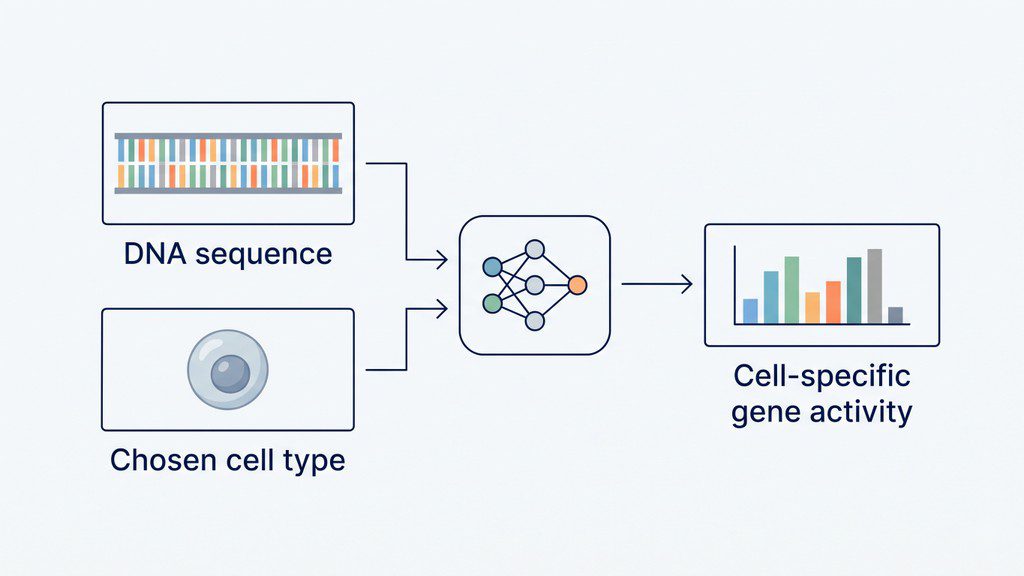
The first AlphaGenome, launched last year, predicted many tissues in parallel. Its approach to variant effect prediction worked well for broad tissue averages. On the other hand, that design spread the model’s capacity thin. AlphaGenome 2 is instead a conditional model that handles one condition at a time. A condition can be a tissue, a cell type or a particular cell state. To begin with, the model reads a DNA sequence one million letters long. At the same time, it receives the chosen condition at every stage of its design. It then predicts gene expression, chromatin accessibility, histone marks and DNA methylation. In this way, it learns how one stretch of DNA behaves across cells. As a result, closely related cell types become easier to tell apart.
Fig. 1: DNA Plus a Chosen Cell Type Gives a Cell-Specific Prediction
Learning From 107 Million Cells
According to the paper, the team trained the model in four stages. For instance, eight separate teacher models were later distilled into one student model. The training data came from both humans and mice. It included bulk tissue data plus single-cell data from 36 studies. In particular, the final stage drew on more than 107 million single-cell profiles. A separate cell encoder learned from over 100 million cells across 68 tissues. What is more, the model can fill in missing measurements for a cell type. Given gene activity alone, it can predict unmeasured features such as open DNA regions.
Twice as Many Causal Variants Found
The team tested the model on TenK10K, a large single-cell study of immune cells. That dataset covers 28 immune cell types from many donors. On this benchmark, AlphaGenome 2 found 30% of causal variants. By comparison, earlier tools found only about 16% of them. Likewise, it predicted the direction of gene effects for 43% versus 23%. Those comparisons include a fine-tuned version of the first AlphaGenome. The paper reports this as doubling recall at 90% precision. In short, the model flags many more real candidates without many false alarms. For variant effect prediction, that is a large step in one model generation.
Reproducing a Known Gut Disease Finding
Next, the team checked a known case from inflammatory bowel disease. An earlier study had shown that a distant variant boosts a gene called ETS2. That effect occurs in gut immune cells known as macrophages. AlphaGenome 2 reproduced this finding using computation alone. In particular, it singled out the causal variant among nearby candidates. It also showed the variant raised ETS2 mainly in gut macrophages. Other cell types and genes, by contrast, stayed largely unaffected. This example shows why cell-specific predictions matter for real diseases.
New Cell States Without Retraining
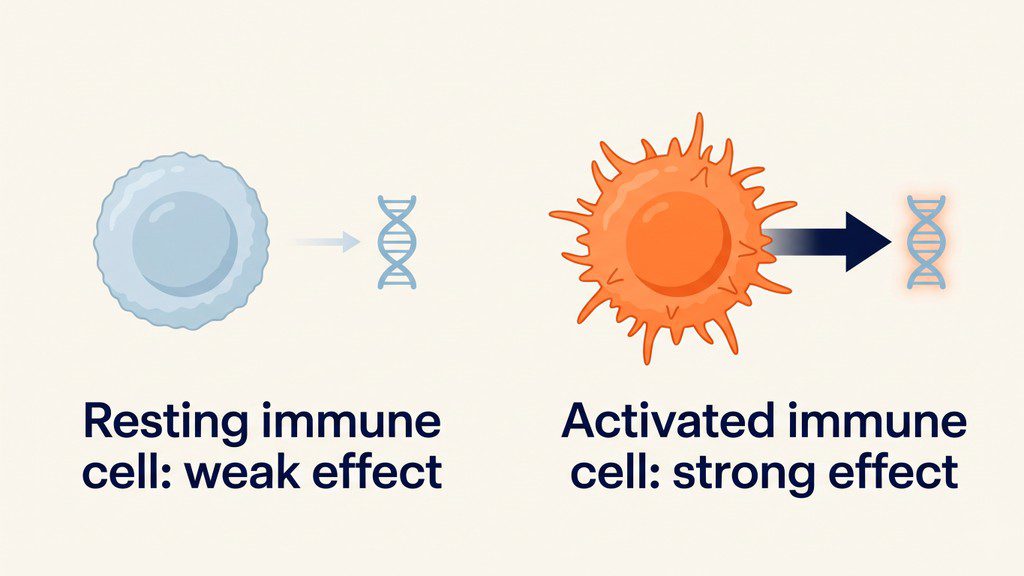
Many earlier models must be retrained for each new dataset. AlphaGenome 2, however, can adapt to a new single-cell experiment directly. Scientists upload gene activity from as few as a few dozen cells. The model then turns that snapshot into a cell-state summary it can use. For example, the team used data from a COVID-19 mRNA vaccine study. The model told vaccine-activated immune T cells apart from resting ones. In addition, a variant linked to severe COVID-19 acted more strongly in activated cells. That effect would be missed by studying resting cells alone. In particular, this flexibility extends variant effect prediction to brand-new cell states.
Fig. 2: Some Variants Matter Only When Immune Cells Are Activated
Scoring Millions of Non-Coding DNA Variants
Running a large model on every variant takes heavy computing power. To save researchers that work, DeepMind precomputed scores for about 7 million variants. These include common variants and fine-mapped variants from published genetic studies. According to the paper, the scores cover 510 human cell and tissue conditions. What is more, the team mapped links between enhancers and their target genes. Those links span 640 conditions, including primary cells such as brain astrocytes. Astrocytes, to illustrate, support and protect neurons in the brain. Because lab screens mostly use cell lines, such maps are rare for real tissues. Consequently, researchers can now check which genes a disease variant may control.
Business Opportunities in Non-Coding DNA Variants
Genome-wide studies have linked thousands of DNA regions to traits and diseases. Even so, turning those signals into drug targets remains slow and costly. For this reason, tools that rank variants could save labs a great deal of time. AlphaGenome 2 is now available through an API for non-commercial research. Meanwhile, a private preview is open for commercial research. According to DeepMind, Genomics Limited plans to add it to its Mystra drug discovery platform. Within five years, such models could become a standard early step in finding drug targets. With this in mind, rare-disease and genetics labs may adopt them first. Our explainer on how DNA becomes RNA and protein covers the basics behind this work.
Careers and What to Study
Variant effect prediction draws on biology, statistics and machine learning together. For example, computational biologists build and test models of gene regulation. Machine learning engineers, on the other hand, design and train the deep networks. Meanwhile, human geneticists link variants to traits in large patient groups. According to the US Bureau of Labor Statistics, biochemists and biophysicists earned a median $127,410. That figure is from May 2025, with 12% growth projected through 2035. Data scientists earned a median $120,230, with 35% projected growth. These are US figures, and pay varies by country. For study, consider genetics, molecular biology, statistics, computer science or bioinformatics. Our article on a universal cell embedding model shows a related approach.
Limits Worth Keeping in Mind
Note that AlphaGenome 2 is for research use only, not for clinical diagnosis. The results also come from a company paper that is not yet peer reviewed. At high precision, the model still recovers only a minority of causal variants. Moreover, it can underestimate effects for variants far from accessible DNA. It also struggles to separate fine-grained states, such as neuron subtypes. Because it learns from observed data, it captures correlations rather than proven causes. Even so, its open access and precomputed scores make it easy to test. In the long run, better variant effect prediction could speed up disease research.
The article explains genes, regulatory switches and cell-specific prediction in clear, student-friendly terms. Its figures match the blog and technical paper, including the 30% versus 16% recall of causal variants. The limits section notes the missing peer review, the low recall at high precision and the correlational nature of the model. Readers who want the methods and benchmarks in full should check the original paper this story draws on.
Editorial note
ENTECH is running this story because most disease-linked DNA changes sit in switches that act only in certain cells. Google DeepMind's AlphaGenome 2 shows students how AI can link genetics to cell biology at a much finer level. It also points to growing careers that combine biology, statistics and machine learning. The results come from a company paper that is not yet peer reviewed, and the model is for research use only. For the full details, we suggest readers turn to the original technical paper.
Sailee Pakhare holds a Master's degree in Biotechnology, with a research background spanning microbiology, molecular biology, and disease biology. Her postgraduate dissertation examined the antimicrobial potential of bioactive peptides from lactic acid bacteria, and her research experience includes molecular identification of bacterial isolates (with sequencing data submitted to NCBI) and work as a Research Assistant at SafeWright Laboratory. She also completed a summer internship at IIT Hyderabad studying circadian rhythms and disease biology using Drosophila melanogaster as a model organism.
Her work has been recognized with the Best Poster award at the 3rd International Conference on Innovations in Biotechnology Research for Sustainable Bioresources and Bioeconomy (2025), and she has contributed to a book chapter on the role of AI and machine learning in climate change.
Sailee is also a co-founder of LifeXtension, a community focused on longevity, ageing, and health science awareness in India. An interdisciplinary thinker, she explores questions ranging from disease biology to space and the origins of life, approaching science as a way of asking questions rather than a fixed body of facts. As a science communicator and researcher, she is committed to translating complex research into writing that is clear, accurate, and engaging.