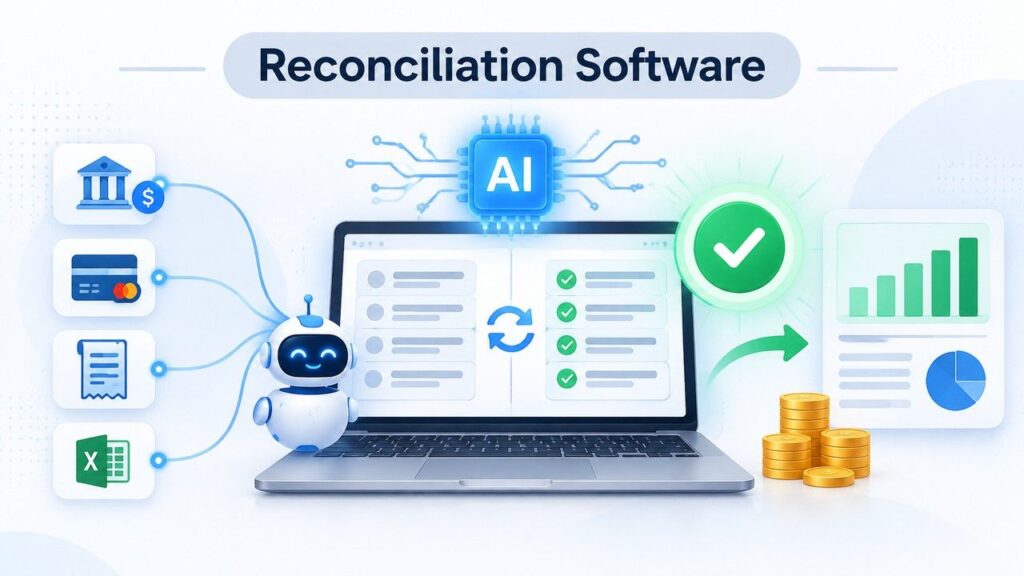
Finance teams use reconciliation software to compare transactions across payment providers, bank accounts, and accounting systems, then investigate items that do not match. The products in this comparison address that work in different ways: some focus on payment and settlement reconciliation, while others combine reconciliation with broader financial-close or finance-operations workflows.
This article compares five platforms across their areas of focus, matching and exception-management capabilities, integrations, deployment options, pricing transparency, and intended users. These differences matter because a tool designed for payment operations may not cover the same needs as software built for account reconciliation or enterprise close management. Use the comparisons to identify which capabilities align with your systems, workflows, and requirements.
Reconciliation software varies in scope, features, and intended users. Therefore, we compare these platforms across the same practical criteria. The comparison draws on publicly available product pages, documentation, pricing information, and company materials. Product details can change, so readers should confirm current capabilities and terms directly with each vendor.
How We Compared the Reconciliation Software Platforms
We considered each platform’s primary use case, including payment reconciliation, account reconciliation, financial close, and broader finance operations. We also reviewed its transaction-matching methods, exception workflows, integrations, and supported data sources.
In addition, we looked at workflow controls, audit trails, deployment options, and publicly documented data-residency choices. We considered pricing transparency, access to trials or self-service options, and the types of organizations each vendor says it serves. Where vendors publish performance figures, customer counts, awards, or product claims, we identify them as vendor-reported rather than treating them as independent findings.
These platforms do not all serve the same reconciliation needs. Some focus on payment and settlement data, while others support account reconciliation and financial close. One of them also covers broader CFO workflows. Therefore, readers should compare each platform within the context of its primary use case.
PLATFORM
PRIMARY FOCUS
COMMON USE CASE
DEPLOYMENT
PRICING
Urenkoff
Payment reconciliation
Fintech and ecommerce
SaaS/on-premise
Published
FloQast
Financial close
Mid-market and enterprise accounting
Contact sales
Not published
BlackLine
Close and accounting operations
Large enterprises
Contact sales
Custom
HighRadius
CFO-wide automation
Large enterprises
Contact sales
Outcome-based
Trintech
Reconciliation and close
Mid-market and enterprise
Contact sales
Custom
Table 1: Comparative Overview
Urenkoff
Urenkoff, is an AI-powered reconciliation platform, matches transactions across banks, PSPs, gateways, POS systems, and ERPs using configurable rules and tolerances, then routes every unmatched item to a named owner for review. It is built for payment-side reconciliation, not general ledger close, which makes it the right fit when the problem is settlement data disagreeing with internal records.
The vendor states that its automated data setup can reduce the work required to configure new PSP reports, rather than turning into a field-mapping project. From the Professional tier ($599/month), teams get collaborative comments and multi-agent approval, keeping preparers and approvers in separate roles with a clear record. Both SaaS and enterprise on-premises deployment are available on published plans ranging from $0 to $1,999/month, with no setup fees attached.
Use case: Fintechs, PSPs, processors, and high-volume ecommerce businesses that need to match across multiple payment sources.
Features:
Rule-based matching with configurable tolerances and matching order
Structure auto-detection on CSV, XLSX, JSON, and custom flat-file imports
Exception ownership assignment and structured reconciliation workflow
REST API from $199/month; webhooks from $599/month
SaaS or on-premises deployment on all plans
FloQast
FloQast was founded in 2013 by CPAs and former corporate accountants, and that background comes through in the product. Its Accounting Platform covers the full financial close cycle, pairing automated reconciliations, AI transaction matching, journal entry management, and variance analysis with close task management and evidence collection. FloQast states that its ISO 42001 certification supports documented AI governance and oversight. Teams should confirm how those controls apply to specific AI workflows.
More than 2,600 accounting teams use FloQast, including Twilio, Zoom, and Snowflake. The company has been rated the number-one solution on G2’s Financial Close Management report for five consecutive quarters and was named to CNBC’s 2025 List of World’s Top Fintech Companies in the Enterprise Category.
Use case: Corporate accounting departments handling month-end close, compliance workflows, and audit-ready reporting at scale.
Features:
Automated reconciliations and transaction matching
Journal entry management and variance analysis
Enterprise Risk Management and automated evidence collection
Free CPE and FloQast Certified Accountant (FCA) training
Considerations: Pricing is not publicly available; enterprise procurement cycles apply. Best suited to mid-market and larger accounting teams rather than small finance departments.
BlackLine
BlackLine pioneered the cloud financial close market and has been building on that position since 2001. Its platform covers account reconciliation, intercompany accounting, and controls assurance through what it calls a Continuous Close model. The Verity™ AI multi-agent system handles financial operations automation while keeping a full audit trail, so automated decisions stay traceable. SiriusXM, The Hershey Company, and Domino’s are among its named customers.
BlackLine completed its IPO on NASDAQ in October 2016 and now employs approximately 1,900 people. Its Agentic Financial Operations platform won the Best AI/ML Powered Solution category at the 2026 FinTech Tech Ascension Awards, and it earned four 2026 Top Rated Awards from TrustRadius based entirely on verified customer reviews.
Use case: Enterprises and large public companies running complex, high-volume financial close processes with strict audit requirements.
Features:
Verity™ multi-agent system with audit trail
Studio360 Platform for end-to-end financial workflow orchestration
Invoice-to-Cash solutions for accelerated cash flow
Intercompany accounting and controls assurance
Record-to-Report with Continuous Close model
HighRadius
HighRadius takes a broader approach than most platforms on this list. Founded in 2006 by Sashi Narahari and headquartered in Houston, it covers Order-to-Cash, Accounts Payable, Close and Reconciliation, Consolidation and Reporting, B2B Payments, and Treasury through more than 180 AI agents coordinating across each workflow. Its outcome-based pricing model ties fees to mutually agreed KPI improvements rather than a fixed subscription, which makes the return on investment conversation a direct one.
The company serves over 1,500 enterprises including 3M, Unilever, and Red Bull. HighRadius has been named a leader in the IDC MarketScape for Accounts Receivable Software and earned a spot on the Forbes Cloud 100. HighRadius carries a valuation of $3.1 billion after $484 million in total funding.
Use case: Large enterprises that want a single AI platform spanning the full CFO office, not just reconciliation.
Features:
180+ agents across Order-to-Cash, AP, Close, Treasury, and Payments
Outcome-based pricing with $0 setup fees until go-live
HighRadius publishes guarantees that include a 30% faster financial close and a 10% DSO reduction. These figures are vendor claims and may depend on contract terms and implementation conditions.
Cash application, deductions, credit management, and cash forecasting
Consolidation and reporting alongside reconciliation
Considerations: Scope and depth are enterprise-grade; smaller finance teams are unlikely to need or be able to absorb the full platform. No self-service access; setup is project-based.
Trintech
Trintech has been building financial close software since 1987, making it the oldest entrant on this list by a wide margin. Its two main products, Adra and Cadency, cover different ends of the market. Adra automates transaction matching and reconciliation workflows for mid-market teams; Cadency handles end-to-end journal entries, task management, and reporting for larger organizations. The platform’s machine learning can automate 90% of transaction matching while still surfacing exceptions that need a human eye.
The company serves over 4,200 clients worldwide, including a majority of the Fortune 100, and its platform integrates with more than 100 partner companies. It was recognized as a leader in the QKS SPARK Matrix for Financial Close Management and named to G2’s 2026 Best Software Awards for Accounting and Finance Products.
Use case: Mid-market to enterprise finance teams that need risk-based automation and ERP connectivity across the full record-to-report cycle.
Features:
Adra suite for mid-market transaction matching and reconciliation
Cadency platform for journal entries, task management, and reporting
Machine learning that automates up to 90% of transaction matching
Explainable AI with embedded risk-based automation
Strong ERP connectivity and a 100+ partner ecosystem
Considerations: Pricing is not publicly available. Founded in 1987, Trintech has extensive experience in financial close software.
Key Features to Evaluate in AI-Powered Reconciliation software
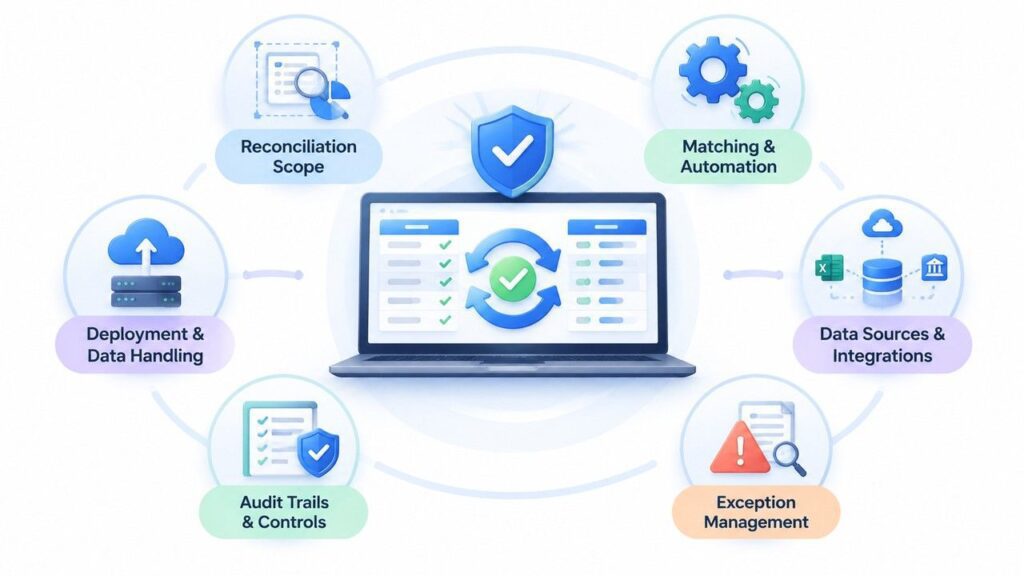
Reconciliation software can support different finance processes and data sources. Therefore, teams should compare features against their actual workflows. A payment team may need settlement matching and exception ownership. However, an accounting team may need close controls and audit evidence.
Fig. 1: Key features to check Reconciliation Software (illustration)
Reconciliation scope
First, define which transactions the platform should reconcile. Some tools focus on payments, settlements, and bank activity. Others support account reconciliations, journal entries, and financial close tasks. Broader platforms may also cover treasury, accounts receivable, or cash management. Therefore, compare each platform’s scope with your current reconciliation process.
Matching and automation
Review how the platform matches records from different systems. Check whether it supports configurable rules, tolerances, matching order, and exception logic. Also, check how it handles partial payments, timing differences, refunds, fees, and chargebacks. If the platform uses AI or machine learning, ask how users review and explain automated matches.
Data sources and integrations
Check which systems can send data to the platform. These systems may include banks, PSPs, gateways, ERPs, accounting tools, and payment processors. Also, review supported file formats, APIs, webhooks, and import methods. Strong integration coverage can reduce manual exports and repeated data preparation.
Exception management
Unmatched transactions still require human review in most workflows. Therefore, examine how the platform identifies, assigns, and tracks exceptions. Look for ownership rules, comments, approval steps, escalation options, and status tracking. These features can help teams manage unresolved items across multiple reconciliation cycles.
Audit trails and controls
Finance teams often need clear evidence for internal reviews and external audits. Check whether the platform records changes, approvals, comments, source data, and matching decisions. Also, review its user permissions and role controls. A clear audit trail helps teams understand how each reconciliation reached its final status.
Deployment and data handling
Compare the available deployment models before starting technical discussions. Some platforms operate through SaaS environments, while others offer on-premises options. Also, review data residency, security certifications, access controls, and retention policies. These requirements may affect which platforms your organization can consider.
Pricing and implementation
Review how each vendor structures its pricing. Costs may depend on users, transaction volumes, modules, integrations, or business outcomes. Also, ask about setup fees, implementation services, training, and support. A transparent cost model makes it easier to compare platforms with different scopes.
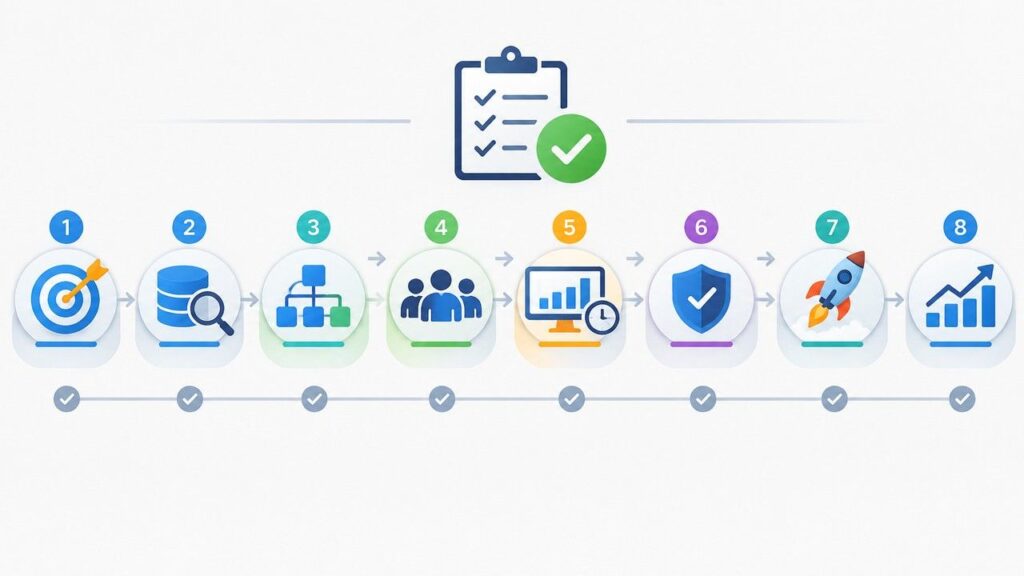
Implementation Checklist
A structured implementation can help finance teams reduce delays and testing problems. Start with one clearly defined reconciliation process. Then, expand after the team confirms the matching rules and workflow.
Choose one process with clear business value and manageable data volume. For example, start with one PSP, bank account, entity, or payment channel. Define the expected inputs, outputs, matching rules, and exception types. This approach gives the team a controlled environment for testing.
Review the source data
Collect recent files from every system involved in the first use case. Review the fields, formats, naming conventions, timestamps, currencies, and transaction identifiers. Also, identify missing values, duplicates, timing differences, and inconsistent references. Clean source data can reduce problems during configuration.
Map the reconciliation rules
Document how the team currently matches transactions. Include exact matches, tolerance-based matches, partial matches, fees, refunds, chargebacks, and timing differences. Then, confirm which rules the platform can automate. Keep manual review steps for items that require judgment or additional evidence.
Assign workflow responsibilities
Define who prepares, reviews, approves, and resolves each reconciliation. Set ownership rules for different exception types and business units. Also, establish escalation timelines for overdue items. Clear responsibilities help prevent unresolved exceptions from remaining invisible.
Test with historical data
Use completed reconciliation files to test the platform before launch. Compare automated results with the team’s previous conclusions. Review both successful matches and unresolved exceptions. In addition, record false matches, missed matches, and rules that need adjustment.
Confirm controls and reporting
Check whether the platform produces the reports your finance team needs. Review approval records, exception reports, audit trails, and reconciliation summaries. Also, confirm that users can export evidence for audits and management reviews. These checks should happen before the production launch.
Plan the rollout
Set a launch date that allows time for training and final testing. Communicate the new workflow to every affected team. Keep the existing process available during the first reporting cycle, where practical. Finally, review the results after launch and adjust rules based on real exceptions.
Measure the results
Agree on baseline measures before implementation begins. These measures may include reconciliation time, match rates, unresolved items, manual adjustments, and close duration. Compare the results after launch. This review shows whether the platform supports the intended process and where further changes may help.
FAQs: AI Powered Reconciliation software
What is reconciliation software?
Reconciliation software compares records from banks, PSPs, ERPs, and other systems. It also identifies unmatched transactions and helps teams review exceptions.
How does reconciliation software use AI?
AI can identify matching patterns across large transaction volumes. However, finance teams can still review exceptions and approve important decisions.
What should teams consider when choosing reconciliation software?
Teams should compare matching rules, integrations, exception workflows, audit trails, deployment options, and pricing. Therefore, the best choice depends on each team’s systems and priorities.
Can reconciliation software support payment reconciliation?
Yes, some platforms match payments across PSPs, gateways, banks, POS systems, and ERPs. However, other platforms focus more on account reconciliation and financial close.
How should a finance team implement reconciliation software?
Start with one reconciliation process and a clean data source. Then, test matching rules, assign workflow responsibilities, and expand after reviewing the results.
Conclusion:
Reconciliation software can help finance teams match transactions, manage exceptions, and reduce manual work. However, these platforms address different needs. Some focus on payment reconciliation across banks, PSPs, and gateways. Others support account reconciliation, financial close, or wider finance operations. Therefore, compare each platform against your systems, workflows, and controls. Review its transaction matching, integrations, audit trails, deployment options, and pricing. Also, consider implementation effort and the level of automation your team needs. A broader platform may suit a complex finance operation, while a focused tool may better match a specific reconciliation process.
The platforms in this article offer different capabilities and approaches. Their features, scope, and commercial models may also change over time. So, verify current details with each vendor and test relevant workflows where possible. Ultimately, the right choice depends on your priorities, data, and requirements. Use the comparison to identify which options merit closer evaluation, then let your team decide which trade-offs make sense.
Deven Nandapurkar is a Software Engineer, Project Lead; working at the strategic intersection of software engineering, productivity science, and emerging technologies. Driven by a core philosophy of "building things worth building," he leads cross-functional teams and drives end-to-end technical strategy—from early-stage conceptualization through production-grade deployment.
A Computer Engineering graduate from Pune University, Deven brings a sharp systems-thinking approach to technical leadership, honed by years of managing high-stakes engineering projects and leading teams to top placements in national and international hackathons, including the NASA Space Apps Challenge and the Peerlist GenAI Hackathon.
Deven explores how human cognition and emerging technology converge. He regularly writes about cognitive performance optimization, attention management, AI integration, and the evolving dynamics of the modern workforce - offering actionable frameworks for professionals seeking to maximize their productivity and thrive alongside intelligent systems.