Electric cars and phones need batteries that store more energy for many years. Now, a team led by Zhong-Shuai Wu, Gongrui Wang and Yan Yu has made progress. The researchers work at the Dalian Institute of Chemical Physics. Colleagues at the University of Science and Technology of China co-led the work. Dalian Maritime University and the Hefei National Synchrotron Radiation Laboratory joined as partners. Synchrotron facilities in Hefei and Shanghai supported the X-ray work. Together, they built high-energy lithium-rich cathodes that survive charging to 4.99 volts. In particular, a thin carbon shell and tiny spinel dots protect each particle’s surface. As a result, the cathode kept 88.9% over 150 cycles at that voltage. The work appears in the journal National Science Review (DOI: 10.1093/nsr/nwag659).
Every lithium-ion battery has a cathode, the positive side that sets much of its energy. Today, many long-range electric cars use nickel-rich layered oxide cathodes. However, the authors point to lithium-rich manganese-based oxides, or LROs, as a strong next step. These materials pack extra lithium into a layered crystal built mainly on manganese.
According to the study, LROs work near 4.8 volts and exceed 250 mAh/g. The authors describe that capacity as ultra-high. This boost comes from the chemistry. In most cathodes, only metal atoms give up electrons during charging. LROs, by contrast, also let oxygen atoms join this exchange, a process called anion redox. Because of this extra step, each gram stores more charge. In short, more charge per gram can mean a lighter battery for the same range. Higher energy density, in turn, could ease the range anxiety that worries many drivers. To see where the cathode sits, read our battery manufacturing guide.
The Knowledge Gap at the Surface
Earlier teams tried two main fixes for LROs. First, they added small amounts of other elements, such as aluminum or titanium. Second, they wrapped particles in protective layers, such as aluminum oxide. Both methods helped, but each came with trade-offs. For instance, cells lost some capacity or moved lithium more slowly. At the same time, one problem stayed largely unsolved. Under high voltage, the cathode releases reactive oxygen from its crystal. That oxygen then speeds up the breakdown of the liquid electrolyte at the surface. The authors call this effect coupled catalytic decomposition. It grows worse at 4.8 volts and above, exactly where LROs deliver their best energy. So far, surface designs had struggled to block it over long cycling. For this reason, the team wanted two separate defenses. One layer would shield the surface chemistry, while another would absorb strain. The National Science Review paper tests that dual design.
Challenges and Motivation Behind the Research
LRO cathodes face three linked problems as they cycle. First, oxygen escapes from the crystal during charging. Second, metal ions such as manganese dissolve into the electrolyte. Third, the layered structure slowly shifts into a less useful form. Together, these changes cause voltage fade, a steady drop in the working voltage. Capacity also falls, little by little, cycle after cycle. Heat makes matters worse, according to the authors. Phones and electric cars often run warm, so this weakness matters in daily use. Meanwhile, the U.S. Department of Energy funds applied research on high-energy lithium-ion chemistries. That support shows why stable LROs would carry real value. Still, a cathode that fades quickly cannot reach a car or a phone. With this in mind, the team set a tough test. Could one surface design pass two separate tests, at 4.99 volts and at 45°C?
Key Findings on High-Energy Lithium-Rich Cathodes
To begin with, the team soaked plain LRO powder in a tannic acid treatment. Next, a short, rapid heating step turned this coating into carbon. The new material, called HV-LRO, kept round particles about 10 micrometers wide. Electron microscope images revealed an even, amorphous carbon shell about 10 nanometers thick. Carbon content rose from 2.09% to 4.77% by weight. Just under the surface, spinel dots about 30 nanometers across formed inside the layers. In fact, spinel made up only 2.4% of the material. The team tried heating times of 10, 20 and 30 minutes. Those runs gave 1.8%, 2.4% and 3.2% spinel. Cycling stability peaked at 2.4%, so extra spinel did not help. In other words, a small dose worked best. The shell blocks reactive oxygen, while the dots absorb strain. That pairing defines these high-energy lithium-rich cathodes, as the paper explains.
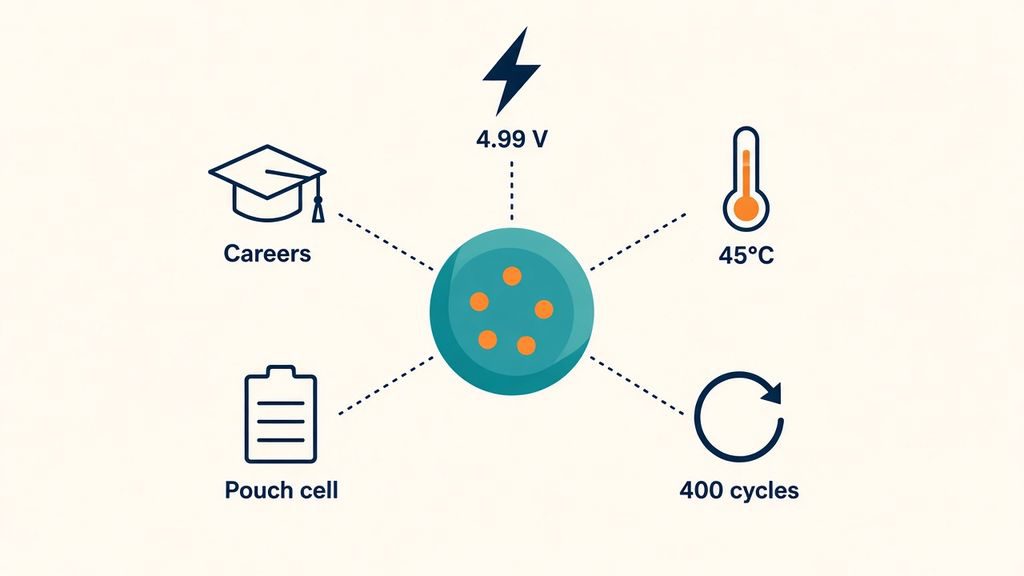
Fig. 1: Key Takeaways from the 4.99-Volt Cathode Study
More Capacity From the First Cycle
Coin cells with lithium metal anodes provided the first tests. At a slow 0.1C rate, HV-LRO delivered 295 mAh/g on its first discharge. The untreated control, by comparison, gave 267 mAh/g. First-cycle efficiency, or ICE, tells how much charge returns after the first charge. HV-LRO reached 93.1%, while the control reached only 79.0%. In practice, a higher ICE wastes less lithium at the very start.
Fast rates also favored the treated material. At 2C, 5C and 10C, it gave 196, 143 and 100 mAh/g. Under the same conditions, the control gave 172, 121 and 82 mAh/g. Long cycling, in turn, confirmed the gap. After 400 cycles at 1C, HV-LRO kept 89.9% of its capacity. In contrast, the control kept 67.9%. Voltage retention also improved, from 79.7% to 85.2%. Across this 2-to-4.8-volt range, voltage fade measured 1.26 millivolts per cycle versus 1.74. According to the study, the shell curbed oxygen loss during the first charge.
Separate Tests at 4.99 Volts and 45°C
Next, the researchers pushed the voltage limit to 4.99 volts. At such voltages, the authors note, oxygen-driven damage grows fastest. HV-LRO started at 242 mAh/g at 1C and kept 88.9% after 150 cycles. On the other hand, the control failed by cycle 80. It had started at 231 mAh/g but held just 29.4% at the end. Voltage fade also stayed lower, at 2.64 millivolts per cycle versus 2.89. Heat brought a second, separate stress test, with charging capped at 4.8 volts. At 45°C, HV-LRO began at 283 mAh/g and kept 79.2% after 200 cycles. Under the same heat, the control kept only 43.2%. Gas measurements showed far less oxygen release during the first charge. X-ray tests also found a smaller crystal stretch, 0.053 versus 0.148 angstroms. After 400 cycles, the treated particles showed no cracks. A dense, even surface film covered them, as National Science Review reports.
A Lithium-Rich Cathode in a Real Pouch Cell
Coin cells suit early lab work, but real products use larger, flatter cells. For that reason, the team also built a 1.58 amp-hour pouch cell. This cell paired HV-LRO with a silicon/carbon anode. Based on the full pouch mass, it stored 307 watt-hours per kilogram. After 100 cycles at 0.8C, it kept 70.7% of its capacity. The cell cycled between 2 and 4.7 volts in this test. For context, the authors compared HV-LRO with earlier LRO reports. One earlier design, for instance, reached 283.3 mAh/g and 86.7% retention after 100 cycles. Against such work, HV-LRO ranked among the best for first-cycle efficiency and long-term retention. Synchrotron X-ray beams in Hefei and Shanghai also checked the chemistry. These scans confirmed steady charge exchange in both metal and oxygen. Even so, 70.7% after 100 pouch cycles leaves clear room to improve. The full pouch data appear in the open-access article.
Explainer: How Lithium-Rich Cathodes Store Energy
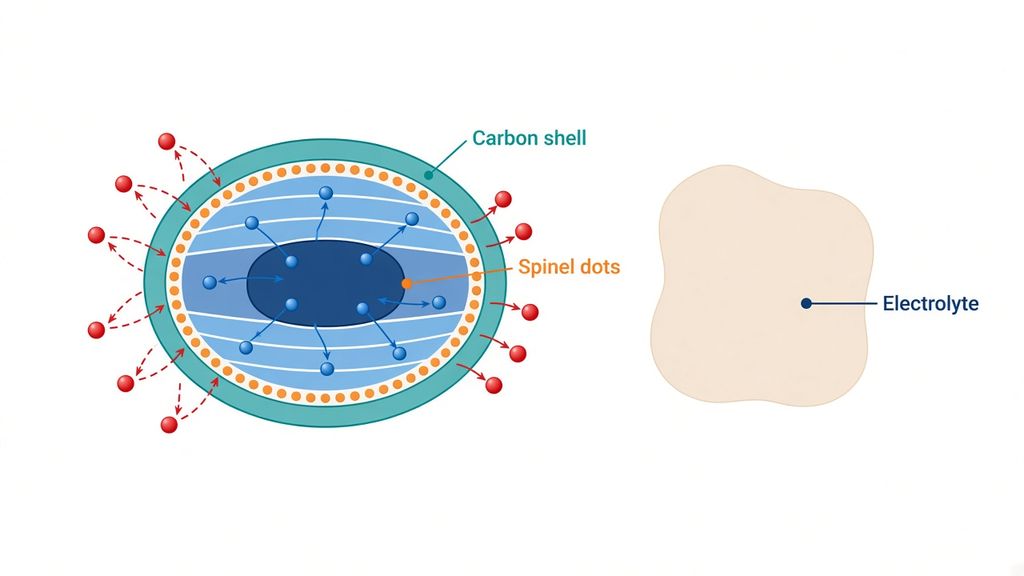
Fig. 2: How the carbon shell and spinel dots work
Voltage, Capacity and Energy in Plain Words
For example, imagine a cathode crystal as a parking garage with many floors. Lithium ions park between the floors after the battery discharges. Charging then pulls them out and sends them to the anode. Capacity, in mAh/g, tells how much charge each gram can hold. Voltage, by contrast, tells how hard that charge pushes through a circuit. Multiply the two, and you get energy, often listed per kilogram. LROs score high on both, so they promise long range.
On the other hand, removing so much lithium strains the garage and loosens its oxygen. In this design, the spinel dots act like extra ramps in every direction. They give lithium three-dimensional paths and spread the strain. The carbon shell, meanwhile, works like a raincoat against the electrolyte. Cheaper options, such as salt-based sodium-ion batteries, aim at low cost instead. The study shows that smart surfaces can help LROs reach their energy potential.
Conclusion: Business, Careers and Next Steps
For business, the method adds a simple surface step to an existing cathode powder. As a result, cathode suppliers and cell startups could trial it in pilot pouch cells. Higher energy per kilogram also suits electric cars, which need range without extra weight. At the same time, this work depends on advanced tools like synchrotron X-ray beams. Therefore, careers could grow for cathode materials scientists, cell design engineers and battery testing engineers. Specialists who run X-ray and microscope studies could find work too. The U.S. Bureau of Labor Statistics expects materials scientist jobs to grow 8% by 2035. It also expects demand for affordable, safe, high-quality materials for energy.
Students who enjoy labs should consider chemistry, especially electrochemistry. Materials science, chemical engineering and physics also lead into this field. Our feature on materials science and engineering shows the wider career map. In addition, internships at battery labs build valuable hands-on skills.
Limits and the Road Ahead
This study still leaves several questions open. Most tests used small coin cells with lithium metal anodes. The single pouch cell ran only 100 cycles, and it kept 70.7% of its capacity. Car batteries, by contrast, must last for many years of daily driving. What’s more, the material still contains nickel and cobalt alongside manganese. The paper also does not report costs or safety tests for larger cells.
In addition, the extra heating step must work at factory scale. For that reason, longer pouch tests and bigger cells form the obvious next stage. Even so, the core idea holds clear value. One layer handles chemistry, while another handles strain, so each fix stays simple. That approach could guide the next wave of high-energy lithium-rich cathodes for cars and electronics. Readers can study every result in the National Science Review article. Step by step, that kind of careful surface design could bring longer-range batteries closer.
References
Yang, M., Wang, G., Han, Y., Xu, Y., Sun, J., Ma, Y., Yang, H., Song, L., Cui, W., Zhang, Y., Sun, J., Yu, Y., & Wu, Z.-S. (2026). Ultrastable 4.99 V Li rich Mn-based cathodes achieved by catalytic-shielded and strain-buffered interface engineering. National Science Review. Advance online publication. https://doi.org/10.1093/nsr/nwag659
The paper supports its mechanism with several independent checks: a smaller lattice change (0.0527 versus 0.1475 Å), less oxygen gas during charging, and particles without cracks after cycling. The article reports most numbers accurately and correctly notes that the material still contains nickel and cobalt. However, it places the 1.26 versus 1.74 mV-per-cycle voltage fade in its 4.99 V and 45 °C discussion; those values come from the 2–4.8 V tests, and at 4.99 V the figures are 2.64 versus 2.89 mV per cycle. The headline also blends separate tests: the 4.99 V run lasted 150 cycles, the 45 °C run stopped at 4.8 V, and the pouch cell went only to 4.7 V, keeping 70.7% after 100 cycles. Fix: report each test condition separately.
Shreyas Kulkarni is a Chartered Electrical Engineer and renewable energy pioneer with over eight years of hands-on experience in the clean energy sector. He is the Co-Founder of UNICUS Energy, a leading provider of solar energy solutions in India, where he drives technical execution, system architecture, and clean tech deployment.
As an author for ENTECH Magazine, Shreyas focuses on making solar technology practical and understandable for students, engineers, and homeowners. His contributions include detailed guides on the inner workings of rooftop solar systems and deep dives into modern hardware advancements, such as lightweight solar panels and flexible photovoltaic materials.