A Zhejiang University team turned polyethylene and aluminum-refinery red mud into hydrogen plus carbon-nanotube composites that raised binder strength in lab alkali-activated pastes.
Looking ahead, tomorrow’s cities will need stronger walls and cleaner waste streams at once. Today, most plastic still never returns as a useful material. Meanwhile, red mud from aluminum refining also piles up with few good homes. Cement, meanwhile, still drives a large share of global CO2. Now a Zhejiang University team sketches a brighter loop for plastic waste nanotubes. Mingyue Yan and Bin Yang led colleagues across chemical engineering and hydrogen institutes. Nature Communications posted the Article in Press on October 31, 2026. Its DOI is 10.1038/s41467-026-79066-8. They heat plastic with red mud as a catalyst. Hydrogen rises. Carbon nanotubes grow on the mud particles. Those composites then toughen alkali-activated binder pastes. Still, the work stays lab scale. As a result, this article follows that hopeful path without skipping the limits ahead.
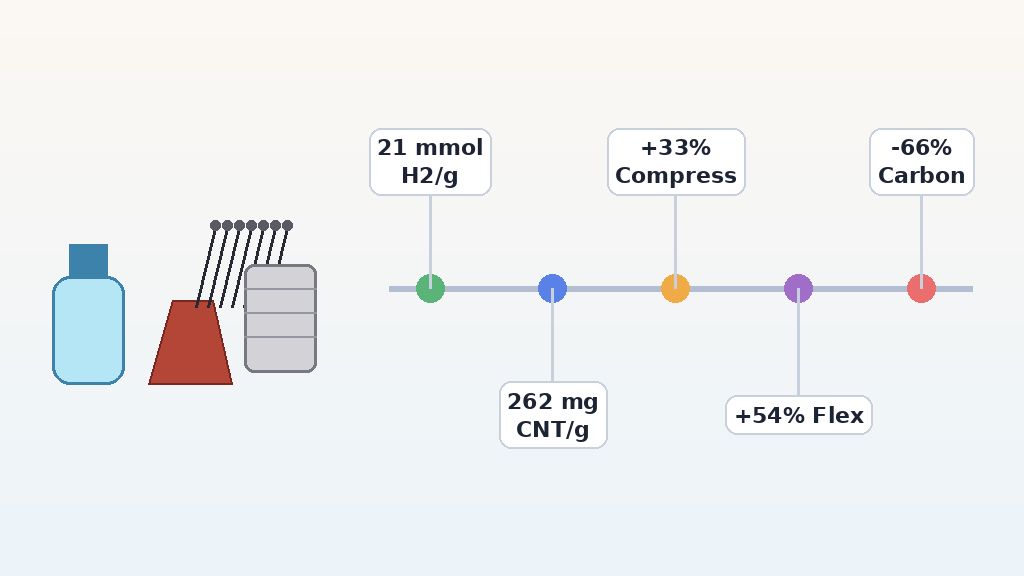
At a one-to-four red mud-to-polyethylene ratio, yields looked strong. The team reported 21.0 millimoles of hydrogen per gram of plastic. They also grew 262 milligrams of CNTs per gram of plastic. A real discarded polyethylene detergent bottle still gave 20.4 millimoles of hydrogen per gram. It yielded 206 milligrams of CNTs per gram. Instead of purifying the tubes, they mixed the whole CNT-red mud composite into alkali-activated pastes. Those pastes used ground granulated blast-furnace slag and sodium hydroxide. At one weight percent CNT dosage, 28-day compressive strength rose 33.1 percent. Flexural strength rose 54.3 percent. Fiber bridging, pore filling, and nucleation help explain the gains. At three weight percent, tubes clumped and strength fell. Modeled LCA figures suggest 65.8 percent lower carbon than conventional CNT routes. Energy demand fell 71.1 percent in that model. Cost fell 13.6 percent as modeled. In short, waste to materials looks promising on the bench.
Why Plastic Waste Nanotubes Matter for Future Builders
Global plastic recycling still sits under ten percent in the paper’s framing. Mechanical recycling often weakens polymers. Ordinary pyrolysis leans toward fuels with limited upside. Catalytic routes that make hydrogen and nanocarbons open higher-value paths. Red mud carries iron and aluminum species that can crack plastic vapors. Alkali-activated materials, or AAMs, offer lower-carbon binders than Portland cement. Their precursors can come from industrial by-products. Our story on plastic-eating enzyme designs shows another future for hard-to-recycle plastics. In contrast to that biological route, this work builds a thermal and materials bridge. For this reason, chemical engineers and civil engineers meet at the same furnace. Red mud catalysis could turn two wastes into tomorrow’s reinforcement. At the same time, cities searching for circular supply chains should watch this space closely.
How Red Mud Catalysis Grows Carbon Nanotube Composite Fibers
To begin with, picture a hot reactor where plastic vapors meet red mud grains. Then iron sites help crack chains and grow tubular carbon. Afterwards, the tubes stay attached to the mud instead of needing a costly purge. That choice matters for cost and for later mixing into binders. The team scanned ratios, plastic types, and mud chemistries. For example, polyethylene performed well. However, PVC released HCl-bearing gases and performed poorly. Different red mud samples shifted yields and tube quality. As a result, feedstock choice shapes both hydrogen and CNT harvests. In other words, the catalyst is not a generic black box. Designers can tune it. On top of that, keeping tubes on the mud simplifies the process flow. Carbon nanotube composite additives then move straight into AAM pastes. Altogether, the furnace becomes a materials studio for the future.
How Alkali-Activated Binder Tests Show the Payoff
Alkali-activated pastes are not the same as finished concrete. The authors tested small binder specimens, not structural pours. Even so, the strength jumps at one weight percent CNT look substantial. Compressive gains of 33.1 percent and flexural gains of 54.3 percent point to tougher pastes. Mechanisms include fiber bridging across cracks, finer pores, and nucleation of binder gels. Full methods appear in the Nature Communications Article in Press. Still, commercial CNTs reached similar toughness gains at only 0.15 weight percent. That comparison sits in the paper. Dose efficiency therefore favors purified tubes today. As a result, the waste-derived composite wins on modeled footprint more than on dose. Our piece on whole glass fabrics from wind blades shows parallel hopes for circular construction. In practice, alkali-activated binder labs now have a new additive to stress-test.
What the Strength Numbers Mean for Waste to Materials
Higher flexural strength matters when binders must resist bending and cracking. Fiber-like CNTs can bridge microcracks before they grow. Pore filling densifies the paste. Nucleation can speed useful gel growth. At three weight percent, aggregation undid those benefits. Dispersion, then, is as important as chemistry. Lab durability tests also moved in a hopeful direction. Sorptivity fell from 0.46 to 0.36. Fifty-day drying shrinkage fell from 5700 to 4807 microstrain. Even so, long-term durability in real structures remains unreported. For this reason, field pilots must come next. Creative flowsheets that ignore dispersion will stall. Honest mixing science will keep the waste to materials story credible. Notably, positive results still need outdoor proof before cities adopt them. In addition, toughness claims deserve careful reading across abstract and body text.
Fig. 1: Key Results From Waste Nanotube Trials
Modeled Footprints Point Toward Cleaner Nanotube Supply
Cradle-to-gate LCA and TEA compared the waste route with conventional CNT production. First, modeled carbon emissions fell 65.8 percent. Next, modeled energy demand fell 71.1 percent. Afterwards, modeled cost fell 13.6 percent per functional unit. Those figures are estimates, not plant invoices. Even so, they sketch a future where waste catalysts cut the price of reinforcement. Hydrogen co-production adds another value stream for energy systems. In short, the furnace could serve materials and fuels together. Meanwhile, investors still need pilot data and continuous reactors. Positive roadmaps stay honest about that gap. Plastic waste nanotubes become more exciting when models and machines both improve. Ultimately, cleaner nanotube supply could reshape low-carbon construction markets. At the same time, pilots must confirm every modeled gain on the ground.
Explainer: From Bottle to Binder in One Hopeful Loop
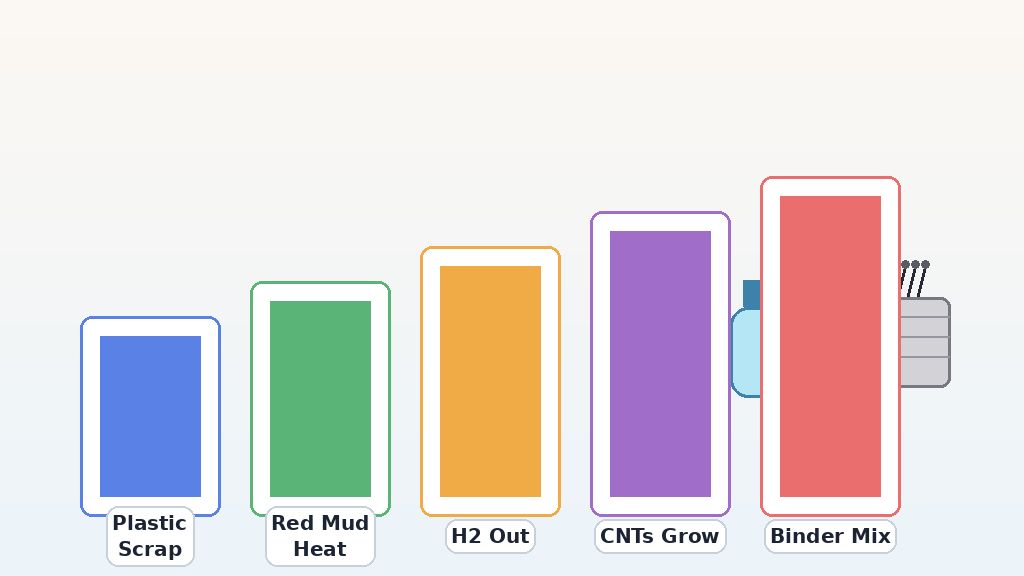
Start with polyethylene scrap and red mud. Heat them so vapors meet catalytic iron sites. Hydrogen leaves as a clean-burning gas stream. Carbon deposits as nanotubes on the mud grains. Skip the purification plant for now. Blend the composite into an alkali-activated paste. At the right dose, tubes bridge cracks and fill pores. The paste grows denser and tougher under lab curing. Related circular ideas appear in our eco-friendly technology innovations guide. As a result, two wastes become one additive. In the same way, future industrial parks could sit beside alumina plants and plastic recyclers. Waste to materials thinking turns today’s leftovers into tomorrow’s beams. Altogether, the loop feels simple enough to teach and bold enough to scale later. For example, a park could share heat, hydrogen, and binder lines.
Fig. 2: How Plastic And Red Mud Grow Tubes
Why Dose and Dispersion Decide Plastic Waste Nanotubes Mixes
Nanotubes only help if they spread through the paste. If too few appear, bridges stay rare. When too many appear, clumps create weak zones. One weight percent worked best in these trials. Three weight percent hurt strength. Commercial tubes needed far less mass for a similar toughness shift. That contrast teaches a clear lesson. Process teams must improve dispersion of waste-grown tubes. They must also keep modeled cost advantages while closing the dose gap. On the other hand, skipping purification already saves steps. In addition, red mud itself becomes part of the composite rather than a disposal burden. For this reason, the next decade could favor hybrid recipes. Optimism here still rests on careful mixing science. In short, the carbon nanotube composite future hinges on uniform blends.
Challenges on the Road to Plant Scale
Gram-scale pyrolysis is not a factory. Small paste specimens are not bridges or floors. PVC and some feedstocks still misbehave. Modeled LCA and TEA gains need real meters and ledgers. The abstract’s toughness-ratio claim also sits beside inconsistent body figures. Therefore, this article avoids quoting a single ratio. Even so, the positive core remains clear. Wastes can grow useful nanocarbons. Hydrogen co-production widens the value case. As a result of this, scale-up teams should prioritize continuous reactors. They should also prioritize dispersion methods for every paste batch. Moreover, they should test larger structural elements outdoors. Without those steps, red mud catalysis stays only a bright laboratory chapter. City builders still wait. Our open Nature Communications source keeps the evidence public for that next climb upward.
Limits That Still Shape the Horizon
First, the manuscript is an Article in Press. Typesetting may still change. Second, long-term structural durability outdoors is unreported. Third, no full plant trial appears. Fourth, dose efficiency trails purified commercial CNTs. Fifth, feedstock choice can release unwanted gases, as with PVC. Even so, polyethylene scrap and industrial red mud already work on the bench today. Chemical engineers, materials scientists, and civil engineers can push the loop forward together. Careers in circular construction will need people who speak pyrolysis and paste rheology well. In particular, teams that pair positive vision with hard pilot data may move fastest. By contrast, hype without dispersion control will fade. Carbon nanotube composite research still has open, exciting work ahead. Ultimately, those limits define the next hopeful experiments for builders.
Conclusion: Next Steps for Plastic Waste Nanotubes
This study gives plastic waste nanotubes a hopeful construction future. Red mud catalyzed polyethylene into hydrogen and CNT composites. Alkali-activated binder pastes grew stronger at one weight percent CNT in the lab. Modeled footprints look cleaner than conventional CNT supply. At the same time, scale, dose efficiency, and outdoor durability remain open. PVC and clumping warn against careless recipes. As a result, the work invites builders and chemists to collaborate. Next, continuous pilots and structural tests should lead. Finally, honest cost sheets must follow the models. Until then, treat the result as a strong laboratory advance with a bright horizon. Keep the study DOI record close while those pilots write the next chapter. In short, tomorrow’s binders may grow from today’s discarded plastic trash streams.
References
Yan, M., Bi, H., Lu, Y., Huang, Z., Sun, C., Li, Z., Hou, Y., Lei, L., & Yang, B. (2026). Toughening alkali-activated construction materials using nanocarbon composites from red mud-catalyzed plastic waste upcycling. Nature Communications. Advance online publication (Article in Press). https://doi.org/10.1038/s41467-026-79066-8
The plastic-to-nanotube piece keeps a positive and futuristic tone that fits the byline. I would still open the dose-and-dispersion tension a little earlier so builders see why the lower dose outperformed the higher one. A clearer call for continuous-reactor pilots near the challenges section would help. Readers are encouraged to refer to the original source paper from which this story is sourced.
Editorial note
Desk note: regenerated under the latest explainer routine with Metallurgy and Materials Engineering as the sole category and Sandeep Shiyekar's positive, futuristic persona. For methods and caveats, please consult the original source paper from which this article is sourced.
Dr. Sandeep Mukund Shiyekar is a distinguished civil engineer, academic leader, and continuum mechanics researcher with over 20 years of expertise in structural engineering, advanced materials, and computational mechanics. He holds a Ph.D. from IIT Bombay and completed prestigious post-doctoral research at Virginia Tech’s Aerospace Engineering Department under a NASA federal grant, where he worked on structural damage tolerance and progressive failure analysis for NASA and Airbus projects.
Throughout his career, Dr. Shiyekar has served as Professor, Head of Department, and College Principal, mentoring four Ph.D. scholars and over twenty postgraduate students. He is an expert in Finite Element Analysis (FEA), using advanced computational tools like ABAQUS, MSC.Marc, and STAAD.Pro to evaluate functionally graded materials, composite laminates, and structural dynamics. He has led over 200 structural design projects, secured major competitive research grants—including ₹12.85 Lakhs from ISRO—and published a NASA Technical Report alongside numerous peer-reviewed papers and book chapters.
As a Chartered Engineer and an active member of international engineering bodies, Dr. Shiyekar brings world-class research experience to ENTECH Magazine, sharing authoritative insights on computational mechanics, aerospace-grade structures, and smart materials innovation.