A green laser and nano-sized ceramic particles let a team print AA7075 aluminum that beat forged metal on yield strength while using 40-45% less laser power.
Aircraft and rockets need metal parts that are both light and very strong. Aluminum alloys fit that need, yet they are hard to 3D print. Now a team reports a fresh approach called green laser 3D printing. Chaolin Tan of Soochow University in China is the corresponding author. Researchers from A*STAR in Singapore also took part. In addition, partners in Shanghai, Dongguan, and Hong Kong joined the study. The paper appeared in Nature Communications on October 30, 2026. It is an Article in Press, so final editing may still change small details. In short, the team swapped the usual infrared laser for a green one. They also mixed tiny ceramic particles into the metal powder. Together, these changes produced aluminum stronger than the forged version of the same alloy. Its DOI, for reference, is 10.1038/s41467-026-78822-0.
The alloy is AA7075, a classic aerospace aluminum. Infrared lasers struggle with it for several reasons. Aluminum reflects much of their light, and the alloy also cracks easily. On top of that, key elements like zinc and magnesium boil away. The new process tackled all three problems at once. As a result, the green laser needed 40-45% less power than the infrared one. After heat treatment, the best samples reached a yield strength of about 591 megapascals. Yield strength marks the point where metal starts to bend for good. Infrared samples, by contrast, reached only 345 to 411 megapascals. Even so, the strongest samples stretched only about 2.9% before breaking. In fact, all results come from lab test samples, not finished parts. Below, we explain how the method works and where its limits lie.
Why Green Laser 3D Printing Matters
Directed energy deposition builds parts by blowing metal powder into a laser beam. The beam melts the powder into a small pool, layer by layer. This method can make large parts quickly. For example, the paper notes that NASA printed an aluminum rocket nozzle this way. Aerospace parts, however, often need ultrahigh strength of about 500 megapascals or more. The 7000-series aluminum alloys offer that strength in forged form. Our guide to aluminum alloy forging advantages explains why forged parts set the bar. Printing these alloys, on the other hand, has proved very difficult. Cracks form along long, column-shaped grains as the metal cools. In addition, lost zinc and magnesium weaken the final part. For this reason, engineers have long searched for a better printing recipe.
Why Infrared Lasers Struggle With Aluminum
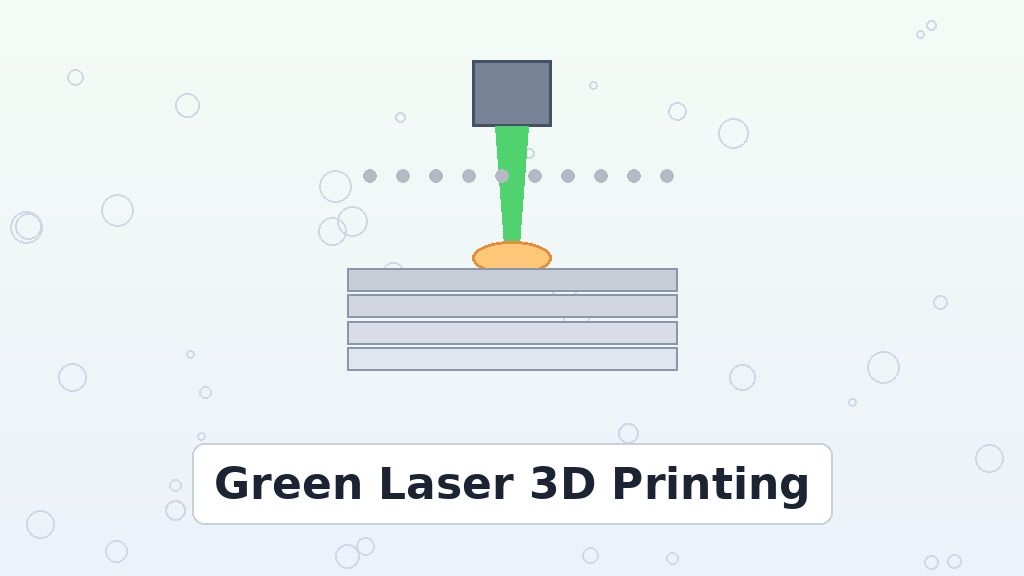
Most metal printers use infrared light near 1064 nanometers. Aluminum, however, reflects much of this light. Green light sits at 532 nanometers, about half that wavelength. According to the paper, green light can raise aluminum’s absorption by nearly 1.5 times. Better absorption means the laser wastes less energy. It also means the melt pool stays calmer. With infrared light, by contrast, machines must push more power to melt the powder. That extra power overheats the pool and boils off light elements. Zinc and magnesium, in particular, have low boiling points. Losing them leaves fewer building blocks for strengthening particles later. In other words, a hotter process can make a weaker metal. The team therefore tested whether green light could solve the energy problem directly. They also needed a separate fix for cracking.
How the Green Laser Additive Manufacturing Tests Worked
The team first made a special powder. They added titanium carbide nanoparticles to molten AA7075 using a salt flux. The final mix held 1.7% titanium carbide by weight. After that, they cast the melt and turned it into fine powder with gas atomization. A Trumpf printing cell then deposited the powder with two disk lasers. One laser emitted infrared light, and the other emitted green light. At the same time, argon gas shielded the melt from air. The team printed at two scan speeds, 600 and 1500 millimeters per minute. Green laser power, in turn, was 600 or 900 watts. The infrared laser, in contrast, needed 1000 or 1100 watts for dense parts. Afterward, all samples went through a standard T73 heat treatment. Full details appear in the Nature Communications paper.
Results for the Printed Aluminum Alloy
Reflection tests came first. Adding titanium carbide and switching to green light cut powder reflectance from 44.9% to 32.9%. After that, the team pulled the samples apart in a testing machine. Slow-speed green samples reached about 591 megapascals with 2.9% stretch. Faster green samples, meanwhile, reached about 543 megapascals with 5.5% stretch. Infrared samples reached only 345 and 411 megapascals. Overall, the green samples showed 32-71% higher yield strength at the same speeds. They did so despite 40-45% lower laser power. The authors say this beats forged AA7075 and almost all similar printed aluminum alloys. Their abstract rounds the best strength to about 600 megapascals. Even so, the strongest samples traded away much of their stretch. As a result, designers would need to weigh strength against toughness for each part.
Fig. 1: Key Results of the Green Laser Study
Inside the Green Laser 3D Printing Melt Pool
High-speed cameras showed a big difference between the two lasers. The infrared pool threw off many spattering droplets. In contrast, the green pool stayed stable with little spatter. Thermal cameras and computer models told the same story. Peak pool temperature fell by 38.6%, from about 2697 °C to 1657 °C. In addition, the green pool had a smaller hot zone and gentler temperature changes. Light given off by the pool also revealed boiling metals. Infrared printing showed many more emission lines from zinc and magnesium. Green printing, at the same time, showed far fewer. Chemical tests then confirmed the difference. Zinc losses fell by 30.1%, and magnesium losses fell by 77.2%. Copper losses, in turn, dropped by 13.3%. In this way, the cooler pool kept more strengthening elements inside the metal.
Explainer: How Green Light and Nanoparticles Work Together
Each ingredient in this recipe does a different job. The green laser mainly improves density and keeps alloying elements in place. Titanium carbide, on the other hand, mainly stops cracks and shrinks grains. The team tested this split directly. Plain AA7075 printed with green light still cracked. Its yield strength reached only about 434 megapascals. In other words, green light alone cannot fix this alloy. The nanoparticles act as seed points where new grains start to grow. As a result, the metal forms small, rounded grains instead of long columns. Rounded grains resist cracking far better. Pore content also fell, from 0.11% with infrared to 0.02% with green light. Our story on laser recovery of solar silver shows another way lasers handle tricky materials. Overall, each ingredient covers a weakness of the other.
Tiny Particles Behind the Strength
Heat treatment produced most of the final strength. During aging, the metal grows tiny particles called eta-prime precipitates. These particles block defects from sliding through the metal. Small clusters called GP zones also form and add more strength. Because the green process kept more zinc and magnesium, more particles could form. Their density reached about 2.13 times 10 to the 16th per square meter. The team then calculated where the strength came from. Particle blocking, known as Orowan strengthening, supplied 45.5-54.7% of the total. For the faster green sample, the calculation gave about 565 megapascals. That figure sits close to the measured 543 megapascals. Similarly, the infrared estimate of 392 matched its measured 411 fairly well. Thus, the model supports the idea that saved elements drive the gain.
Fig. 2: How Green Light and TiC Strengthen AA7075
Challenges for Green Laser 3D Printing
Several hurdles stand between this result and real aircraft parts. First, the strongest samples stretched only 2.9% before breaking. Low stretch can make parts less tolerant of damage. The faster setting, by comparison, gave more stretch but slightly lower strength. Second, green lasers in this study had a lower maximum power than the infrared unit. The green laser topped out at 1000 watts, while the infrared reached 3000 watts. Third, the recipe depends on a custom composite powder. Making that powder adds extra steps before printing even starts. Our refractory alloys at 20 kelvin story shows this balance problem. For now, the paper reports no cost figures for the full process. Likewise, it reports no tests on large, curved, or complex parts. Those tests would matter for real aircraft and rocket hardware.
Limits the Researchers Report
To begin with, this paper is an Article in Press, so details may still change. Also, every test used small samples cut from printed blocks. The team also measured strength mainly at room temperature. Fatigue, corrosion, and long-term heat exposure, by contrast, fall outside this study. In addition, the green process cooled more slowly than the infrared one. Slower cooling let grains grow slightly larger in the green samples. The authors note that this coarsening partly offsets other gains. Moreover, the powder reflectance test only indicates absorption trends, not real-time absorption. The study does not name a specific aircraft part or product either. For these reasons, the method still needs larger trials and industry testing. Even so, the authors argue the approach could help other reflective metals that crack easily. Copper alloys, for instance, face similar laser problems.
Conclusion: A Brighter Path for Printed Aluminum
This study offers a promising step for green laser 3D printing of aerospace aluminum. A green laser and titanium carbide particles worked together in a careful way. The green light cut reflection, calmed the melt pool, and saved zinc and magnesium. Meanwhile, the nanoparticles stopped cracks and kept grains small and rounded. After heat treatment, samples reached about 591 megapascals of yield strength. That beats forged AA7075, according to the authors. At the same time, the strongest samples stretched only 2.9% before breaking. Soochow University also posted a Chinese news page on the study. In the long run, researchers must test larger parts, fatigue life, and production costs. They must also show the method works on real aircraft components. Until then, the result remains an encouraging lab advance. Still, it shows how changing the color of light can change a metal.
References
Liu, T.-S., Cheng, X. W., Mikula, J., Ng, F. L., Xiong, L., Zhao, Y., Laskowski, R., Luan, J., Wu, X., & Tan, C. (2026). Ultrahigh strength aluminum alloy by green laser additive manufacturing. Nature Communications. Advance online publication (Article in Press). https://doi.org/10.1038/s41467-026-78822-0
This draft reads cleanly for a general science audience, and the laser-versus-powder framing is easy to follow. I would still tighten the challenges section so the remaining lab-to-factory gaps feel sharper without leaning on jargon. A short line on what independent tests would need to show before aerospace use would help readers judge readiness. For fuller context, readers are encouraged to consult the original research paper this article draws on.
Editorial note
ENTECH is covering green-laser aluminum printing because it sits at the intersection of aerospace metals and everyday manufacturing careers our readers ask about. The piece stays focused on what the open study reports and what it leaves open. Readers are encouraged to refer to the original source paper from which this story is sourced.
Dinesh Joshi is a leading consultant in the field of product design and development, production engineering, industrial engineering, and program management. He has worked with esteemed domestic as well as European and US organizations.
Mr. Dinesh G. Joshi has completed Graduation in Mechanical Engineering from Pune University and thereafter pursued Post Graduation in Production Engineering from Walchand College of Engineering Sangli (Shivaji University). He is member of Project Management Institute (PMI), Pennsylvania, USA as well as Indian Institute of Welding (IIW) Kolkata. He has good blend of diversified experience of about 22 years in Product Design and Development, Production Engineering, Industrial Engineering and Program Management by virtue of working in the esteemed domestic as well as European and US organizations in addition to 5 years of academic experience.