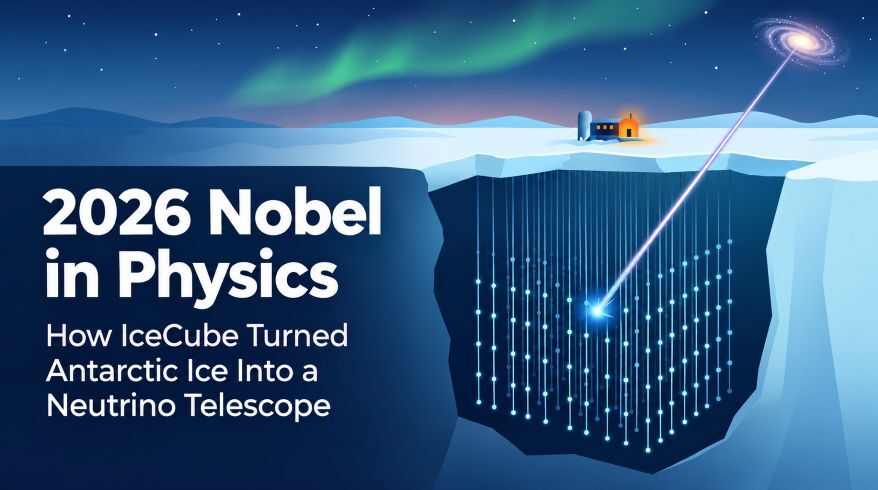
The 2026 Nobel Prize in Physics recognises Francis Halzen’s IceCube scientific leadership. IceCube catches high-energy neutrinos from beyond our solar system in Antarctic ice. These elusive particles travel straight from violent cosmic events, revealing hidden sources. Other messengers cannot reveal these sources as clearly to astronomers on Earth. Cosmic rays carry immense energy, but magnetic fields bend their paths significantly. Neutrinos avoid this problem, and IceCube detects faint flashes called Cherenkov light.
Key Takeaways: 2026 Nobel Prize in Physics
The idea, dating from 1988, eventually developed into AMANDA and then into IceCube: a one-cubic-kilometre volume equipped with 5,160 sensors.
The most significant outcome is the presence of a diffuse flux of high-energy astrophysical neutrinos coming from all over the sky.
The Milky Way is the first astronomical source of high-energy neutrinos confirmed beyond the 5σ threshold.
Sources like NGC 1068 and TXS 0506+056 still need confirmation.
Ultimately, this Nobel Prize in neutrino astronomy reflects decades of international cooperation.
Who Won the 2026 Nobel Prize in Physics?
Then the committee awarded Francis Halzen the prize, announcing it on 6 October 2026. The citation honours “decisive contributions to the IceCube Neutrino Observatory” and “the discovery of high-energy neutrinos of astrophysical origin.” Moreover, the prize includes 12 million Swedish kronor (The Royal Swedish Academy of Sciences, 2026c).
Additionally, Halzen was born in Tienen, Belgium, in 1944 and obtained his PhD from KU Leuven in 1969; he is a professor at the University of Wisconsin–Madison in the United States. He has led the project from the beginning as principal investigator. The collaboration involves approximately 450 people from 58 institutions in 14 countries (The Royal Swedish Academy of Sciences, 2026b).
Finally, committee chair Mark Pearce credits Halzen’s tenacity and vision with pioneering astronomy (The Royal Swedish Academy of Sciences, 2026c).
What Are Neutrinos? The 2026 Nobel Prize in Physics Explained Here
A neutrino, central to the 2026 Nobel Prize in Physics, is a fundamental particle with no electric charge and little mass; consequently, it passes through Earth, our bodies, and most matter unnoticed. In fact, 65 billion solar neutrinos pass through a fingernail each second. Therefore, scientists detect one only when it collides directly with an atomic nucleus (The Royal Swedish Academy of Sciences, 2026a).
Fig. 1: Neutrinos have no electric charge and almost no mass, so about 65 billion solar neutrinos pass through a fingernail every second. (Generated by AI)
Initially, Wolfgang Pauli suggested the particle’s existence in 1930; later, Cowan and Reines verified it in 1956 using a nuclear reactor (The Royal Swedish Academy of Sciences, 2026b). Since neutrinos interact so weakly, they consequently traverse the cosmos almost unchanged.
Why Do Cosmic Neutrinos Matter for Astronomy?
The 2026 Nobel Prize in Physics highlights cosmic rays, atomic nuclei from outer space, mostly protons, the nuclei of hydrogen. They carry energy a million times greater than any machine on Earth (The Royal Swedish Academy of Sciences, 2026a). Magnetic fields curve their charged paths, concealing origins of these rays (The Royal Swedish Academy of Sciences, 2026b).
Fig. 2: Magnetic fields bend cosmic rays and gamma rays can be absorbed, but neutrinos travel straight, so they point back to their source. (Generated by AI)
Likewise, the same mechanisms that speed up protons also produce high-energy neutrinos (The Royal Swedish Academy of Sciences, 2026a). Matter tends to absorb gamma rays or make them lose their energy as they travel. By contrast, magnetic fields do not deflect neutrinos, and dust cannot stop them either.
The Sun and the Earth’s atmosphere likewise produce neutrinos, but at considerably lower energies. Since these neutrinos are more numerous than those from cosmic sources, astronomers focus on the most energetic events (The Royal Swedish Academy of Sciences, 2026a). Astronomers combine neutrinos with cosmic rays, gamma rays, and gravitational waves through multi-messenger astronomy (The Royal Swedish Academy of Sciences, 2026b). With this in mind, scientists can trace a detected neutrino back to its origin in space (The Royal Swedish Academy of Sciences, 2026a).
How Did Halzen Turn Antarctic Ice Into a Detector?
In the autumn of 1987, Halzen spoke at the University of Kansas. Glaciologist E. Zeller, who attended, described the Soviet Union’s plan to detect neutrinos with radio antennas in Antarctic ice. However, researchers found that detecting astrophysical neutrinos required an excessively high energy threshold (The Royal Swedish Academy of Sciences, 2026b). As a result, Halzen decided to use light instead.
Fig. 1: IceCube’s 5,160 light sensors on 86 strings watch for the faint blue Cherenkov flash made after a neutrino hits the ice. (Generated by AI)
Water-detector ideas date back to 1960 and helped inspire the 2026 Nobel Prize in Physics (The Royal Swedish Academy of Sciences, 2026a). When a rapidly charged particle passes through ice, it produces a faint blue flash called Cherenkov light. Halzen realised that light sensors embedded in the ice could detect these flashes. His colleague John G. Learned served as spokesperson for DUMAND, a neutrino project off Hawaii. The team published its proposal in 1988 (The Royal Swedish Academy of Sciences, 2026b) and presented it at a conference in Poland (The Royal Swedish Academy of Sciences, 2026a). These early efforts helped pave the way for the 2026 Nobel Prize in Physics.
A research station already stood at the South Pole, where supplies arrived regularly. The ice offers continuous darkness, low radioactivity, and no interference from living organisms. Moreover, the ground is geologically stable (The Royal Swedish Academy of Sciences, 2026a). However, the extreme cold limits construction to the brief Antarctic summer, from November to February—a practical challenge for the project recognised by the 2026 Nobel Prize in Physics
From AMANDA to IceCube: How Did Scientists Build It?
In 1991, a test on Greenland’s ice sheet showed that its clarity could support a kilometre-scale detector (The Royal Swedish Academy of Sciences, 2026b). From 1993 to 2000, researchers developed AMANDA in stages. They drilled kilometre-deep holes with hot water, using a technique borrowed from glaciology, then lowered strings of light sensors into them. AMANDA helped lay the groundwork for IceCube, the observatory central to the 2026 Nobel Prize in Physics.
Air bubbles at depths of about 800 to 1,000 metres scattered light and blurred particle tracks. However, the deeper ice was clearer. Below about 2,100 metres, Cherenkov light could travel roughly 200 metres before the ice absorbed it (The Royal Swedish Academy of Sciences, 2026b).
In 1999, Halzen and his team submitted the IceCube proposal to the National Science Foundation. The foundation awarded funding in March 2002, and construction began in 2004 (The Royal Swedish Academy of Sciences, 2026b). From 2005 to 2010, crews installed 86 strings at depths of 1,450 to 2,450 metres. The team completed the experiment in 2011 with 5,160 light sensors (The Royal Swedish Academy of Sciences, 2026a). Halzen calls each sensor “a lightbulb in reverse”: it captures light and converts it into an electrical signal (The Royal Swedish Academy of Sciences, 2026a). IceCube’s work underpins the recognition associated with the 2026 Nobel Prize in Physics.
Muon neutrinos leave long trails of light in the ice, while electron and tau neutrinos produce compact particle cascades (The Royal Swedish Academy of Sciences, 2026a, 2026b). These distinct signals help explain the observatory’s role in the 2026 Nobel Prize in Physics.
What Has IceCube Discovered? The 2026 Nobel Prize in Physics and Its Significance
The observatory has delivered landmark results. In addition to the cosmic flux, IceCube registers about 100,000 atmospheric neutrinos a year; scientists expect roughly 100 of those to come from space (The Royal Swedish Academy of Sciences, 2026b). That signal is diffuse, arriving from across the sky rather than from one point (The Royal Swedish Academy of Sciences, 2026b). Sigma (σ) measures statistical confidence, with 5σ marking a discovery.
1. First cosmic neutrinos (2013)
Two events had energies of 1.04 and 1.14 petaelectronvolts; one petaelectronvolt equals 10^15 electronvolts. Together, they provided the first evidence of high-energy neutrinos originating in space; in 2014, the purely atmospheric explanation was rejected at the 5.7σ level (The Royal Swedish Academy of Sciences, 2026b).
2. Sources beyond the galaxy
Earlier results demonstrate that the neutrino sources are predominantly extragalactic. As expected for such a population, no significant anisotropy appears in the sky (The Royal Swedish Academy of Sciences, 2026b).
3. The Milky Way
Galactic neutrinos were reported at 4.5σ in 2023. Updated 2026 results reached 5.7σ, making the Milky Way the first source of high-energy neutrinos past the discovery threshold. No point sources were identified (The Royal Swedish Academy of Sciences, 2026b).
4. Candidate: NGC 1068
In 2022, IceCube reported 79 neutrinos from the direction of this active galactic nucleus, 46 million light-years away (4.2σ) (The Royal Swedish Academy of Sciences, 2026b). An active galactic nucleus is the bright centre of a galaxy, driven by a supermassive black hole. Yet the evidence is not yet robust enough to confirm it (The Royal Swedish Academy of Sciences, 2026a).
5. Candidate: TXS 0506+056
On 22 September 2017, the IceCube Observatory recorded a neutrino within 0.06° of a jet directed at Earth. Previous data indicated a jet directed toward Earth. Previous data indicated a 3.5σ flare between 2014 and 2015 (The Royal Swedish Academy of Sciences, 2026b).
At the same time, one class has not yet been confirmed: gamma-ray bursts. Specifically, more than a thousand follow-up observations have failed to detect any coincident neutrinos (The Royal Swedish Academy of Sciences, 2026b). In short, IceCube has a clear signal, but the exact sources remain unknown.
What Comes Next for Neutrino Astronomy?
Astronomers still hope to identify individual sources rather than just the general glow (The Royal Swedish Academy of Sciences, 2026a). The IceCube-Gen2 project will cover eight cubic kilometres of polar ice. At the same time, a global network is expanding: it includes KM3NeT in the Mediterranean, P-ONE off Vancouver Island, TRIDENT in the South China Sea, and Baikal-GVD in Lake Baikal (The Royal Swedish Academy of Sciences, 2026b).
The Nobel Prize continues a tradition dating back to 1995, 2002, and 2015, when it recognised neutrino detection, cosmic neutrino astronomy, and neutrino oscillations (The Royal Swedish Academy of Sciences, 2026b). In short, the field is still in its early stages, and further results are expected.
Frequently Asked Questions: 2026 Nobel Prize in Physics
What is the IceCube Neutrino Observatory?
In short, it is a neutrino telescope built into a cubic kilometre of Antarctic ice at the South Pole. Strings of light sensors watch for faint Cherenkov flashes, and data travel by satellite for analysis.
Who won the 2026 Nobel Prize in Physics, and how much is the prize?
Francis Halzen received the award for the IceCube Neutrino Observatory, which he led from the beginning. The announcement then came on 6 October 2026, and, moreover, the prize is 12 million Swedish kronor.
What are neutrinos?
They have no electric charge and are very low in mass. Because they seldom collide, billions pass through your body each second. Consequently, they remain difficult to capture, which makes them ideal cosmic messengers
I completed my Master of Science from the University of Allahabad in 2017 with a strong academic background in life sciences and chemistry. My specialization included Molecular Biology, Microbiology, Genetics, Plant Breeding, Phycology, Paleobotany, and Bioinformatics, along with Organic Chemistry, Inorganic Chemistry, and Physical Chemistry. This multidisciplinary training provided me with a comprehensive understanding of biological systems and analytical scientific approaches.
After completing my postgraduate studies, I gained valuable professional experience in both the education and social development sectors. I worked at A.M. Oxford Public School, where I was actively involved in guiding students toward academic excellence. In this role, I focused on creating an engaging learning environment, encouraging critical thinking, and nurturing students’ curiosity for scientific learning. My experience as an educator strengthened my communication, mentoring, and classroom management skills.
In addition to my teaching experience, I worked with Jeevan Jagriti Foundation, where I contributed to community-based initiatives aimed at improving educational access and awareness among underprivileged sections of society. Through this work, I participated in programs designed to support social development and promote the value of education in marginalized communities.
These professional experiences helped me develop strong interpersonal, leadership, and organizational skills while reinforcing my commitment to education and community service.
I completed my Master of Science from the University of Allahabad in 2017 with a strong academic background in life sciences and chemistry. My specialization included Molecular Biology, Microbiology, Genetics, Plant Breeding, Phycology, Paleobotany, and Bioinformatics, along with Organic Chemistry, Inorganic Chemistry, and Physical Chemistry. This multidisciplinary training provided me with a comprehensive understanding of biological systems and analytical scientific approaches.
After completing my postgraduate studies, I gained valuable professional experience in both the education and social development sectors. I worked at A.M. Oxford Public School, where I was actively involved in guiding students toward academic excellence. In this role, I focused on creating an engaging learning environment, encouraging critical thinking, and nurturing students’ curiosity for scientific learning. My experience as an educator strengthened my communication, mentoring, and classroom management skills.
In addition to my teaching experience, I worked with Jeevan Jagriti Foundation, where I contributed to community-based initiatives aimed at improving educational access and awareness among underprivileged sections of society. Through this work, I participated in programs designed to support social development and promote the value of education in marginalized communities.
These professional experiences helped me develop strong interpersonal, leadership, and organizational skills while reinforcing my commitment to education and community service.