Find the most reliable healthcare compliance platforms to enhance compliance management and navigate regulatory challenges effortlessly.
Best Healthcare Compliance Platforms to Consider in 2026

Estimated reading time: 11 minutes
Most healthcare organizations don’t fail audits because they ignored the rules. They fail because managing compliance across departments, training staff consistently, and keeping pace with shifting HIPAA, HITECH, CMS, and state-specific requirements is genuinely hard without the right tools. Healthcare compliance platforms exist precisely to close those gaps. After reviewing dozens of options across user reviews, case studies, and product pages, this guide covers the five platforms worth your time in 2026.
The shortlist methodology
Publicly available information shaped every decision here: user review scores, verified case studies, feature documentation from official websites, and listings across major software review directories. Only platforms with a demonstrated track record of supporting healthcare organizations through real regulatory adherence challenges made the final cut.
→ See the full research breakdown
- ComplyAssistant – Best for healthcare compliance and HIPAA management
- MetricStream – Best for enterprise GRC and healthcare compliance automation
- SAI360 – Best for enterprise risk and compliance management
- Sprinto – Best for continuous compliance management and healthcare security certification
- Drata – Best for mid-to-enterprise healthcare organizations pursuing SOC 2 or HIPAA compliance
The Stakes Behind Choosing Healthcare Compliance Platforms
Picking the wrong platform doesn’t just slow your team down. It leaves your organization exposed to audit findings, repeat deficiency cycles, and documentation gaps that are hard to explain after the fact.
Federal and state healthcare requirements don’t wait for your system to catch up. HIPAA, HITECH, CMS Conditions of Participation, Joint Commission standards, and OIG guidelines shift regularly, and organizations managing multiple facilities or care settings feel that pressure the hardest.
Specialized platforms built for healthcare compliance give teams a structural advantage. They’re designed around how policy acknowledgment, staff training completion, and vendor BAA management actually work inside a healthcare organization.
That kind of fit matters when you’re tracking open versus closed compliance risks or trying to cut the time it takes to remediate a compliance gap before your next inspection.
The right platform won’t just help you pass an audit. It will lower your repeat deficiency rate and give you defensible documentation when it counts.
Also Read: AI in Pharmacy and Intelligent Medication Management
5 Healthcare Compliance Platforms Compared
Note: All data in this table is sourced from review platforms and the official websites of the listed companies.
| Company Name | Years Operating | Team Size | Headquartered In |
| ComplyAssistant | Est. 2002 | 11-50 | Woodbridge, NJ |
| MetricStream | Est. 1999 | 1,266 | San Jose, CA |
| SAI360 | 25+ years | 438 | Chicago, IL |
| Sprinto | Est. 2020 | 316 | San Francisco, CA |
| Drata | Est. 2020 | 723 | San Diego, CA |
1. ComplyAssistant – Best for Healthcare Compliance and HIPAA Management
What Problems Does ComplyAssistant Solve?
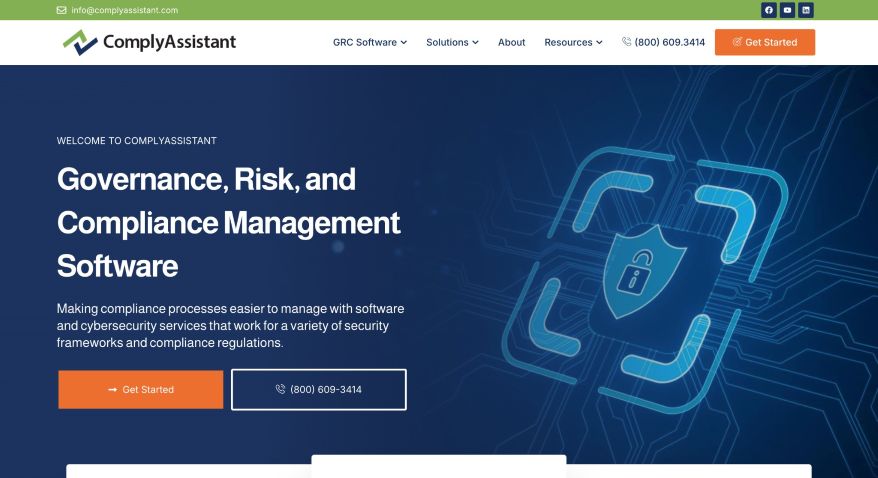
ComplyAssistant focuses exclusively on healthcare, which already sets it apart from general-purpose GRC tools. It covers security framework management, third-party vendor risk, and HIPAA compliance in one platform. Founded in 2002, with cloud software development starting in 2009, they’ve built their platform around what healthcare organizations actually need day-to-day. The client roster includes HackensackUMC Palisades and Cape Regional Health System, and they’re endorsed by HASC, which signals real credibility in this space.
Why Pick ComplyAssistant for Healthcare Compliance Platforms?
ComplyAssistant solves the specific problem of managing HIPAA, HITECH, and HITRUST requirements without forcing a healthcare team to adapt a generic GRC tool to fit their workflows. Their responsiveness is worth calling out: they’re known for modifying the platform quickly based on client feedback, which is rare among larger vendors.
What the Reviews Show:
The platform earned 2025 GetApp Category Leader recognition in HIPAA Compliance, which isn’t a small thing. Users at healthcare organizations of varying sizes seem to trust it, and the “small but mighty” positioning resonates with compliance officers who want a responsive team behind the software, not just a ticket queue.
2. MetricStream – Best for Enterprise GRC and Healthcare Compliance Automation
What Problems Does MetricStream Solve?
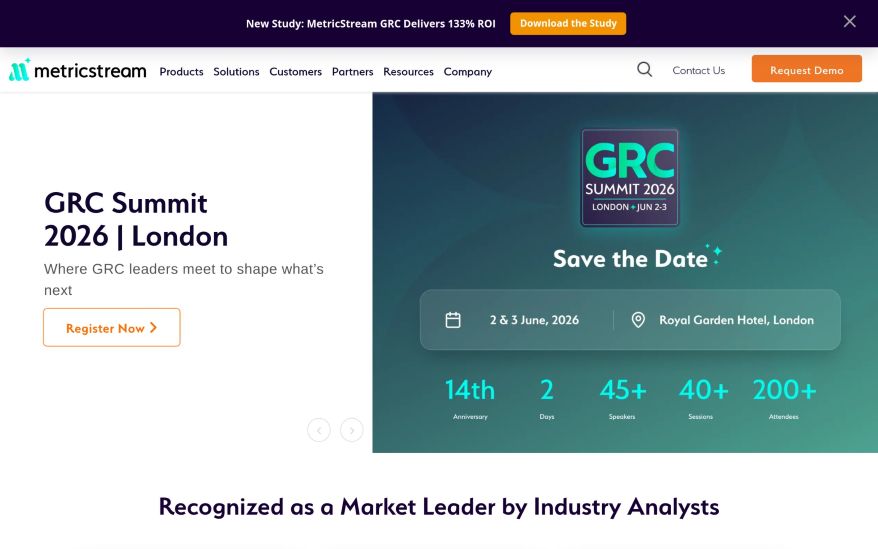
MetricStream runs an AI-first cloud platform covering regulatory compliance management, internal audit, SOX compliance, cyber GRC, and third-party risk management. The platform’s low-code/no-code design cuts repetitive GRC tasks significantly, which matters when compliance teams are stretched thin. They serve over 1 million professionals across 35-plus countries, including major healthcare and life sciences organizations.
Why Pick MetricStream for Healthcare Compliance Platforms?
Teams dealing with large-scale, multi-facility compliance programs will find MetricStream built for that level of scale (think enterprise pricing). Their ranking as a Leader across all five domains in Chartis Research’s 2025 GRC report reflects real depth, not just marketing, and that kind of third-party validation is hard to match.
What the Reviews Show:
Industry analysts have placed MetricStream at the top of multiple GRC categories, including a #1 ranking in operational risk and audit. Organizations that need proven enterprise-grade credibility alongside automation tend to land here. Users point to the platform’s breadth as both its strength and, occasionally, its learning curve.
Also Read: Quality in Drug Manufacturing
3. SAI360 – Best for Enterprise Risk and Compliance Management
What Problems Does SAI360 Solve?
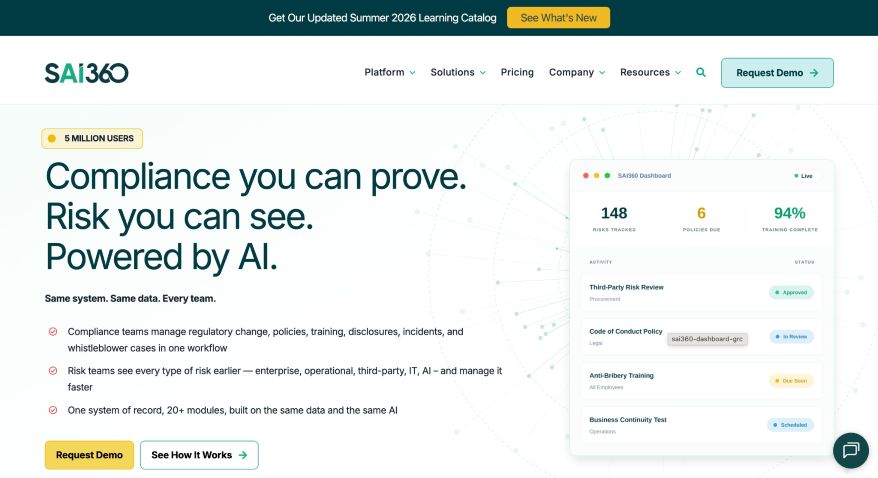
SAI360 combines GRC and ESG capabilities in one platform, with 25-plus years behind it. They cover compliance and policy management, regulatory updates, business continuity, audit management, and ethics and compliance training. The AI layer connects risk and compliance data so teams can spot issues before they become findings. Organizations like Colgate-Palmolive and Kraft Heinz use the platform, which signals it scales well.
Why Pick SAI360 for Healthcare Compliance Platforms?
SAI360 addresses the challenge of managing regulatory change alongside day-to-day compliance training, something healthcare organizations constantly juggle across departments. Six Brandon Hall Group Learning and Development awards point to serious strength in staff training programs, and that kind of recognition for training quality is rare in a pure GRC platform.
What the Reviews Show:
SAI360 earned a Leader designation in the 2025 Verdantix Green Quadrant for GRC software and won Company of the Year in Educational Technology at the 2025 Stevie Awards. The training-focused recognition tells you something real: users who care about consistent staff competency documentation tend to respond well to this platform.
Also Read: Contract Management System Features That Reduce Risk and Ensure Compliance
4. Sprinto – Best for Continuous Compliance Management and Healthcare Security Certification
What Problems Does Sprinto Solve?
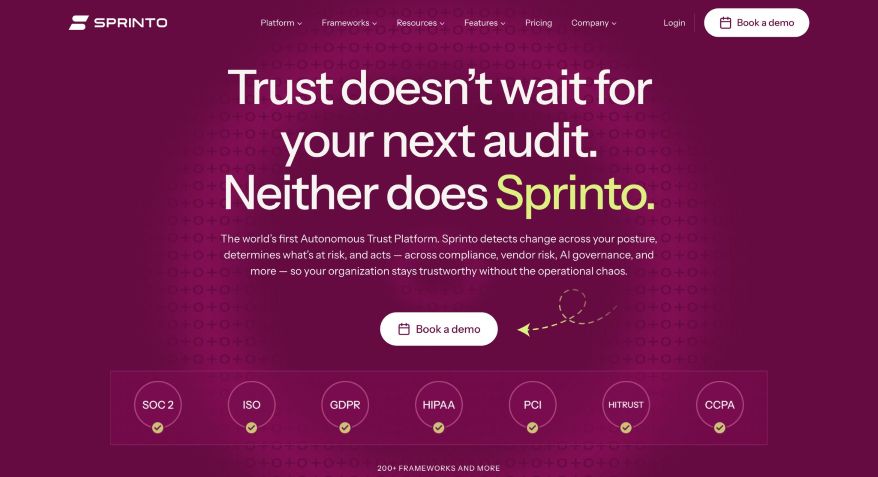
Sprinto runs as an autonomous trust platform, meaning it doesn’t just alert you to compliance gaps; it works to close them automatically. The platform supports 200-plus global standards including SOC 2, ISO 27001, HIPAA, GDPR, and PCI-DSS, with 300-plus integrations and a presence across 75 countries. Founded in 2020, it’s grown fast, with 63% year-over-year headcount growth signaling strong market pull. Healthcare vendors and providers needing rapid certification will find the speed story compelling.
Why Pick Sprinto for Healthcare Compliance Platforms?
Sprinto tackles the specific pain of evidence collection burnout. Instead of asking compliance teams to manually gather and refresh documentation, the platform handles that automatically. The autonomous execution model (not cheap, but worth it for teams drowning in recurring audit prep) means your staff spends time on judgment calls, not paperwork.
What the Reviews Show:
Sprinto holds a 4.8-star rating on G2, and client case studies back up the speed claims: one customer achieved SOC 2 certification in under 30 days, and another completed ISO 27001 in two weeks. Users appreciate not just the speed but the reduction in manual compliance workload volume.
Drata – Best for Mid-to-Enterprise Healthcare Organizations Pursuing SOC 2 or HIPAA Compliance
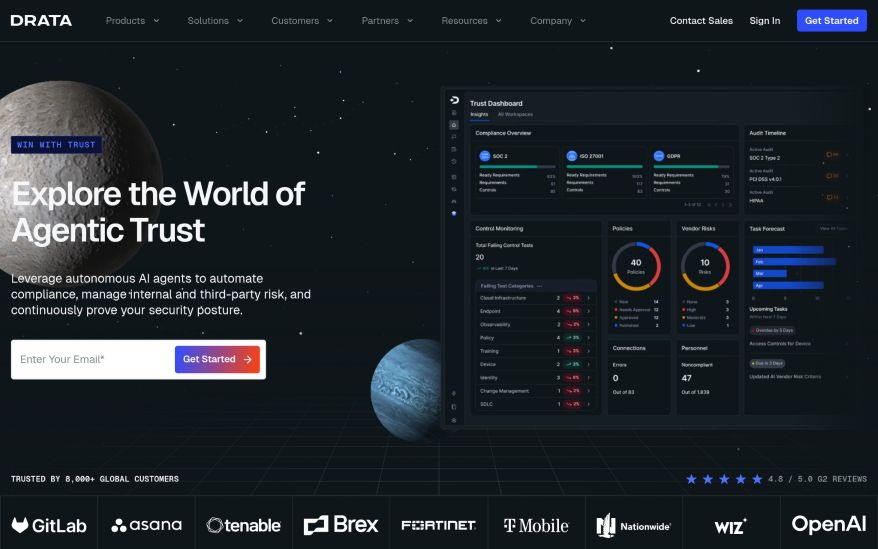
What Problems Does Drata Solve?
Drata automates security compliance evidence collection and continuously monitors controls across 14-plus frameworks including SOC 2, HIPAA, GDPR, and ISO 27001. It also handles asset tracking and employee compliance workflows, which removes a lot of the manual overhead that slows down healthcare compliance teams. With over 4,000 customers worldwide and 75-plus integrations, the platform has real market depth behind it.
Why Pick Drata for Healthcare Compliance Platforms?
Drata handles the continuous monitoring side of compliance that most organizations struggle to keep current without dedicated staff. As a unicorn company valued at $2 billion, it’s well-funded enough to keep pace with changing regulatory requirements without the risk of going stale.
What the Reviews Show:
Drata has been named a leader in multiple G2 categories, covering cloud compliance and security compliance grids. Users at growth-stage and mid-market healthcare organizations appreciate how much audit prep time the platform removes. Customers like Notion and Fivetran add some tech-forward credibility, though healthcare compliance officers will want to verify their specific HIPAA workflow depth before committing.
Evaluation Criteria and Research Approach
Building this list started with a wide net and got progressively tighter as the research moved forward.
Establishing Your Data Foundation
The starting point was a broad sweep across software directories, industry publications, and review aggregators to map out which platforms show up consistently when healthcare compliance professionals are searching for help. Company websites, product documentation, and published case studies were pulled in early. The goal at this stage was breadth: understand what’s out there before cutting anything.
Filtering Candidates Against Your Priorities
Once the longlist was in place, options without verifiable healthcare compliance track records were removed. Review patterns were analyzed carefully, looking for consistency across reviewer types. A platform that scores well among general IT buyers but poorly among healthcare compliance officers tells a different story than one that consistently earns trust from compliance-focused teams. Unverified claims and thin review histories pushed companies down or out entirely.
Validating Selection Accuracy
Cross-referencing came next. Claims made on company websites were checked against what actual users reported on review platforms. Platforms that described specific healthcare regulatory adherence capabilities but had no verified case studies or user evidence to support those claims were flagged. Real-world results, like documented time to remediate compliance gaps or audit readiness improvements, carried more weight than feature marketing.
The Authority Layer
Third-party recognition added another dimension to the evaluation. Industry analyst designations, awards from credible organizations like Brandon Hall Group and Verdantix, and mentions in research reports were treated as supporting signals. These don’t replace user evidence, but a platform that earns recognition from authoritative sources in the GRC space while also maintaining strong review scores is generally telling you something real about its quality.
Healthcare Compliance Platforms Case Files
Each finalist was checked for dedicated healthcare compliance service pages, documented workflows specific to HIPAA, HITECH, CMS, and Joint Commission requirements, and verifiable client references from healthcare organizations. General compliance platforms with minimal healthcare-specific documentation were given less weight than those with clear evidence of serving covered entities and business associates. Case studies naming actual healthcare clients were treated as particularly strong signals.
Also Read: Top 5 Innovations Making Healthcare More Accessible Today
Finding the Right Healthcare Compliance Platforms for Your Needs
No single platform is the right answer for every healthcare organization. Size, regulatory scope, existing systems, and budget all shape which option will actually serve your team well. Here’s what to weigh before making a decision.
- Industry/Domain Experience: Look for platforms with documented experience serving covered entities and business associates under HIPAA, HITECH, and CMS Conditions of Participation. General GRC tools can work, but they require more customization to fit healthcare workflows.
- Features and Services: Match the platform’s feature set to your actual gaps. If staff training completion and policy acknowledgment tracking are your weak spots, prioritize platforms with strong learning and policy management modules.
- Pricing Structure: Pricing in this space ranges widely. Smaller healthcare organizations will find purpose-built platforms like ComplyAssistant more accessible, while enterprise health systems may need the depth of MetricStream or Drata despite the higher cost.
- Results Measurement: Ask vendors how they track compliance gap closure rates, audit finding reductions, and vendor BAA coverage percentages. Platforms that give you clear reporting on those metrics are easier to defend at the board level.
- Industry Knowledge and Compliance: A platform built by people who understand healthcare operations, not just compliance theory, is worth the extra vetting time. The difference shows up in how well their frameworks map to your actual regulatory exposure.
Healthcare Compliance Platforms: Final Words
Choosing among healthcare compliance platforms comes down to fit, not just features. Organizations with deep HIPAA exposure and limited internal compliance staff will gravitate toward specialized platforms. Larger health systems with multi-facility risk programs need enterprise-grade depth. The platforms covered here each bring something distinct to the table. As regulatory requirements around HIPAA, HITECH, and CMS standards keep changing, the organizations that invest in purpose-built compliance infrastructure now will be better positioned to handle whatever comes next.
Reviewed by Dr. Archana Ainapure on October 13, 2026Edited by Ramya Dobbala
- Author
- Latest Posts

I completed my Master of Science from the University of Allahabad in 2017 with a strong academic background in life sciences and chemistry. My specialization included Molecular Biology, Microbiology, Genetics, Plant Breeding, Phycology, Paleobotany, and Bioinformatics, along with Organic Chemistry, Inorganic Chemistry, and Physical Chemistry. This multidisciplinary training provided me with a comprehensive understanding of biological systems and analytical scientific approaches.
After completing my postgraduate studies, I gained valuable professional experience in both the education and social development sectors. I worked at A.M. Oxford Public School, where I was actively involved in guiding students toward academic excellence. In this role, I focused on creating an engaging learning environment, encouraging critical thinking, and nurturing students’ curiosity for scientific learning. My experience as an educator strengthened my communication, mentoring, and classroom management skills.
In addition to my teaching experience, I worked with Jeevan Jagriti Foundation, where I contributed to community-based initiatives aimed at improving educational access and awareness among underprivileged sections of society. Through this work, I participated in programs designed to support social development and promote the value of education in marginalized communities.
These professional experiences helped me develop strong interpersonal, leadership, and organizational skills while reinforcing my commitment to education and community service.