The Nobel economics prize winners for 2026 were named on 12 October: Robert E. Hall and Michael Woodford.
2026 Nobel Prize in Economics: Why Stabilization Matters

Hall was born in 1943 in Palo Alto, California, USA, and obtained his PhD from the Massachusetts Institute of Technology in 1967; he currently teaches at Stanford University. Woodford, who was born in 1955 in Chicopee, Massachusetts, USA, got his PhD from the same university in 1983 and is now a lecturer at Columbia University in New York. John Hassler, chairman of the committee, states that their work provided policy with “a stable theoretical foundation”.
They arrived at their conclusions independently and several years apart; Hall proved in 1978 that consumption smoothing fitted the aggregate data rather well; Woodford then became the principal architect of the New Keynesian model.
Also read: 2026 Nobel Prize in Chemistry
What Is Stabilization Policy, and Why Did It Stall in the 1970s?
Stabilization policy consists of actions taken by governments and central banks to smooth economic fluctuations and prevent either very high unemployment or uncontrolled inflation, for example by altering the policy rate or by increasing or decreasing taxes and transfers, such as child benefits.

The idea goes back to John Maynard Keynes, almost a century ago. He argued that demand does not automatically match what an economy can produce. Older models leaned on stable statistical links, such as the Phillips curve: inflation tends to be low when unemployment is high, and vice versa.
During the 1970s oil crises, those links became much more unstable. Inflation ran uncontrolled, while unemployment did not fall. Lucas, a 1995 laureate, argued that a policy change alters behavior, thereby altering the links themselves. Many concluded that the stabilization policy had done more harm than good. The fix was microfoundations: bottom-up models built from individual decisions by households and businesses.
What Did Robert Hall Discover About Consumption?
People look to the future; when they are deciding how much to spend, they take into account their expected future earnings rather than just their current income. Economists refer to this as consumption smoothing, which is the preference for maintaining a steady level of spending over time. It was difficult to test this idea since expectations could not be observed directly.
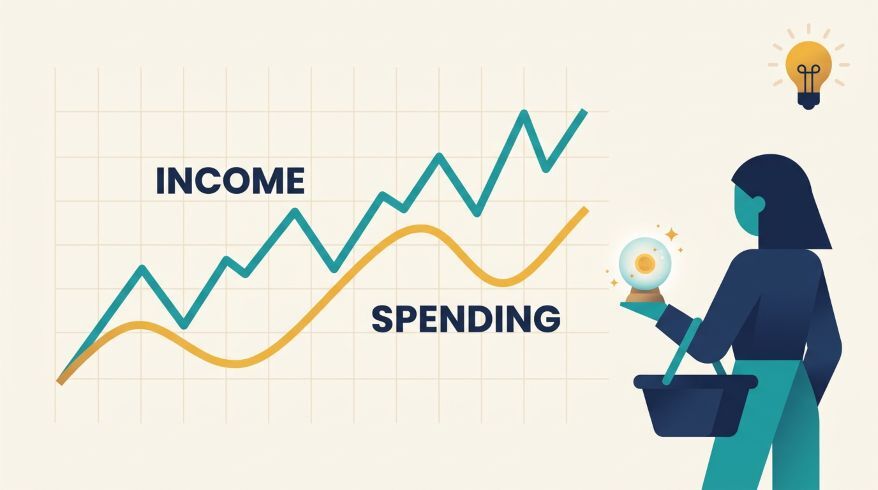
Hall reinterpreted the problem in the following way: since spending reflects expectations, it is only when new information becomes available that spending can change; thus, changes in spending should be unpredictable. If a tax cut is seen as temporary it will be saved, but if it is seen as permanent it will lead to considerably more spending.
Hall published his test in 1978, and the prediction was mostly confirmed by the quarterly US aggregate data on non-durable consumption. This was described as a ‘Eureka’ moment . Yet the predictive ability of asset valuations was only moderate, and later household studies showed that consumption was more responsive to temporary changes in income than the benchmark suggests. Nevertheless, a large part of consumption remains surprisingly difficult to predict.
The data from households provided additional insight. Together with Mishkin, Hall looked at spending on food for 2,309 US families between 1969 and 1975. About 20 percent of their consumption was hand-to-mouth, that is, it was spent as it was earned, since those households could not borrow and had no savings. Subsequent studies have given different figures, the proportions varying both over time and from country to country. Nevertheless, Hall’s theory was the first equation in the New Keynesian model.
What Is the New Keynesian Model Behind the Nobel Prize in Economics 2026?
Similar to Keynes, the framework supposes that markets can be slow to react and that policy can play a role. Unlike the earlier models, it is based on microfoundations. Woodford is the main designer of it; in his 2003 book, Interest and Prices, he built upon previous research, such as the work by Calvo and Rotemberg on how firms set prices.

The most straightforward version consists of just three equations.
- Households. Spending today depends on expected future income and on the interest rate. When the central bank cuts its rate, the interest rate on savings falls, so spending rises today.
- Firms. Prices are sticky, meaning firms cannot reset them every time costs or demand shift. When a firm resets a price, it looks ahead to rivals’ prices and its own costs.
- The central bank. The bank sets the interest rate in response to inflation and demand pressure, raising it by more than one-for-one when inflation climbs, in a pattern economists call the Taylor rule. The model needs no measure of the money supply.
The output gap is the amount by which actual output exceeds natural output and is therefore a measure of demand pressure. Natural output refers to the level of production the economy would achieve if prices could adjust freely. Woodford gave a new definition of natural output.
How Does the Model Guide Interest-Rate and Budget Decisions?
Shocks disrupt the balance between supply and demand; a supply shock refers to a sudden change in the amount that an economy can produce, for example a sharp increase in energy prices, while a demand shock is a sudden change in spending—good news has the effect of raising it and bad news has the effect of reducing it.

Take the case of energy. The natural level of output drops by a greater amount than the actual output. This causes the output gap to become positive and so the model suggests an increase in interest rates even though output has in fact fallen. In contrast, the older Keynesian models would have advised the opposite since different shocks call for different responses. This contrast shows why the Nobel Prize in Economics 2026 matters to central banks.
Fiscal policy raises the same questions. When targeted transfers increase demand and prices, an independent central bank can raise interest rates in order to offset part of the stimulus. Credibility is also important since clear communication influences expectations at the present time. A method for achieving this is forward guidance, which involves announcing the future course of interest rates. This was applied at the zero lower bound, a situation in which rates cannot be reduced any further, also in the United States from 2008 to 2015.
Does the Model Solve Everything? What Are Its Limits?
By no means, and it is difficult to prove the advantages. The scientific background shows that it is not possible to establish beyond reasonable doubt that faster recoveries result from better stabilization policy. That said, there is agreement that it played a very important role. Nevertheless, the core model was of great practical use during the 2008 Great Recession. The press release describes the models as “extremely helpful” in times of downturn, whereas the booklet states that they were hugely beneficial during the pandemic and the recent energy crises.
There are still some limitations. The sticky-price assumptions are arbitrary and not based on more fundamental principles. Rational expectations have difficulty dealing with “black swan” events, for example wars or pandemics. It cannot be assumed that inflation expectations will remain anchored. Moreover, the “forward guidance puzzle” shows that in the simple model the announcements concerning the distant future had unreasonably strong effects.
When all is said and done, the research led to a thriving field and the models are able to adapt to each country. The booklet is more direct when it comes to alternatives, stating that “there are no other viable alternatives”. Yet, no model is able to prevent the next shock.
Why Does the 2026 Economics Nobel Matter Beyond the Classroom?
The correct answer is everyday use. Central banks and governments worldwide make use of such models in order to examine how changes in interest rates affect GDP and inflation. The Riksbank in Sweden has one of its own, known as MAJA, since it is necessary to include foreign trade in the case of a small open economy in which about half of demand is derived from exports. Because downturns have a greater impact on less well-off households, it is most important for those with the smallest capacity to absorb shocks to have more stable economies.
Frequently Asked Questions About the 2026 Nobel Prize in Economics
Who won the 2026 Nobel Prize in Economics, and how much is the prize?
Robert E. Hall and Michael Woodford won the 2026 Nobel Prize in Economic Sciences, announced on 12 October. The prize totals 12 million Swedish kronor, shared equally.
What is stabilization policy?
It covers the measures that governments and central banks use to smooth economic ups and downs, such as changing the policy rate or adjusting taxes and transfers.
What are microfoundations?
Microfoundations mean building a model from the bottom up, based on the decisions of individual households and businesses, rather than on fixed links between large economic variables.
What is the New Keynesian model?
It is a framework in which prices are sticky and central banks steer activity through interest rates. It is built on microfoundations, and Woodford was its key architect.
Can the model prevent recessions?
No. It guides policy in ordinary times, and it cannot prevent shocks from arriving. Its assumptions about price stickiness and its treatment of expectations also face criticism.
Key Takeaways From the 2026 Nobel Prize in Economics
To conclude, the Nobel Prize given to Hall and Woodford was a recognition of a series of ideas. The old Keynesian models had been based on statistical relationships that ceased to work in the 1970s. Hall’s 1978 test demonstrated that forward-looking consumption matched the aggregate data quite well. Woodford then played a role in developing the New Keynesian model, which enables policymakers to make decisions taking into account how people anticipate the future. Nevertheless, some issues remain unanswered: expectations, the assumption of sticky prices, and shocks that no model can prevent.
How This Guide Was Compiled
The article is based exclusively on three documents from the Royal Swedish Academy of Sciences: the press release, the popular-science background, and the scientific background relating to the 2026 economic sciences prize. It has not made use of any undisclosed sources.
References
Royal Swedish Academy of Sciences. (2026a, October 12). Scientific background on the Sveriges Riksbank Prize in Economic Sciences in Memory of Alfred Nobel 2026: Microeconomic foundations of macroeconomic stabilization. NobelPrize.org.
Royal Swedish Academy of Sciences. (2026b, October 12). Microfoundations deliver macro insights: Popular science background to the Prize in Economic Sciences 2026. NobelPrize.org.
Royal Swedish Academy of Sciences. (2026c, October 12). The Prize in Economic Sciences 2026 [Press release]. NobelPrize.org.


