How can a chemical reaction choose one mirror-image molecule over another? The answer lies in chirality, or molecular handedness. In this article, we explore how Henri Kagan and Kenso Soai helped reveal the fascinating ways…
2026 Nobel Prize in Chemistry: Molecules Can Pick a Hand

Estimated reading time: 9 minutes
Henri B. Kagan and Kenso Soai were awarded the 2026 Nobel Prize in Chemistry for demonstrating chemical reactions that can favour one of the two mirror-image molecules. This matters because life uses only one mirror image of its building blocks. Pharmaceutical companies must use the correct one (The Royal Swedish Academy of Sciences, 2026c).
Imagine a locksmith who always cuts two mirror-image keys but finds that only one fits the lock. Molecules face the same issue: they can exist in mirror-image forms known as enantiomers. Chemists call this property chirality. Life uses just one of these forms: homochirality. Asymmetric catalytic reactions favour one form. The 2026 Nobel Chemistry laureates demonstrated how to amplify a particular hand.
Who Won the 2026 Nobel Prize in Chemistry?
The Royal Swedish Academy of Sciences announced the award on 7 October 2026. Kagan and Soai received it jointly, with a prize of 12 million Swedish kronor. The official citation states: “for the discovery of non-linear effects and autocatalysis in asymmetric organic synthesis”.
Henri B. Kagan was born in 1930 in Boulogne-Billancourt, France. He earned his PhD from the Collège de France in 1960. He is now a Professor Emeritus at the Université Paris-Sud. Meanwhile, Kenso Soai was born in 1950 in Hiroshima, Japan. He got his PhD from the University of Tokyo in 1979 and has been Professor Emeritus at the Tokyo University of Science since 2026.
Kagan took the first major step in 1986 by developing a new method for manipulating chemical reactions. Soai designed the first reaction that had the potential to be homochiral in 1995 and achieved his result in 2003. Heiner Linke, who chairs the committee, describes it as “a chemical mystery that is over a century old”.
What Are Mirror-Image Molecules, and Why Do They Matter?
Some molecules have two forms that are mirror images of each other, just as a left hand and a right hand are. Chemists call this characteristic chirality, and, accordingly, the two forms are called enantiomers. Amino acids such as alanine occur as L-alanine and D-alanine. Proteins use L-amino acids, and the sugars in DNA are D-sugars. In short, homochirality is the preference for one side.

In medicine, however, the difference is practical because one mirror image may produce the desired therapeutic effect, while the other might cause side effects. Therefore, chemists use a measure known as enantiomeric excess (ee) when comparing mixtures. It is the amount by which one mirror image is present. This history begins in the mid-19th century, when Louis Pasteur discovered that crystals of tartaric acid occurred in two mirror-image forms.
Also Read: https://entechonline.com/understanding-the-role-of-asymmetric-co2-transfer/
Why Was Life’s One-Handedness Such a Puzzle?
Chemists who produced chiral molecules without external aid always obtained a racemate. That is, equal quantities of both enantiomers. Inspired by this, theoretical physicist Sir Frederick Charles Frank of the University of Bristol proposed a model in 1953. This model requires three conditions. First, a substance must catalyse its own formation. In autocatalysis, the product acts as its own catalyst, and a catalyst drives a reaction without being consumed. Second, it must prefer one mirror image. Third, it must inhibit the other mirror image—this is known as ‘mutual antagonism’. Frank concluded with a concise remark: “A laboratory demonstration may not be impossible”.
The Nobel Prize in Chemistry first recognised asymmetric catalysis in 2001 and again in 2021; Willy Marckwald carried out the first successful asymmetric reaction in the 1900s.
What exactly did Henri Kagan discover? An explanation of non-linear effects.
For many years, chemists believed in a straightforward rule: the purity of the product should match the catalyst’s chirality.
Yet Kagan questioned that view. In 1986, he argued that a metal atom could attract two chiral molecules. Meanwhile, left-handed and right-handed forms are mixed. resulting in three types of catalysts: right-right, left-right, and left-left. The mixed form works only very poorly. To make this point, the common explanation refers to a mixture in a 75:25 ratio. This consists of about 56 per cent right-right, 38 per cent mixed and 6 per cent left-left. Thus, approximately 90 per cent of the reaction is driven by the right-handed form and 10 per cent by the left-handed form.
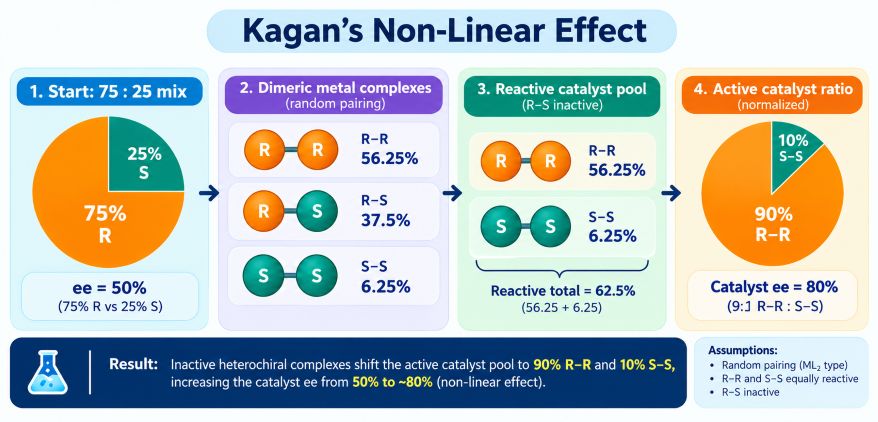
The mismatch involves a non-linear effect because, as a result, the output no longer follows the input in a straight line. Moreover, the effect can be either positive or negative. Specifically, it is positive when the product’s ee is higher than that of the catalyst and negative when it is lower. He examined three reactions in his 1986 study. Two showed a negative effect, while the Sharpless epoxidation of geraniol showed a positive effect.
For instance, the diethylzinc addition investigated by Ryoji Noyori’s group converted a ligand from 15 per cent ee to a product with 98 per cent ee, and α-pinene, which had an optical purity of 70 per cent at Merck, yielded 95 per cent ee. Most importantly, non-linear effects have become a diagnostic tool since they show how a reaction works.
What Did Kenso Soai Discover? The Soai Reaction
Autocatalysis refers to a product catalysing its own formation. On its own, it cannot increase purity because each run would cause the ee to decrease; therefore, Frank’s model also required one mirror image to suppress the other. Soai’s research took place in stages.

- In 1990, Soai carried out his first asymmetric autocatalytic reaction; the product acted as a catalyst for its own formation, but the product purity was lower than that of the catalyst, namely 35 per cent compared with 86 per cent.
- In 1995, a pyrimidine-based version improved purity. Initially, a catalyst with 5 per cent ee produced 55 per cent purity after the first run and 87 per cent after the second. Subsequently, after five consecutive runs, the purity plateaued at 90 per cent.
- For the alkynyl compound, the enantiomeric excess rose from 0.00005 per cent to above 99.5 per cent after three runs—an increase in the stereoisomeric ratio of 630,000-fold.
- In absolute asymmetric synthesis, even without any chiral input, slight random imbalances could, nevertheless, develop into a definite preference. Moreover, in 37 experiments, 18 favoured one mirror image, while 19 favoured the other, with ee values ranging from 15 to 91 per cent. Daniel Singleton also demonstrated this possibility; at the start, it is a matter of chance which one wins.
To sum up, a small imbalance is enough to take control of the reaction, and if this process repeats, the other mirror image can win. The widely accepted description of the Soai reaction calls it “one of the most spectacular chemical experiments ever carried out”.
Does the 2026 Nobel Prize Explain How Life Became One-Handed?
Not on its own; the 2026 Nobel Prize-winning work demonstrates how handedness can appear in a laboratory setting. It does not show how it developed on Earth. The scientific background is careful: the Frank model is just one of several possible solutions to an event that took place 3.5 to 4 billion years ago, and a definite answer will most likely never be reached. Although the Soai reaction is an important proof of concept, it is not pertinent to biological homochirality in aqueous systems.
Moreover, the mechanism remains debated, with two detailed models proposed: one by Scott Denmark and his colleagues and the other by Oliver Trapp and his colleagues. At the same time, ongoing research focuses on network processes and kinetic resolution. The widely accepted explanation describes the reaction as artificial and different from the chemistry of life.
What Makes The 2026 Nobel Discoveries So Important Outside of the Laboratory?
The Nobel Prize in asymmetric synthesis changed how reactions are studied, since non-linear effects reveal how a reaction works and enable chemists to obtain purer products. The general description mentions the main areas involved: pharmaceuticals, flavours, scents, agricultural chemicals, and, in some cases, new materials. Carreira and his colleagues produced a key intermediate of efavirenz using asymmetric autocatalysis, although they did not report any details about nonlinear effects. Most importantly, these findings have increased our understanding of how chirality is generated and amplified.
Frequently Asked Questions About the 2026 Nobel Prize in Chemistry
Who won the 2026 Nobel Prize in Chemistry, and how much is the prize?
Henri B. Kagan and Kenso Soai — announced 7 October 2026, with 12 million Swedish kronor split equally.
What are enantiomers and chirality?
Enantiomers are two non-identical mirror images of the same molecule. Chirality is the property of having such forms. When life uses a single form, that state is homochirality.
What is a non-linear effect in catalysis?
Product purity then fails to track catalyst purity in a straight line; it can exceed or fall below what a linear relationship predicts.
What is the Soai reaction?
It is an asymmetric autocatalytic reaction, in which the product catalyses its own formation. It can turn a tiny imbalance into almost entirely one mirror image.
Key Takeaways
The line of thought moves from theory to experiment: it starts with Frank’s model in 1953, then moves to Kagan’s work on non-linear effects in 1986, and finally to Soai’s autocatalytic reactions between 1990 and 2003. The key finding is that reactions can strongly prefer one mirror image even with a very small imbalance. The outstanding question remains as to how biological preference for one hand originated. To conclude, the 2026 Chemistry Nobel Prize both expanded the available tools and raised more questions.
How This Guide Was Compiled
The article is based exclusively upon three documents from the Royal Swedish Academy of Sciences: the popular science background, the scientific background and the press release. It does not use any unnamed sources.
Verified Resources
- The official page on the Chemistry Nobel Prize 2026, together with the press release and background documents: nobelprize.org
- The Royal Swedish Academy of Sciences, which publishes the background documents, can be found at kva.se
References
- Royal Swedish Academy of Sciences. (2026a). Advanced information: The Nobel Prize in Chemistry 2026. NobelPrize.org.
- Royal Swedish Academy of Sciences. (2026b). Popular information: The Nobel Prize in Chemistry 2026. NobelPrize.org.
- Royal Swedish Academy of Sciences. (2026c). Press release: The Nobel Prize in Chemistry 2026. NobelPrize.org.
Reviewed by Dr. Charudatta PathakEdited by Juveriya Khan
- Author
- Latest Posts

Sailee Pakhare holds a Master’s degree in Biotechnology, with a research background spanning microbiology, molecular biology, and disease biology. Her postgraduate dissertation examined the antimicrobial potential of bioactive peptides from lactic acid bacteria, and her research experience includes molecular identification of bacterial isolates (with sequencing data submitted to NCBI) and work as a Research Assistant at SafeWright Laboratory. She also completed a summer internship at IIT Hyderabad studying circadian rhythms and disease biology using Drosophila melanogaster as a model organism.
Her work has been recognized with the Best Poster award at the 3rd International Conference on Innovations in Biotechnology Research for Sustainable Bioresources and Bioeconomy (2025), and she has contributed to a book chapter on the role of AI and machine learning in climate change.
Sailee is also a co-founder of LifeXtension, a community focused on longevity, ageing, and health science awareness in India. An interdisciplinary thinker, she explores questions ranging from disease biology to space and the origins of life, approaching science as a way of asking questions rather than a fixed body of facts. As a science communicator and researcher, she is committed to translating complex research into writing that is clear, accurate, and engaging.