Learn about the unique RuO₂ Spin Texture that combines mirror image and reflection patterns in ultrathin films.
RuO₂ Spin Texture: A New Discovery in Ultrathin Films

Estimated reading time: 5 minutes
Imagine a material so thin it defies conventional physics. Scientists have now observed something remarkable in ultrathin RuO₂ films. These films reveal a unique spin texture that challenges our understanding of magnetism, and this phenomenon is referred to as RuO₂ spin texture. This discovery comes from a recent study published in Science Advances. The research team used epitaxially strained RuO₂ layers to reveal two distinct spin patterns. One pattern acts like a mirror image. The other acts like a standard reflection. Both patterns coexist in the same material. This finding opens new doors for spintronics and quantum computing. I will explain this breakthrough in simple terms. You will learn how these spin textures work and why they matter. Let us explore the hidden dance of electrons in ruthenium dioxide.
ENTECH STEM Magazine has included this research in its list of Top 10 STEM Discoveries and Innovations of August 2026.
Key Takeaways: RuO₂ Spin Texture
- Mirror-odd spin texture breaks mirror symmetry in the material.
- Mirror-even spin texture preserves mirror symmetry in the material.
- Ultrathin RuO₂ films measure only a few nanometres thick.
- Epitaxial strain alters the crystal structure of the film.
- These spin textures could lead to energy-efficient electronics.
Understanding the Basics of RuO₂ and Spin Texture
Ruthenium dioxide is a metal-like oxide used in electronics. Its crystal shape sets its electric traits. RuO₂ spin texture tells us how electron spins line up in the stuff. Spin is a small quantum trait of electrons. Think of it as a tiny magnet found on each electron. In normal stuff, spins point in all ways. In contrast, spins line up in set patterns in RuO₂ films. As a result, these patterns make new magnetic action.
The Science Behind Epitaxially Strained RuO₂ Films
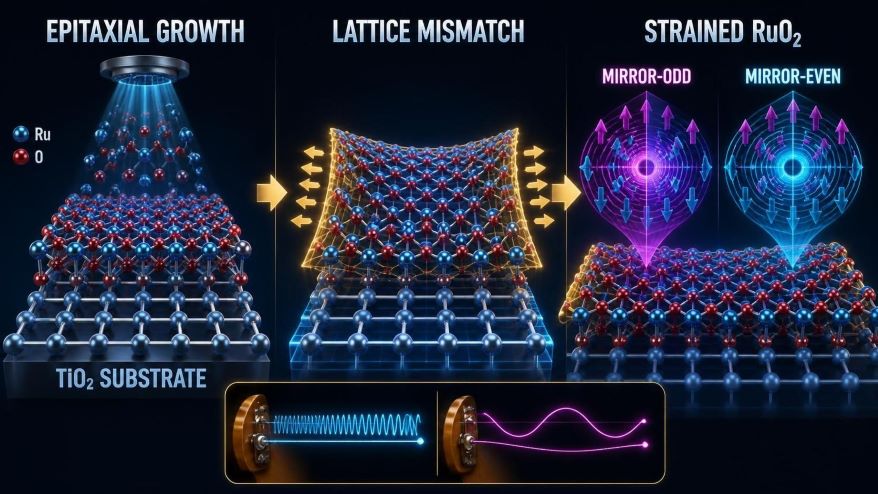
To begin with, epitaxial growth deposits atoms in a precise crystal pattern. After that, scientists place RuO₂ on a substrate like titanium dioxide. As a matter of fact, the substrate has a different lattice constant. Consequently, this mismatch forces the RuO₂ to stretch or compress. As a result, strained RuO₂ then exhibits unusual properties.
To illustrate, consider how a guitar string sounds when stretched. A tight string produces a high pitch. A loose string produces a low pitch. In like fashion, strained RuO₂ produces new electronic pitches. In short, these pitches are the mirror-odd and mirror-even spin textures.
Observing Mirror-Odd and Mirror-Even Spin Textures
To begin with, the research team used spin-resolved photoemission spectroscopy. As I have noted, this technique measures electron spin and energy. After that, they shone ultraviolet light on the RuO₂ films. Consequently, the light ejected electrons from the material. At this point, sensors captured each ejected electron’s spin direction.
So far, the results showed two distinct patterns. To be sure, the mirror-odd spin texture reversed spin direction across a mirror plane. To illustrate, imagine looking at your left hand in a mirror. As a matter of fact, your right hand appears. In short, that is mirror symmetry. In contrast, the mirror-odd texture breaks that symmetry. As a result, spin points up on one side and down on the other. By all means, this asymmetry arises from spin-orbit coupling.
Implications for Spintronics and Quantum Computing
First of all, spintronics relies on controlling electron spin. At the present time, current devices use magnetic fields for control. As a result, magnetic fields consume lots of energy. In contrast, the RuO₂ spin texture offers a better approach. After all, it uses electric fields instead. Consequently, electric fields require much less power.
To put it another way, the mirror-odd texture creates a Rashba effect. As I have noted, this effect splits electron spins into two energy levels. As a result, it acts like a spin filter. For the most part, electrons with one spin direction move one way. On the other hand, electrons with the other spin direction move the opposite way. In short, this filtering enables spin transistors.
Challenges and Future Research Directions
At the present time, scalability remains the biggest challenge. As I have noted, producing ultrathin RuO₂ films requires precise control. For the most part, current techniques work in lab settings. In contrast, mass production needs cheaper methods. Provided that atomic layer deposition could solve this problem.
In like fashion, film quality also matters. As a result, defects in the crystal shape break spin patterns. To put it differently, even one empty spot can push electrons away. Consequently, this ruins the spin-based flow of power. All in all, researchers must build defect-free growth ways.
Practical Applications in Everyday Electronics
To illustrate, imagine a smartphone that never needs charging. As a matter of fact, spintronics devices could make that possible. In contrast to normal tools, they use spin currents instead of charge currents. As a result, spin currents produce less heat. Consequently, this means less energy wasted as heat.
By comparison, hard drives already use spin effects. As I have noted, the giant magnetoresistance effect reads data in modern drives. After all, RuO₂ spin texture could enable spin torque oscillators. To explain, these oscillators generate microwaves for wireless communication. In short, they are tiny and efficient.
Frequently Asked Questions: RuO₂ Spin Texture
What is RuO₂ used for?
RuO₂ is used in electronics as a conductive material. It appears in resistors, capacitors, and electrodes. Its unique properties also make it useful for catalysis
How thin is an ultrathin RuO₂ film?
An ultrathin RuO₂ film measures just a few nanometres thick. That is about 10 to 20 atomic layers. At this scale, quantum effects dominate.
What is spin texture in simple terms?
Spin texture describes how electron spins orient in a material. Think of it like a pattern of tiny compass needles. Different materials have different spin patterns.
Reference
Zhang, Y., Jeong, S. G., Buiarelli, L., Lee, S., Guo, Y., Wen, J., Li, H., Nair, S., Choi, I. H., Ren, Z., Yue, Z., Hyun, J., Zhang, T., Fedorov, A., Mo, S.-K., Lim, H., Hunt, A., Waluyo, I., Kono, J., … Yi, M. (2026). Observation of mirror-odd and mirror-even spin texture in ultrathin epitaxially strained RuO₂ films. Science Advances, 12(31), eaec2917. https://doi.org/10.1126/sciadv.aec2917
Editorial Note: This article was written by Rakshanda Jabbar and reviewed for editorial accuracy by our editorial team. It has not yet undergone independent review by a professional.
Edited by Juveriya Khan
- Author
- Latest Posts
I completed my Master of Science from the University of Allahabad in 2017 with a strong academic background in life sciences and chemistry. My specialization included Molecular Biology, Microbiology, Genetics, Plant Breeding, Phycology, Paleobotany, and Bioinformatics, along with Organic Chemistry, Inorganic Chemistry, and Physical Chemistry. This multidisciplinary training provided me with a comprehensive understanding of biological systems and analytical scientific approaches.
After completing my postgraduate studies, I gained valuable professional experience in both the education and social development sectors. I worked at A.M. Oxford Public School, where I was actively involved in guiding students toward academic excellence. In this role, I focused on creating an engaging learning environment, encouraging critical thinking, and nurturing students’ curiosity for scientific learning. My experience as an educator strengthened my communication, mentoring, and classroom management skills.
In addition to my teaching experience, I worked with Jeevan Jagriti Foundation, where I contributed to community-based initiatives aimed at improving educational access and awareness among underprivileged sections of society. Through this work, I participated in programs designed to support social development and promote the value of education in marginalized communities.
These professional experiences helped me develop strong interpersonal, leadership, and organizational skills while reinforcing my commitment to education and community service.