V1298 Tau is a star about 10 to 30 million years old. This star is considered very young when compared to our Sun, which is nearly 4.6 billion years old.
Young Star V1298 Tau Reveals Clues to Planet Formation and Evolution
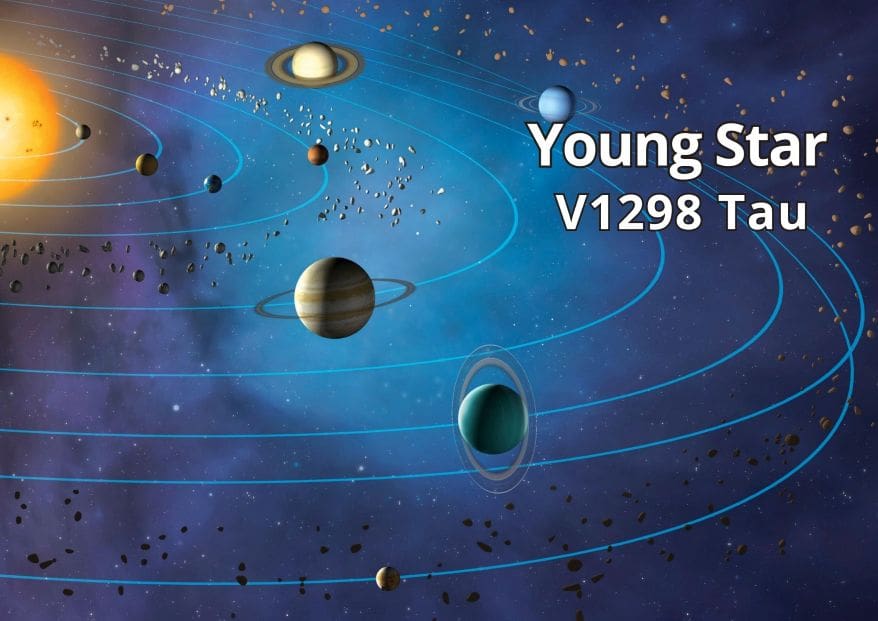
The universe constantly offers us fascinating insights into how planets form and evolve. One such remarkable system is V1298 Tau, a young star surrounded by four large planets orbiting closely together. This system provides scientists a unique chance to study planetary development in its early stages. Understanding these systems helps us learn about the history and future of planets, including those in our own solar system.
V1298 Tau is a star about 10 to 30 million years old. This star is considered very young when compared to our Sun, which is nearly 4.6 billion years old. This youthful star resides in the Taurus star-forming region, making it important for scientists studying how planets grow just after birth.
This star has four big planets ranging from 5 to 10 times Earth’s radius. These planets orbit very close to their host star in compact paths. It’s unusual because typically larger planets are less common at such small distances from stars, while smaller ones dominate.
The Chain of Planets and Their Timing Dance
The V1298 Tau planets create a chain known as near-resonances, meaning their orbits have special relationships where gravitational pulls cause them to influence each other regularly. This effect leads to something called transit-timing variations (TTVs). This effect causes the times when the planets pass in front of their star to change slightly over hours.
Studying TTVs helps measure planet masses and orbits without interference from the star’s strong magnetic activity. Through observations spanning nearly nine years, scientists tracked each planet’s transit carefully, revealing accurate information about their movements.
Using Transit Timing Variations (TTVs) to Decode Planet Properties
TTV analysis combines careful measurement and modeling to understand how gravitational forces shift planetary orbits back and forth over time. The V1298 Tau system showed TTVs ranging between 50 minutes up to almost two hours for some planets!
This approach confirmed that these large worlds are actually quite light compared to their size. Fitting into a category called sub-Neptune mass planets. Despite their giant radii, they have low densities indicative of thick gaseous envelopes surrounding rocky cores or icy interiors still cooling down after formation.
What Does This Tell Us About Planet Formation?
The findings suggest that right after forming inside what’s called a protoplanetary disk. A swirling cloud of gas and dust around young stars these massive but low-density planets cooled rapidly while still holding on tightly to light atmospheres.
A Glimpse Into Early Evolutionary Processes
This cooling and contraction phase contrasts sharply with mature exoplanets found by missions like Kepler later in life. These young giants are denser and smaller because they have lost much of their gases over billions of years. Scientists predict that these young giants will shrink further over hundreds of millions more years. They will resemble super-Earths or sub-Neptunes commonly detected around older stars.
The study focuses on the stability and dynamics of the V1298 Tau planets.
The study also revealed that the four planets orbiting V1298 Tau follow mostly circular paths with less than 1% orbital eccentricity, indicating a dynamically calm history. Their gravitational interactions within the V1298 Tau system stabilize the planetary orbits rather than trigger the chaotic events often observed elsewhere in space.
This orbital balance suggests that the planets around V1298 Tau likely avoided violent collisions or major disturbances during their formation period, making the system an ideal laboratory for directly testing planet formation models.
This discovery enriches our understanding of how Earth-sized and larger worlds form across galaxies and highlights the power of advanced observational techniques such as transit timing variation (TTV) measurements combined with long-term data from both ground-based observatories and space telescopes.
Additionally, to stay updated with the latest developments in STEM research, visit ENTECH Online. Basically, this is our digital magazine for science, technology, engineering, and mathematics. Further, at ENTECH Online, you’ll find a wealth of information.
Reference
Livingston, J. H., Petigura, E. A., David, T. J., Masuda, K., Owen, J., Nesvorný, D., Batygin, K., De Leon, J., Mori, M., Ikuta, K., Fukui, A., Watanabe, N., Miquel, J. O., Murgas, F., Parviainen, H., Korth, J., Libotte, F., García, N. A., Gallardo, P. P. M., . . . Pino, L. (2026). A young progenitor for the most common planetary systems in the Galaxy. Nature, 649(8096), 310–314. https://doi.org/10.1038/s41586-025-09840-z
- Author
- Latest Posts

I’m a web developer and science writer with a Master’s degree in Computer Applications (MCA) from Pune University.
I work in tech, building websites and staying updated with the latest developments. I also love writing about physics, chemistry, technology, robotics, mathematics, and breakthrough innovations. My passion is breaking down complex scientific topics into simple, easy-to-understand stories.
My goal is to help everyone stay informed about the exciting changes happening in science and technology. I believe understanding science shouldn’t be complicated—it should be accessible to all.