Scientists have discovered indications of shallow water ice on Mars.
Could This Hidden Ice Make Mars Habitable? Scientists Think So
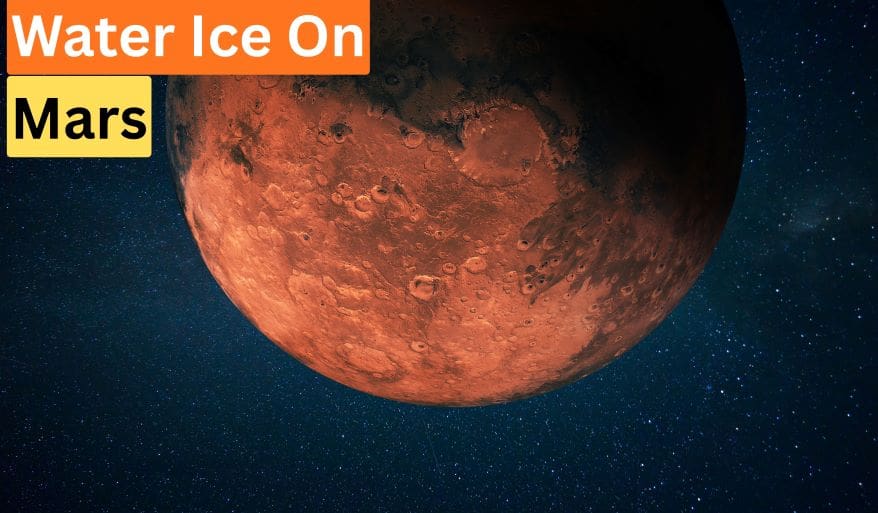
Scientists have discovered indications of shallow water ice on Mars. This ice is located in the planet’s mid-latitudes. The finding highlights a region that could be important for future exploration. This region, therefore, is a potential resource hub for future explorers. The site could also help humans survive on Mars and provide clues about whether the planet was ever livable. Based on the findings, it appears that there is a vital resource that subsequent astronauts could rely on.
Erica Luzzi, Jennifer L. Heldmann, Kaj E. Williams, Giacomo Nodjoumi, Ariel Deutsch and Alexander Sehlke published this research under the title “Geomorphological Evidence of Near-Surface Ice at Candidate Landing Sites in Northern Amazonis Planitia, Mars” in May 2025.
ENTECH STEM Magazine has included this research in its list of the Top 10 Astronomy Discoveries of 2025.
Potential Benefits of Shallow Water Ice On Mars
Support for Human Exploration
Access to water ice on mars could provide a critical resource for future astronauts. It could not only supply drinking water and support food production through hydroponics but can also be used to generate oxygen through electrolysis. This reduces the need to transport large amounts of supplies from Earth.
Fuel Production
Water ice on mars can also be split into hydrogen and oxygen. These elements can, therefore, be used as rocket fuel. This supports return missions or further exploration. Using local resources makes Mars missions more sustainable and cost-effective.
Scientific Insights
Studying this water ice on mars can help scientists understand Mars’ climate history and whether conditions once supported life, shedding light on the planet’s habitability over time.
Resource Hub Development
The identified site might also become a strategic base for future missions, serving as a staging ground or resource depot, facilitating extended surface operations.
Technological Advancement
Developing techniques to locate, extract, as well as utilize water ice on mars in this context will advance in-situ resource utilization (ISRU) technology, beneficial for Mars and also other planetary missions.
Site Selection for Habitats
A mid-latitude location is easier to access than poles and may have milder temperatures. This, therefore, provides a potential hub for long-term Mars bases, research stations, and landing zones.
Overall, this discovery of shallow water ice on mars enhances the feasibility of sustained human presence on Mars while also contributing to our understanding of the planet’s past environment.
Educational and Career Opportunities
Planetary Science and Geology
This discovery of water ice on mars provides research opportunities in studying Martian surface processes, climate history, as well as ice distribution, can be appealing to students and scientists interested in planetary geology and astrobiology.
Astrobiology
Exploring the potential habitability of Mars and the search for past or present life forms, can also foster careers in biological sciences combined with space exploration.
Aerospace Engineering
Designing spacecraft, landers, and drilling equipment capable of accessing and utilizing subsurface ice, as well as developing life support systems for astronauts.
In-Situ Resource Utilization (ISRU) Technologies
Opportunities in developing technologies to extract and process water ice for human use as well as fuel production, is a growing field critical for sustainable space exploration.
Robotics and Automation
Create autonomous systems and rovers to explore and harvest resources on Mars. This work offers career opportunities in robotics engineering and artificial intelligence.
Environmental and Earth Sciences
Comparative planetology studies can enhance understanding of Earth’s climate and water cycles, expanding careers in environmental science with a planetary perspective.
STEM Education and Outreach
Inspiring educational programs as well as initiatives aimed at engaging students in science, technology, engineering, and mathematics through Mars exploration topics.
Space Policy and Management
With increased exploration activities, there are roles in space mission planning, international collaboration, ethics, and resource management.
These opportunities encourage interdisciplinary education. They can lead to careers in academia, government space agencies like NASA or ESA, private space companies, and research institutions. All of these focus on Mars exploration and beyond.
Additionally, to stay updated with the latest developments in STEM research, visit ENTECH Online. Basically, this is our digital magazine for science, technology, engineering, and mathematics. Also, at ENTECH Online, you’ll find a wealth of information.
Reference:
- Luzzi, E., Heldmann, J. L., Williams, K. E., Nodjoumi, G., Deutsch, A., & Sehlke, A. (2025). Geomorphological evidence of Near‐Surface IcE at candidate landing sites in northern Amazonis Planitia, Mars. Journal of Geophysical Research Planets, 130(5). https://doi.org/10.1029/2024je008724
- Author
- Latest Posts

I am a Master’s qualified in Science with focus on Zoology and Entomology and am a passionate, curiosity-driven science enthusiast aiming to transform complex scientific ideas in a manner that are easy to understand hence, educate, and inspire.
I have an experience of working on the projects in the field of Entomology which has provided me hands-on experience with various research techniques. Besides, I have also gained experience of lab work as well as developed communication skills during the course of my bachelors and masters.
With a strong foundation in life sciences and a growing interest in Medical and Biological research, I have cultivated a writing style that merges scientific facts with creativity.
My experience in teaching has also taught me to develop an understanding of what are the interests of people and how to communicate them effectively.
I am committed to lifelong learning, actively engaging in Interdisciplinary learning, so as to broaden my perspective.