The brain uses many neurons that communicate through spikes of activity, making it highly efficient.
Neuromorphic Computing System Meets Science: Solving Complex Equations Like the Brain
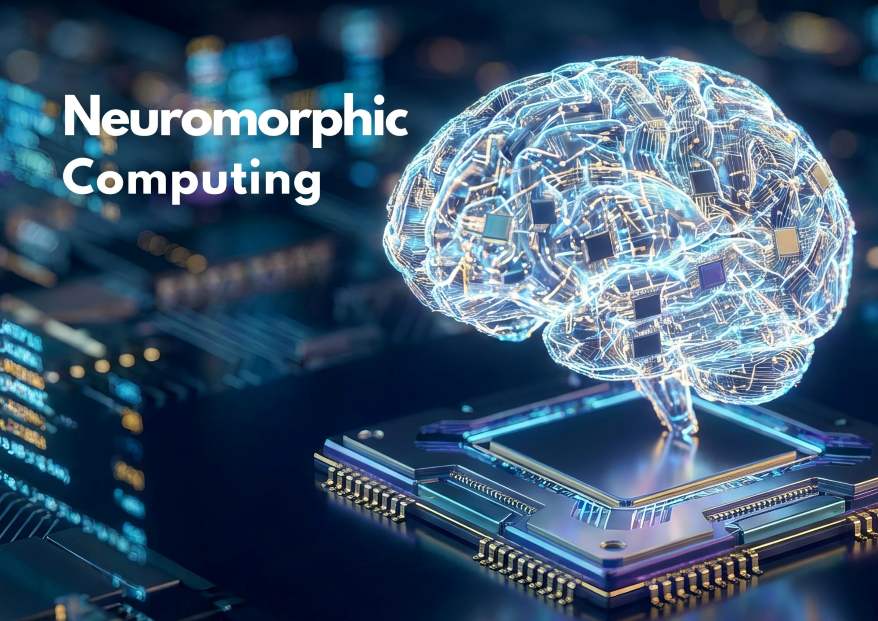
Scientists are designing new computer systems inspired by the human brain, called neuromorphic computing system. This exciting technology aims to create powerful and energy-efficient microelectronics. However, it has been difficult to find real-world uses that show clear benefits so far. Recently, researchers took a big step forward. They developed a method using neuromorphic computers to solve complicated partial differential equations (PDEs) essential for modeling physical phenomena.
What Is Neuromorphic Computing system?
Neuromorphic computing System tries to copy how brains work. The brain uses many neurons that communicate through spikes of activity, making it highly efficient. Engineers build special chips with similar architectures that are sparse, distributed, and asynchronous. This design helps computers perform tasks using less power than traditional systems.
The Loihi 2 chip from Intel is a well-known example of a neuromorphic computing system. In a manner that is analogous to that of little animal brains, it simulates over a billion artificial neurons. Because of its power, the chip is capable of performing sophisticated computations for the sake of scientific study.
The Challenge of Scientific Computing
PDEs describe things like how heat spreads or how waves travel through air and water. Scientists solve these equations with numerical methods such as the finite element method (FEM). FEM breaks down a large problem into smaller pieces called mesh elements.
This method generates extremely large sparse linear systems, which are problems that involve a huge number of variables that are connected in a restricted manner. Extremely powerful processors that need a significant amount of energy are typically utilized by supercomputers to solve these systems.
This recent research shows that neuromorphic computing system can solve FEM problems efficiently without changing user experience or accuracy.
Sparse & Distributed Design Aligns With Brains
The FEM matrices used in solving PDEs have connections only between neighboring elements; consequently, this keeps data sparse and localized. Furthermore, this setup matches how brain neurons connect sparsely and communicate asynchronously with spikes. The neuromorphic design stores computation and memory close together within neuron circuits instead of central processing units reading from distant memory banks. This arrangement reduces power use and speeds up calculations for large problems.
A New Neuromorphic Computing System Algorithm for PDEs
Introducing NeuroFEM: The Spiking Neural Network Solver
The researchers created NeuroFEM, an algorithm turning FEM’s sparse linear system into a network of spiking neurons on a chip like Loihi 2. Each mesh node gets its population of neurons firing spikes based on problem data. This spiking neural network reaches the correct solution over time through its activity patterns without needing training like regular AI models.
Solve Large Problems Efficiently
The beauty lies in scalability: hundreds or thousands of mesh nodes become groups of neurons processed simultaneously. The spike communication carries numeric information inherently encoded by timing rather than digital numbers passed around in regular parallel computing.
This method suits huge scientific simulations requiring low-power computation, extending what conventional supercomputers offer today.
The Tug-of-War Inside Neuron Groups
Inside each node’s neuron group, half project positive outputs while others project negative ones, creating a balance pulling towards the precise solution value dynamically as spikes occur. This tug-of-war ensures accuracy while embracing brain-inspired dynamics controlling output variables smoothly over time from spike inputs received by synapses weighted properly according to original FEM matrix data.
The Future of Energy-Efficient Scientific Computing
This breakthrough bridges traditional numerical techniques with cutting-edge neuromorphic computing system hardware, carrying enormous potential:
- Saves energy: Reduces power needed significantly for simulations compared to classic supercomputers.
- Keeps precision: Produces mathematically exact solutions equivalent to existing methods users trust today.
- Easily scalable: Can handle larger problems as neuromorphic chips grow more capable over time.
- No retraining required: Works out-of-the-box, translating algorithms directly into spiking models, avoiding learning phase delays or errors common in AI tasks.
Additionally, to stay updated with the latest developments in STEM research, visit ENTECH Online. Basically, this is our digital magazine for science, technology, engineering, and mathematics. Further, at ENTECH Online, you’ll find a wealth of information.
Reference
Theilman, B. H., & Aimone, J. B. (2025). Solving sparse finite element problems on neuromorphic hardware. Nature Machine Intelligence, 7(11), 1845–1857. https://doi.org/10.1038/s42256-025-01143-2
- Author
- Latest Posts

I’m a web developer and science writer with a Master’s degree in Computer Applications (MCA) from Pune University.
I work in tech, building websites and staying updated with the latest developments. I also love writing about physics, chemistry, technology, robotics, mathematics, and breakthrough innovations. My passion is breaking down complex scientific topics into simple, easy-to-understand stories.
My goal is to help everyone stay informed about the exciting changes happening in science and technology. I believe understanding science shouldn’t be complicated—it should be accessible to all.