The ability to remove or redirect heat directly inside quantum circuits is a game-changer. Specifically...
Noise-Assisted Quantum Refrigeration In Superconducting Circuits
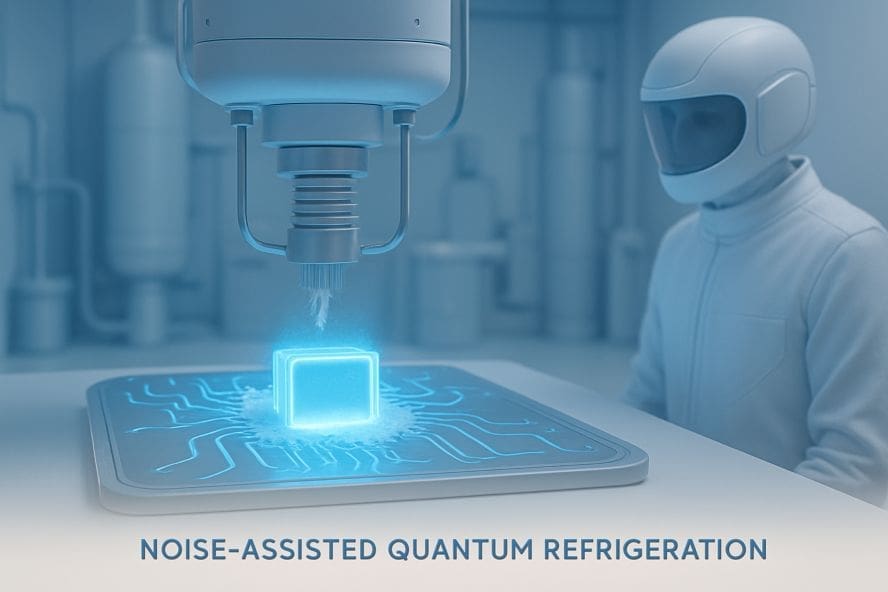
Researchers at Chalmers University of Technology have developed a novel approach to noise-assisted quantum refrigeration, turning unwanted quantum noise into a useful resource. Importantly, this device harnesses random noise within a superconducting circuit for power—the very noise that experts traditionally see as a major hurdle for quantum computing. Moreover, it successfully transfers heat against a temperature gradient using noise-assisted quantum transport. Specifically, an artificial molecule connects to two microwave waveguides serving as thermal reservoirs. To achieve this, the researchers inject controlled dephasing noise to enable steady-state cooling. Additionally, they detect extremely small heat currents with sub-attowatt resolution. Ultimately, Nature Communications published the discovery, paving a new way to manage heat in sensitive quantum chips.
Simon Sundelin, Mohammed Ali Aamir, Vyom Manish Kulkarni, Claudia Castillo-Moreno & Simone Gasparinetti conducted this research and published it under the title “Quantum refrigeration powered by noise in a superconducting circuit” in January 2026.
ENTECH STEM Magazine has included this research in its list of Top 10 STEM Discoveries and Innovations of January 2026.
Potential Benefits-Noise-assisted Quantum Refrigeration
Internal Heat Management
The ability to remove or redirect heat directly inside quantum circuits is a game-changer. Specifically, this approach targets a microscopic scale that conventional, external cooling systems—such as massive dilution refrigerators—simply cannot reach. By utilizing Noise-Assisted Quantum Refrigeration at the junction level, researchers can consequently maintain stable qubits within complex architectures.
Scalability of Quantum Technology
Scaling quantum computers faces heat management challenges as more qubits increase unwanted thermal noise. Fortunately, this discovery enables more reliable and robust quantum chips by allowing control of thermal flows locally. Instead of using “one-size-fits-all” external cooler, each chip can manage its own environment, paving the way for thousand-qubit processors.
Turning Noise into a Resource: Noise-Assisted Quantum Refrigeration
Notably, researchers are transforming dephasing noise into a functional power source for quantum systems. This technique, known as Noise-Assisted Quantum Refrigeration, uses the energy from environmental fluctuations to actually drive the cooling process. As a result, this reduces the need for absolute noise suppression in specific areas of the circuit, allowing engineers to focus on performance rather than just insulation.
High-Precision Control
Controlled microwave noise enables noise-assisted quantum refrigeration and extremely precise regulation of energy transport within the system. As a result, this high level of control allows for the measurement of heat currents with sub-attowatt resolution, thereby providing unprecedented insight into the thermal behavior of quantum components.
Versatile Operational Modes
Remarkably, the device not only provides noise-assisted quantum refrigeration but also operates as a quantum heat engine, a thermal transport amplifier, or a heat valve—all depending on the reservoir temperatures.
Advancement of Quantum Thermodynamics
Overall, this innovation opens new avenues for investigating fundamental thermodynamics at the single quantum level. Moreover, it includes potential applications in optimizing quantum batteries and other nanoscale machines.
Educational and Research Opportunities in Noise-Assisted Quantum Refrigeration
Harnessing Environmental Noise
Current research is exploring a significant frontier by utilizing “true thermal source” noise or artificial noise to activate photon-assisted tunneling for local cooling. Furthermore, this approach fundamentally shifts the scientific perspective on noise, moving away from treating it as a purely detrimental factor that causes decoherence. Ultimately, these fluctuations are reimagined as a potential energy source for the operation of autonomous thermal machines.
Advanced Qubit Initialization
Currently, research explores combining quantum-circuit refrigerators (QCR) with energy harvested from thermal activation to enable fast and accurate qubit initialization. Indeed, this is critical for scaling superconducting quantum processors.
Engineering Open Quantum Systems
On-demand, tunable dissipation enables researchers to study fundamental open quantum system physics with truly unprecedented levels of control. Moreover, this flexibility enables the exploration of reservoir engineering in situ, allowing for real-time adjustments to the quantum environment.
Autonomous Quantum Heat Engines (QHE)
Excitingly, new opportunities exist in developing autonomous heat engines where a resonator can exhibit effectively negative internal dissipation. This approach potentially realizes thermodynamic cycles, such as the quantum Otto cycle, using superconducting platforms.
Thermodynamic Precision Limits
Researchers are investigating how coherent quantum dynamics can outperform traditional thermodynamic precision limits. Consequently, these insights could lead to the development of high-precision, low-dissipation quantum devices.
Additionally, to stay updated with the latest developments in STEM research, visit ENTECH Online. Basically, this is our digital magazine for science, technology, engineering, and mathematics. Also, at ENTECH Online, you’ll find a wealth of information.
Reference
Sundelin, S., Aamir, M. A., Kulkarni, V. M., Castillo-Moreno, C., & Gasparinetti, S. (2026). Quantum refrigeration powered by noise in a superconducting circuit. Nature Communications, 17(1), 359. DOI: 10.1038/s41467-025-67751-z
- Author
- Latest Posts

A Master’s-qualified Zoologist with a focus on Limnology, I combine hands-on laboratory experience with a sophisticated background in science communication. My career is defined by an interdisciplinary approach to the life sciences, merging technical research skills with a proven ability to teach and engage diverse audiences. I am committed to lifelong learning and the creative dissemination of medical and biological research, ensuring scientific literacy and inspiration remain at the forefront of the field.