At the present time, the world produces approximately 1.5 billion waste tyres every year.
The Black Smoke Crisis: How Burning Waste Tyres Is Choking Our Planet
A Growing Global Threat Nobody Is Talking About Enough
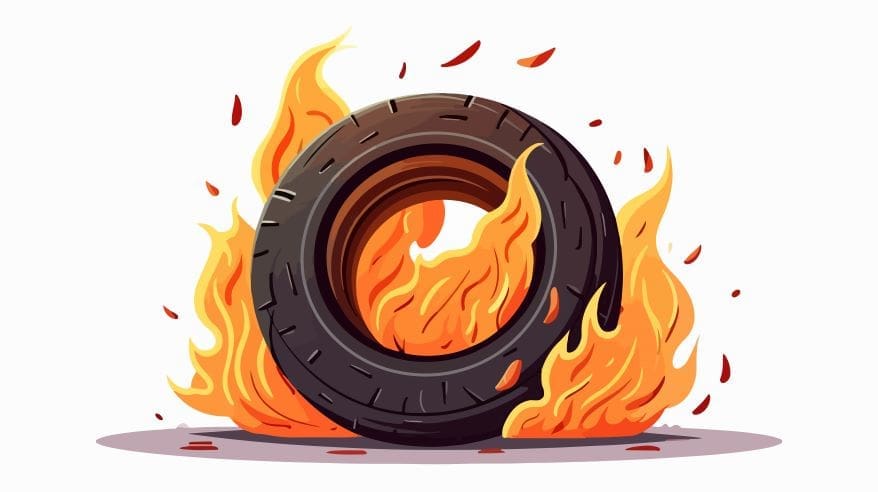
At the present time, the world produces approximately 1.5 billion waste tyres every year. That number keeps rising. Sooner or later, every single tyre on every vehicle reaches its end of life. The question is: where do they all go?
As can be seen globally, waste tyre disposal has become one of the most pressing environmental crises of our time. Prior to exploring solutions, we must understand the problem. Above all, we must understand who pays the price.
What Happens When a Tyre Dies?
After that, a tyre ends its life on the road, it does not simply disappear. Rubber does not biodegrade easily. It can take centuries to break down naturally. At this point, countries face a serious waste management challenge.
To enumerate the main disposal methods currently in use: landfilling, stockpiling, mechanical recycling, and thermal processing through pyrolysis. At first glance, pyrolysis appears to be a scientific and sustainable solution. To explain, pyrolysis heats tyres in the absence of oxygen. This process breaks rubber down into oil, carbon black, and steel.
While it may be true that controlled pyrolysis has environmental benefits, the reality on the ground tells a different story. As a matter of fact, many pyrolysis plants around the world operate without proper safeguards. With this in mind, the consequences for nearby communities are severe.
The Toxic Cocktail Released Into the Air
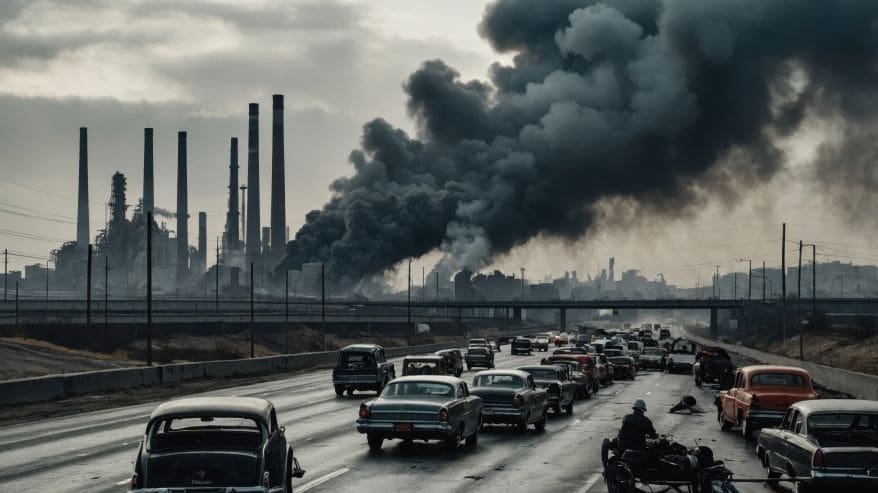
To illustrate the dangers, consider what happens when tyres burn without proper controls. The combustion releases a dangerous mixture of toxic chemicals. To list some of the most harmful:
Polycyclic Aromatic Hydrocarbons (PAHs) form during incomplete combustion. These compounds are known carcinogens. They attach to particles in the air. People breathe them in daily.
Dioxins and furans are among the most toxic substances known to science (Liu et al., 2023). Even tiny amounts cause serious harm. They accumulate in the food chain over time.
Nitrogen oxides contribute to acid rain and respiratory disease. What is more, heavy metals including lead, zinc, and cadmium release into the air and soil. These metals accumulate in the human body. They cause neurotoxicity, kidney damage, and developmental disorders in children (Zerin et al., 2023).
At the same time, carbon black soot settles on crops, water sources, and homes. As has been noted, this soot does not respect boundaries. It travels with the wind. It enters homes. It enters lungs.
Developed Nations Export Their Problem
Another key point that demands global attention is this: developed countries are increasingly exporting their waste tyre problem to developing nations. Balanced against their own strict environmental laws at home, these countries find it cheaper to ship tyres abroad.
To put it another way, wealthier nations are outsourcing pollution to communities with weaker regulations and poorer enforcement. This is an act of environmental injustice. The communities receiving this waste are often poor, vulnerable, and have little political power to resist.
As I have noted, investigative reports have documented how tyres shipped from countries including the United Kingdom, the United States, Australia, and Gulf nations end up in poorly regulated processing facilities thousands of kilometres away (Reporters’ Collective, 2026). On paper, the tyres are sent for “recycling.” In reality, they are burned.
This time, the consequences fall hardest on workers and nearby residents. By and large, these communities experience elevated rates of respiratory illness, skin disease, and cancer.
Workers Bear the Heaviest Burden
To that end, it is critical to acknowledge the human cost within these facilities. Workers often handle burning rubber without any protective equipment. No masks. No gloves. No training. So as to survive economically, many accept these dangerous conditions. They have no other choice.
Being that these jobs attract workers from the most economically vulnerable backgrounds, the cycle of exploitation continues. Workers report black soot coating their skin. They describe breathing difficulties after every shift. They speak of colleagues who develop serious illness within months.
Seeing that the health risks are well-documented in scientific literature, the continued exposure of workers represents a fundamental violation of human rights (Liu et al., 2023).
The Policy Gap That Enables This Crisis
So far, many countries have introduced regulations to manage end-of-life tyres. Policies such as Extended Producer Responsibility (EPR) frameworks obligate tyre manufacturers to fund proper disposal. Analogous to other waste management policies, these frameworks show promise in theory.
All things considered, however, enforcement remains the critical weakness. Provided that monitoring mechanisms are weak, bad actors exploit loopholes. Import bans exist on paper. Inspections occur rarely. Penalties are low.
With the result that illegal trade in waste tyres flourishes globally. At length, communities near processing facilities pay with their health, their land, and their water.
What the World Must Do
To sum up the scope of the problem: 1.5 billion tyres discarded annually, toxic emissions harming millions, and a regulatory system failing to protect the most vulnerable. Summing up, this is not a regional problem. It is a global one.
With this purpose in mind, the following actions are urgent and necessary:
- First, wealthier nations must take full responsibility for their own tyre waste. They must invest in proper domestic recycling infrastructure. Exporting pollution to developing countries must face strict legal consequences.
- Second, all countries must strengthen monitoring and enforcement of tyre processing facilities. Real-time inspection systems and independent oversight can close enforcement gaps.
- Third, global trade standards for waste tyres must be harmonised. At this instant, there is no single international HS code specifically for scrap tyres. This gap enables systematic misrepresentation of cargo. Closing this loophole is essential.
- Fourth, workers in tyre processing facilities must receive full legal protection. Proper protective equipment, health monitoring, and fair wages are non-negotiable.
- Fifth, communities living near these facilities need independent health assessments. Those harmed deserve compensation and medical support.
A Crisis With a Solution
While this may be true that waste tyre recycling is technically challenging, it is also true that solutions exist. Controlled, properly equipped pyrolysis plants with full emission controls can process tyres more safely. Mechanical recycling into rubber crumb for road surfaces and playgrounds provides a lower-risk alternative. Retreading extends tyre life and reduces waste generation.
All in all, the problem of waste tyres is a test of global responsibility. To repeat: the communities suffering most from this crisis did not create it. At least, the world owes them protection.
At last, the world must stop treating developing nations as convenient dumping grounds for toxic waste. The black wind that carries soot and poison does not stop at borders. It is everyone’s problem to solve.
Additionally, to stay updated with the latest developments in STEM research, visit ENTECH Online.
References
- Goksal, F. P. (2022). An economic analysis of scrap tire pyrolysis, potential and new opportunities. Heliyon, 8(11), e11446. https://doi.org/10.1016/j.heliyon.2022.e11446
- Zerin, N. H., Rasul, M. G., Jahirul, M. I., & Sayem, A. S. M. (2023). End-of-life tyre conversion to energy: A review on pyrolysis and activated carbon production processes and their challenges. Science of the Total Environment, 905, 166981. https://doi.org/10.1016/j.scitotenv.2023.166981
- Sun, J., Gu, H., Ma, W., Chen, S., Chen, H., Zhang, R., & Yan, B. (2022). Integrated assessment of waste tire pyrolysis and upgrading pathways for production of high-value products. ACS Omega, 7(35), 30954–30966. https://doi.org/10.1021/acsomega.2c02952
- Kakvi, K. (2026, February 4). The black wind: How India is becoming the world’s waste tyre furnace. The Reporters’ Collective. https://www.reporters-collective.in/trc/india-is-becoming-worlds-waste-tyre-furnace
- Author
- Latest Posts

I am an inspirational writer and emerging science blogger with a deep-rooted passion for understanding and sharing the wonders of the world around us. My journey began with a Bachelor of Science in Chemistry from AKI’s Poona College of Arts, Commerce and Science, where I developed not only a strong foundation in scientific principles but also a mindset that values curiosity, observation, and critical thinking. Studying chemistry has taught me to approach problems with logic, to look beyond the obvious, and to see patterns where others might only see complexity. These experiences have shaped the way I perceive life and influence the way I express my thoughts, both scientifically and creatively.
I have always believed that knowledge is only as powerful as the way it is shared. This belief has guided me to create content that bridges the gap between science and everyday life. I aim to simplify complex scientific ideas so they become approachable, relatable, and engaging for everyone—whether someone has a formal background in science or is simply curious about the world. Science, in my view, is not confined to textbooks and laboratories; it is a way of thinking, understanding, and connecting with the world around us. By making science accessible, I hope to inspire curiosity, ignite learning, and encourage people to see the beauty and relevance of scientific discovery in their daily lives.
Alongside my love for science, I am deeply passionate about motivational writing. I believe words carry the power to transform perspectives, encourage self-reflection, and inspire action. By combining analytical thinking with creativity, I create content that is intellectually stimulating yet emotionally resonant. Whether I am breaking down a chemical concept, exploring a scientific phenomenon, or crafting motivational narratives, my goal is to communicate ideas in a way that is clear, meaningful, and impactful.
Through my work, I strive to empower my readers—not just by helping them understand the science around them, but by inspiring them to grow, learn, and realize their full potential. Every article, post, or story I write reflects my commitment to turning knowledge into inspiration. I want to spark curiosity, encourage self-improvement, and show that learning and personal growth are deeply connected. For me, writing is not just a craft; it is a way to touch minds, connect hearts, and make ideas come alive in a way that truly resonates.