Scientists discovered carbon material traps pores in just 2 minutes! Discover the chemistry behind cleaner water — and the STEM careers.
Carbon Material Traps for Bacterial Removal from Contaminated Water
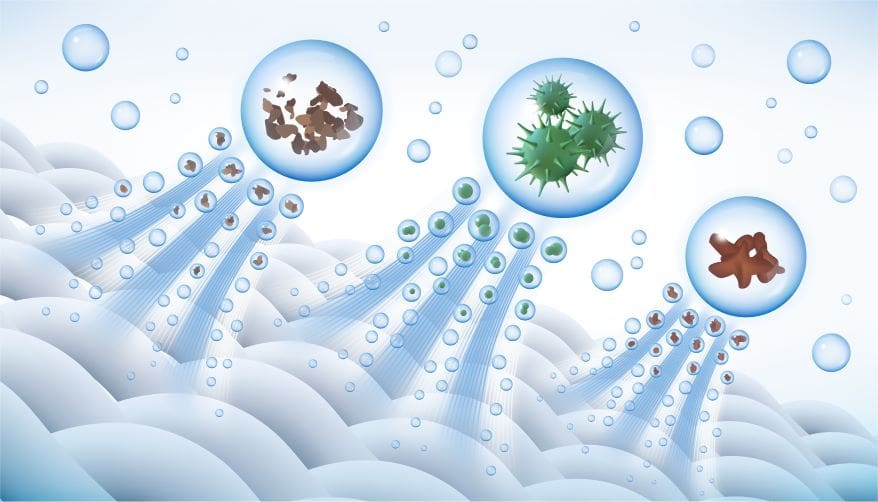
Clean drinking water is a fundamental human need. Yet, bacterial contamination remains a serious global challenge. Scientists have developed a new carbon material traps method. This technique removes bacteria from water effectively. A recent study in the journal Chemistry (MDPI) presents this innovation. The research describes a macroporous carbon adsorbent. This material acts like a sponge. It traps bacteria physically. It does not use chemicals. This approach is sustainable and cost-effective. The carbon adsorbent has large pores. These pores capture bacteria. The material is reusable. It can clean water repeatedly. This breakthrough offers hope for communities. It provides a simple solution. The technology requires no electricity. It works with basic filtration. This article explains the science. It highlights the benefits. It also covers practical applications.
Key Takeaways: Carbon Material Traps
- Macroporous carbon traps bacteria through physical filtration.
- The material is reusable after simple washing.
- It works without chemicals or electricity.
- The synthesis uses sustainable biomass sources.
- This technology addresses global water safety issues.
What Makes This Carbon Material Special?
The new carbon material stands out because of its unique structure. First, it contains large pores that measure several micrometres in size. Furthermore, these pores form an interconnected network that acts like a maze for bacteria. As a result, bacteria can become trapped inside the network and cannot easily escape. Therefore, the material can effectively capture bacteria while allowing water to pass through. In contrast, traditional filters usually contain much smaller pores and often require high pressure to push water through them. However, this new carbon material uses larger interconnected pores, allowing filtration to work with gravity alone. In addition, its synthesis process is relatively simple. First, researchers used a silica template as the starting structure. Next, they added a carbon precursor and heated the mixture. Afterward, the silica template was removed, leaving behind a carbon replica. Consequently, the final material contained a network of interconnected pores.
How Does the Synthesis Work?
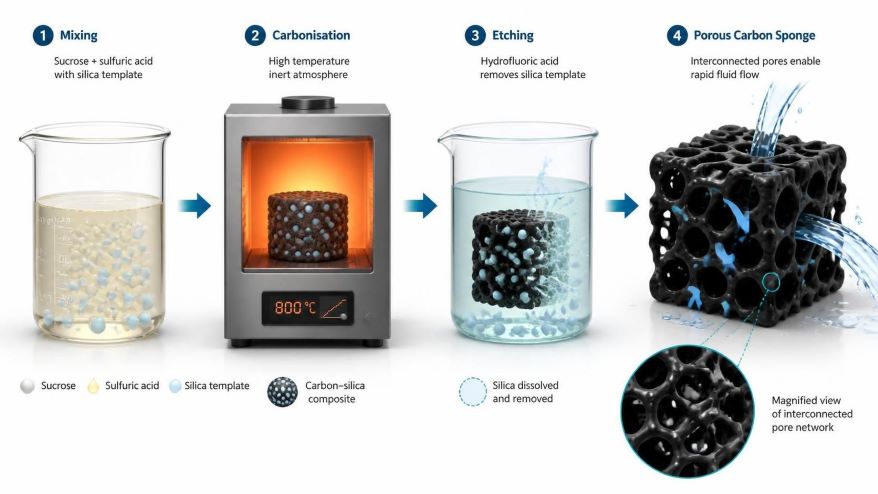
The research team used a combination of sucrose and sulphuric acid to produce the carbon material. First, they mixed these components with a silica template. Next, the mixture was carbonised at high temperatures, which produced a carbon–silica composite. Afterward, the silica was removed through an etching process using hydrofluoric acid. As a result, the resulting carbon material developed a sponge-like structure with uniform pores. Furthermore, these pores were interconnected, allowing water to flow through the material easily. In addition, the synthesis process was reproducible under the reported conditions. Moreover, it relied on commonly available laboratory equipment, which may support further development. Therefore, the relatively straightforward process could potentially be adapted for larger-scale production and future industrial applications.
Why Macroporous Structure Matters
On studying carbon material traps, macroporous carbon contains pores larger than 50 nanometres. Importantly, these large pores are well suited for capturing bacteria, which are typically about 0.5 to 5 micrometres in size. As a result, the pores can trap bacterial cells while still allowing water to flow through easily. Therefore, this structure provides an important advantage for filtration. In contrast, microporous materials contain much smaller pores. Although they can effectively filter particles, they may become clogged more quickly. However, macroporous materials can reduce this problem because their larger pores support higher flow rates. Consequently, they may be more practical for real-world water filtration applications. Furthermore, the larger pores can make the material easier to clean. For example, backwashing can help remove trapped bacteria from the pore network.
Bacterial Removal Efficiency
The researchers tested the material against common waterborne bacteria. They used Escherichia coli and Bacillus subtilis. The carbon material traps achieved high removal rates. For E. coli, the removal efficiency exceeded 99.9%. For B. subtilis, it was above 99.5%. These results are impressive. They meet World Health Organization standards. The material works in both tap water and synthetic wastewater. The removal mechanism is purely physical. Bacteria adhere to the carbon surface. There is no chemical disinfection. This eliminates the risk of harmful byproducts.
Factors Influencing Performance
On Studying Carbon Material Traps, Several Factors Affect the Material Performance. The pore size is one. The surface chemistry is another. The carbon surface has functional groups. These groups include carboxyl and hydroxyl. They attract bacteria through electrostatic interactions. The flow rate also matters. Slower flow allows more contact time. This increases removal efficiency. Researchers can adjust synthesis conditions. They can control pore size. They can modify surface chemistry. This flexibility is valuable for different applications.
Applications in Water Treatment
On studying carbon material traps, this technology has broad applications. It can be used in point-of-use filters. It can be integrated into municipal treatment plants. Remote communities can benefit from it. Disaster relief efforts can use it. The material is lightweight. It is easy to transport. It works without electricity. This makes it ideal for off-grid locations. The material can also be combined with other treatments. It can be used before UV disinfection. It can be used after sedimentation. This versatility is a major advantage.
Point-of-Use Systems
On studying carbon material traps first, researchers can use this carbon material in small-scale water filters. For example, they can incorporate it into a simple gravity-fed filtration system. Furthermore, users can replace the filter cartridge easily when needed. As a result, households could use these filters to improve access to safer drinking water. In addition, the material can help keep costs low because researchers can produce it from biomass. Moreover, local production could reduce dependence on distant suppliers and create new economic opportunities.
Environmental and Economic Benefits
The carbon material trap approach offers several environmental benefits. First, researchers can make the material from biomass such as sugarcane bagasse or coconut shells. Because these materials come from renewable resources, they provide a more sustainable raw material source. Furthermore, researchers can use common chemicals during the synthesis process and avoid generating large amounts of hazardous waste.
Frequently Asked Questions: Carbon Material Traps
Is the material safe for drinking water?
Yes, the material can provide a safe option for water filtration when researchers properly prepare and test it. First, the material uses carbon as its main component, and carbon generally shows high chemical stability. Furthermore, proper synthesis and purification can remove unwanted impurities.
How long can the material be used?
The lifespan of the carbon material depends on the quality of the water. In relatively clean water, users can use the material for several months before regeneration or replacement. Furthermore, users can regenerate the material multiple times to restore its filtration capacity. With proper cleaning and maintenance, the material can remain useful for several years.
Can it remove viruses and other pathogens?
Researchers designed the material specifically to capture bacteria, and they optimised its pore size for this purpose. However, the material removes viruses less efficiently because viruses are much smaller than bacteria. Therefore, users can combine this material with other treatment methods to improve virus removal
Reference:
- Stoycheva, I., Petrov, P., Petrova, B., Tsyntsarski, B., Kosateva, A., Velkova, L., Petrov, N., Dolashka, P., & Krstić, J. (2026). Synthesis of Macroporous Carbon Adsorbent for Effective Bacterial Removal from Water. Chemistry, 8(3), 35. https://doi.org/10.3390/chemistry8030035
- Author
- Latest Posts

I am an inspirational writer and emerging science blogger with a deep-rooted passion for understanding and sharing the wonders of the world around us. My journey began with a Bachelor of Science in Chemistry from AKI’s Poona College of Arts, Commerce and Science, where I developed not only a strong foundation in scientific principles but also a mindset that values curiosity, observation, and critical thinking. Studying chemistry has taught me to approach problems with logic, to look beyond the obvious, and to see patterns where others might only see complexity. These experiences have shaped the way I perceive life and influence the way I express my thoughts, both scientifically and creatively.
I have always believed that knowledge is only as powerful as the way it is shared. This belief has guided me to create content that bridges the gap between science and everyday life. I aim to simplify complex scientific ideas so they become approachable, relatable, and engaging for everyone—whether someone has a formal background in science or is simply curious about the world. Science, in my view, is not confined to textbooks and laboratories; it is a way of thinking, understanding, and connecting with the world around us. By making science accessible, I hope to inspire curiosity, ignite learning, and encourage people to see the beauty and relevance of scientific discovery in their daily lives.
Alongside my love for science, I am deeply passionate about motivational writing. I believe words carry the power to transform perspectives, encourage self-reflection, and inspire action. By combining analytical thinking with creativity, I create content that is intellectually stimulating yet emotionally resonant. Whether I am breaking down a chemical concept, exploring a scientific phenomenon, or crafting motivational narratives, my goal is to communicate ideas in a way that is clear, meaningful, and impactful.
Through my work, I strive to empower my readers – not just by helping them understand the science around them, but by inspiring them to grow, learn, and realize their full potential. Every article, post, or story I write reflects my commitment to turning knowledge into inspiration. I want to spark curiosity, encourage self-improvement, and show that learning and personal growth are deeply connected. For me, writing is not just a craft; it is a way to touch minds, connect hearts, and make ideas come alive in a way that truly resonates.
- Author
- Latest Posts

I completed my Master of Science from the University of Allahabad in 2017 with a strong academic background in life sciences and chemistry. My specialization included Molecular Biology, Microbiology, Genetics, Plant Breeding, Phycology, Paleobotany, and Bioinformatics, along with Organic Chemistry, Inorganic Chemistry, and Physical Chemistry. This multidisciplinary training provided me with a comprehensive understanding of biological systems and analytical scientific approaches.
After completing my postgraduate studies, I gained valuable professional experience in both the education and social development sectors. I worked at A.M. Oxford Public School, where I was actively involved in guiding students toward academic excellence. In this role, I focused on creating an engaging learning environment, encouraging critical thinking, and nurturing students’ curiosity for scientific learning. My experience as an educator strengthened my communication, mentoring, and classroom management skills.
In addition to my teaching experience, I worked with Jeevan Jagriti Foundation, where I contributed to community-based initiatives aimed at improving educational access and awareness among underprivileged sections of society. Through this work, I participated in programs designed to support social development and promote the value of education in marginalized communities.
These professional experiences helped me develop strong interpersonal, leadership, and organizational skills while reinforcing my commitment to education and community service.


