Edge AI in Industry 4.0 makes smart factories affordable, faster, and more efficient with real-time computer vision on low-cost devices.
Edge AI in Industry 4.0: Smart Factories on a Budget
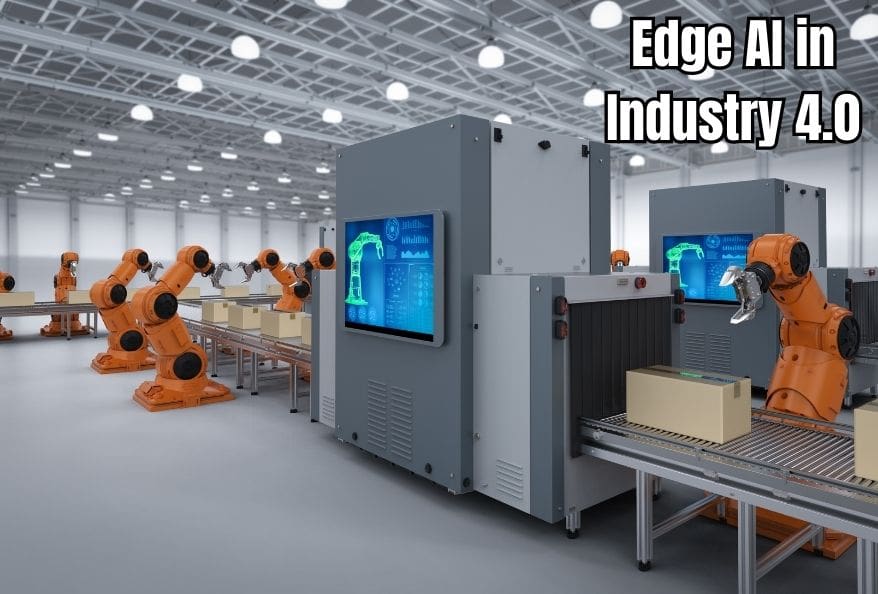
Edge AI in Industry 4.0 is revolutionizing manufacturing worldwide. Factories are becoming smarter each day, with robots working alongside humans to assemble cars, inspect products, and manage logistics. However, a critical challenge remains: these robots must “see” accurately and respond instantly to changing conditions. In high-speed production environments, even a slight delay can lead to defects, downtime, or expensive accidents.
Traditionally, factories depended on massive cloud servers to process AI vision tasks. Although effective, this method introduced latency because data had to travel to remote servers and back. Consequently, engineers are moving intelligence directly onto machines through edge computing. By processing data locally, factories reduce delays, improve reliability, and enable real-time decision-making on the production floor.
What Is Edge AI in Industry 4.0?
Edge AI in Industry 4.0 refers to running artificial intelligence models directly on local devices such as robots, cameras, or embedded systems instead of relying on cloud servers.
In other words, the thinking happens exactly where the action takes place.
For example:
- A robot detects defective products instantly.
- A conveyor belt camera identifies parts in real time.
- A machine adjusts settings automatically without waiting for cloud instructions.
Because processing occurs locally, factories gain three major advantages:
- Lower latency – Instant decision-making
- Higher privacy – No sensitive data sent to the cloud
- Greater reliability – Works even without internet
Consequently, factories can operate continuously without interruption.
The Big Challenge in Edge AI
Although edge computing offers clear benefits, there is a major obstacle. Edge devices are small and power-efficient. However, advanced AI models require heavy computation.
For instance, devices like the Raspberry Pi 4 are affordable and compact. Yet they cannot easily run large neural networks without optimization.
Therefore, engineers face a trade-off:
- High accuracy but slow processing
- Fast speed but reduced intelligence
Researchers Eman Azab, Mohamed Ehab, Lamia Shihata, and Maggie Mashaly developed an optimization strategy specifically designed for edge deployment in Industry 4.0 environments.
How Edge AI in Industry 4.0 Becomes Smaller and Faster
Instead of relying on a single method, the researchers applied a three-stage optimization pipeline.
1. Backbone Refinement in Edge AI in Industry 4.0
First, they refined the model’s backbone architecture. This reduced unnecessary computations while maintaining high detection accuracy.
2. Hyperparameter Tuning in Edge AI in Industry 4.0
Next, they carefully tuned the model’s hyperparameters. As a result, the AI achieved better performance using fewer system resources.
3. Quantization
Quantization essentially lowers the mathematical precision of AI calculations, thereby reducing model size and speeding up inference. For example, like compressing a high-resolution image without losing clarity, it allows advanced computer vision models to run efficiently on compact hardware, which in turn makes Edge AI more practical for Industry 4.0.
Hardware Comparison for Edge AI
To validate their framework, the researchers tested three popular edge devices:
1. Raspberry Pi 4
- CPU-based processing
- Budget-friendly
- Ideal for educational projects
2. NVIDIA Jetson Nano
- Equipped with a GPU
- Designed for AI acceleration
- Strong balance of performance and cost
3. Google Coral
- Includes a dedicated TPU
- Optimized specifically for AI inference
The experiment involved object detection on a fast-moving conveyor belt system, simulating real industrial conditions.
Performance Results of Edge AI in Industry 4.0
The optimized YOLOv10 nano variant achieved:
- 98.1% precision
- Real-time inference on edge hardware
Most notably, the NVIDIA Jetson Nano delivered approximately 25 frames per second (FPS). This performance matches real-time video processing standards.
Although the Google Coral also performed well, the Jetson Nano offered the best balance between speed, accuracy, and affordability.
Therefore, smart factories no longer need expensive server clusters to deploy AI vision systems.
Why Edge AI in Industry 4.0 Matters for Students
If you are a student exploring engineering or computer science, Edge AI in Industry 4.0 offers tremendous career potential. Today, the barrier to entry is lower than ever. Affordable hardware platforms, accessible development tools, and open-source AI frameworks make it possible to start building real-world projects even from home.
First, edge devices are budget-friendly, allowing students to experiment without heavy investment. Second, open-source libraries such as TensorFlow, PyTorch, and OpenCV provide powerful tools for learning and innovation. Third, industries across manufacturing, logistics, healthcare, and energy are actively seeking professionals skilled in automation, embedded systems, and real-time AI deployment. As automation expands rapidly, the demand for edge AI engineers continues to grow. Moreover, hands-on learning has become easier, enabling students to gain practical experience while still in college.
How to Start Learning Edge AI in Industry 4.0
- Learn Python programming
- Study basic machine learning concepts
- Explore OpenCV and YOLO-based object detection
- Practice using devices like Raspberry Pi 4 or NVIDIA Jetson Nano
- Build small real-time vision projects
For example, connect a camera and train a simple model to recognize everyday objects. Gradually, you can scale toward industrial-level applications.
Final Thoughts on Edge AI in Industry 4.0
Edge AI in Industry 4.0 is transforming smart manufacturing by enabling real-time, efficient, and affordable automation. Local processing reduces costs, improves speed, and makes this technology accessible to both industries and students.
Additionally, to stay updated with the latest developments in STEM research, visit ENTECH Online. Basically, this is our digital magazine for science, technology, engineering, and mathematics. Also, at ENTECH Online, you’ll find a wealth of information.
Reference
Azab, E., Ehab, M., Shihata, L., & Mashaly, M. (2026). Optimizing computer vision for edge deployment in Industry 4.0: A framework and experimental evaluation. Technologies, 14(2), 126. https://doi.org/10.3390/technologies14020126
- Author
- Latest Posts

Kottauppari Venkat Raghava
I am a technology-driven IT graduate with a strong passion for science and innovation. I am fascinated by how innovations like artificial intelligence, robotics, and emerging technologies are shaping our world. I specialize in analyzing complex scientific and technological research and presenting it in a clear, accessible way. My goal is to make science and technology understandable and engaging for students, tech enthusiasts, and professionals alike. By breaking down advanced concepts into simple, insightful narratives, I strive to inspire curiosity, learning, and innovation, helping readers stay informed about the breakthroughs that are shaping the future.