A star chose a strange way to end itself. Instead of going with a huge blast, it underwent a silent stellar collapse.
Silent Stellar Collapse: A Star Just Vanished
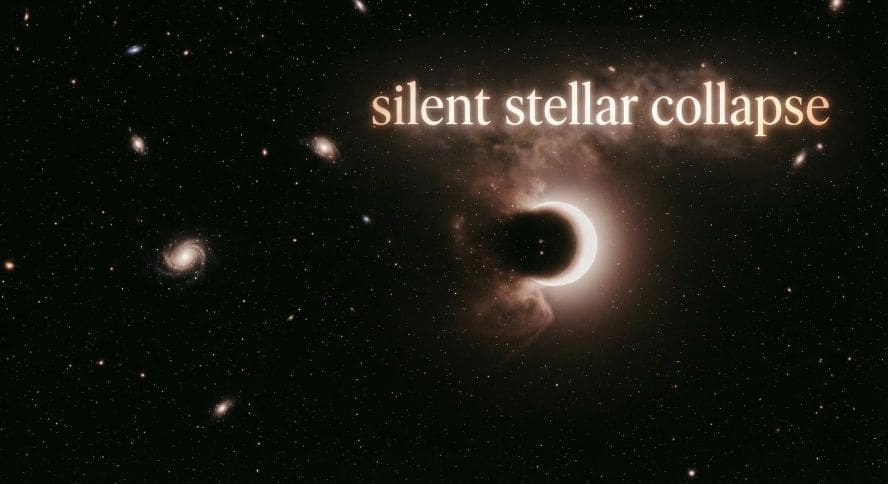
A massive star in the Andromeda Galaxy just disappeared. Usually, dying stars end their lives with a huge supernova blast. However, this star did something very different and strange. It underwent a silent stellar collapse and blinked out of existence. Astronomers call this a failed supernova. It happens when a star collapses directly into a black hole. This discovery helps us understand the universe better than before.
As a result, we now have proof of the silent stellar collapse. This rare event shows that huge stars can vanish without a bright flash. Instead of a loud explosion, gravity simply pulled the star inward. Because this process is so quiet, it is hard to catch. To be sure, this changes our knowledge of how many black holes exist.
The Mystery of the Silent Stellar Collapse
The star, known as M31-2014-DS1, was once very bright. At first, it began to glow in infrared light in 2014. After that, its brightness faded over several years. By the present time, the star is almost impossible to see. Scientists used data from the Hubble Space Telescope to study it. They found only a faint, dusty remnant left behind. To illustrate, the silent stellar collapse left almost no trace.
This event is very rare to witness in real-time. Prior to this, we only had theories about such collapses. Now, researchers have a clear observation of a black hole birth. While this may be true, many stars still explode as supernovae. Seeing that this star chose a silent stellar collapse is a big deal. It suggests that many black holes might form very quietly. All in all, this finding changes our map of the cosmos.
Why this Matters for Your Future Career
Are you interested in space, math, or physics? This research shows how STEM careers can be exciting. To enumerate, you could work as an astrophysicist or a data scientist. These experts use coding to analyze images from space. As a matter of fact, many discoveries hide in archival data. To be sure, you need a strong foundation in science. You can explore different types of engineering to see what fits you.
Many students think astronomy is just looking through telescopes. In reality, it involves heavy math and computer science. With this in mind, you should look into engineering mathematics early. These skills allow you to model a silent stellar collapse. At the same time, they help you solve Earthly problems too. Another key point is that space agencies need engineers constantly. You could design the telescopes of the future!
How Does a Star Perform a Silent Stellar Collapse?
To explain, a star stays alive by burning fuel. This creates pressure that fights against gravity. When the fuel runs out, gravity wins the fight. Usually, a shockwave blows the star apart. In this case, the shockwave was not strong enough. So as to understand, a silent stellar collapse occurred immediately. To put it differently, it became a black hole without noise.
This means the core fell inward at incredible speeds. Prior to this, we thought all giant stars exploded. Now, we see that physics can be very quiet. Balanced against a supernova, this event leaves no bright gas. To summarize, the star vanished while nobody was looking. It is a dark end for a bright object.
What’s Next for Space Science ?
Scientists will keep watching the Andromeda Galaxy for more events. All things considered, we might find many more missing stars. At length, this will tell us how many black holes exist. This knowledge is vital for understanding galaxy evolution. With this purpose in mind, new satellites are being built. So far, the data looks very promising for future researchers.
To list, upcoming missions will use infrared sensors. These tools can spot a silent stellar collapse easier. By comparison, older telescopes missed these dark shifts. After all, the universe holds many unseen wonders. To repeat, your generation will lead these discoveries. At this time, the sky is the limit.
Conclusion
In short, the disappearance of M31-2014-DS1 is a milestone. It proves that stars do not always go out with a bang. Sometimes, they leave us with a silent stellar collapse. To sum up, science is about asking questions and finding answers. This story is a perfect example of scientific tenacity. If you love solving puzzles, a STEM career is for you. At any rate, the universe still has many surprises for us.
Additionally, to stay updated with the latest developments in STEM research, visit ENTECH Online. Basically, this is our digital magazine for science, technology, engineering, and mathematics. Also, at ENTECH Online, you’ll find a wealth of information.
References
De, K., MacLeod, M., Jencson, J. E., Lovegrove, E., Antoni, A., Kara, E., … & Simcoe, R. (2026). Disappearance of a massive star in the Andromeda Galaxy due to formation of a black hole. Science, 391(6786), 689-693. DOI: 10.1126/science.adt4853
- Author
- Latest Posts

A Master’s-qualified Zoologist with a focus on Limnology, I combine hands-on laboratory experience with a sophisticated background in science communication. My career is defined by an interdisciplinary approach to the life sciences, merging technical research skills with a proven ability to teach and engage diverse audiences. I am committed to lifelong learning and the creative dissemination of medical and biological research, ensuring scientific literacy and inspiration remain at the forefront of the field.