VR fitness helps people with motor disabilities stay active through immersive, engaging virtual reality experiences that improve health, motivation, and accessibility.
VR Fitness for Disabilities: A New Hope in Rehab
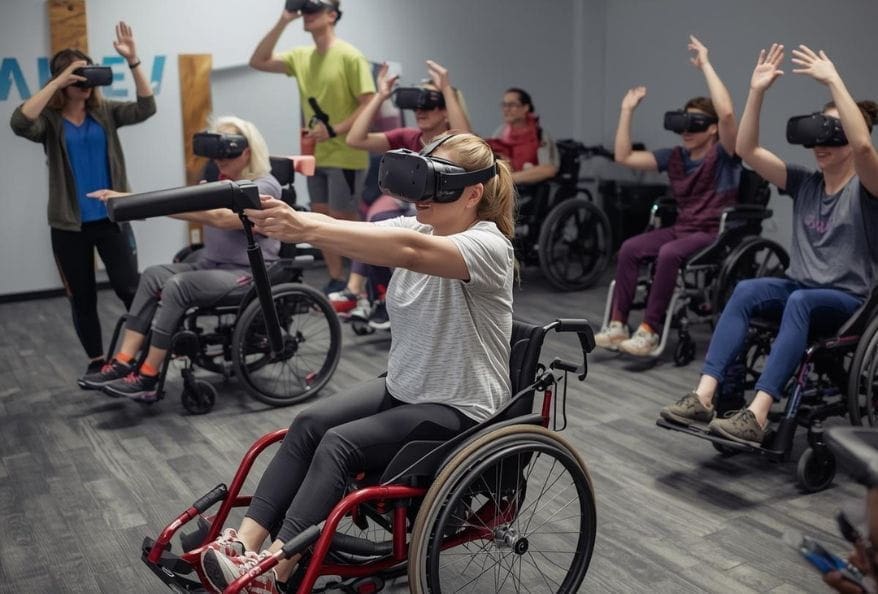
VR fitness for disabilities is transforming rehabilitation by turning exercise into immersive, engaging experiences that improve health and independence.
Physical activity matters for everyone. However, people with motor disabilities often face serious barriers to staying active. Traditional gyms may lack adaptive equipment. In addition, some individuals feel uncomfortable or self-conscious in public workout spaces. As a result, many struggle to maintain regular exercise routines.
At the same time, technology is opening new doors. A recent scoping review by Antonelli et al. (2024) examined how virtual reality can engage people with motor disabilities in leisure-time physical activity. The findings suggest that VR fitness for disabilities is more than entertainment — it is a promising health innovation.
Breaking Barriers with VR Fitness for Disabilities
Many individuals with motor impairments find daily movement challenging. Consequently, structured exercise can feel overwhelming. Prior to immersive technologies, physical therapy often seemed repetitive and exhausting.
Now, virtual reality headsets create interactive digital worlds. Users can row across a scenic lake, box with virtual opponents, or play rhythm-based games that require coordinated arm and leg movements. Although the environment is digital, the physical effort is real.
Furthermore, VR systems provide instant feedback. Users can track their scores, progress, and improvements. This immediate response increases motivation. In contrast to traditional workouts, VR experiences feel like adventures rather than chores.
Most importantly, VR offers a safe and controlled space. Users can attempt new movements without fear of falling or being judged. Therefore, confidence grows alongside physical strength.
The Science Behind VR Fitness for Disabilities
Researchers conducted a scoping review to evaluate whether VR interventions genuinely support physical health.
For example, studies report improvements in:
- Cardiovascular endurance
- Muscle strength
- Balance and coordination
- Overall mood and motivation
Moreover, VR-based exercise increases adherence. In other words, participants are more likely to continue exercising when it feels enjoyable. While traditional rehabilitation can be repetitive, gamified VR encourages consistent engagement.
Earlier research by Tuena et al. (2020) also highlights the long-standing role of virtual reality in rehabilitation science. Over the past six decades, VR has evolved from experimental setups to accessible consumer technology. As technology advanced, accessibility improved.
Additionally, motion-tracking systems such as Microsoft Kinect have been validated for functional assessment (Bonnechère et al., 2016). This demonstrates that digital tracking tools can reliably measure movement performance.
Engineering Inclusive Virtual Environments
Engineering plays a critical role in making VR fitness for disabilities accessible. Developers must design hardware and software with inclusivity in mind.
For instance, not all users can grip handheld controllers. Therefore, engineers are developing hands-free motion tracking systems. Some platforms use body sensors, cameras, or adaptive controllers. Consequently, more users can participate regardless of physical limitations.
User experience (UX) designers also contribute significantly. They ensure that menus are easy to navigate and that feedback systems are clear and motivating. In addition, biomedical engineers collaborate with therapists to align game mechanics with rehabilitation goals.
All in all, inclusive design transforms VR from a novelty into a powerful therapeutic tool.
STEM Careers in VR Fitness for Disabilities
The rise of VR fitness for disabilities is creating exciting career opportunities. As healthcare and technology intersect, new roles continue to emerge.
For example, students interested in STEM can explore:
Software Engineering for VR Platforms
Developers create immersive worlds, motion-tracking systems, and adaptive interfaces.
Biomedical Engineering
These professionals design assistive devices and rehabilitation technologies.
UX Design for Accessibility
Designers ensure that digital platforms are usable for individuals with diverse abilities.
Digital Physical Therapy
Therapists increasingly integrate VR into rehabilitation programs.
Therefore, students who combine creativity with technical expertise can make a meaningful social impact. As long as innovation continues, inclusive health technologies will expand.
The Future of VR Fitness for Disabilities
Although current results are promising, more long-term research is needed. Scientists aim to determine which types of VR games produce the strongest health benefits. In addition, affordability remains a key factor.
Nevertheless, hospitals and rehabilitation centers already use VR systems. Meanwhile, home-based versions are becoming more accessible. As a result, patients can exercise independently in their living rooms. This reduces travel costs and increases convenience.
Above all, VR fitness promotes autonomy. Instead of relying solely on supervised sessions, individuals can take control of their physical activity routines. Consequently, quality of life improves.
Why VR Fitness for Disabilities Matters
In summary, VR fitness for disabilities bridges the gap between gaming and rehabilitation. It transforms physical activity into an engaging, safe, and motivating experience.
While challenges remain, the potential impact is significant. Provided that technology remains inclusive and affordable, virtual reality could redefine rehabilitation for millions.
Ultimately, everyone deserves the opportunity to stay active. With continued innovation, virtual exercise may become a cornerstone of modern healthcare.
Additionally, to stay updated with the latest developments in STEM research, visit ENTECH Online.
Reference
Bled, A., Royal, M., Kerchi, A., Archambault, P., Gagnon, M., & Routhier, F. (2026). Virtual Reality to Engage People with Motor Disability in Leisure-Time Physical Activity: A Scoping Review. Technologies, 14(2), 137. https://doi.org/10.3390/technologies14020137
- Author
- Latest Posts

Kottauppari Venkat Raghava
I am a technology-driven IT graduate with a strong passion for science and innovation. I am fascinated by how innovations like artificial intelligence, robotics, and emerging technologies are shaping our world. I specialize in analyzing complex scientific and technological research and presenting it in a clear, accessible way. My goal is to make science and technology understandable and engaging for students, tech enthusiasts, and professionals alike. By breaking down advanced concepts into simple, insightful narratives, I strive to inspire curiosity, learning, and innovation, helping readers stay informed about the breakthroughs that are shaping the future.