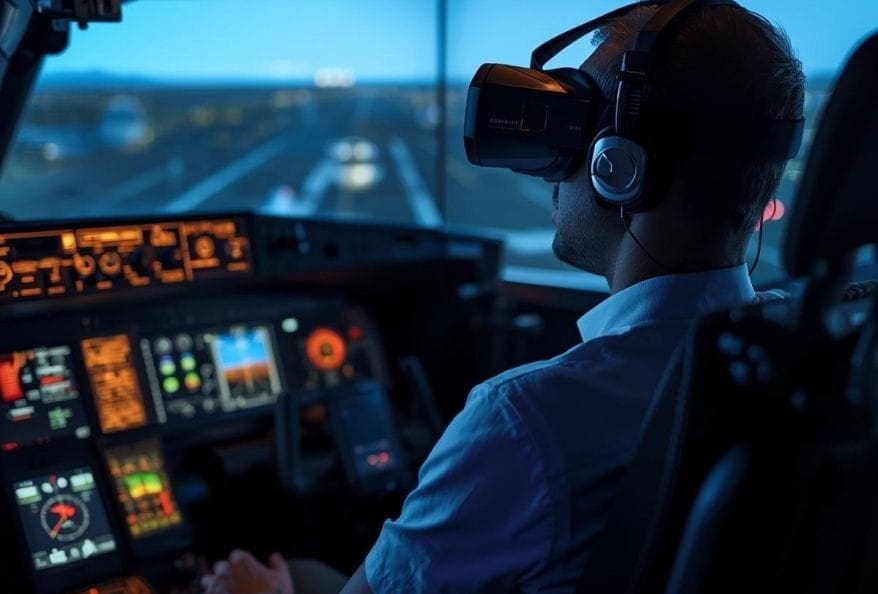
Virtual reality lets you pilot a plane without leaving your room. But can VR really make you a real-life pilot?
VR Flight Training: Can You Really Learn to Fly Virtually?
Estimated reading time: 4 minutes
Most teens enjoy gaming on PCs and consoles. Many already own a virtual reality headset. VR flight training is now moving from gaming rooms into real flight schools worldwide. At first, VR existed mainly for entertainment. At the present time, it is reshaping aviation education. Above all, flight training costs a lot. Real aircraft training needs fuel, instructors, and airport access. As a matter of fact, professional simulators can cost millions of dollars.
Prior to recent research, experts questioned affordable VR systems. They asked whether low-cost headsets could teach real flying skills. A new scientific study finally tested this idea using VR flight training methods. Researchers focused on students learning instrument flying skills. This means flying without looking outside the cockpit. Instead, pilots rely fully on onboard instruments.
The Science Behind VR Flight Training
How VR Flight Training Teaches Instrument Flying
To illustrate, imagine flying through thick clouds. You cannot see the ground or the horizon. At the same time, your body feels confused. This condition is called spatial disorientation. It plays a role in many aviation accidents. To explain, pilots must trust cockpit instruments completely when visibility disappears.
Learning this skill safely is difficult. With this in mind, researchers used a PC-based aviation training device. They combined it with virtual reality pilot training tools. The VR headset created an immersive cockpit environment. Students felt present inside the aircraft during training. This realistic setting helped the brain process motion and depth more effectively.
How the Experiment Worked
After that, students practiced simulated instrument approaches. These included navigation and landing tasks. The system recorded accuracy and flight stability. In detail, researchers measured improvement over time. They focused on transfer of training. This shows whether practice improves real-world flying ability.
To put it differently, the study tested whether learning to fly using VR helps pilots perform better beyond the simulator. This question matters greatly for aviation education and safety. The study design allowed researchers to compare performance before and after VR-based practice.
Does Learning to Fly Using VR Actually Work?
As a result, most students showed strong improvement. Navigation accuracy increased noticeably. In fact, landing approach performance improved by a wide margin. The immersive nature of VR flight training helped students focus better on instruments.
At this instant, the results suggest real potential. Students reacted faster to changing flight data. Their confidence improved during complex procedures. To repeat, these gains came from learning to fly using VR rather than expensive full-motion simulators.
The study showed that even affordable VR equipment can support serious aviation learning. This finding surprised many instructors who once doubted consumer-grade headsets.
Why VR Flight Training Beats a Normal Screen
By comparison, flat screens feel limited. They cannot recreate cockpit depth effectively. With attention to realism, virtual reality pilot training surrounds the learner visually. This improves spatial awareness and memory retention.
In essence, the brain treats VR experiences more like real flight. This strengthens learning outcomes over time. Students feel movement, distance, and orientation more naturally. You can explore similar engineering innovations on entechonline.com through articles on emerging engineering technologies.
Lower Costs and Wider Access with VR Flight Training
What’s more, VR flight training systems cost far less than traditional simulators. They fit inside small rooms easily. All in all, schools can train more students with limited budgets. Students can also practice more often without scheduling aircraft time.
So long as the software remains accurate, learning continues effectively. At least, current results support this approach. At any rate, accessibility matters for young learners interested in aviation. Teens exploring future careers can read more about aviation and engineering pathways on entechonline.com.
Challenges Facing VR Flight Training Technology
Motion Sickness and Comfort
While it may be true that VR flight training improves learning, challenges remain. Some users experience nausea or dizziness. This happens when motion cues conflict with visual input. To be sure, smoother graphics and higher refresh rates reduce this problem.
Engineers continue improving headset performance. In due time, comfort should improve further, making virtual reality pilot training easier for longer sessions.
Physical Controls and Realism
Another key point involves cockpit controls. Users cannot always see their real hands while wearing a headset. Physical buttons feel harder to locate. After all, touch feedback is important for pilots.
So far, haptic gloves show promise. They provide vibration and pressure feedback during training. This time, realism in VR flight training continues to improve steadily.
What VR Flight Training Means for Teens
All things considered, VR flight training connects gaming with engineering. Teens already understand simulations intuitively. This familiarity supports faster learning. In general, learning to fly using VR combines computer science, physics, and human perception.
Additionally, to stay updated with the latest developments in STEM research, visit ENTECH Online. Basically, this is our digital magazine for science, technology, engineering, and mathematics. Further, at ENTECH Online, you’ll find a wealth of information.
Reference:
- Somerville, A., Joiner, K., & Wild, G. (2026).Virtual reality in PCATD-based instrument flight training: A quasi-transfer of training study. Technologies, 14(2), 94. https://doi.org/10.3390/technologies14020094
- Author
- Latest Posts

Kottauppari Venkat Raghava
I am an Information Technology graduate (B.Tech) and a technology writer specialising in artificial intelligence, robotics, automation, and space technologies. I analyse complex scientific research and convert it into clear, practical insights for students, tech enthusiasts, and professionals. My work bridges the gap between academic research and real-world understanding by simplifying findings from peer-reviewed journals into engaging, easy-to-follow content. Alongside my writing, I have hands-on experience developing real-world projects, showcased on my GitHub, including an Expense Tracker web application for managing and visualising spending, and a Simple Video Summariser that generates concise insights from video content using automation techniques. I also produce research-driven articles on topics such as AI-powered corrosion detection, deep learning in engineering, and advanced automation systems. I follow a research-driven approach, ensuring every article is grounded in verified sources, industry knowledge, and practical applications. My goal is to make advanced technology accessible and meaningful, helping readers stay informed about innovations shaping the future.