Learn how AR and VR in real estate change traditional property viewing into efficient virtual experiences for potential buyers.
Ultimate Guide to AR VR in Real Estate

Estimated reading time: 10 minutes
The real estate industry is changing fast. Technology now leads the way for property sales and home design. Augmented Reality (AR) and Virtual Reality (VR) are the primary tools driving this shift. This technology is reshaping how people interact with properties, consequently making process more efficient and fun. The technology not only reduces time spent on viewings, but also enhances decision-making for buyers and sellers.
This guide looks at how AR VR in real estate works.
How AR and VR Are Changing Real Estate
The impact of AR VR in real estate cannot be overstated. Generally, property viewing involves physical visits to multiple locations, which consumes too much time and energy. However, virtual tours enabled with AR VR eliminate these constraints. Thus allowing potential buyers to explore spaces from anywhere in the world.
AR and VR change how we look at real estate. Prior to this technology, people relied on 2D photos. Now, virtual tours provide a 3D experience. To explain, VR creates an entire digital environment. You can walk through a virtual house from your couch. AR adds digital elements to the real world. Buyers can now explore properties from their homes. They can even revisit spaces as many times as needed. On the other hand, sellers can showcase their properties to a global audience dissolving geographical boundaries of real estate marketing.
VR technology creates immersive 3D environments. Potential buyers virtually walk through properties. They can experience room dimensions in realistic detail. AR applications overlay digital information, and also show renovation possibilities instantly.
In addition, these technologies reduce showings that lead nowhere. Real agents focus only on qualified buyers. Time efficiency improves significantly for everyone involved.
Why AR and VR Are Gaining Popularity in the Real Estate Market

The adoption rate of AR VR in real estate keeps increasing. Several compelling reasons drive this trend. Lets take a look at some of the main reasons:
Cost Reduction and Efficiency
Creating virtual property tours costs less than traditional marketing. Photography and videography expenses remain reasonable. The technology scales easily across multiple listings. Furthermore, agents spend less time on routine viewings, rather dedicate more effort to closing deals.
Real estate companies report faster sales cycles indeed. For instance, properties sell quicker with virtual tours. As a result inventory moves more efficiently through the sales pipeline.
Enhanced Buyer Experience
Modern homebuyers expect cutting-edge experiences. AR and VR technologies deliver exactly what they want. Young professionals particularly appreciate digital-first solutions. Remote buyers access properties across continents instantly.
Additionally, virtual exploration reduces buyer anxiety. People make informed decisions before visiting physically. This confidence leads to serious inquiries. Serious inquiries convert into actual sales more frequently.
Competitive Advantage
Real estate agents using these technologies stand out. Properties with virtual tours attract more interest. Marketing materials become more engaging and memorable. Companies adopting these tools gain market leadership.
Real-World Applications of AR VR in Real Estate

Virtual Property Tours
VR property tours represent the most common application. Users wear VR headsets and explore homes/properties completely. They navigate between rooms independently. They examine details like flooring and fixtures closely. This experience replicates physical walkthrough authenticity remarkably well.
These tours work across residential as well as commercial properties. Apartments, houses, and office spaces all benefit. International clients can also participate without any travel expenses.
Augmented Reality Visualization
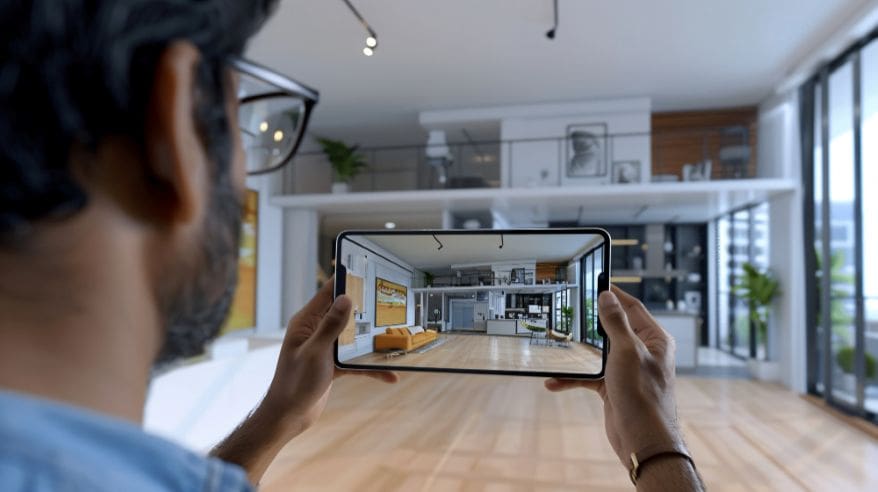
AR in real estate helps buyers see potential differently. Homeowners point their phones at empty rooms. Digital furniture appears in real-time on their screens. They experiment with different layouts instantly. They can also visualize paint colors even before making purchases.
Contractors use AR to demonstrate renovation possibilities. Clients see renovated spaces before construction begins. This clarity certainly prevents costly misunderstandings later.
Site Plans and Property Information
AR applications overlay property data on real locations. For example, boundary lines appear on-screen when viewing properties, and lot dimensions display instantly. Previous inspection also reports become accessible through the app. This information surely helps buyers make confident decisions.
AR and VR in Real Estate: How Buyers Benefit
Viewing Multiple Properties Efficiently
Buyers can visit dozens of properties virtually. They screen options without physical travel. This efficiency saves considerable time and money. Moreover, virtual viewing helps identify genuine interests first.
Only promising properties require actual site visits. This focused approach increases viewing effectiveness, and buyers feel more prepared during physical tours.
Making Informed Decisions
VR property exploration reveals details that photos miss. Lighting conditions become apparent throughout the day. Spatial relationships feel more realistic than flat images. Natural light patterns influence buying decisions significantly.
Additionally, furniture placement options become clearer in 3D spaces. Buyers envision their belongings in rooms. This mental mapping in fact reduces post-purchase regrets substantially.
Comparing Properties Side-by-Side
Virtual tours allow easy property comparisons. For instance, buyers revisit properties repeatedly without inconvenience, and evaluate multiple options simultaneously. This thorough comparison leads to better as well as more informed choices.
Satisfaction with purchases increases measurably!
AR VR in Real Estate: How Sellers, Builders, and Contractors Leverage it?
Marketing Properties More Effectively
Not to mention that sellers showcasing AR and VR properties receive more inquiries than usual. Virtual tours expand the potential buyer pool significantly. Remote, out-of-state as well as international buyers become accessible easily. The use of AR VR technology surely makes properties stand out in competitive markets.
Additionally, these listings generate more social media engagement. For instance, people share immersive experiences readily, gaining attention and free marketing.
Presenting Development Plans
Builders use VR property visualization for pre-construction marketing. As a result, future homeowners see completed projects before breaking ground, allowing them to understand the vision completely. This increased confidence consequently encourages early commitments and deposits.
Similarly, contractors demonstrate renovation results through AR. By doing so, clients approve designs with visual certainty. Change orders decrease significantly because of this clear visualization.
Streamlining the Sales Process
Virtual tours reduce casual inquiries and tire-kickers. Serious buyers contact agents genuinely interested. Time wasted on unqualified leads diminishes significantly. Sales teams focus energy where it matters most.
Negotiation becomes easier with documented virtual walkthroughs. Both parties reference the same property details. Disputes about property conditions decrease markedly.
AR and VR in Interior Design and Home Staging
Interior design professionals embrace AR VR technologies eagerly.
Visualizing Design Options
Designers use VR to present multiple design schemes. Consequently clients experience different styles and color combinations before making a purchase. Moreover, material choices become clearer in realistic settings.
This approach reduces expensive design revisions. As clients approve plans confidently, the implementation proceeds smoothly thereafter.
Virtual Home Staging
Empty properties seem uninviting to most buyers. However, virtual staging with AR transforms bare spaces drastically. By all means, digital furniture fills rooms attractively, and decorative elements appear on walls and floors. Consequently, the staged property becomes far more appealing instantly.
Virtual staging costs significantly less than physical staging. Changes happen instantly without moving furniture repeatedly. Multiple staging options present themselves easily.
Personalized Design Exploration
Buyers imagine personalized changes through AR applications. They experiment with wall colors in real-time. They visualize furniture purchases before committing money. This interactive approach builds confidence in design decisions.
Intersection of AR, VR, and AI in Real Estate
Artificial intelligence amplifies AR and VR in real estate.
Predictive Analytics and Pricing
AI algorithms can now analyze property data across regions, and predict future value trends accurately. Machine learning helps identify undervalued properties for investors. Market insights emerge from massive datasets efficiently.
Real estate professionals leverage these insights strategically so that pricing becomes more competitive and informed. Given that, return on investment improve through better analysis.
Personalized Property Recommendations
AI learns individual buyer preferences through interactions. In like manner, virtual tour engagement patterns reveal genuine interests. The system then recommends suitable properties automatically. Buyers discover options matching their criteria quickly. All things considered, this personalization makes the AR VR in real estate experience feel tailor-made for every user.
Automated Property Descriptions
AI generates detailed property descriptions from VR data. These descriptions highlight key features effectively so as to give buyers a clear picture. In another case, content creation becomes faster and more consistent through this. This in fact makes marketing materials better in quality and quantity.
Smart Virtual Assistants
Chatbots powered by AI answer property questions instantly. Apart from that, they also schedule viewings and provide information automatically, reducing customer service costs. As a matter of fact, response times improve dramatically around the clock, even during holidays.
Challenges and Limitations of AR and VR in Real Estate
Despite tremendous potential, obstacles remain present.
Technology Adoption Barriers
Not all real estate professionals embrace new tools readily. Training requirements demand time and resources. Initial investment costs discourage smaller companies. Overcoming this resistance requires knowledge and clearly demonstrated value.
Hardware and Software Costs
Quality VR and AR equipment remains relatively expensive for many local firms. At the same time, the development of custom applications requires specialized expertise that is hard to find. Maintenance and updates also need ongoing attention to keep the software running smoothly. As a result, small agencies struggle with these heavy commitments.
Limited Internet Connectivity
High-quality virtual tours require robust internet speeds to function properly. At the present time, remote areas lack adequate infrastructure to support this. Streaming VR experiences demands significant bandwidth that many homes simply do not have yet. In reality, these technical limitations affect the user experience in some regions.
Emotional Connection Gaps
Virtual experiences cannot fully replicate in-person feelings for everyone. Some buyers still prefer physical property exploration entirely. To explain, the neighborhood ambiance often feels different online versus reality. You cannot hear the local birds or smell the fresh air through a headset. For the most part, distance cannot completely replace personal visits always.
Future of AR and VR in Real Estate

The trajectory points toward increased integration as well as innovation. Technology improvements continue accelerating rapidly across the entire sector. In similar fashion, costs decrease as adoption becomes mainstream for every agency. To emphasize, real estate transformation has only just begun.
As industry experts note: “VR isn’t replacing real estate agents. Instead, it’s freeing them to focus on what truly matters—building relationships and closing deals.”
Emerging technologies like 5G connectivity will enable faster streaming. Battery improvements will extend VR session lengths. Haptic feedback will add tactile sensations soon. Brain-computer interfaces may arrive eventually.
After all, the real estate industry will look fundamentally different within next few years. AR and VR will become standard expectations, not novelties. Buyers will demand these experiences as baseline offerings. As a result, sellers who resist will find themselves at disadvantages.
Conclusion: AR VR in Real Estate
AR VR in real estate represent chiefly transformative technologies.
- They solve real problems facing buyers, sellers, and agents.
- reduce costs
- improve experience
- expand market reach beyond traditional boundaries.
As a matter of fact, AR VR revolution in real estate is already happening in progressive markets. Early adopters surely gain competitive advantages here. Overall, as technology improves and costs decrease, universal adoption approaches.
In upcoming articles, we will certainly explore exciting STEM career opportunities within this domain. Whether you’re interested in software development, 3D design, or data analysis; possibilities stay around.
Additionally, to stay updated with the latest developments in STEM research, visit ENTECH Online. Basically, this is our digital magazine for science, technology, engineering, and mathematics. Further, at ENTECH Online, you’ll find a wealth of information.
References:
- Sun, X., & Wu, M. (2024). The State and Optimization of VR Technology in Real Estate: A Big Data and Visualization Approach. BDEIM’24, 261–265. https://doi.org/10.1145/3724154.3724198
- Sekar, A. N., Nathania, A. L., Tsalasa, K. S., & Permana, F. (2024). Transforming real estate sales and marketing with AReal: Sustainable solutions through augmented reality. Procedia Computer Science, 245, 365–374. https://doi.org/10.1016/j.procs.2024.10.262
- Author
- Latest Posts

Deven Nandapurkar is a Software Engineer, Project Lead; working at the strategic intersection of software engineering, productivity science, and emerging technologies. Driven by a core philosophy of “building things worth building,” he leads cross-functional teams and drives end-to-end technical strategy—from early-stage conceptualization through production-grade deployment.
A Computer Engineering graduate from Pune University, Deven brings a sharp systems-thinking approach to technical leadership, honed by years of managing high-stakes engineering projects and leading teams to top placements in national and international hackathons, including the NASA Space Apps Challenge and the Peerlist GenAI Hackathon.
Deven explores how human cognition and emerging technology converge. He regularly writes about cognitive performance optimization, attention management, AI integration, and the evolving dynamics of the modern workforce – offering actionable frameworks for professionals seeking to maximize their productivity and thrive alongside intelligent systems.