December often closes the year with moments that challenge our boundaries in science, medicine, space, and human understanding. From daring leaps in nuclear physics to bold missions beyond Earth’s bounds, December holds many of the…
Time Capsule: December
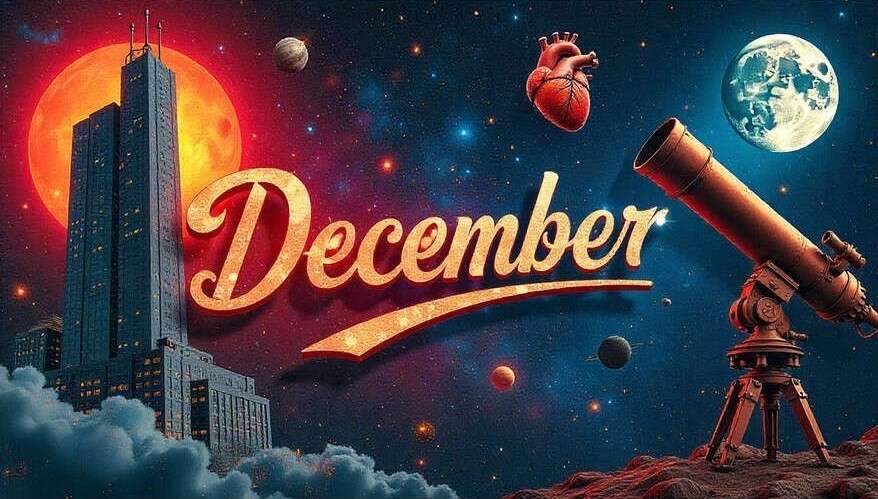
December often closes the year with moments that challenge our boundaries in science, medicine, space, and human understanding. From daring leaps in nuclear physics to bold missions beyond Earth’s bounds, December holds many of the occasions that shaped what we know today. Let’s explore some of the most pivotal historical events in December — milestones that changed the course of progress.
December 2, 1942
The first self-sustaining nuclear chain reaction begins under Enrico Fermi
On December 2, 1942, a team led by physicist Enrico Fermi achieved something once only theorized: the first self-sustaining nuclear chain reaction. Conducted beneath the University of Chicago’s football stadium, this experiment was part of the Manhattan Project and used a specially constructed reactor known as Chicago Pile-1.
Achieving criticality meant that the nuclear reaction became self-perpetuating, releasing energy without external input. This breakthrough signaled that atomic power was more than theoretical; it was a force that could be harnessed. The success of this experiment set the stage for both the development of nuclear energy and the atomic bomb.
Its impact has been immense and double-edged. On one hand, nuclear reactors now provide significant portions of electricity in many countries; on the other, nuclear weapons changed warfare forever. December 2, 1942, remains a turning point; one that highlights how scientific achievement carries both promise and responsibility.
December 3, 1967
Christiaan Barnard performs the first successful human heart transplant

On December 3, 1967, South African surgeon Christiaan Barnard carried out the world’s first successful human heart transplant. The patient, Louis Washkansky, survived 18 days post-surgery before succumbing to pneumonia, but the operation was a landmark showing that heart transplantation was indeed possible.
The procedure required innovations not only in surgical technique but also in immunology: the methods for suppressing the body’s rejection of transplanted organs were in their infancy. This operation opened a new field of medicine, inspiring surgeons and researchers around the world to improve survival rates and refine organ preservation.
Today, heart transplants are standard practice in many hospitals. Advances have improved long-term survival, lowered complications, and expanded eligibility. The first transplant in December 1967 paved the way for what was once thought impossible: replacing a failing human heart with another, giving life where death once loomed inevitable.
December 13, 1962
Launch of Relay 1, the first active repeater communication satellite
December 13, 1962, marked the launch of Relay 1, the first active repeater communications satellite in orbit. Unlike passive satellites that merely reflected signals, Relay 1 could receive, amplify, and retransmit communications. Thus, this was a major step forward in how humans connect over distance.
Relay 1 allowed more reliable long-distance television broadcasts, improved telephone connectivity, and military communications. It served as a proof-of-concept that satellites could serve not just as mirrors in space, but as essential nodes in global networks.
Today’s communications infrastructure, from live news broadcasts via satellite to global internet services, owes much to early satellites like Relay 1. What seemed futuristic in December is now an everyday expectation for our interconnected world. Thus, it is one of the major historical events in December.
December 21, 1968
Apollo 8, the first crewed mission from lunar orbit
On December 21, 1968, NASA’s Apollo 8 mission made history as the first crewed spacecraft to orbit the Moon and return safely to Earth. Astronauts Frank Borman, James Lovell, and William Anders orbited the moon ten times, sending back the iconic “Earthrise” photograph that reshaped how humanity saw both its planet and itself.

This mission represented more than technological prowess. It was a bold statement about what collective human effort, political will, and scientific innovation could achieve. At a time of global tension during the Cold War, Apollo 8 offered a moment of unity and awe.
The knowledge gained about lunar orbit, communications, and spacecraft navigation was essential stepping stones to the later landing of Apollo 11. Apollo 8 transformed our view of Earth and our place in the cosmos, a cornerstone in what December has given the world in terms of exploration.
December 23, 1954
First human kidney transplant
On December 23, 1954, a successful kidney transplant was performed between identical twins in Boston. Surgeon Joseph Murray conducted the operation, using a donor kidney from Ronald Herrick, who donated to his twin brother, Richard. Because they were identical twins, rejection was not an issue, making this the first case that showed organ transplantation could succeed in humans without immunological complications.
This event reinforced the medical community’s hopes that organ transplantation could become more than an experimental procedure. Following this, research advanced into immunosuppressive drugs and matching techniques that made transplants viable beyond identical twins.
Modern transplant medicine, now saving countless lives each year, can trace its roots to this December operation. Today, kidney transplantation is common, with success rates much improved due to better surgical techniques, medicine to prevent rejection, and organ preservation.
December 26, 1898
Curie announces the isolation of radium
On December 26, 1898, Marie and Pierre Curie announced they had isolated the element radium.
The Curies’ isolation of radium opened the door to modern radiology and cancer treatment, as well as research into radioactivity that would influence major scientific developments in the 20th century.
Thus, this singular innovation became one of the major historical events of December.
December 28, 1612
Galileo Galilei observes Neptune as a fixed star
On December 28, 1612, Galileo Galilei turned his telescope toward the heavens and observed what we now know as Neptune, though he cataloged it as a fixed star. Without knowledge of its motion, Galileo’s observation did not identify it as a planet, yet this early glimpse still marks one of the first recorded observations of Neptune by a human.
Though Galileo did not have the tools to confirm its planetary status, his work reflected a shifting human curiosity: looking upward, trying to understand what lies beyond. Observations like his paved the way for future astronomers to map and study our solar system more precisely.
Today, Neptune is well understood in terms of its orbit, composition, and place in the solar system. Galileo’s early observation, even if incomplete, stands as a reminder of how scientific progress often builds in small, imperfect steps.
Conclusion
Looking back on these historical events in December, we see more than just dates. We see leaps in human imagination, courage, and determination. Whether it’s the birth of nuclear physics, the first successful heart replacement, satellites that changed how we connect, or eyes lifted toward distant planets, December reminds us that even the coldest month can warm the future.
Additionally, to stay updated with the latest developments in STEM research, visit ENTECH Online. Basically, this is our digital magazine for science, technology, engineering, and mathematics. Furthermore, at ENTECH Online, you’ll find a wealth of information.
References:
- Cooper, D. K. (2018). Christiaan Barnard—The surgeon who dared: The story of the first human-to-human heart transplant. Global Cardiology Science & Practice, 2018(2), 11. https://doi.org/10.21542/gcsp.2018.11
- National Archives. (2022, January 28). Manhattan Project Notebook (1942). National Archives. https://www.archives.gov/milestone-documents/manhattan-project-notebook
- NASA. (2025, February 14). State-of-the-Art Small Spacecraft Technology. NASA. https://www.nasa.gov/smallsat-institute/sst-soa/soa-communications/
- Author
- Latest Posts

I am currently pursuing Masters degree in Chemistry from the University of Lucknow, and I hold a keen interest in both the subject and its broader applications. With a particular fascination for physical and organic chemistry, my academic path is complemented by a passion for science communication and writing.
I am also actively involved in extracurricular activities, especially public speaking, and debates, where I learned to think clearly and communicate effectively. These experiences have been instrumental in developing my confidence, critical reasoning, and a sense of responsibility toward effective knowledge-sharing.
My skill set includes research writing and editing, and of course, a constant zeal to learn more from everybody. Alongside academics, I enjoy reading poetry and history. My hobbies include singing and gardening.
I have participated in platforms that support women in science, such as IUPAC’s Global Women’s Breakfast. These engagements have helped shape my perspective and strengthened my resolve to contribute positively wherever possible.