May has witnessed pivotal moments in science and global history, from medical revolutions to international treaties that have shaped our future. The month is marked by stories of innovation, diplomacy, and discovery, each event leaving…
Time Capsule: May
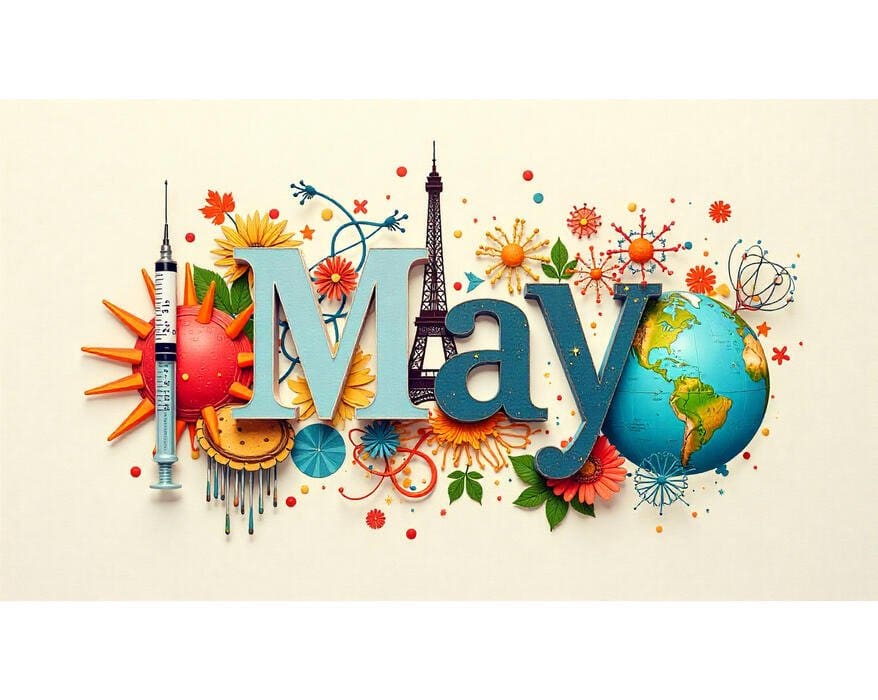
May has witnessed pivotal moments in science and global history, from medical revolutions to international treaties that have shaped our future. The month is marked by stories of innovation, diplomacy, and discovery, each event leaving behind a legacy that continues to influence the world today. In this article, we explore the historic events of May, tracing moments that redefined medicine, technology, and international cooperation.
May 6, 1889
The Eiffel Tower Officially Opened at the Universal Exposition

On this day, the Eiffel Tower was officially opened to the public during the Universal Exposition in Paris. Originally constructed as a temporary exhibit, the iron tower designed by Gustave Eiffel became one of the most recognizable symbols of modern engineering. Standing over 300 meters tall, it was the tallest structure in the world at the time.
Though critics initially dismissed it as an eyesore, the Eiffel Tower represented the triumph of industrial design and the possibilities of iron construction. Its success went beyond architecture—it inspired future projects in civil engineering and became a global symbol of human ingenuity. Today, it remains both a scientific landmark and a cultural icon.
May 7, 1952
Integrated Circuit Concept Published
Geoffrey W.A. Dummer, a British engineer, first presented the concept of the integrated circuit, the foundation of modern electronics. His proposal suggested building electronic components—resistors, capacitors, and transistors—into a single block of material. While the technology to realize his vision did not yet exist, the idea laid the groundwork for the microchip revolution.
Decades later, integrated circuits transformed computing, enabling smaller, faster, and more powerful machines. From smartphones to spacecraft, nearly every modern device relies on this innovation. Dummer’s foresight marked a defining step in the digital age, one that reshaped how societies work, communicate, and create.
May 11, 1995
Nuclear Non-Proliferation Treaty Extended
In New York City, representatives from more than 170 countries agreed to extend the Nuclear Non-Proliferation Treaty (NPT) indefinitely and without conditions. The treaty, first signed in 1968, sought to prevent the spread of nuclear weapons while promoting peaceful uses of nuclear technology.
The 1995 decision strengthened global efforts to control nuclear weapons at the end of the Cold War. By reaffirming the NPT’s principles, nations emphasized diplomacy, cooperation, and the shared responsibility of maintaining international security. The event remains one of the most significant milestones in nuclear arms control.
May 14, 1796
Edward Jenner Administers the First Smallpox Vaccination
On this day, Edward Jenner carried out the first successful vaccination against smallpox. He used material from cowpox lesions to protect a young boy against smallpox infection, proving the concept of immunization. Jenner’s work introduced a safe, systematic way to prevent one of the deadliest diseases in human history.

The smallpox vaccine revolutionized medicine and laid the foundation for modern immunology. Over the following centuries, vaccination campaigns built upon Jenner’s discovery ultimately led to the eradication of smallpox in 1980. His experiment remains one of the most celebrated moments in medical history, saving countless lives worldwide. And of course, it is one of the major historic events of May.
May 17, 2004
Stockholm Convention on Persistent Organic Pollutants Enters into Force
The Stockholm Convention, an international treaty aimed at restricting the production and use of harmful chemicals such as DDT, polychlorinated biphenyls (PCBs), and dioxins, came into effect. The agreement represented a global commitment to protecting human health and the environment from long-lived pollutants. Thus, this is marked as one of the major historic events of May.
The treaty recognized that certain chemicals persist in the environment, accumulate in living organisms, and pose risks across generations. By uniting countries under a common framework, the Stockholm Convention highlighted how international cooperation could address environmental challenges. It remains a cornerstone of global chemical safety and sustainability efforts.
May 20, 1927
Charles Lindbergh Completes First Solo Transatlantic Flight
On May 20, 1927, aviator Charles Lindbergh achieved a milestone that would forever alter the history of flight. Piloting the Spirit of St. Louis, Lindbergh departed from Roosevelt Field in New York and embarked on a daring nonstop journey to Paris, covering over 3,600 miles alone in 33 hours and 30 minutes. Facing fatigue, navigational challenges, and unpredictable weather, Lindbergh relied on skill, courage, and ingenuity to guide his aircraft across the Atlantic Ocean.
This flight was not merely a personal triumph—it marked a pivotal moment in aviation history. Lindbergh’s success demonstrated that long-distance air travel was feasible, paving the way for commercial aviation and international air routes. His achievement inspired engineers and pilots worldwide, fueling innovations in aircraft design, navigation systems, and aerodynamics.
Beyond its technological significance, the flight captivated global imagination. Newspapers hailed Lindbergh as a symbol of human perseverance and ingenuity, and his journey became a cultural touchstone, representing the daring spirit of the 20th century. From advancing aviation safety to shrinking the world metaphorically and literally, Lindbergh’s solo transatlantic flight remains one of May’s most iconic historical events, exemplifying how a single moment of bold ambition can redefine what humanity believes is possible.
Conclusion
From Jenner’s pioneering vaccination to the Eiffel Tower’s debut and the birth of the integrated circuit, the historic events of May reveal how science, medicine, and diplomacy intertwine to shape our collective future. These milestones demonstrate that progress is built on both bold experiments and shared agreements, reminding us of humanity’s constant drive toward innovation and safety.
References
- World Health Organization. (n.d.). A brief history of vaccination. Retrieved September 28, 2025, from https://www.who.int/news-room/spotlight/history-of-vaccination/a-brief-history-of-vaccination
- Stockholm Convention Secretariat. (n.d.). Overview of the Stockholm Convention. Retrieved September 28, 2025, from https://www.pops.int/TheConvention/Overview/tabid/3351/Default.aspx
- Fischer, D. (1997). History of the International Atomic Energy Agency: The first forty years (STI/PUB/1032). International Atomic Energy Agency. Retrieved September 28, 2025, from https://www-pub.iaea.org/MTCD/Publications/PDF/Pub1032_web.pd
Additionally, to stay updated with the latest developments in STEM research, visit ENTECH Online. Basically, this is our digital magazine for science, technology, engineering, and mathematics. Furthermore, at ENTECH Online, you’ll find a wealth of information.
- Author
- Latest Posts

I am currently pursuing Masters degree in Chemistry from the University of Lucknow, and I hold a keen interest in both the subject and its broader applications. With a particular fascination for physical and organic chemistry, my academic path is complemented by a passion for science communication and writing.
I am also actively involved in extracurricular activities, especially public speaking, and debates, where I learned to think clearly and communicate effectively. These experiences have been instrumental in developing my confidence, critical reasoning, and a sense of responsibility toward effective knowledge-sharing.
My skill set includes research writing and editing, and of course, a constant zeal to learn more from everybody. Alongside academics, I enjoy reading poetry and history. My hobbies include singing and gardening.
I have participated in platforms that support women in science, such as IUPAC’s Global Women’s Breakfast. These engagements have helped shape my perspective and strengthened my resolve to contribute positively wherever possible.


