The AI Backpack uses deep learning and YOLO object detection to help visually impaired individuals navigate streets safely with real-time voice alerts.
AI Backpack Becomes Digital Eyes for Visually Impaired
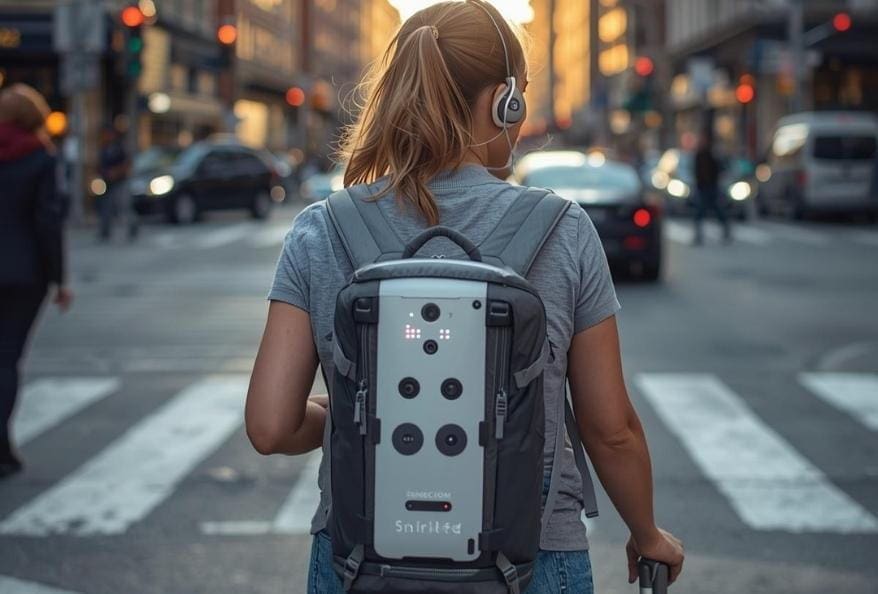
A revolutionary AI Backpack is transforming mobility for visually impaired individuals. Busy streets, moving vehicles, and crowded sidewalks often present serious risks. However, researchers have introduced a wearable system that functions like digital eyes.
The lightweight backpack includes a spatial AI camera that captures real-time images. Unlike traditional assistive tools that detect only simple obstacles, this system identifies pedestrians, vehicles, bicycles, and traffic lights. As a result, users receive detailed environmental awareness.
At first, the camera captures a wide-angle street view. After that, an embedded processor analyzes the footage instantly. Because the system uses deep learning algorithms, it can accurately distinguish between objects such as trees, signboards, and people.
How the AI Backpack Detects Objects in Real Time
YOLO Model Powers the AI Backpack
The technology behind the AI Backpack relies on YOLO (You Only Look Once), a fast and accurate object detection framework created by Joseph Redmon.
In fact, YOLO processes images in milliseconds. This speed is crucial because visually impaired individuals must be alerted immediately about approaching hazards. At the same time, the backpack uses depth-sensing technology to calculate how far away objects are. Consequently, it not only detects obstacles but also measures distance precisely.
Real-Time Voice Alerts Enhance Safety
Instead of displaying visual data, the AI Backpack delivers short and clear voice alerts. For example, it may announce “Car approaching” or “Traffic light red.” Meanwhile, Bluetooth headphones provide discreet guidance.
Although earlier navigation tools were often slow or limited, this system works in real time. Therefore, users can move more confidently through complex environments. By comparison, traditional canes primarily detect objects at ground level.
Research Results Show Strong Accuracy
The wearable system was tested in parks and busy urban streets. According to research published in Electronics, the AI demonstrated high object detection accuracy even in dynamic surroundings.
Moreover, researchers plan to make future versions smaller and more energy-efficient. Eventually, the technology could evolve into compact smart glasses. With continuous development, wearable AI navigation may soon become mainstream.
Why the AI Backpack Matters
The AI Backpack represents a major advancement in assistive innovation. Previously, visually impaired individuals depended largely on canes or guide dogs. Now, artificial intelligence provides enhanced situational awareness.
Furthermore, this development highlights the real-world impact of deep learning and computer vision. As technology progresses, similar wearable systems could support independent mobility in cities worldwide.
Future Improvements and Real-World Applications of AI Backpack
While the current AI Backpack already delivers impressive results, researchers are actively exploring further enhancements. For instance, future versions may integrate GPS tracking to provide turn-by-turn navigation in unfamiliar areas. In addition, cloud connectivity could allow real-time updates and improved object recognition accuracy over time.
Moreover, the AI Backpack could integrate with smart city infrastructure. Traffic systems might communicate directly with wearable devices to provide safer crossing alerts. As battery technology improves, the device may become lighter and last longer throughout the day. Ultimately, these advancements will make intelligent navigation more affordable, accessible, and widely adopted across communities worldwide.
Final Thoughts on AI Backpack Innovation
In summary, the AI Backpack combines hardware and software into one intelligent wearable device. Not only does it improve safety, but it also restores independence and confidence.
Above all, this breakthrough signals a future where navigation technology becomes more inclusive. As research continues, digital vision systems may transform daily mobility for millions of visually impaired individuals.
Additionally, to stay updated with the latest developments in STEM research, visit ENTECH Online.
Reference
Salman Shah, S., Imran, A., Saad-Ur-Rehman, Arif, A., Khan, K., Arsalan, M., Manzoor, S., & Sirewal, G. J. (2026). Vision-Based Smart Wearable Assistive Navigation System Using Deep Learning for Visually Impaired People. Automation, 7(2), 41. https://doi.org/10.3390/automation7020041
- Author
- Latest Posts

Kottauppari Venkat Raghava
I am a technology-driven IT graduate with a strong passion for science and innovation. I am fascinated by how innovations like artificial intelligence, robotics, and emerging technologies are shaping our world. I specialize in analyzing complex scientific and technological research and presenting it in a clear, accessible way. My goal is to make science and technology understandable and engaging for students, tech enthusiasts, and professionals alike. By breaking down advanced concepts into simple, insightful narratives, I strive to inspire curiosity, learning, and innovation, helping readers stay informed about the breakthroughs that are shaping the future.