Learn effective Patient Counseling and Communication Skills to improve patient understanding, trust, and treatment adherence.
The Importance of Patient Counseling and Communication Skills in Modern Healthcare
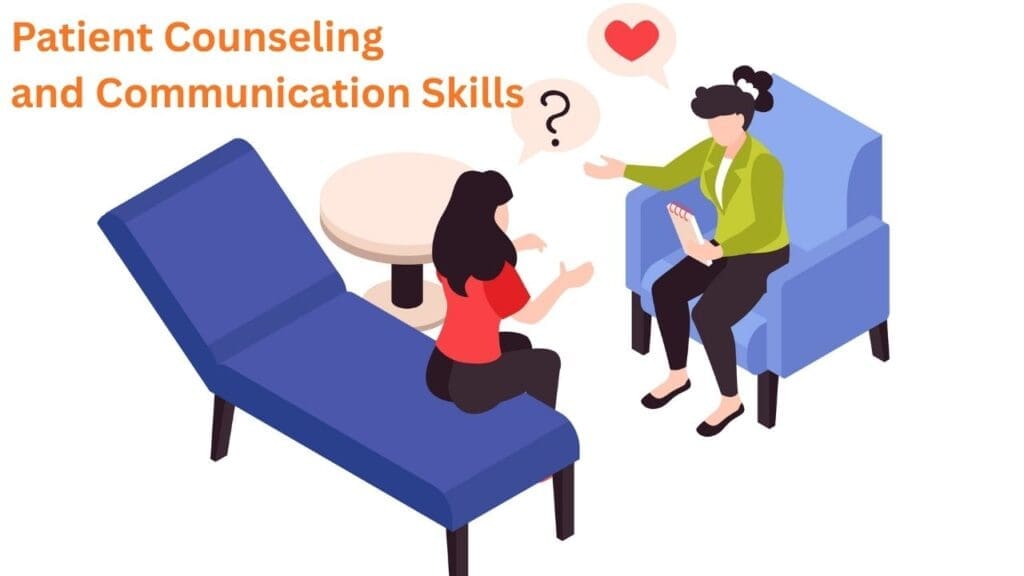
Pharmacists do more than dispense medication—they are healthcare leaders. Every day, they interact with patients through Patient Counseling and Communication Skills, a core component of modern pharmacy practice. Effective counseling can save lives by ensuring patients understand and take their medications correctly, highlighting the importance of strong communication skills in promoting safe and effective treatment
Key Takeaways
- Active Listening: Focus fully on the patient to understand their concerns without interruption.
- Clear Language: Use simple, non-technical words to explain medical information.
- Empathy: Show understanding and compassion toward the patient’s feelings and situation.
- Nonverbal Communication: Maintain eye contact and positive body language to build trust.
- Feedback and Clarification: Encourage questions to confirm the patient understands the instructions.
Why Communication Matters in Medicine
At the present time, healthcare is very complex. Patients often feel overwhelmed by medical jargon. As a result, they may forget instructions. A pharmacist must simplify this information. Prior to giving a drug, you must listen. You need to hear the patient’s concerns. This builds trust between you and them.
All things considered, trust leads to better health outcomes. If a patient trusts you, they follow advice. To put it another way, communication is therapy. It is just as important as the medicine itself. While it may be true that science is hard, kindness is easy.
The Basic Steps of a Counseling Session
To enumerate, a good session has several phases. At first, you must greet the patient warmly. Use their name if possible. After that, verify their identity for safety. Then, ask what the doctor told them. This is an open-ended question. It lets the patient speak freely.
With this in mind, follow these steps:
- Identify the medication name.
- Explain the purpose of the drug.
- Describe the correct dosage schedule.
- Mention common side effects.
- Discuss how to store the medicine.
To illustrate, take the case of high blood pressure. The patient must take the pill every morning. If they miss a dose, they need a plan. So as to help, you provide written guides. What’s more, you offer a pill organizer.
Mastering Verbal and Non-Verbal Skills

Communication is not just speaking. It involves your body language. As a matter of fact, actions speak loudly. Stand tall and maintain eye contact. This shows you are attentive. Avoid crossing your arms at this point. That can look defensive or bored.
The Power of Active Listening
To be sure, you must be an active listener. This means you do not interrupt. Wait for the patient to finish their thought. After that, repeat back what you heard. To rephrase it, confirm your understanding. This prevents errors in medication use.
Another key point is your tone of voice. Speak clearly and at a moderate pace. Do not rush the conversation. Being that patients are often ill, they need patience. Provided that you stay calm, they will stay calm too.
Overcoming Barriers to Communication
Many things can block a good talk. To list, noise in the pharmacy is a big one. Privacy is also a major concern. At length, patients may feel shy about private issues. To that end, use a private counseling area. This makes the patient feel secure.
Language and Literacy Challenges
At this instant, many patients speak different languages. You might need a translator or apps. To put it differently, use pictures to show instructions. Analogous to a map, visuals guide the user.
Low health literacy is common. This means people struggle to read labels. With this purpose in mind, use simple words. Instead of “hypertension,” say “high blood pressure.” Instead of “analgesic,” say “pain reliever.” Summing up, keep it simple.
Special Populations in Pharmacy
Different groups need different approaches. Take the case of elderly patients. They may have hearing loss. Speak louder but do not shout. They might take many pills at once. This is called polypharmacy. As an illustration, help them create a daily chart.
Balanced against that, consider pediatric patients. You often talk to the parents instead. However, involve the child too. Use props to show how to use an inhaler. So that they feel brave, give them a sticker. With attention to detail, you help the whole family.
Patient Counseling and Communication Skills: Opportunities
Are you curious about STEM? A pharmacy career is a great choice. You study chemistry and biology. At the same time, you study psychology. This helps you understand human behavior. To this end, you become a drug expert.
So far, the demand for pharmacists is high. You can work in hospitals or clinics. You can even work in research. Prior to this, you need a Doctor of Pharmacy degree. This takes about six to eight years. While this may be true, the reward is great. You help people get healthy every day.
The Future of Pharmacy Communication
In due time, technology will change things. We use telepharmacy now. This means counseling over a video call. This is helpful for people in rural areas. At this time, we use digital health records. These show a patient’s full medical history.
In spite of tech, the human touch remains. A machine cannot show empathy. A computer cannot see a patient’s tears. All in all, your humanity is your best tool. With this intention, keep improving your skills.
Conclusion
Pharmacy is about people. Use short sentences when you teach. Use active voice to be clear. To repeat, clear talk is safe talk. At last, you will be a great pharmacist.
FAQs
What is patient counseling?
Patient counseling is the process of providing clear information and guidance to help patients understand and manage their health conditions.
Why are communication skills important in healthcare?
Effective communication builds trust, improves treatment adherence, and enhances patient outcomes.
How can healthcare professionals improve patient counseling skills?
They can improve by practicing active listening, using simple language, and showing empathy during interactions.
Additionally, to stay updated with the latest developments in STEM research, visit ENTECH Online
Reference
Gülpinar, G., & Özçeli̇Kay, G. (2020). Development of a structured communication and Counseling skills course for pharmacy students: a simulation-based approach. Turkish Journal of Pharmaceutical Sciences, 18(2), 176–184. https://doi.org/10.4274/tjps.galenos.2020.93709
Disclaimer: We do not intend this article/blog post to provide professional, technical, or medical advice. Therefore, please consult a healthcare professional before making any changes to your diet or lifestyle. In fact, we use AI-generated images for illustration and decoration. Their accuracy, quality, and appropriateness can differ. So, users should avoid making decisions or assumptions based only on the text and images.
- Author
- Latest Posts
I completed my Master of Science from the University of Allahabad in 2017 with a strong academic background in life sciences and chemistry. My specialization included Molecular Biology, Microbiology, Genetics, Plant Breeding, Phycology, Paleobotany, and Bioinformatics, along with Organic Chemistry, Inorganic Chemistry, and Physical Chemistry. This multidisciplinary training provided me with a comprehensive understanding of biological systems and analytical scientific approaches.
After completing my postgraduate studies, I gained valuable professional experience in both the education and social development sectors. I worked at A.M. Oxford Public School, where I was actively involved in guiding students toward academic excellence. In this role, I focused on creating an engaging learning environment, encouraging critical thinking, and nurturing students’ curiosity for scientific learning. My experience as an educator strengthened my communication, mentoring, and classroom management skills.
In addition to my teaching experience, I worked with Jeevan Jagriti Foundation, where I contributed to community-based initiatives aimed at improving educational access and awareness among underprivileged sections of society. Through this work, I participated in programs designed to support social development and promote the value of education in marginalized communities.
These professional experiences helped me develop strong interpersonal, leadership, and organizational skills while reinforcing my commitment to education and community service.