A Dual-Arm Robot powered by sensor fusion and advanced SLAM technology achieves accurate navigation and real-time arm coordination in complex environments.
Dual-Arm Robot Redefines Smart Robot Navigation
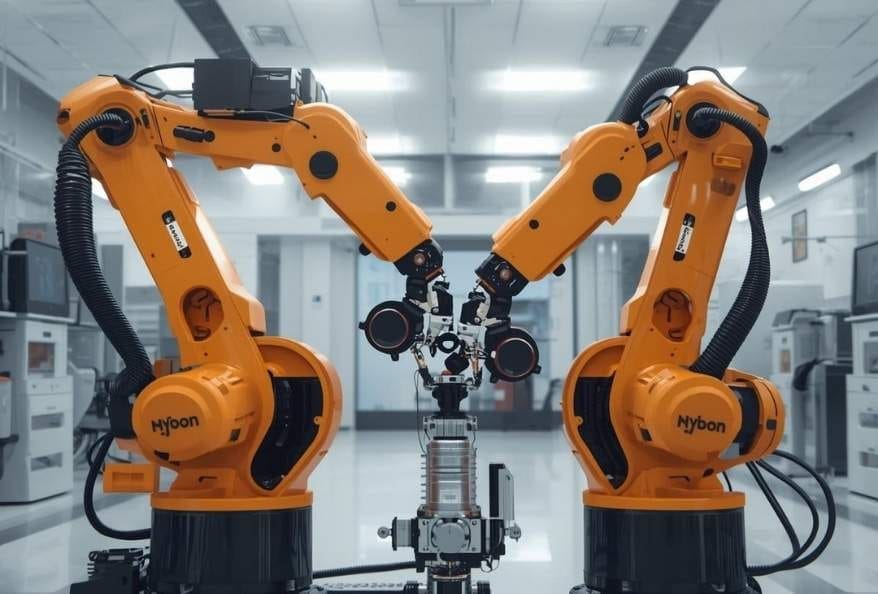
Robotics is advancing faster than ever. While self-driving vehicles often dominate technology headlines, a Dual-Arm Robot may represent a more transformative breakthrough for modern automation. Unlike traditional robots that either move or manipulate objects, this system performs both actions simultaneously with remarkable precision.
As industries demand smarter and more adaptable machines, innovations in smart robot navigation are becoming essential. Consequently, researchers have developed a new approach that allows robots to move efficiently while coordinating two robotic arms in real time.
What Makes the Dual-Arm Robot Unique?
A Dual-Arm Robot combines a mobile base with two fully functional robotic arms. In other words, it can navigate complex environments while performing manipulation tasks at the same time.
However, this capability introduces significant engineering challenges. The robot must:
- Map its surroundings accurately
- Track its own position continuously
- Control two arms simultaneously
- Maintain balance while moving
Therefore, researchers introduced a more advanced system built on sensor fusion and improved SLAM algorithms.
Sensor Fusion Enhances Smart Robot Navigation
Traditional mobile robots rely on SLAM (Simultaneous Localization and Mapping). Although SLAM helps robots build virtual maps and determine their location, it often struggles in cluttered, dark, or dynamic environments.
For example, reflective surfaces, moving objects, or poor lighting conditions can confuse single-sensor systems. As a result, navigation errors may occur.
To overcome this limitation, researchers combined multiple sensors:
- LiDAR sensors, which measure distances using laser pulses
- IMU sensors, which track motion, tilt, and acceleration
By merging data from both sources, the Dual-Arm Robot gains a more reliable understanding of its environment. In comparison, relying on only one sensor is like trying to navigate with limited vision. Sensor fusion ensures higher accuracy and stability.
Advanced SLAM for Precise Trajectory Generation
In addition to sensor fusion, the research focuses on trajectory generation. This refers to the exact path the robot follows to reach its destination efficiently.
First, the robot scans its surroundings using high-speed LiDAR. Next, the system filters out sensor noise through advanced algorithms. After that, it calculates the most efficient path while simultaneously coordinating both robotic arms.
Meanwhile, the arms must remain synchronized with the movement of the mobile base. To illustrate, imagine a dancer moving across a stage while maintaining perfect arm balance. Similarly, the Dual-Arm Robot ensures smooth coordination between mobility and manipulation.
As a result, navigation becomes more precise, efficient, and stable—even in tight or dynamic spaces.
Real-World Testing of Dual-Arm Robot
The researchers tested the Dual-Arm Robot in challenging simulated environments. These tests included narrow passages, sharp turns, and obstacle-filled rooms.
The results were highly promising:
- Accurate real-time mapping
- Efficient path optimization
- Stable arm coordination
- Improved handling of tight spaces
All things considered, the sensor fusion approach outperformed traditional single-sensor SLAM methods. Moreover, the system demonstrated strong adaptability in complex scenarios.
Therefore, this advancement marks a significant step toward truly autonomous robotic assistants.
Applications Across Multiple Industries
The potential applications of the Dual-Arm Robot extend across several sectors. For instance:
- Healthcare facilities could use it for logistics and assistance.
- Disaster response teams could deploy it in hazardous environments.
- Manufacturing industries could enhance automation precision.
- Space missions could utilize it for construction and maintenance tasks.
Because the robot integrates movement and manipulation seamlessly, it offers greater flexibility than conventional robotic systems.
The Mathematics Behind the Motion
Behind every movement of the Dual-Arm Robot lies advanced mathematical modeling. Engineers use kinematics and motion planning equations to predict how each joint should move.
In essence, physical motion is translated into digital algorithms. Provided that these equations remain accurate, the robot can maintain balance and execute complex actions in real time.
Thus, this innovation demonstrates how mathematics, software, and hardware work together to create intelligent machines.
The Future of Dual-Arm Robot Technology
In conclusion, the Dual-Arm Robot represents a major advancement in smart robot navigation. By combining sensor fusion, advanced SLAM, and coordinated arm control, it overcomes many traditional limitations of mobile robotics.
As research continues, such systems may soon operate alongside humans in hospitals, factories, and even space missions. Ultimately, this breakthrough signals a future where robots not only move intelligently but also interact with the world more naturally and efficiently.
Additionally, to stay updated with the latest developments in STEM research, visit ENTECH Online.
Reference
- Kolla, N. K., & Vundavilli, P. R. (2026). A Novel SLAM Approach for Trajectory Generation of a Dual-Arm Mobile Robot (DAMR) Using Sensor Fusion. Automation, 7(2), 42. https://doi.org/10.3390/automation7020042
- Author
- Latest Posts

Kottauppari Venkat Raghava
I am a technology-driven IT graduate with a strong passion for science and innovation. I am fascinated by how innovations like artificial intelligence, robotics, and emerging technologies are shaping our world. I specialize in analyzing complex scientific and technological research and presenting it in a clear, accessible way. My goal is to make science and technology understandable and engaging for students, tech enthusiasts, and professionals alike. By breaking down advanced concepts into simple, insightful narratives, I strive to inspire curiosity, learning, and innovation, helping readers stay informed about the breakthroughs that are shaping the future.