Pre-Inca Guano Farming reveals how ancient Peruvians used seabird fertilizer to boost maize crops and support early societies.
Pre-Inca Guano Farming: How Seabirds Shaped Ancient Peru
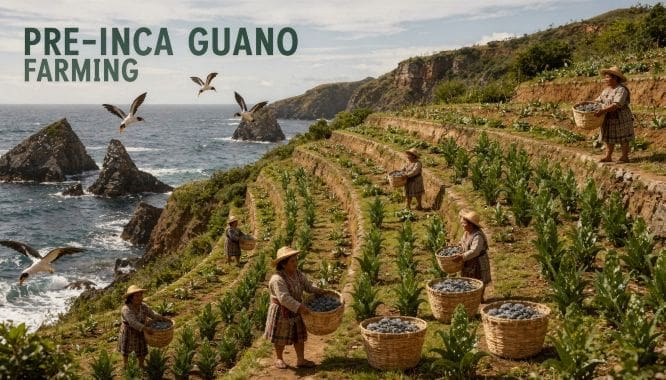
Did you know bird poop once helped an ancient society grow? It’s true! A new study shows that seabird guano (that’s bird poop) helped farmers in Peru ages ago. Scientists now describe this early practice as Pre-Inca Guano Farming. This discovery connects science and history in a surprising way. It also shows how ancient communities used natural resources wisely.
What’s more, it highlights exciting career paths in science, archaeology, and environmental studies for students interested in STEM. Let’s explore the research and what it means for the future.
The Role of Pre-Inca Guano Farming in Ancient Agriculture
While it may seem unusual, seabird guano is a potent fertilizer that significantly boosted maize production in Peru’s Chincha Valley. To investigate this, researchers analyzed 35 ancient maize cobs and 11 seabird remains using isotopic analysis. By examining the chemical elements within these materials, scientists successfully detected the specific fingerprints of Pre-Inca Guano Farming used centuries ago.
Specifically, measurements of carbon, nitrogen, and sulfur isotopes revealed an elevated nitrogen signal in the maize cobs. This chemical signature is a definitive marker of Pre-Inca Guano Farming, proving that Indigenous communities utilized marine fertilizers as early as 1250 CE. Ultimately, this evidence confirms that these ancient farmers possessed a sophisticated understanding of natural nutrients long before the rise of the Inca Empire.
Why Is This Pre-Inca Guano Farming Discovery Important?
This study changes how historians understand agriculture in ancient Peru. It shows that coastal people were not farming with soil alone. Instead, they improved their harvests by using seabird droppings as fertilizer. This innovative method is now recognized as Pre-Inca Guano Farming. By adding guano to the soil, farmers increased nutrients and crop productivity. As a result, maize harvests likely became larger and more reliable. Better farming methods supported stronger communities.
The research also connects with historical records and artwork from the region. These sources show that seabirds were important to the culture and economy. This means farming practices were closely tied to the surrounding environment. Pre-Inca Guano Farming may have helped societies expand and grow stronger. More food allowed communities to trade, build, and organize politically. Cultural traditions may also have protected seabird colonies.
The Science Behind the Study of Pre-Inca Guano Farming
To uncover the secrets of these ancient fields, researchers combined archaeology with chemistry. Initially, they collected ancient maize samples and seabird bones spanning from 200 BCE to 1825 CE. By analyzing stable isotopes, they detected clear chemical signatures of marine fertilizers within the maize. Furthermore, the team utilized radiocarbon dating to precisely confirm the age of each sample.
The study specifically found that nitrogen levels in the maize were significantly higher than normal, providing a clear signal that Pre-Inca Guano Farming was the primary cultivation method. Although sulfur isotopes showed less variation—suggesting other environmental factors were at play—guano fertilization remains the most robust explanation for the nitrogen boost. Consequently, this scientific evidence confirms the sophisticated nature of ancient Peruvian agriculture.
What Does This Mean for Teens Interested in STEM and Pre-Inca Guano Farming?
All things considered, this research shines a light on careers in archaeology, chemistry, and environmental science. As an illustration, archaeologists work to uncover and interpret ancient human activities. Chemists analyze materials to solve scientific puzzles. Environmental scientists study ecosystems and natural resources, just like researchers studying Pre-Inca Guano Farming and the ancient use of seabirds for agriculture.
Students curious about STEM can pursue studies in:
- Biogeochemistry: Exploring chemical cycles in nature
- Archaeological science: Using scientific tools to study the past, including practices like Pre-Inca Guano Farming
- Ecological management: Balancing human needs with nature
This study also shows how teamwork among experts advances knowledge. It involves fieldwork, lab analysis, and historical research all at once. Such collaboration helps scientists better understand systems like Pre-Inca Guano Farming and other ancient innovations.
How Can You Learn More?
If you want to explore STEM topics and career paths, websites like entechonline.com STEM Education provide great resources. They offer helpful guides on how to prepare for jobs in science and engineering.
Furthermore, exploring careers in environmental science can show you how to solve modern environmental challenges by learning from nature, just like the ancient farmers in Peru.
Conclusion
n sum, this research demonstrates that ancient people were experts at Pre-Inca Guano Farming, using every resource available to them. This innovation helped them grow crops better and build successful societies before the Incas, proving that technological progress isn’t just a modern phenomenon. It shows how people cleverly adapted to their environment, combining nature and knowledge to thrive in a challenging landscape.
Additionally, to stay updated with the latest developments in STEM research, visit ENTECH Online.
Reference:
- Bongers, J. L., Milton, E. B., Osborn, J., Drucker, D. G., Robinson, J. R., & Scaffidi, B. K. (2026). Seabirds shaped the expansion of pre-Inca society in Peru. PLoS One, 21(2), e0341263. https://doi.org/10.1371/journal.pone.0341263
- Author
- Latest Posts

A Master’s-qualified Zoologist with a focus on Limnology, I combine hands-on laboratory experience with a sophisticated background in science communication. My career is defined by an interdisciplinary approach to the life sciences, merging technical research skills with a proven ability to teach and engage diverse audiences. I am committed to lifelong learning and the creative dissemination of medical and biological research, ensuring scientific literacy and inspiration remain at the forefront of the field.