Beyond the Obvious: Your Strategic Guide to Finding the Perfect STEM Career
Why Most STEM Career Advice Fails—and How to Actually Find Your Dream Job!

Key Takeaway: STEM careers are growing fast. The right strategy can help you find a career that fits your unique skills and passions.
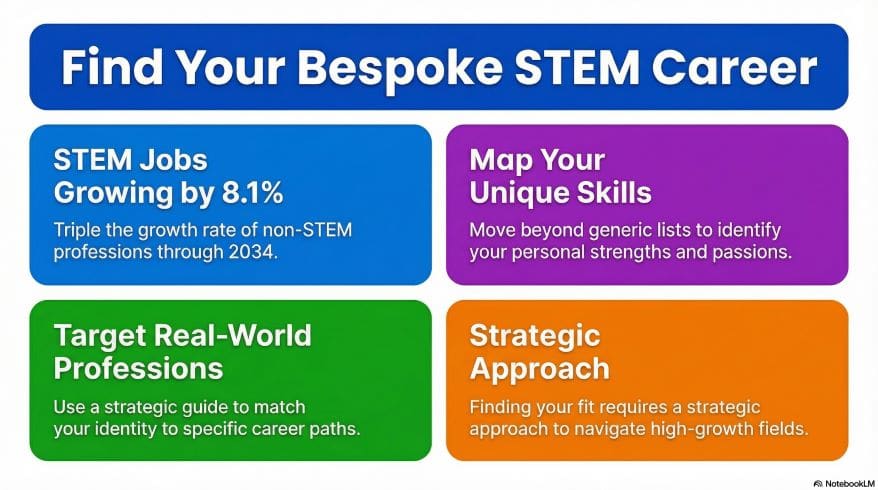
Feeling overwhelmed by all the possible STEM career options? You are not alone. At first, it can seem like there are just too many choices. Above all, this article is your strategic guide to finding a STEM career that fits you—not just another job from a list. The goal is to match your unique skills and passions to a real-world profession. To point out the opportunity, STEM employment is projected to grow 8.1% from 2024 to 2034, compared to only 2.7% for non-STEM jobs (U.S. Bureau of Labor Statistics, 2025).
The Manual, Confusing Way to Explore STEM Careers
All in all, most students try to figure out STEM careers the hard way. This method relies on disconnected sources and leads to confusion and missed opportunities. At this point, let’s see why this approach is so tough.
Step 1: Guessing Your Interests with Generic Quizzes
At first, students try to understand their skills and interests using scattered online tools. Take the case of a student who takes a “color personality quiz” on one site. After that, they read a “top 10 jobs for introverts” listicle somewhere else. Then again, they try to connect those vague results to their chemistry class. With this in mind, they end up feeling even more confused.
Common generic tools students use:
- Personality quizzes with random results
- Listicles about “best jobs” for certain traits
- Career suggestion generators with no STEM focus
- Random YouTube advice videos
Step 2: Trying to Understand Vague Corporate Job Titles
To explain, researching careers often means reading dry, corporate job descriptions. For example, “Data Analyst” or “Biomedical Engineer” sound impressive. At the same time, job boards list software skills like SQL, Python, or Excel. In effect, they miss the creative problem-solving and storytelling involved in these roles.
What job boards show vs. what they miss:
- List of required software skills
- Years of experience needed
- Generic job duties
- Miss the creative and human side of the job
Step 3: Searching for Real People Behind the Professions
With attention to role models, it’s hard to find relatable professionals in STEM. While it may be true that famous people like Elon Musk are everywhere, their paths feel out of reach. To illustrate, a student searches for a “real” chemical engineer on social media. All of a sudden, they find only technical jargon or no useful career journey info.
Where students search and why it falls short:
- Social media: too technical or not personal
- School career days: limited variety
- YouTube: highlights only the most famous
- Forums: not always trustworthy
A Smarter Path: Discovering Your Future with ENTECH Online
At this instant, ENTECH Online offers a direct solution to these challenges. It is a dedicated platform that gives teens a clear, engaging, and personalized roadmap in STEM. With this intention, let’s see how its features solve the problems above.
Connect Your Passions to a Profession
With attention to your interests, ENTECH Online makes the connection between school subjects and real careers clear and exciting.
From Gaming to Game Development
To enumerate, the “Real-world application showcases” feature takes your love for video games and shows you real career paths.
Gaming-related STEM career paths:
- Software engineer for game studios
- Graphic designer for game art
- UX researcher for player experience
- Sound designer for game audio
From Science Class to Saving the Planet
In similar fashion, “In-depth STEM content” connects biology or chemistry class to careers in sustainability and conservation. To learn more, check out Top 15 Lucrative Careers in Science Field.
See the People Behind the Job Titles
To put it another way, ENTECH Online closes the gap between abstract job titles and real-world careers. The “STEM professional spotlights” feature is a great example. For instance, an interview with a 28-year-old robotics engineer shows their college major, first job, and daily tasks. As a result, this makes the career feel achievable.
What spotlights reveal:
- College major and why they chose it
- First job and how they got it
- What a typical day looks like
- Surprising challenges and rewards
Get a Clear Roadmap, Not a Vague Description
With this purpose in mind, ENTECH Online provides structured guidance that demystifies career entry steps. The “Comprehensive career guidance” feature breaks down the exact high school classes, college majors, and skills needed for careers like forensic scientist.
Roadmap for a forensic scientist:
- High school: biology, chemistry, math
- College major: forensic science or biology
- Key skills: attention to detail, lab techniques, critical thinking
- Internships: local labs or police departments
High-Impact STEM Fields You Haven’t Considered
At the present time, many exciting STEM careers don’t appear on standard “Top 10” lists. To sum up, here are some unique and forward-thinking options.
The Intersection of Technology and Creativity
To point out, STEM is not just about numbers. Some careers blend technology with creative design.
Architectural and Engineering Management
This role leads creative projects, from designing sustainable buildings to developing new electronics.
What this role involves:
- Leading teams of engineers and designers
- Overseeing project budgets and timelines
- Making decisions on materials and design
- Ensuring projects meet safety and sustainability goals
UX/UI Design
UX/UI design is the “human side” of technology. It focuses on making apps and websites both functional and enjoyable.
What UX/UI designers do:
- Research how people use technology
- Design layouts and color schemes
- Test prototypes with real users
- Work with coders and artists
The Frontier of Biotechnology and Health
In effect, health and life sciences offer more than just doctor or nurse roles.
Genetic Counseling
Genetic counselors help families understand genetic diseases and make informed health decisions. They blend science with empathy and communication.
What genetic counselors do:
- Explain genetic test results to families
- Guide families through tough decisions
- Work with doctors and researchers
- Stay updated on new genetic discoveries
Bioinformatics Specialist
Bioinformatics specialists work at the crossroads of biology, computer science, and data analysis. For example, they analyze genetic data to help develop new medicines. To learn more, visit the National Human Genome Research Institute.
What bioinformatics specialists do:
- Write code to analyze DNA data
- Help doctors find new treatments
- Work with huge data sets
- Collaborate with scientists and engineers
Ready to Find Your Place in the World of STEM?
In conclusion, finding the right STEM career is an active journey of discovery. While it may be true that you can try to piece together information on your own, a dedicated platform gives you a clearer and more inspiring path. Stop the overwhelming search. Begin a focused journey of discovery. Find a STEM career that truly excites you. Explore our expert-written articles, learn from real professionals, and see where your passion can take you.
References
U.S. Bureau of Labor Statistics. (2025, February 6). Numbers, research, and discovery: STEM employment projected to take off! The Economics Daily. https://www.bls.gov/opub/ted/2025/numbers-research-and-discovery-stem-employment-projected-to-take-off.htm
National Human Genome Research Institute. (2026, March 30). Bioinformatics. https://www.genome.gov/
- Author
- Latest Posts

Charudatta Pathak was a student at St. Aloysius High School in Bhusawal, established in 1874, making it one of India’s oldest convent institutions. He earned his bachelor’s degree in mechanical engineering from SSVPS College of Engineering, Dhule in 1995, demonstrating exceptional academic achievement. Thereafter, he launched his career as a CNC programmer in a toolroom. He has utilized FANUC, Deckel, Maho, and Mikron controllers to operate 2-axis and 3-axis machines for the fabrication of jigs, fixtures, dies, and molds. He commenced his career as an academic in 1996, when he assumed the role of lecturer at SSVPS College of Engineering, Dhule. Additionally, he earned his post-graduate degree in CAD/CAM from L. D. College of Engineering, Ahmedabad, in 2000, and then acquired a Ph.D. from COEP in 2011 while concurrently engaged in teaching. Until 2023, he occupied many academic roles, including lecturer, assistant professor, professor, dean, principal, director, and vice chancellor at both public and private universities throughout India. From 2008 to 2010, he served as the project lead in the CAE department of a European multinational firm. During his 28-year professional tenure, he identified a need for dependable books targeted at students in grades 8 to 12, particularly for nascent career planning. He founded ENTECH Digital Magazine, a free monthly publication available on entechonline.com and magzter.com. Teens with a strong interest in Science, Technology, Engineering, and Mathematics (STEM) who aspire to pursue careers in these fields may find ENTECH Digital Magazine beneficial.