The future of aerospace testing is here 6 DOF robotic arm design enables safe and accurate flight simulation.
6 DOF Robotic Arm Design That Transforms Flight Tests
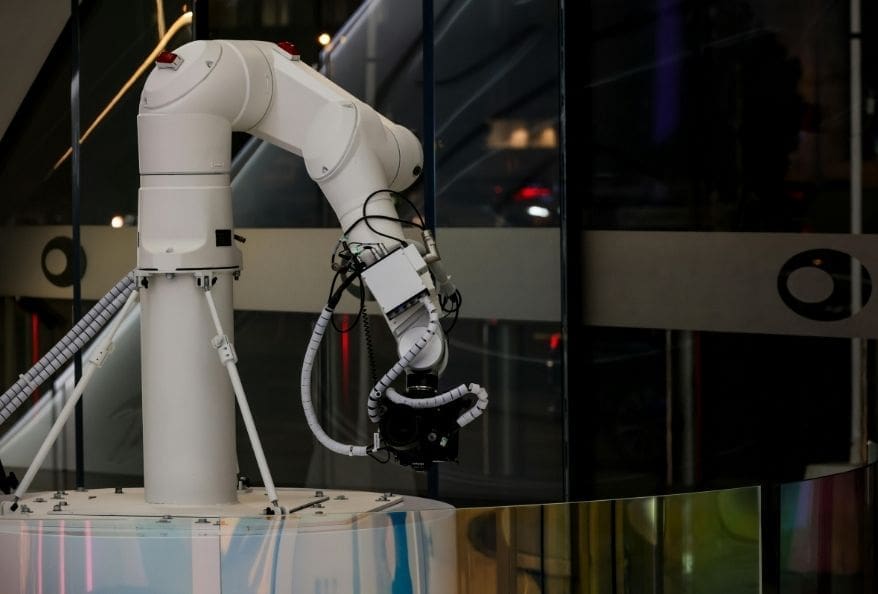
To ensure safety when aircraft release equipment like fuel tanks, engineers use a Captive Trajectory System (CTS) to simulate flight paths. In fact, I found that a specialised 6 DOF robotic arm design called ROBO-S makes this possible by replicating complex movements within a wind tunnel.
This smart mechanical setup allows researchers to accurately predict separation trajectories, preventing dangerous collisions before any real-world flight testing occurs,.
Key Findings:
- The ROBO-S system tracks complex flight paths with six degrees of freedom.
- Engineers used inverse kinematics to tell the robot exactly how to move its joints.
- The prototype was built using 3D printing, making it much cheaper to produce.
- Tests proved that the robot follows experimental data with very high accuracy.
Understanding 6 DOF Robotic Arm Design
When we talk about 6 DOF robotic arm design, we are looking at a machine that can move in six different ways. In simple terms, it can move up and down, left and right, and forward and back, but it can also roll, pitch, and yaw.
This is vital because the air around a fast-moving jet is very messy and unpredictable. I found it fascinating that this specific design allows the arm to act as a “stand-in” for the actual forces a plane feels in the sky.
Advanced Robotic Manipulator Techniques
You might be asking why we need such a complex robotic manipulator in the first place. In reality, testing real planes is incredibly expensive and can also be very dangerous for pilots. Therefore, by using a robot in a wind tunnel, we get:
- A safe way to see how “stores” (like fuel tanks) fall away from a wing.
- A tool that acts like an “analog function generator” for aerodynamic forces.
- A method to test hundreds of flight conditions without ever leaving the ground.
The Core Design Elements of ROBO-S
- I found that the 6-DOF design is what allows this arm to mimic the complex, six-way movements of an object in flight.
- To make sure the arm moves correctly, the team used the DH convention to map out the math for every joint.
- Furthermore, they applied inverse kinematics so the robot knows exactly how to reach specific target positions.
- The robot has a 600 mm reach, which is the perfect size for working inside the tight space of a wind tunnel.
How They Built the ROBO-S Prototype
- The researchers started by creating a digital model using PTC CREO software to plan out every structural detail.
- Next, they ran MATLAB simulations to prove the robot could follow experimental flight paths with high accuracy.
- I was impressed that they used 3D printing to create the physical parts quickly and at a much lower cost.
- To power the movement, they installed stepper motors (NEMA 17 and 23) and connected them to an Arduino Uno controller.
The Real Benefits of This Robotic Testing System
- First, it helps ensure safety by predicting how items like fuel tanks or missiles will fall away from a plane.
- It also saves money because engineers don’t have to fly real, expensive jets just to see if a design works.
- By acting as an analog generator, the wind tunnel and robot work together to simulate real-world air forces.
- Finally, this system provides a transparent framework for other researchers to use, since many similar designs are usually kept secret.
Career Paths
If you are a student, this field is wide open with career opportunities that are truly exciting. I see more and more companies looking for people who understand how to combine coding with physical hardware.
You could find yourself working in aerospace, or even in “smart factories” where these robots do the heavy lifting. Learning how to use software like MATLAB or 3D design tools is the first step toward building the future of flight.
Conclusion on 6 DOF Robotic Arm Design
ROBO-S proves that scientific breakthroughs don’t need million-dollar equipment when using 3D printing and smart math. This 6 DOF robotic arm design improves flight safety by accurately simulating how parts separate from planes.
Future robots will likely use artificial intelligence to monitor their own mechanical health and performance. It is an exciting time as new technology transforms the future of aviation.
Additionally, to stay updated with the latest developments in STEM research, visit ENTECH Online.
Reference
- Sadiq, S., Sohail, M. U., Wasim, M., Ullah, F. K., & Khan, Z. (2026). Design and Verification of 6-DOF Robotic Arm for Captive Trajectory System Applications in Wind Tunnel. Automation, 7(2), 58. https://doi.org/10.3390/automation7020058
- Author
- Latest Posts

Kottauppari Venkat Raghava
I am a technology-driven IT graduate with a strong passion for science and innovation. I am fascinated by how innovations like artificial intelligence, robotics, and emerging technologies are shaping our world. I specialize in analyzing complex scientific and technological research and presenting it in a clear, accessible way. My goal is to make science and technology understandable and engaging for students, tech enthusiasts, and professionals alike. By breaking down advanced concepts into simple, insightful narratives, I strive to inspire curiosity, learning, and innovation, helping readers stay informed about the breakthroughs that are shaping the future.