Many developers use software to aid in the design, development, and testing of software applications. They play a crucial role in the development of computer software and innovative technological solutions.
What is Software Engineering? A Teen-Friendly Guide to Degrees, Jobs, and Real Uses
Estimated reading time: 17 minutes
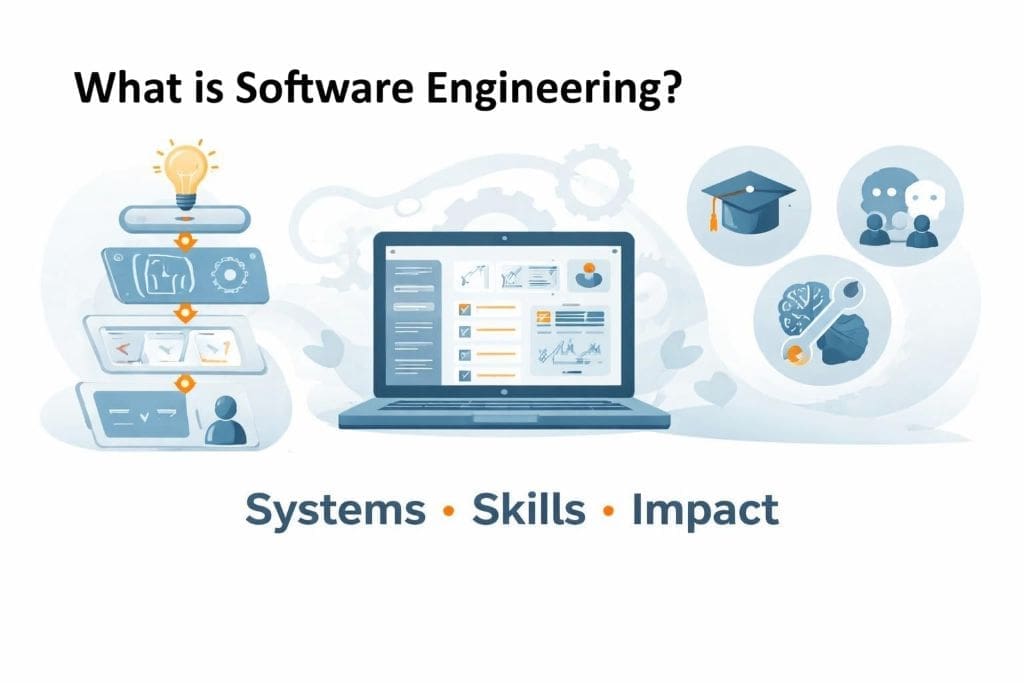
If you ask what is software engineering, I answer with one idea first: systems. Software engineering is not just writing code. It is the disciplined process of planning, building, testing, and improving software so people can use it well. Research also shows that software engineers need both hard and soft skills from the undergraduate level onward (Borges & Gratão de Souza, 2024). That matters for grade 11–12 learners because university choices should match how the field actually works. Employers also expect skills that go beyond coding, including communication and teamwork (Galster et al., 2023), (Wyrich & Montgomery, 2025). For students, this means the field rewards more than technical talent alone.
Software also shapes daily life in obvious ways. It runs apps, websites, and digital services. It supports health, finance, education, and many other sectors. Because many industries now depend on software, future demand for capable graduates remains strong (2022), (Tenbergen et al., 2023). So, if you are choosing subjects or thinking about a degree, this topic matters now. It helps you judge whether software engineering fits your interests, strengths, and study style. It also helps you prepare early.
What readers will learn in this guide (revised on 19 May 2026)
This guide explains software engineering in clear terms. It shows how the work happens in practice. It also explains what a software engineering degree can teach you (Striuk & Semerikov, 2022), (Gupta & Gupta, 2024). I will connect those ideas to real job roles and workplace expectations (Akdur, 2022), (Wyrich & Montgomery, 2025). I will also show which skills students can start building before university (Hynninen et al., 2022), (Borges & Gratão de Souza, 2024). Above all, this guide helps you connect school learning to real software careers. That connection can make your next study choices feel far more concrete.
Key Takeaways: The Core Ideas in Simple Terms
The simplest definition of software engineering
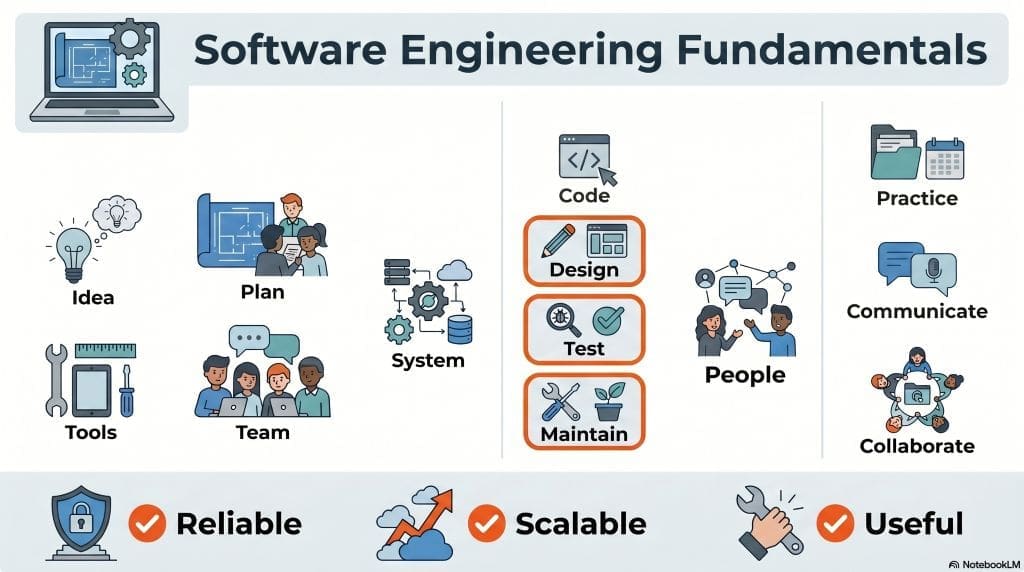
The simplest answer to what is software engineering is this: it is the engineering approach to software creation. It uses planned methods, tools, and teamwork to build software that solves real problems. Unlike casual coding, it aims for systems that are reliable, scalable, and useful. That definition matters because the field sits between theory and practice. It draws on computing ideas, yet it also depends on design choices, testing, and user needs. Students often think the field is only about syntax. The evidence says otherwise. Software engineering is a full process with technical and human parts.
Why software engineering is more than coding
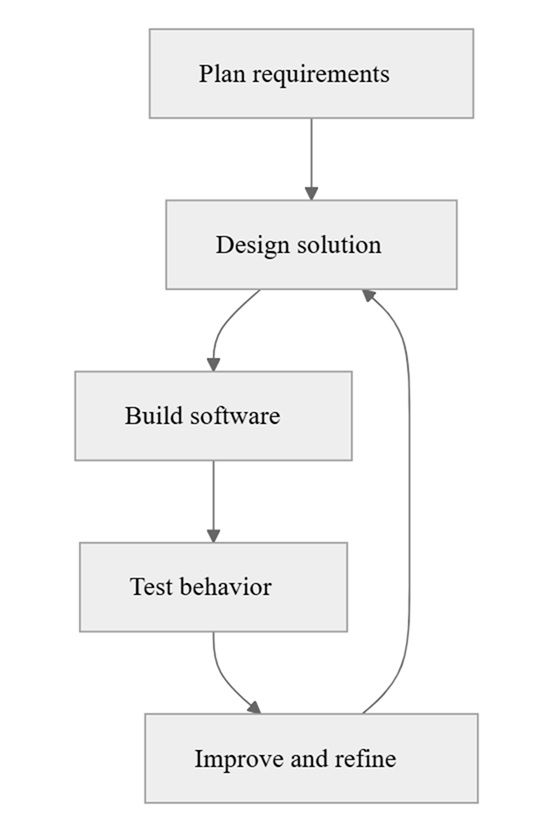
Software engineering is more than coding because the work starts before code exists. Engineers plan requirements, design structures, test behavior, and improve products over time. Studies on education and industry also show that employers value communication, collaboration, adaptability, and problem solving alongside programming (Galster et al., 2023), (Akdur, 2022), (Wyrich & Montgomery, 2025). This means a person can write correct code and still struggle in the job if teamwork fails. It also means university programs should teach both technical and non-technical skills (Borges & Gratão de Souza, 2024). The key lesson is simple: software engineering is a team discipline, not an isolated one. That is why project work matters so much.
What students should remember first
Students should remember three ideas first. Software engineering is about building useful systems. It requires both programming and people skills (Borges & Gratão de Souza, 2024), (Galster et al., 2023). It also rewards steady practice through projects, not passive reading alone (Hynninen et al., 2022). Early-career engineers often recommend soft skills, programming, and practical experience as the most useful preparation (Hynninen et al., 2022). That pattern matters for students deciding how to prepare. If you can code, explain your ideas, and work with others, you already match the direction of the field. The sooner you build those habits, the better your university transition will feel. In that sense, software engineering is very learnable, but it is also demanding.
How Software Engineering Works in Practice
Planning, designing, building, testing, and improving software
Software engineering usually follows a cycle. Teams plan what software should do. They design how it should work. They build it, test it, and improve it after feedback. This cycle helps teams manage complexity and reduce mistakes. It also reflects why software engineering is called an engineering discipline. The work is systematic, not random. Studies on undergraduate teaching show that design-based and milestone-driven learning can help students practice these stages in realistic ways (Gupta & Gupta, 2024), (Striuk & Semerikov, 2022). That matters because software products rarely emerge in one pass. They grow through repeated decisions. In practice, the engineer must balance usefulness, quality, and constraints. That balance is central to the field.
Tools, teamwork, and process in everyday projects
Everyday software projects depend on tools and process. Students often use shared platforms, issue tracking, version control, and collaborative workflows to manage tasks. Research on education shows that project-based learning and gamified support can improve motivation and team productivity (Di Nardo et al., 2024). Other work shows that communication skill is central to project success, especially when teams need feedback and coordination (Galster et al., 2023), (Pilapitiya & Peiris, 2021). Employers also want candidates who fit organizational goals and work well with others (Wyrich & Montgomery, 2025). So, the daily reality of software engineering includes meetings, reviews, task splitting, and learning new tools quickly. It is not only about typing code into a screen. It is about making a group effort function well under changing demands.
How software supports real-world applications
Software engineering matters because software supports real-world systems. It powers digital services, and it also shapes healthcare, finance, education, and robotics, (Daun, 2023). As systems grow more complex and critical, the need for careful engineering rises too (Tenbergen et al., 2023). That is why software engineers must think about reliability, clarity, and user needs. They do not just build features. They help create services people depend on. For teenagers, this connection is useful because it turns an abstract degree into a visible social role. The field helps hospitals manage information, schools deliver learning tools, and businesses run online services. The work is technical, but its impact is human.
What a Software Engineering Degree Can Teach You
Core technical knowledge and programming foundations
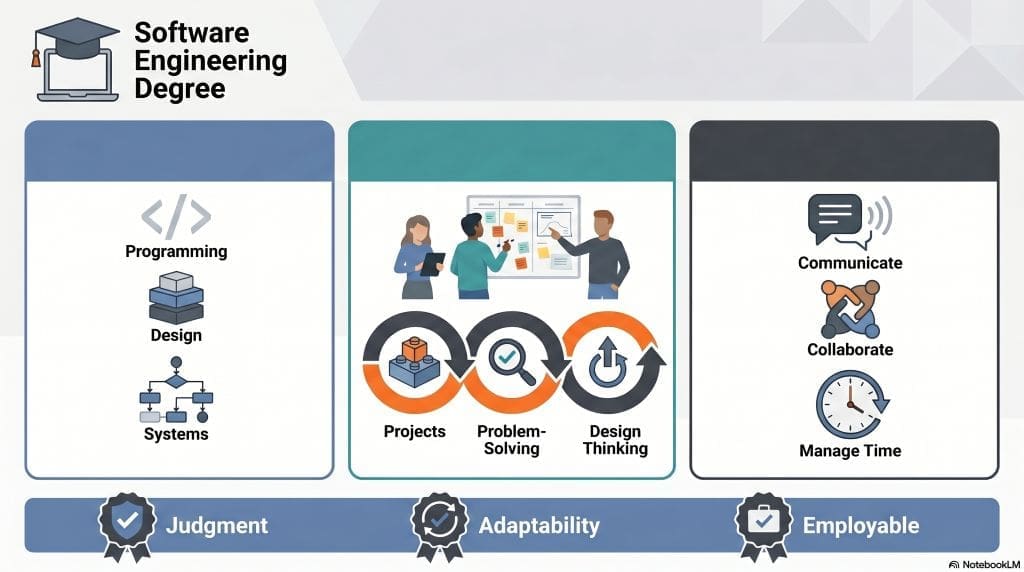
A software engineering degree usually starts with technical foundations. Students learn programming, software design, and structured ways to build systems (Striuk & Semerikov, 2022). They also learn how software projects are organized and how technical decisions affect later stages of development (Sarasa-Cabezuelo & Rodrigo, 2021). Evidence from education research suggests that software engineering is often harder to learn than students expect, because it blends engineering thinking with computing ideas (Sarasa-Cabezuelo & Rodrigo, 2021). That challenge is useful to know early. It means the degree is not only about coding syntax. It is also about understanding how to create systems that work in practice. Students who enjoy both logic and structure often find this part rewarding. The degree therefore builds a foundation for future specialization.
Project work, problem solving, and design thinking
Degree programs also teach project work and design thinking. Research on undergraduate training highlights design-based learning, milestone tracking, and realistic constraints as useful ways to develop industry readiness (Gupta & Gupta, 2024), (Striuk & Semerikov, 2022). Early-career engineers also point to practical experience as a core preparation need (Hynninen et al., 2022). This means students learn best when they solve real problems, not just complete small exercises. They must compare options, defend choices, and refine solutions. That process develops judgment. It also helps them see why software engineering is not a linear activity. A good solution often requires trade-offs. Students who can weigh those trade-offs will usually adapt better to actual work. The degree therefore trains thinking, not only memory.
Communication, collaboration, and professional habits
Software engineering degrees also build professional habits. Communication matters because teams need to explain ideas, give feedback, and present progress (Galster et al., 2023), (Pilapitiya & Peiris, 2021). Collaboration matters because most modern projects require group work (Daun, 2023). Research on skills development shows that undergraduate education should develop soft skills alongside technical ones (Borges & Gratão de Souza, 2024). Research on graduate competencies also shows that employers value adaptability and practical experience, not just academic knowledge (Akdur, 2022), (Hynninen et al., 2022). So, a degree in this field should shape how students communicate, manage deadlines, and work with others. Those habits are part of being employable. They also make the degree more relevant to real projects. In other words, professional growth is built into the curriculum when programs are designed well.
Job Roles, Future Demand, and Workplace Expectations
Common job roles for software engineering graduates
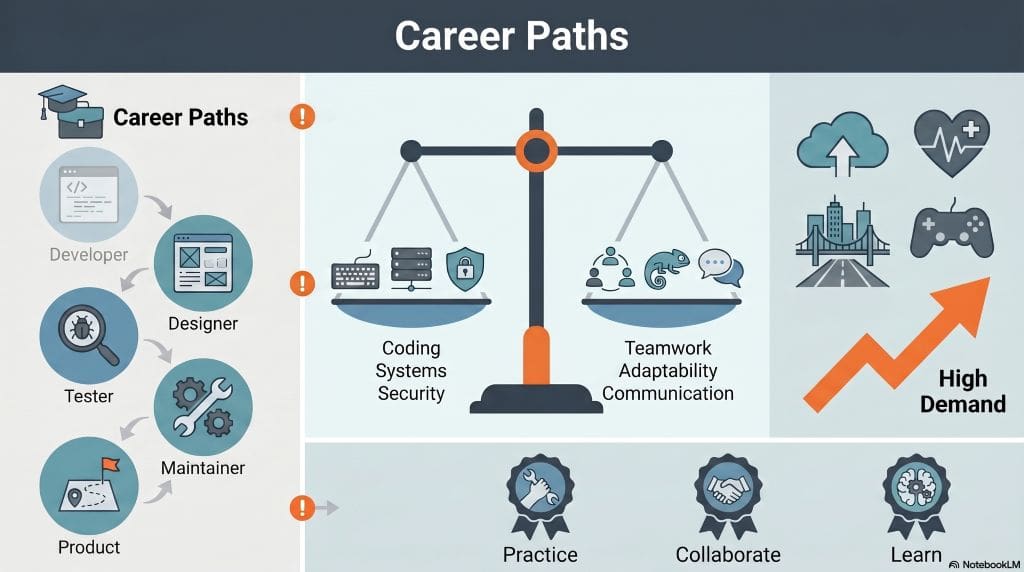
Software engineering graduates can move into different job roles, depending on interests and experience. The literature points to many role-based expectations rather than one fixed profile (Akdur, 2022). That means employers may value different mixes of technical and soft skills across positions. In practice, graduates may work on design, development, testing, maintenance, or product-related tasks, (Wyrich & Montgomery, 2025). Some roles demand stronger collaboration. Others need more debugging or system thinking. The important point is that the field is broad. Students should not assume there is only one path. The graduate profile is flexible because software work itself is varied. That variety can appeal to students who want options later.
Why employers value adaptability and teamwork
Employers value adaptability and teamwork because software work changes quickly. Research comparing industry needs with academic training shows a mismatch in many cases, especially when students lack practical exposure (Akdur, 2022). Other studies show that employers explicitly ask for communication and related soft skills in job adverts (Galster et al., 2023). The same pattern appears in more recent job-posting analysis, where cultural fit, growth orientation, and interpersonal ability matter alongside technical skill (Wyrich & Montgomery, 2025). These findings do not mean programming is unimportant. They mean technical ability alone is incomplete. A strong graduate should learn new tools, adjust to team norms, and cooperate under deadlines. That combination helps employers trust new hires. It also helps students adjust faster after graduation.
Future demand in software-heavy industries
Future demand remains strong because industries are becoming more software dependent (2022). Education research also notes that software systems have grown in complexity, size, and criticality (Tenbergen et al., 2023). Those changes increase the need for trained software engineers. They also increase the need for skills in secure software, agile work, gamification, and industry collaboration (Tenbergen et al., 2023). Since software now supports many sectors, graduates can find roles in business, services, public systems, and emerging technology areas. The evidence does not let me predict exact job numbers. It does support a strong general conclusion: software skills will remain valuable. For students, that makes the degree a serious long-term option rather than a passing trend.
Skills Students Should Build Before University
Programming, analytical thinking, and debugging practice
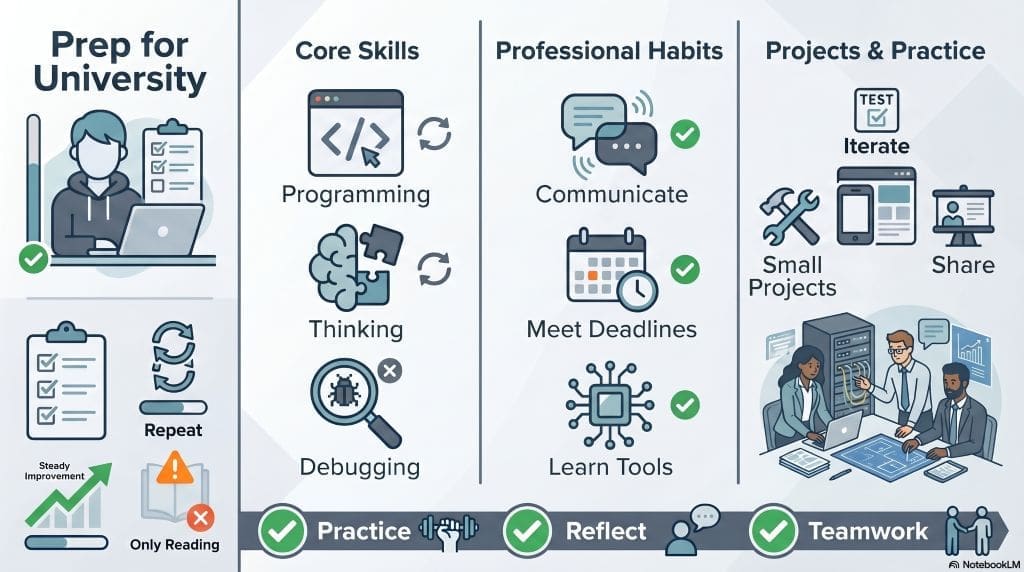
Students should start with programming and analytical thinking. Early-career engineers often recommend programming skills, soft skills, and practical experience as top preparation areas (Hynninen et al., 2022). Other education studies also show that analytical ability and problem solving are important for successful job performance (Gope & Gope, 2022). Debugging practice is useful because it teaches patience and precision. It also helps students learn how software fails. That matters in real work. A good engineer must notice patterns, trace errors, and test fixes carefully. You do not need perfect skill before university. You do need habit-building. Small, repeated practice is better than occasional bursts of effort. That approach also makes the degree less intimidating later.
Communication, deadlines, and learning new tools quickly
Communication and deadlines matter just as much. Research on job adverts shows that communication-related skills are especially in demand (Galster et al., 2023). Student and academy surveys also point to communication, work planning, and adapting to new technology as important skills (Gope & Gope, 2022). Employers want people who can explain progress clearly and keep work moving. Students should therefore practice writing, presenting, and asking questions. They should also get used to learning new tools quickly. That habit helps in university and work alike. Software environments change often, so the ability to learn matters. In that sense, the field rewards flexible learners. It also rewards students who meet deadlines without waiting for perfect conditions.
Small projects that build confidence and experience
Small projects are one of the best ways to prepare. Project-based learning and student development projects help build practical experience, teamwork, and motivation. Gamified approaches can also support engagement, although they should supplement, not replace, normal teaching (Di Nardo et al., 2024). This means students can begin with simple websites, apps, or class tools. They can then improve them step by step. Each project teaches something different: planning, coding, testing, and presenting. That experience gives confidence. It also helps students talk about their interests in future applications. If you want to prepare well, build small things and reflect on them. That process is often more useful than only reading about software engineering.
Real-World Applications and Why They Matter
Software engineering in apps, websites, and digital services
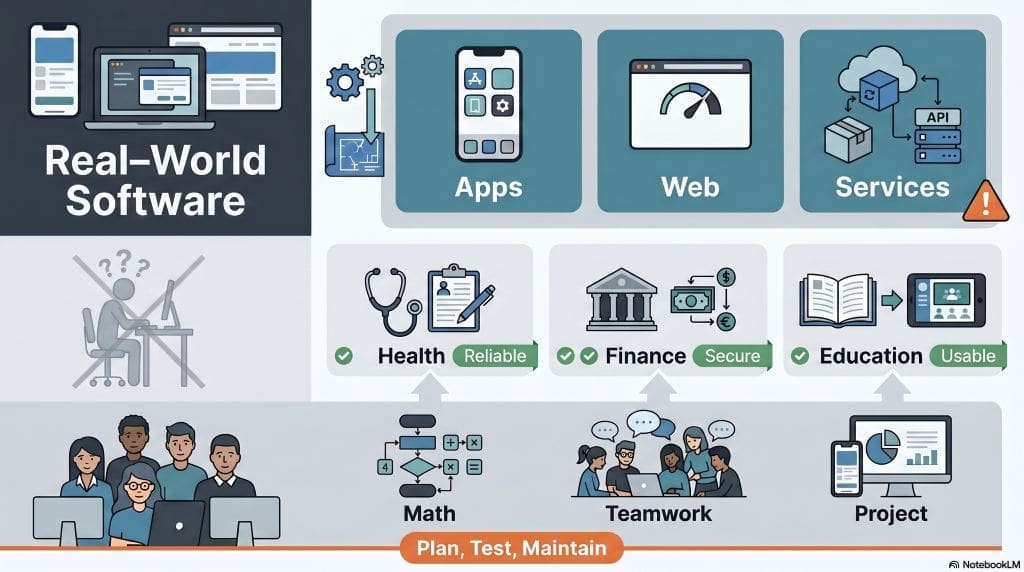
Software engineering is visible in apps, websites, and digital services. It creates products that people use daily. These systems need planning, testing, and maintenance because users expect them to work reliably. As software becomes central to more activities, the need for careful engineering increases (Tenbergen et al., 2023), (2022). Students should pay attention to this because it shows the field has practical impact. A clean app interface or a fast website may look simple, yet many engineering choices sit behind it. This is where the discipline becomes real. It turns abstract code into useful tools. That connection can be motivating for students who like visible outcomes.
How software engineers support healthcare, finance, and education
Software engineers also support healthcare, finance, and education. Research explicitly links software engineering to these sectors and to other critical systems. Education studies also show active interest in digital learning tools and AI-supported assessment in software-related courses (Diyab et al., 2025). That connection matters because it shows the field is not limited to tech companies. It reaches into daily social infrastructure. In healthcare, software can support information handling. Next, in finance, it can support transactions and services. In education, it can support learning and feedback. These areas need reliability and good design. For students, that breadth may be important. It shows the degree can lead to work with social value as well as technical challenge.
Why teens should connect school learning to these examples
Teens should connect school learning to these examples because it makes the subject easier to understand. Math, logic, teamwork, and writing all matter in software work (Borges & Gratão de Souza, 2024), (Gope & Gope, 2022). If you see those school skills inside real systems, the degree becomes less abstract. A website project can show design decisions. A class app can show debugging. A group assignment can show collaboration. Those links help students judge whether the field fits their style. They also help explain why software engineering education includes more than coding drills (Gupta & Gupta, 2024), (Striuk & Semerikov, 2022). The school-to-career bridge is therefore very important. It helps students choose with clearer expectations.
Conclusion: A Clear Next Step for Future Software Engineers
Main lessons from the article
The main lesson is simple: what is software engineering? It is the structured practice of building software that works for real people. Also, it combines coding with design, testing, teamwork, and communication (Borges & Gratão de Souza, 2024), (Galster et al., 2023). It also asks students to think beyond classroom tasks and toward practical outcomes (Hynninen et al., 2022). Employers want graduates who adapt, collaborate, and keep learning (Akdur, 2022), (Wyrich & Montgomery, 2025). So, the field is both technical and human. Students who understand that early can prepare more wisely. They can also choose subjects and projects with clearer purpose.
How to explore the field before university
You can explore the field before university in simple ways. Start small projects. Join a coding group. Practice explaining your work. Look at how software supports school, health, finance, and education. These activities help you see whether you enjoy the process. They also build habits that degree programs expect. Research suggests that project-based learning, communication practice, and practical experience matter a lot (Di Nardo et al., 2024), (Pilapitiya & Peiris, 2021), (Hynninen et al., 2022). So, exploration should be active. Read less. Build more. Then reflect on what you learned. That is a strong way to test your interest.
Why software engineering can be a strong career path
Software engineering can be a strong career path because modern industries rely on software more than ever (2022), (Tenbergen et al., 2023). The field also offers many roles and many entry points (Akdur, 2022). It rewards people who keep learning and who work well with others. It also connects to meaningful real-world systems (Researcher, 2024). For grade 11–12 students, that combination is powerful. It means your current effort can lead into a degree with broad use. If you like solving problems, making things, and working with others, this field is worth serious attention. Start now, and keep your learning practical.
References
- Akdur, D. (2022). Analysis of Software Engineering Skills Gap in the Industry. In ACM Transactions on Computing Education (Vol. 23, Issue 1, pp. 1–28). Association for Computing Machinery (ACM). https://doi.org/10.1145/3567837
- Avdoshin, S. M., Pesotskaya, E. Y., & Kuruppuge, D. M. (2022). Software Engineering Education: Discovering Future Skills. In Programmnaya Ingeneria (Vol. 13, Issue 6, pp. 277–285). New Technologies Publishing House. https://doi.org/10.17587/prin.13.277-285
- Borges, G. G., & Gratão de Souza, R. C. (2024). Skills development for software engineers: Systematic literature review. In Information and Software Technology (Vol. 168, p. 107395). Elsevier BV. https://doi.org/10.1016/j.infsof.2023.107395
- Daun, M. (2023). Software Engineering Education for Technical Engineering Degrees: A Comparison With the Needs of Robotics Software Engineering Education. In IEEE Software (Vol. 40, Issue 6, pp. 40–46). Institute of Electrical and Electronics Engineers (IEEE). https://doi.org/10.1109/ms.2023.3291655
- Di Nardo, V., Fino, R., Fiore, M., Mignogna, G., Mongiello, M., & Simeone, G. (2024). Usage of Gamification Techniques in Software Engineering Education and Training: A Systematic Review. In Computers (Vol. 13, Issue 8, p. 196). MDPI AG. https://doi.org/10.3390/computers13080196
- Diyab, A., Frost, R. M., Fedoruk, B. D., & Diyab, A. (2025). Engineered Prompts in ChatGPT for Educational Assessment in Software Engineering and Computer Science. In Education Sciences (Vol. 15, Issue 2, p. 156). MDPI AG. https://doi.org/10.3390/educsci15020156
- Galster, M., Mitrovic, A., Malinen, S., Holland, J., & Peiris, P. (2023). Soft skills required from software professionals in New Zealand. In Information and Software Technology (Vol. 160, p. 107232). Elsevier BV. https://doi.org/10.1016/j.infsof.2023.107232
- Gope, D., & Gope, A. (2022). Students and academicians views on the engineering curriculum and industrial skills requirement for a successful job career. In Open Education Studies (Vol. 4, Issue 1, pp. 173–186). Walter de Gruyter GmbH. https://doi.org/10.1515/edu-2022-0011
- Gupta, C., & Gupta, V. (2024). C4 Skills in the Engineering Graduate: A Study to Align Software Engineering Education With Market-Driven Software Industry Needs. In IEEE Transactions on Education (Vol. 67, Issue 1, pp. 31–43). Institute of Electrical and Electronics Engineers (IEEE). https://doi.org/10.1109/te.2023.3301625
- Hynninen, T., Knutas, A., & Hujala, M. (2022). What can we learn from recommendations of early-career engineers? Assessing computing and software engineering education using a career monitoring survey. In Proceedings of the 2022 Conference on United Kingdom & Ireland Computing Education Research (pp. 1–7). ACM. https://doi.org/10.1145/3555009.3555017
- Pilapitiya, S., & Peiris, T. (2021). Tailored Software Design for Remote Communication Skill Development in Software Engineering Curriculums. In 2021 International Conference on Engineering and Emerging Technologies (ICEET) (pp. 1–5). IEEE. https://doi.org/10.1109/iceet53442.2021.9659667
- Researcher. (2024). SOFTWARE ENGINEERING: FOUNDATIONS, PRACTICES, AND FUTURE DIRECTIONS. Zenodo (CERN European Organization for Nuclear Research). https://doi.org/10.5281/zenodo.14472069
- Sarasa-Cabezuelo, A., & Rodrigo, C. (2021). Development of an Educational Application for Software Engineering Learning. In Computers (Vol. 10, Issue 9, p. 106). MDPI AG. https://doi.org/10.3390/computers10090106
- Striuk, A. M., & Semerikov, S. O. (2022). Professional competencies of future software engineers in the software design: teaching techniques. In Journal of Physics: Conference Series (Vol. 2288, Issue 1, p. 012012). IOP Publishing. https://doi.org/10.1088/1742-6596/2288/1/012012
- submission, B. for. (2024a). Gamified Student Software Development Projects in Software Engineering Education – Code. Zenodo (CERN European Organization for Nuclear Research). https://doi.org/10.5281/zenodo.13873155
- submission, B. for. (2024b). Gamified Student Software Development Projects in Software Engineering Education – Code. Zenodo (CERN European Organization for Nuclear Research). https://doi.org/10.5281/zenodo.13873154
- Tenbergen, B., Krusche, S., Hanna, R., & Bano, M. (2023). Software Engineering Education and Training: Industry Demands, Curriculum Deficits, and Pedagogy Direction. In IEEE Software (Vol. 40, Issue 6, pp. 36–39). Institute of Electrical and Electronics Engineers (IEEE). https://doi.org/10.1109/ms.2023.3318268
- Wyrich, M., & Montgomery, L. (2025). What’s in a Software Engineering Job Posting? arXiv (Cornell University). https://doi.org/10.48550/arxiv.2511.13656
- Author
- Latest Posts

Charudatta Pathak was a student at St. Aloysius High School in Bhusawal, established in 1874, making it one of India’s oldest convent institutions. He earned his bachelor’s degree in mechanical engineering from SSVPS College of Engineering, Dhule in 1995, demonstrating exceptional academic achievement. Thereafter, he launched his career as a CNC programmer in a toolroom. He has utilized FANUC, Deckel, Maho, and Mikron controllers to operate 2-axis and 3-axis machines for the fabrication of jigs, fixtures, dies, and molds. He commenced his career as an academic in 1996, when he assumed the role of lecturer at SSVPS College of Engineering, Dhule. Additionally, he earned his post-graduate degree in CAD/CAM from L. D. College of Engineering, Ahmedabad, in 2000, and then acquired a Ph.D. from COEP in 2011 while concurrently engaged in teaching. Until 2023, he occupied many academic roles, including lecturer, assistant professor, professor, dean, principal, director, and vice chancellor at both public and private universities throughout India. From 2008 to 2010, he served as the project lead in the CAE department of a European multinational firm. During his 28-year professional tenure, he identified a need for dependable books targeted at students in grades 8 to 12, particularly for nascent career planning. He founded ENTECH Digital Magazine, a free monthly publication available on entechonline.com and magzter.com. Teens with a strong interest in Science, Technology, Engineering, and Mathematics (STEM) who aspire to pursue careers in these fields may find ENTECH Digital Magazine beneficial.




Nice information.
Thanks for your comment!
Keep visiting entechonline.com to read the latest news and articles on Science, Technology, Engineering and Mathematics STEM. ENTECH Online is more than just a magazine; it’s a gateway to a world of possibilities for teenagers passionate about Science, Technology, Engineering, and Mathematics (STEM).
💯💯
Thanks for your comment, keep visiting entechonline.com for more articles related to your interests.
Fantastic software engineering article!